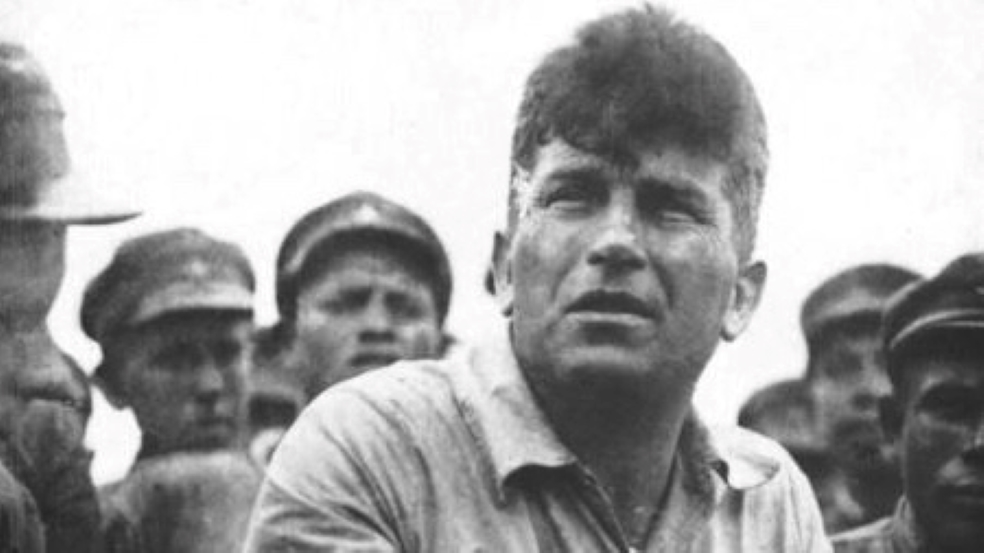
A report of the trial of heroic working class fighter Max Hölz who led the armed resistance to the 1920 Kapp Putsch and 1921’s ‘March Action,’ for which he was sentenced to life in prison, to be amnestied after seven years.
‘Max Hölz Puts the Bourgeoisie in the Dock’ from Moscow. No. 36. July 8, 1921.
The concluding speech by Max Holz before the Berlin Special Court gives a splendid characteristic of the German bourgeoisie and its hirelings and deserves to be widely known. After the speech by his advocate Frank, Hölz was allowed to make the concluding speech.
Hölz. Most Supreme, respected, venerable Special Court!
President. (Sharply interrupting him). Hölz, if you wish to offend us here, I shall at once stop you.
Hölz. It really does not make much difference whether you stop me in the beginning, the middle or the end of my speech. I shall speak as long as you allow me to speak and I shall say what I want and what I feel. I don’t want to defend myself, for I am not guilty. I regard myself innocent, particularly, before a bourgeois court, which I do not recognise. I shall not even refer to the speech of the public prosecutor. It was the funeral oration for the capitalist class, from which he holds his appointment and from which he must draw his salary.
I have also nothing to say with regard to the arguments of my advocates. My advocates are intellectually my superiors, but as revolutionary practice I know more than all the three put together. They are treating with a human beast. But I am going to cut open that beast.
Hölz then gave a very detailed description of his youth, of his surroundings, his mode of life until his entrance in the political arena. In the course of the last three years he continued:
I have come to the conviction that the revolution must come not because we want it or wish it, but because it is rendered necessary by the historical development. We cannot make a revolution we can only help it. I regard myself as a rank and file soldier of this revolution. I am convinced that the revolution will come, for it must come, even if the workers declare themselves against the revolution.
The accused then gave a graphic account in his wanderings in the country. In long periods the accused described the events of the Vogtland and then spoke of the March rising. He himself organised and led at that time an armed fight in Central Germany, as he was convinced as the idea of the liberation of the proletariat could not be realised without violence. Hölz further declared that the workers have not murdered a single monarch or leader of the parties of the right, whereas bourgeois society has thousands of murders on its conscience.
President: This has nothing to do with the case.
Hölz: Yes, you don’t want to hear it. It is not I who am the accused but bourgeois society. Your sentence on Max Hölz will not hit me, you will hit yourself. By this trial you will do more for the revolution than I have done by my whole activity. I answer for all my deeds it only remains for you to pronounce the sentence of death and to execute it. You can try Max Hölz, but not his spirit. You can kill one Hölz, and thousands of others will take his place. And some of the latter will be very tough ones, whose revolutionary methods will not be limited to mere blows. The proletariat will fight without arms, it will squash its enemies with fists and hands. The so-called November revolution was only an interlude.
The coming German revolution will exceed in cruelty all the former revolutions not because the proletariat is more cruel, but because the bourgeoisie is treating the workers in a cruel fashion. The day will arrive when the revolutionary proletariat will be like a raging beast. I will regard your sentence as the marks at a school examination. If you were to acquit me–of course I do not for a moment entertain that idea–there would be four dead men to-morrow: three judges and one accused. You should have to hang yourselves, for you could not show yourselves after that to your friends of the bourgeois, class. I should have to hang myself for I should be too ashamed to face the revolutionary proletariat. Ten years imprisonment means a bad examination mark for me, life imprisonment on the other hand will be a good mark. If you condemn me to death, I shall receive A. 1, the best mark, for you will then prove to the revolutionary classes of the world that a genuine revolutionary is prepared to sacrifice his life for his class consciousness. I have never possessed the so-called bourgeois sense of honour. I understood by it only the monocle in the eye, full stomach and empty head. I understood only proletarian honour. I should feel offended if you do not deprive me of my civil rights.
The accused continued to speak in the same strain, and the President interrupted him with the remark that this had nothing to do with the case. Hölz, however, was not in the least abashed by the remark but continued his speech without even stopping.
President: I deprive you of the right to speak. (The Court retires to consider the judgement).
Hölz: (Exclaims loudly). You can forbid the words, but you cannot kill the spirit!
Moscow was the English-language newspapers of the Communist International’s Third Congress held in Moscow during 1921. Edited by T. L. Axelrod, the paper began on May 25, a month before the Congress, to July 12.
PDF of full issue: https://www.marxists.org/history/international/comintern/3rd-congress/moscow/Moscow%20issue%2036.pdf
 Revolution's Newsstand