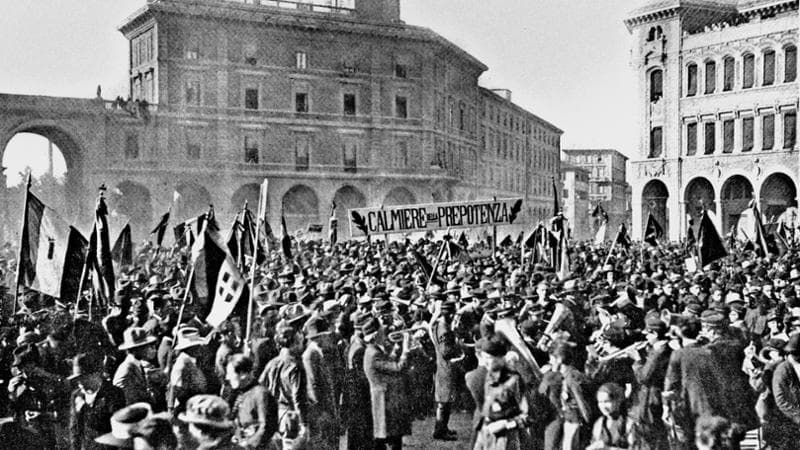
The Fascist rise to power in Italy necessarily went through the agricultural district of the Po Valley and its well-organized, Socialist agricultural workers. The prolific, multi-lingual Peluso, once a member of the Socialist Party of America in the early 1900s, joined the Italian Communist Party in 1921. He would move to the Soviet Union in 1927 where he joined the Russian party and taught Italian labor history. A victim of the Purges, he was arrested in 1938 and executed on January 31, 1942 at sixty.
‘The Fascisti Invasion of Bologna’ by Edmondo Peluso from International Press Correspondence. Vol. 2 No. 51. June 20, 1922.
The valley of the Po is certainly the most fertile in Italy. It is a region of great cultivated tracts, where there lived a whole population of proletarian land workers, poor and exploited, who, after 30 years of strife and conflict, have succeeded in attaining, with the aid of a powerful organization, a strong economic position. Before the persistent proletarian advance, the landowners saw their influence little by little disappearing. The general strikes of 1919 and 1920–both crowned with success–marked the apogee of their advance. At that time the agricultural workers had just forced from the Italian agriculturists an agreement most favorable to the workers and the monopoly of distributing employment.
This position was naturally intolerable for the owners who were seeking by every means to take their revenge. Profiting by the general critical situation of the Italian proletariat, after the period of factory occupation (September 1920), they joined their efforts with those of industrial capitalism and governmental reaction to shatter the red organization of the agrarian wage-earners.
Thanks to the treason of the Socialist leaders the formation of armed Fascisti bands was relatively easy work, as these bands were materially subsidized by the great agrarian and industrial bourgeoisie, besides which they received from the government its moral backing and the arms necessary for an offensive on a grand scale. This offensive was not only launched for the destruction of the trade organizations of the town and country proletariat, but to wrest from the masses the gains of their organization, and to make them submit to such a degree of exploitation as would allow the bourgeoisie to renew the fact decaying fabric of its economic system.
The plan of the Italian bourgeois counter-offensive is an integral part of the great bourgeois counter-offensive against the world proletariat, which has manifested itself especially by political and judicial reaction in all countries during the period following the war and which succeeded because the reformists, as much in the unions as in the Socialist Party, had undermined the revolutionary preparation of the proletariat.
Terrorized by the violent and brutal attack of the Fascisti, and abandoned by their leaders, the Italian proletariat have only opposed a passive resistance to the attacks of the White Guard of the bourgeoisie.
After this, when the resistance of their employees is quite broken, the employers will openly announce their intentions, which they had in the beginning veiled with hypocrisy in saying that they desired the freedom of employment of labor. They are now busy abolishing agricultural agreements, reducing wages and suppressing the monopoly of labor exchanges in the hands of the peasant wage-earners’ organization. Seeing, because of the passive resistance of the proletariat, who submitted with resignation to violence and abuse, for thus they had been exhorted by the Social Democratic leaders, that victory was too slow, the employers had recourse to a new stratagem to achieve their ends more quickly. They abandoned lands and ceased cultivation, thus artificially increasing unemployment. At the same time they offered employment to anyone not organized.
Making a pretext of the opposition of the Prefect Mori (who in reality is a brother Fascisti) to their attack, the Italian agriculturists in possession of this extra-legal arm for the realization of their demands, and certain of immunity, launched their avalanche of White Guards upon Bologna, which was not very long ago the heart and citadel of Italian agrarian Socialism. The Fascisti in their advance, like the mercenaries of the Middle Ages, looted, burned and killed. This region, so prosperous for the Italian workers’ movement, possessed numerous cooperatives and countless socialist circles. The White mercenaries pillaged and destroyed them, and then, to leave bloody evidence of their passage, threw bombs, sowing death in the proletarian ranks. Arrived at Bologna, the authorities, who were in accord with the Fascisti, ordered the troops to retire. The Fascisti made their camp in the principal square of the city, in front of the Prefecture, and immediately began the man-hunt.
Among the most horrible episodes is the following: Comrade Bonazzi, ex-secretary of the Bologna Labor Exchange, lay suffering in a sick-bed. The Fascisti invading his house and entering his room, began to stab him with their daggers. His wife and his mother, running at his cries, covered him with their bodies and only thus were able to save him. Suspected houses were drenched with petrol and burned, the most prominent men in the workers’ movement summarily “brought to justice” and, to prevent the news of this modern St. Bartholomew’s Eve spreading, all telephone and telegraph wires were cut.
What did the Government do during this time?
It issued a decree forbidding the carrying of arms and the holding of public meetings. At the same time it sent the Italian Chief of Police, that old notorious policeman, Senator Vegliani, to conduct investigations on the spot. Vegliani is the father of the Italian Fascisti and is not the father to deny such a child. On the other hand, the forbidding of public meetings could not touch the Fascisti as daily they held several meetings under the prefect’s nose and he could hear them, from his own balcony, taking him to task for his “partiality”. As for the ban upon the carrying of arms, it was not worth mentioning, for the bombs, revolvers and munitions are supplied to the Fascisti by the Italian army; as the arrest of several of the guilty has unmistakably shown. Thus the Government has shown itself openly and without scruple to be on the side of the invaders and has destroyed the fiction of the neutrality of the State in the conflict of class and party, in which fiction our ingenuous Social Democratic leaders still believe. One would have thought that in face of such a “breach” of neutrality, they would have acted, have done something. But not at all, the Socialists at this time commenced to crowd the Parliamentary lobbies, to hold conversations “for a better government”, and the masses, already electrified by the example of the courageous defense of the people of San Lorenzo near Rome, where they had felt a rebirth of the will to conflict, and who commenced to think it were better to fight than to die without striking a blow, have had nothing for an incentive, for a rallying cry, but a simple manifesto from the Labor Alliance protesting vehemently against the Fascisti invasion and requesting the proletariat, by remaining disciplined, to have confidence in their organizations.
The Communist Trade Union Committee had proposed, from the 26th of May, that they must reply to Fascisti menaces and attacks by the organization of a common action of the whole Italian proletariat. The E.C. of the Communist Party of Italy has issued an appeal for the formation of a united front against the employers’ offensive, advising it be done in such a manner that this united front of defense and revolt become a reality which should lead the Alliance of Labor to a real goal, embracing all working-class organs and that it is only by uniting all proletarian forces and launching them in one general action, that the enemy can be brought to reason.
The epilogue of the drama of Bologna is that the Fascisti, after having obtained from the Government, through the offices of their leader, the renegade Mussolini, the head of Prefect Mori (who has been recalled to Rome, because they thought him opposed to their plan of “conquest”) and the promise of absolute immunity, abandoned the town with patriotic songs and the waving of tricolors.
Since then the plan of the Italian bourgeoisie is quite evident: they are engaged at the moment in separating industrial Northern Italy from Central Italy by occupying the entire Pô valley, which has become, they assert, Fascist.
The valley of the Pô will be for a long time to come a valley of tears for the Italian agrarian proletariat, at least if it does not arouse in the whole of the martyred proletariat the conviction that only in their unity lies their strength.
International Press Correspondence, widely known as”Inprecorr” was published by the Executive Committee of the Communist International (ECCI) regularly in German and English, occasionally in many other languages, beginning in 1921 and lasting in English until 1938. Inprecorr’s role was to supply translated articles to the English-speaking press of the International from the Comintern’s different sections, as well as news and statements from the ECCI. Many ‘Daily Worker’ and ‘Communist’ articles originated in Inprecorr, and it also published articles by American comrades for use in other countries. It was published at least weekly, and often thrice weekly.
PDF of full issue: https://www.marxists.org/history/international/comintern/inprecor/1922/v02n051-jun-20-1922-Inprecor.pdf
 Revolution's Newsstand