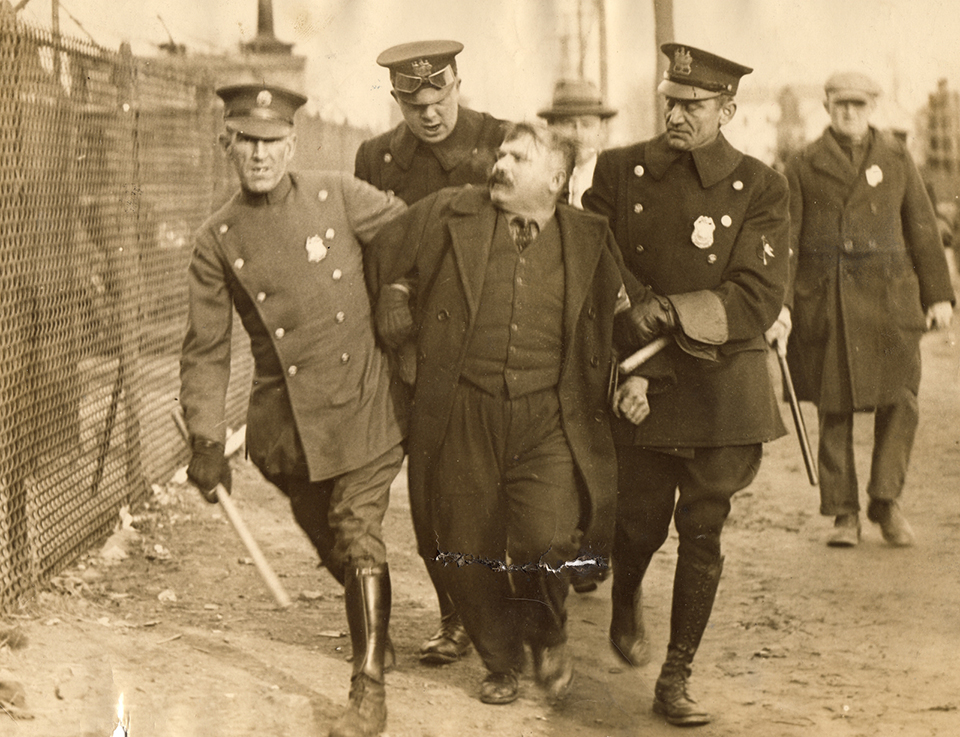
One of the major class battles of the 1920s, the strike of silk workers at Passaic, New Jersey in 1926 was led by the Communist Party and summoned the best of the radical traditions laid down in the mill towns by wobblies and others the previous decades.
‘After One Year of Striking at Passaic’ by Robert W. Dunn from The Daily Worker. Vol. 4 No. 10. January 25, 1927.
SUNDAY, January 23, 1927. Almost a year since the Botany walked out. I have just come from a meeting in Ukrainian Hall. Botany workers, Forstmann workers, Gera workers–hundreds from each mill–singing, shouting, listening to speeches. A long, slippery walk from their homes, but they are here to listen to union men telling them about unionism. To hear Gus Deak read the list of the union workers who are to return to work at the Botany tomorrow morning. A few are called back every day.
Speeches by United Textile Workers’ union organizers Starr and Regan, speeches about the fakery of the company union and the importance of picket lines in front of the Forstmann gates. The workers listen with both ears, just as they used to listen to Weisbord and Gurley Flynn, They applaud with enthusiasm. Yes, this must be about speech No. 1000 they have heard since last January. For they have been fed on speeches, at least about 3 a day, sometimes as high as 6 or 8 at a meeting. And they’re not tired yet, of speaking, or striking, or working to build a union that will last.
A WORKER comes back stage to tell us that the Fortsmann company agents were flying around in motors yesterday visiting the workers, begging them to come back to work. The season is coming on fast; the trade is picking up; Botany is working fuller and fuller. Forstmann is, worried in spite of his faithful but unskilled strikebreakers. He needs back those competent spinners who a few nights ago voted to stay on the picket line till they get a union recognized. Yes, the Forstmann company agents are promising the workers that a stout police escort will be furnished those who return tomorrow. “Two cops for every scab,” says an informant. That ought to be enough to show him the way to the mill gate–if he wants to return. Mr. Forstmann has plenty of cops to provide for just such purposes. He has the cossacks of three boroughs at his disposal. But still he is worried. Spinners refuse to accept the terms, or the escort…
So the Slavic-Hungarian-Italian workers listen to their 1000th speech on unionism. Who has not been there to speak to them during these twelve months?
AND of course the workers will also remember the birds who got on the payroll of the mills to break their morale, discredit leaders, create dissension, develop scabbery and sow defeatism. One specimen of this type was the celebrated Robert J. O’Brien, emissary of the National Security League and a professional anti-radical. This is the chap who dresses up like Bill Foster or Trotsky in order to scare the Rotarians; after which he tears off his Bolshevik stage whiskers to the accompaniment of a song and dance about spread of the Red Menace. O’Brien went to Passaic. O’Brien got money from the mills, the exact amount I do not know. Something in the thousands. O’Brien issued a journal in which he promised to expose the wicked redness of the American Civil Liberties Union, Volume 2 of this sheet did not appear. O’Brien helped the police make the raids on the United Front Committee. Out of his clumsy imagination grew the charges against Albert Weisbord. He told the police and the prosecutors on what grounds he thought the indictments still pending against Weisbord should be based. He invented the speeches about the Moscow gold–speeches which the Honorable Senators from New Jersey delivered in Washington. He planned and plotted an uncommon amount of deviltry in Passaic where he still keeps his residence, commuting thence in a locomobile to shock the Kiwanians with fantastic yarns about the “lesson in revolution.”
THUMBING thru the official journal of the Oklahoma Employment Association the other day I came upon this item in the March, 1924, issue; under the title “Jack O’Brien Again Active”:
“A letter from the Michigan Manufacturers Association states that Soap Box Jack O’Brien is again busy, this time using a fraudulent endorsement on the letterhead of the Michigan Association and attempting to raise money for a so- called Constitutional Defense League, which league claims to fight radicalism. In a bulletin to his members John J. Lovett, manager of the Michigan Manufacturers’ Association urges no funds be contributed to Mr. O’Brien or a solicitor named Hanson, or anyone connected with this so-called Constitutional Defense League. It is stated that funds which have been collected in the past have been used for purposes other than those for which they were obtained.”
But the Passaic millowners didn’t know this when O’Brien rushed to Passaic to save the workers from “revolution” last January. If these millowners want to be economical they should at least keep track of the professional shake-down men who follow militant labor organizers from place to place in order to cash in on the bosses’ fears and uncertainties. But perhaps they would have hired him anyway. After all he is an expert in flagwaving, patriotism, and constitution defense for the breaking of strikes. The Passaic Prussians probably thought they needed that kind of an expert last January. And O’Brien could give them a hot line about the strike he helped to break in Buffalo for Mr. Mitten of the Philadelphia Rapid Transit, and of the help he gave to the anthracite mine owners when they had Pat Toohey arrested in Scranton a couple of years ago, and of his affiliations with various Chambers of Commerce. The man has an exceedingly, slick line. He looked good to the Passaic bosses. It was only later that he began to bungle things. He is now said to be off the payroll.
But enough of stoolpigeoning for the present. Except to say that the unsettled mills are still busy trying to bring in strikebreakers. They also use a certain kind of person to help weaken morale. Witness the advertisements in the Philadelphia Bulletin some weeks ago, “Wanted–Investigator, female, experienced. One who can speak Polish and Slavish. State age, experience and references.” A person was sent to apply for this job and was informed that her duties in Passaic would consist of talking to the striking workers in an effort to persuade them to return to work.

THE Botany mill has settled and the workers are going back very gradually. As they go back they run into the rival “union” that got under way while they were out on strike. This is the company committee. When a forelady asked a woman striker to sign up with the union that takes no dues, calls no strikes, and causes no “trouble” she received the reply–“Me no wan company union, Me want A.F. of L. Me stick to real union.” This terrible heresy probably grew out or the “lesson in revolution” that Weisbord was teaching them and that the U.T.W. local has been teaching them these many months. Not so bad at that. A thousand speeches against the company union. The result–“me stick to the real union.” I propose that the A.F. of L. immediately lay down that assessment they voted at the last convention to fight company unionism. That they send a good chunk of the fund at once to the Passaic relief stores. That will do more to kill company unionism than anything I can think of at the moment.
The Botany company union must now be fought on the inside, just as the Forstmann “assembly” must now be fought on the outside. And the Botany management will certainly put up a fight. After all, some of their labor advisors and welfare managers are men who formerly worked with the International Auxiliary Co. famous labor spy corporation. They will not give in to union labor unless they are forced to by a fighting union on the inside. That fight remains to be fought, but the prospects are not so bad if the spirit of the Botany union workers is any sign.
THE main points to remember now are: 1–The strike is not over in four of the mills. 2–The police are still active. One worker on the Gera picket line was arrested the other day for laughing. 3-Workers are hungry. 4–Relief stores must be kept full of beans, black bread and spaghetti. 5–The job must be finished.
Julius Forstmann has written a letter to a mediation committee. He talks about no discrimination, but forgets this is a fight for union and for collective bargaining. Julius has taken the first step tho; he must be made to take the second. The season is opening. He needs workers. He must take that step. He will take it if relief, lots of it, goes to Passaic. The job must be finished.
The Daily Worker began in 1924 and was published in New York City by the Communist Party US and its predecessor organizations. Among the most long-lasting and important left publications in US history, it had a circulation of 35,000 at its peak. The Daily Worker came from The Ohio Socialist, published by the Left Wing-dominated Socialist Party of Ohio in Cleveland from 1917 to November 1919, when it became became The Toiler, paper of the Communist Labor Party. In December 1921 the above-ground Workers Party of America merged the Toiler with the paper Workers Council to found The Worker, which became The Daily Worker beginning January 13, 1924.
PDF of full issue: https://www.marxists.org/history/usa/pubs/dailyworker/1927/1927-ny/v04-n010-Final-City-Ed-jan-25-1927-DW-LOC.pdf
 Revolution's Newsstand