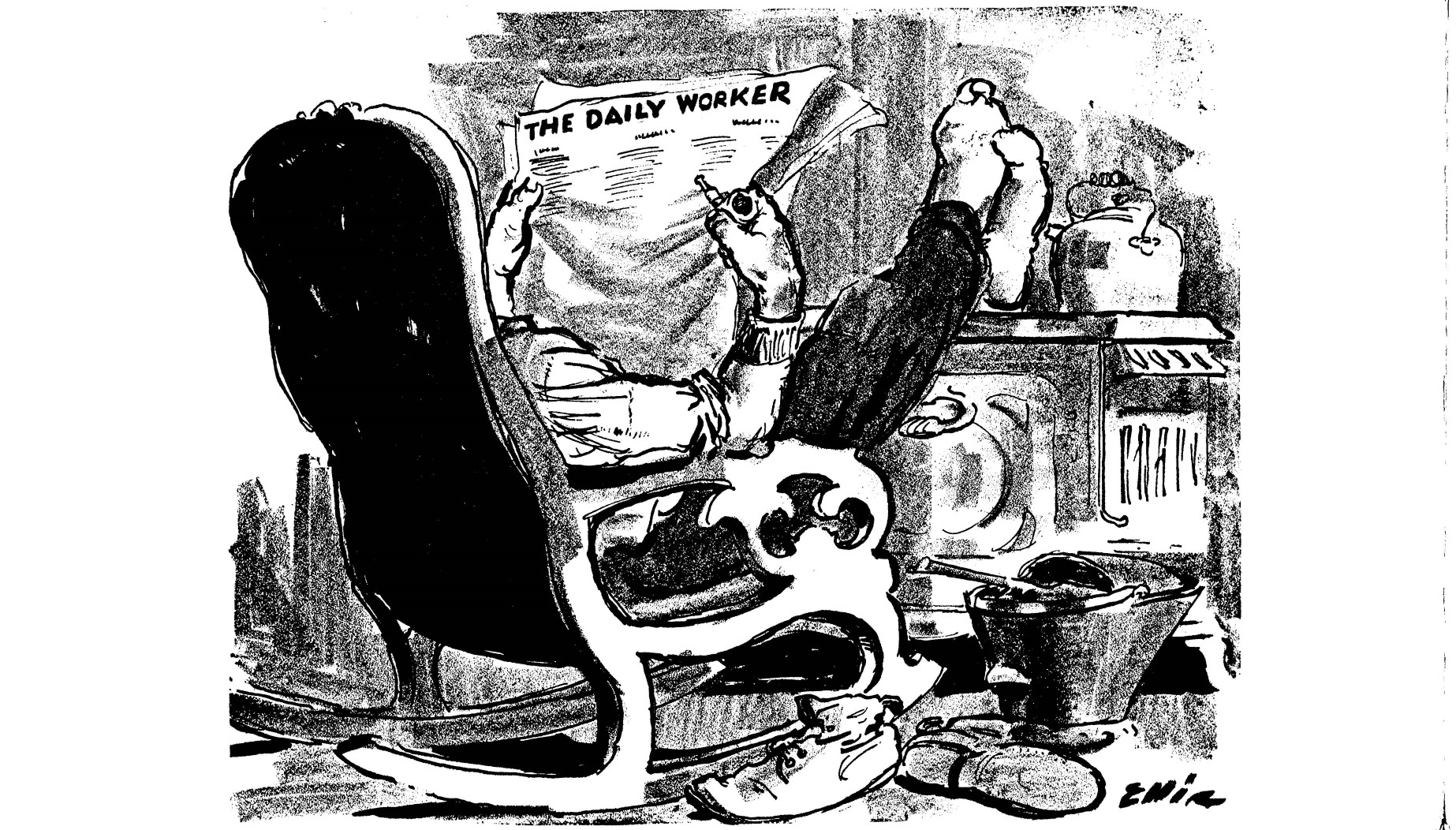
C.P. leader, journalist and trade unionist William F. Dunne, who had edited several successful radical workers’ papers, on the central importance of a journalism voicing workers in the class war.
‘The Revolutionary Role of Worker Correspondents’ by William F. Dunne from Little Red Library No. 4. Daily Worker Publishing, Chicago, 1924.
Worker correspondents differ from professional journalists in that they are part of the labor and revolutionary movement and fight actively in the struggles of which they write.
The wider the activity of a worker correspondent in the class struggle, the greater will be the field covered by his reports. At first the worker correspondent will find it hard to gather material. As a worker, ordinary, daily events of development of the class struggle are familiar to him. He expects these. things as the routine of working class life and sees no news value in them.
It is this outlook of the worker that makes it hard for him to write or speak. He is not inarticulate because of lack of words, but because he has been taught by capitalism to look upon the thousand and one tyrannies, inconveniences and hardships inflicted on the workers as of little importance–things to be endured without comment or complaint.
The countless risks of industry, the accidents to and deaths of workers, even great disasters taking a huge toll of working class lives, quite often cause less excitement among the workers than among the liberal middle class.
Why is this?
Because among the workers, deaths and accidents are common things to be expected as part of the price paid for being allowed to work.
This is the idea drilled into the mass mind by capitalists and especially by capitalist journalism. The death of the wealthy idler will get the first page and a streamer headline, but the death of a worker is either not mentioned at all or given a half dozen lines.
Journalism is recording and expressing opinion on contemporary events. Journalism, like everything else in capitalist society, is a class enterprise.
Journalism is the day by day listing of the facts of industry and politics and an analysis of those facts.
Journalism is therefore a class affair just the same as politics, industry, art and education.
The ruling class puts its stamp on journalism just as it stamps every other form of social activity. It can even be said that more than in any other from of social expression are the class lines apparent in journalism.
Not only does the clearly class character of the capitalist press become obvious to the class conscious worker, but the most casual observation shows that every division and sub-division of the social organism has its journalistic expression.
The capitalist press itself shades off into innumerable organs of separate groups–employers’ and bankers’ associations, trade associations, clubs, special organizations for suppression of the workers, all have their own publications.
The middle class has countless journals which cater to and express the opinions of some particular group.
Church newspapers and magazines are legion. In addition to these journals speaking openly, for some vested interest, there are the special propaganda organs of the ruling class–each with its own field.
All of these journals are anti-working class in character–some of them frankly so, some of them thinly disguised with the veil of humanitarianism, and “social welfare.”
Then there are the official organs of the trade union movement and its various sections and affiliated bodies–formally opposing the capitalist but actually ruled by the ethics and swayed by the prejudices of capitalism.
The trade union press of the United States is not a labor press (with a few negligible exceptions). It is in reality an aid to capitalism with its warfare on the communist Party, its espousal of imperialism, its catering to ignorant prejudices, its imitation of capitalist journalism and its middle class doctrine of “equality of opportunity and identity of interest.”
The Socialist press joins with the official trade union press, apologizing for capitalism, praising its parliamentary system and fighting the Communist Party as well as every revolutionary tendency in the working class movement.
There remains the Communist press and it is for the Communist press we organize and train worker correspondents.
The Communist press, like the Communist Party for which it speaks, stands forth as the only clear challenge to the capitalist press and the capitalist class.
The Communist Party is the most intelligent, resolute and disciplined section of the working class. The Communist press is the most militant of all the labor press.
To the Communist press the workers and the working class are always right. It never apologizes for the working class or attempts to reconcile the class conflict. Instead it seeks to encourage and broaden it.
The worker correspondents of the Communist press therefore are not mere observers and reporters of the workers’ struggles. Their stories must not only reflect the life and battles of the working class, but shape their lives and struggles. They are not only the pulse of the movement, but the heart as well.
Worker correspondents of the Communist press are not only mirrors in which the class conflicts are reflected, but hammers by whose blows these conflicts are welded into one battle line. Their writings must build “The iron battalions of the proletariat.”
Tireless energy is needed by worker correspondents. They secure their information while engaged in the tasks that capitalism allots them. Their stories for the most part are written after the day’s toil when both body and mind are tired. Often they must make special journeys to get additional facts.
But they can and should write with the hot breath of the struggle still upon them. Sometimes it will seem to them that they are writing with their own blood.
But they will learn and they will teach the working class that no matter how small a thing it is, if it happens to or affects the workers, it is important.
The first task of worker correspondents is to see every event from the class angle and to make the workers for whom they write view it the same way. Class pride is the essence of revolutionary journalism and class pride should shine from every word and line that a worker correspondent writes.
Once more!
NOTHING THAT HAPPENS TO THE WORKERS IS UNIMPORTANT.
The capitalist class and capitalist journalists pay little attention to the daily tyrannies inflicted on the workers. When these things are noticed, it is only to apologize for, or to justify them. The leaders and social traitors think that only certain things are important, but Communists know better. It is by paying attention to all the ordinary woes of the working class that Communist journalism demonstrates its class character.
It is only in the Communist press that the workers find a knowledge of their smallest grievances, understanding of the causes of these grievances and the connection of them with their struggles as a class.
The capitalist class rules because it is able to divide the workers and break up their struggles into isolated conflicts. Worker correspondents for the Communist press in every industrial center, in the factories and shops, in unions and fraternal organizations, in rural communities, wherever there are workers, link up these isolated conflicts and give to the working class a correct picture of the world ruled by capitalism because the working class is fighting not as a class, but as individuals and groups.
The Communist press becomes a mass organ reflecting and molding the struggles of the workers in the same proportion that these struggles are recorded and correctly interpreted by worker correspondents–correspondents who write of the battles of their class as a soldier writes of the battles which he helps to fight. Worker correspondents are WAR correspondents—they tell of the class war in its every sector and salient.
An army of worker correspondents means a powerful Communist press.
A powerful Communist press means a powerful Communist Party.
A powerful Communist Party means the Dictatorship of the Working Class–VICTORY FOR THE SOCIAL REVOLUTION.
“Without a Communist press,” said the Second Congress of the C.I., “the preparation for the dictatorship of the proletariat is impossible.”
We can say, by virtue of the experience gained in our struggles since that time, that without worker correspondents a Communist press is impossible.
Worker Correspondents by William. F. Dunne. The Little Red Library No. 4. Daily Worker Publishing, Chicago. 1925.
Contents: Revolutionary Role of the Worker Correspondent, Nothing that Happens to the Working Class is Unimportant, Instructions and Suggestions to the Workers Correspondent, Types of Stories, Writing Stories, Explanatory and Analytical Articles, Shop Factory and Job News, Examples of Workers Correspondence, Building the Communist Press. 33 pages.
The Little Red Library was a series of eleven pamphlets published by the Workers (Communist) Party of America in the mid-1920s by the Daily Worker Publishing Company in Chicago.
PDF of full pamphlet: https://www.marxists.org/history/usa/pubs/lrlibrary/04-LRL-worker-coress.pdf
 Revolution's Newsstand