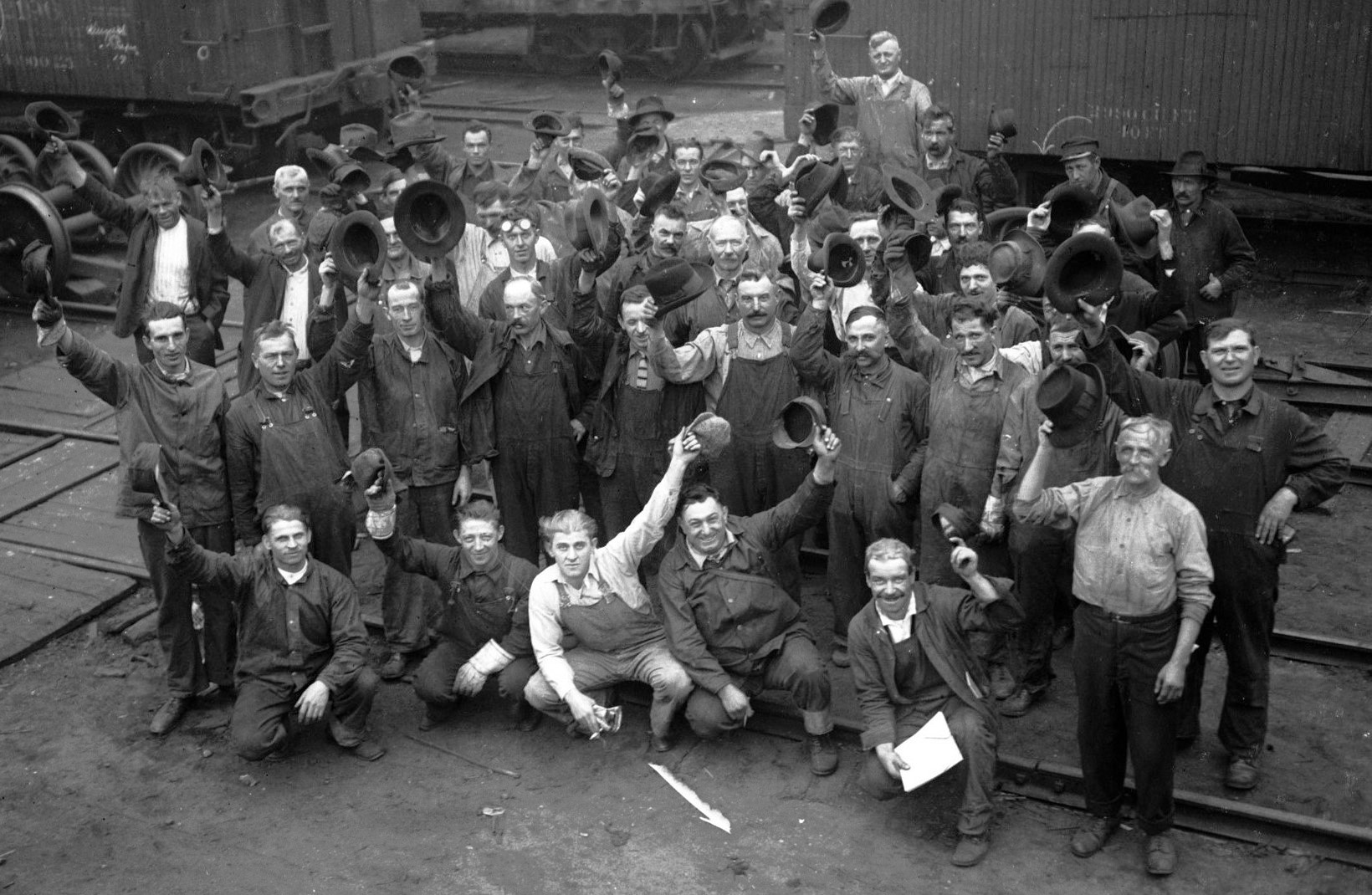
One of the key practical problems for the U.S. workers’ movement, one closely connected with organizing the unorganized, is the division among unions in workplaces and industries. The old craft vs. industrial union debate was only partially resolved by the C.I.O. as many unions retained the philosophy, if not the form. Though many also retain the form. Perhaps the industry most impacted by those divisions has been rail, as evidenced by the recent government intervention. Historically Foster, unlike Debs and the A.R.U., did not favor a new union but amalgamation of existing unions on an industrial basis. Written just before 1922’s Great Railroad Shopmen’s Strike of 400,000 workers, Foster looks at the consequences of continued separation and answers objections to amalgamation.
‘Amalgamation or Annihilation’ by William Z. Foster from Labor Herald. Vol. 1 No. 2. April, 1922.
THE present situation of railroad trade unionism is intolerable. It must be remedied at all costs. The sixteen principal organizations (not to mention the smaller ones) are in disordered retreat before the vicious attacks of the “open shop” employers. Either by direct pressure or through their lickspittle Railroad Labor Board, the railroad owners are whipping the unions singly and in groups. The Clerks, Maintenance of Way, Signalmen, and Stationary Firemen have lost the eight hour day and have had their wages cut to the bone. The shop trades have lost their national agreement and many of its hard-won conditions. Their wages have been slashed, and they have lost much of their work to the “independent” scab shops. So far the transportation men have escaped the lightest, but they are in for a trimming as soon as the roads have done with the other trades. All told the situation is a desperate one, The rank and file of the organizations are becoming discouraged and demoralized and are quitting in large numbers. Unless something drastic is done to stiffen the resistance against the companies the men will find themselves right where we were before the war, in “open shop” slavery.
What must be done? The answer is that we must stop our stupid and ruinous tactics of single trades or groups of trades going alone against the companies while the rest stand around twiddling their thumbs and awaiting the pleasure of the companies to give them a beating. What we must do is to so combine our forces that every railroad worker will stand shoulder to shoulder. We must build up such a solidarity that the entire body of railroaders in the country will move as one man, so that if one section is attacked all the rest will rally to its support. When we have accomplished that, then the “open shop” slave drive will soon come to an end. Really united, the 1,850,000 railroad workers would be invincible.
But how can such a thoroughgoing solidarity be built up? How can the great army of railroad men be got to act as a unit? We make bold to say that it can only be done by actually joining the many railroad organizations into one single body. So long as the various trades are in different unions just that long will harmony and common action between them be impossible, and just that long will the companies be able to play one group against another until all are defeated. Federations and “understandings” among the various organizations will not suffice; they always break down in the crisis and leave the workers divided in face of the foe. Only by organic unity of the unions, only through the medium of an organization as broad as the railroad industry, can united action be brought about. For the railroad workers the alternative is clear and inescapable: It is either amalgamation or annihilation.
Some Pretended Objections
Nearly everyone, no matter how reactionary, will admit that it would be a splendid thing to have one powerful organization to include all railroad workers. But many, often sincerely, object that it is an impossibility. They say that it cannot be done. And their reasons range all the way from the childishly ridiculous (like one urged recently in the B. of L.E Journal that for the Engineers to join hands with the Firemen would be a confession of weakness) to the semi-practical and sensible. Let us take up a few of these objections and see what there is to them: A favorite one is that such an organization would contain so many classifications of workers that the interests of many of them, particularly the skilled men, would be lost sight of. But there is nothing to this. A general railroad union to include all the workers would have to be constructed upon the departmental plan, like the National Union of Railwaymen of Great Britain. That is, there would be several subdivisions to it. At first there would probably be one for each of the amalgamating unions. Later on, however, when these had been properly absorbed, the number of departments would be reduced as much as necessary; say to one each for enginemen, train service men, shop men, etc. Each of these departments would be headed by a committee composed of the different trades in the department. They would be perfectly capable of representing the interests of their men under any and all circumstances. The combined committees of the departments would make up the general committee. All told it would consist of tradesmen of every sort in the industry and would be thoroughly representative. This general committee would handle the affairs of the great body of railroad workers as a whole, and do it incomparably more efficiently than is now the case.
Another objection often urged is that the great diversity in the dues and benefit systems prevailing in the various organizations (with the unskilled workers charging only $1.25 or so per month and the Brotherhoods as much as $4.00 or $5.00) make it impossible for these organizations to combine. It is argued that it would be a physical impossibility to get the unskilled to raise their dues and benefits to the level of the transportation men, or to get the latter to reduce theirs to the level of the unskilled. But neither of these is necessary. The departmental system would take care of this problem without the slightest difficulty in a general organization. There is absolutely no valid reason whatever why a different set of dues and benefits could not prevail in the several departments, all based upon the wage rates, or other conditions existing in them. In such a union the Engineers, if they deemed fit, could carry just as much insurance as they now have or even more, and the section men could carry just as little as they wanted. The harmonizing of the many dues and benefit systems, instead of being the insurmountable problem some people believe, would really be solved easily by men determined upon a program of amalgamation and solidarity. A further contention often urged by the opponents of amalgamation is that all the unions could never be gotten to agree to such a combining of their forces, that there would be bound to be one or more stand out and thus wreck the whole business. But such an argument will not stand up either. The fact is that under the departmental system the amalgamation could be brought about all at once or piecemeal, just as circumstances dictated. If all the unions agreed to go along, well and good, the combination could be formed complete, each union being given its department. But if only a few consented to the plan, while the rest hesitated, these few could be joined together, setting up the necessary departments. Later on, as fast as the other unions became converted to the project, they could be added to the general amalgamation and provided with their proper departments. We should aim at a complete amalgamation of all the trades, but we must be prepared, if necessary, to hook them together in ones and twos and threes, just as they join the movement. The thing can be done.
The metal trades men usually object that a general amalgamation would ruin their organizations because it would cut them in two, detaching the powerful railroad branches of their unions from the struggling contract shop sections.
But like all the other contentions against amalgamation, there is nothing to this one either. There would be no necessity to split the Machinists’, Blacksmiths, of any of the other metal trades unions. On the contrary, such a division of them would have to be scrupulously avoided. All that would be necessary would be to transfer the bargaining power and strike control of the shop mechanics from the present craft officers into the hands of the railroad organization, and a sufficient share of the per capita tax to finance this work. The blacksmiths’, machinists,’ etc. would remain affiliated with their respective craft unions, even as now. The vital difference would be that the latter would have nothing to say as to when they should strike or stay at work. That power would rest entirely with the general railroad union, which would thus be able to establish real solidarity of the workers in action. The Railway Employees’ Department is a start, even though a very poor one, in this general direction. Everything that leads to strengthening its control over the affiliated railroad trades (as against their control by the old unions) is a step away from craft unionism and towards industrial organization.
Often the weak argument is put forth that a general railroad amalgamation would be such a large organization that it could not be handled. But this is childish. The British Miners’ Federation has 1,125,000 members and it functions as easily as any craft union. The same is true of the giant Metal Workers’ Union of Germany. It consists of metal trades workers of every sort, from those who make jewelry to those who build battleships. It has no less than 1,800,000 members. What European workers have done, Americans can accomplish also. Size is a great advantage, not a disadvantage, in the labor struggle.
The Real Objection
The foregoing are the most important of the arguments commonly made against amalgamation. But there is no weight to any of them, as even a casual examination shows. Labor practice all over the world has given them the lie. Indeed, they are not real objections at all; they are only so much camouflage to obscure the actual opposition to amalgamation. And what, then, is this hidden and powerful opposition? It is nothing else but a fear, conscious or unconscious, by the paid officials of the various organizations that they might lose their good jobs if the numerous bodies were fused together. That is the true obstacle to amalgamation. All the rest is but make-believe, arguments conjured up out of thin air to hide the real reason.
It is a deplorable fact that everywhere the very greatest difficulty to be overcome in joining the workers’ organizations into more powerful combinations is this job of the officialdom. It makes but little difference what industry or what country we consider, the thing works out pretty much the same. Nearly always the officials are against proposed amalgamations. No matter how badly the fusion of the organizations may be needed they can rarely be made to see its necessity. Usually they are adamant in their opposition. Sometimes this is consciously based upon job fear, but mostly it is unconscious. A typical case of the former was that of the International Association of Car Workers. That organization was ordered by the American Federation of Labor to amalgamate with the Railway Carmen. But it flatly refused to do so. And why? Simply because of the personal ambition of Patsy Richardson, who carried it in his pocket. He knew that he would not be the big fish in the new combination, and rather than play second fiddle he was willing to play into the hands of the railroad companies by splitting the workers into two warring camps. And the same thing has occurred upon scores and hundreds of other occasions. Have we not seen time and again little rags of craft organizations fighting desperately against being fused with other unions so that the workers might have some real power? And have we ever seen the officials of the unions in question lack for “arguments” to sustain their position, so fatal to the interests of the workers.
It is only fair, however, to say that much of the job fear of the officials is unconscious, or sub-conscious. They have good positions and this automatically prejudices them against anything which may cause the loss of them. When they hear a proposition of amalgamation proposed, they instinctively react against it as, by wiping out much duplication of effort, it seems to threaten their jobs. They do this not because they are bad, but because they are human beings. Men are swayed in their judgement almost entirely by their material interests, and officials generally have (or think they have) a material interest against amalgamation. Hence they oppose it flatly. Occasionally a few men can rise above this narrow conception and voluntarily yield for the benefit of the mass.
But they are rare exceptions. In general, the only way one can interest officials in amalgamation is to prove to them that they will not suffer personally by it. If there are a dozen unions in an industry, and the president of one is convinced that he would be the president of an amalgamation of all of them, he will be hot foot for such an amalgamation, and the presidents of all the other unions (with the rare exception above noted) will be bitterly opposed to it. This is a common-place of the labor movement and no one can deny it. In fact about the only way amalgamations are or can be effected is by arranging matters so that none of the officials of the amalgamating unions lose their jobs.
This job fear is the great hindrance that must be overcome before amalgamation can be had on the railroads. Its influence will be enormous. At present we have sixteen international presidents. If we were amalgamated we would have only one; the rest would have to retire to secondary positions. This fact will make amalgamation very unpopular among our chief executives. They may be depended upon to use all their great power against it. And the same is true of our editors. Instead of our sixteen separate journals, the amalgamated union would have only one, and that a live one. Consequently our many editors, most of whom would have to find other berths, will oppose amalgamation. To expect anything else from them would be to fly into the face of human nature. It would be ridiculous. The many members of the various executive boards will be in about the same situation. They will not want to give up their positions or see them jeopardized in any way. And how is it with the system chairman? As things now stand there are anywhere from ten to sixteen of them upon each big system. If the unions were amalgamated the saving in effort would be so great that four or five paid men on the various systems could do as much work, and do it better. Does anyone think then, with this clipping of their number in prospect, that the chairman as a rule will be in favor of amalgamation? If so he has a lot to learn about human nature and the labor movement.
The outstanding feature of the railroad industry is that the rank and file of the workers are the only ones who have a clear-cut interest in bringing about amalgamation, and it is up to them to do the job. Unless this is recognized from the start nothing can be accomplished. Never in the world will amalgamation come from the paid officialdom. They are constitutionally opposed to it. Although in actual practice amalgamation rarely reduces the number of officials–it merely transfers their activities–the officials as a class always fear that it will, and consequently they are firm in their opposition to it. Amalgamation always has been, and probably always will be purely a rank and file movement.
The Labor Herald was the monthly publication of the Trade Union Educational League (TUEL), in immensely important link between the IWW of the 1910s and the CIO of the 1930s. It was begun by veteran labor organizer and Communist leader William Z. Foster in 1920 as an attempt to unite militants within various unions while continuing the industrial unionism tradition of the IWW, though it was opposed to “dual unionism” and favored the formation of a Labor Party. Although it would become financially supported by the Communist International and Communist Party of America, it remained autonomous, was a network and not a membership organization, and included many radicals outside the Communist Party. In 1924 Labor Herald was folded into Workers Monthly, an explicitly Party organ and in 1927 ‘Labor Unity’ became the organ of a now CP dominated TUEL. In 1929 and the turn towards Red Unions in the Third Period, TUEL was wound up and replaced by the Trade Union Unity League, a section of the Red International of Labor Unions (Profitern) and continued to publish Labor Unity until 1935. Labor Herald remains an important labor-orientated journal by revolutionaries in US left history and would be referenced by activists, along with TUEL, along after it’s heyday.
PDF of full issue: https://www.marxists.org/history/usa/pubs/laborherald/v2n02-apr-1923.pdf
 Revolution's Newsstand