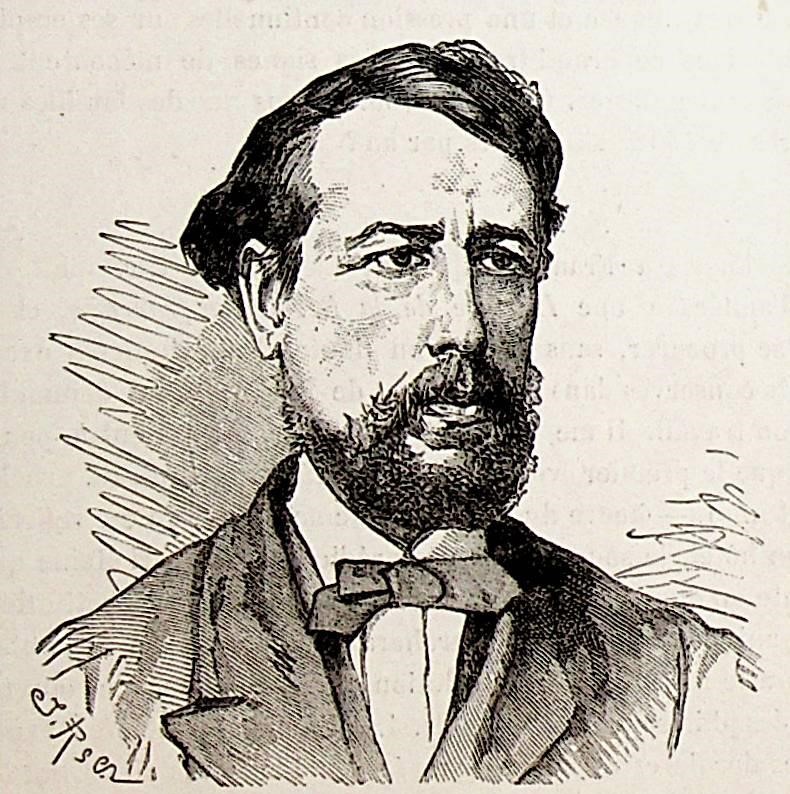
In this letter Liebknecht describes the post-Commune revanchism in both France and Germany, including his own persecution.
‘Letter from Leipzig, XXI’ by Wilhelm Liebknecht from Workingman’s Advocate (Chicago). Vol. 7 No. 48. August 19, 1871.
Leipzig, July 14, 1871
To the Editor of the WORKINGMAN’S ADVOCATE:
The success of the French National Loan has astounded our patriots. They should never have thought the beaten arch-enemy capable of such an effort and such an achievement. What did they, the conquerors, achieve, when three-quarters of a year ago glorious and victorious Bismarck required a National Loan? Hundred millions of thalers were wanted and–not more than ten millions offered! And now these Frenchmen, beaten in a hundred battles, are called upon to advances five hundred millions of thalers, and lo! they give twelve hundred! Rather humiliating that for our patriots1–besides the unmistakable political meaning, which is: “You thought France was dead or stunned. We will prove to you that she is alive and full of vigor! Your hand is at her throat yet you want reason–here it is–off with your hand! A little breathing time and then we shall talk together again.”
No doubt, revanche is the mot d’ordre of all parties in France, one excepted. And this one, international socialism, has been driven from the political stage for the present. All other parties from Thiers, Trochu, down or up to Gambetta are national in their views and aspirations, and do not think of solving political and social problems, but only how to retrieve the defeat and how to restore France to her old place in the European concert. Bonapartists, Legitimists and Orleanists are on that point fully in accord with the honnêtes and radical republicans. Even Louis Blanc, the quondam socialist is over head and ears in the quagmire of national glory. Had the Commune not been overcome, all these parties would have been obliged to turn their attention and activity to home questions, and to repress their desire for revanche, while now, just by, and in consequence of, their victory over the Commune they have a double incentive to drive France into a foreign war. Certainly Mr. Bismarck will soon have cause to repent of his narrow-minded and short-sighted policy in helping the Versaillese to destroy the Commune–thus removing with his own hands the sole guarantee of a lasting peace!
That what we have now is no peace, but only an armistice, is clear to everybody in Germany, and openly acknowledged by those in power. General Reyer, when entering Königsburg at the head of his soldiers, told the burghers not to think of peaceful times, he had no doubt the war would soon break out again. Still more expressive is the utterance of King-Emperor William, who, on the day of the triumphal entry into Berlin, said to some civil deputation: I hope that the peace will not be broken as long as I live. Considering that the King Emperor is in his 75th year, and suffering from the gout, a disease which in a man of such age excludes the possibility of long further life, this expression contains a broad hint indeed that but a very short peace can be hoped for under existing circumstances. And a few days ago, when the Darmstadt Chamber of Deputies was debating the new military convention of Hesse with Prussia, the once (1848-49) all powerful Herr von Gagern, one of the celebrities of the liberal party. (though he has been honest enough to turn his back on the miserable turncoats calling themselves national liberals) developed, in a short speech, that the convention robbed the unfortunate Grand Duchy of the little rest of its independence; yet he could not vote against the bill, because it was evident that the war with France would have to be resumed before long, and there was no fit time now for domestic greatness.
In the meantime militarism is holding its orgies in Germany. The day before yesterday there was a triumphal entrance in Dresden, which also cost the lives of several soldiers that fell the victims of the burning July sun. Altogether, it must be owned, our returning soldiers behave very well, they are happy to be at home again, and their highest wish is to get rid of the uniform and the drilling. However there are many who, during the horrors of war and in the rude life of the camp have forgotten the customs and feelings of civilization; and these brutalized fellows want to continue in peace the usages of war, and by their over-bearing, swaggering, insolent conduct they occasion frequent brawls, which, owing to the scandalous rule of letting the soldiers continually wear their swords, end often in murder and bloodshed. This too is one of the amenities of military glory, which our once glory-mad burghers sighingly must bear with. Well, they have what they deserve. Tu l’a voulu, Georges Dandin’s. Thou didst will it so, my dear Michel!
Of course no diminution of taxes–on the contrary–the French Milliardes, if ever they are paid in full–which, by the by, not even old women believe–will hardly be sufficient to cover the direct expenses of, and losses through the war, and, it having been proved by experience that the Prussian military organization and armament is defective in many respects, improvements are to be introduced on the largest scale; the infantry is to have new guns, the cavalry is to have new cannons, the fortresses are to be rebuilt after a new system, accommodated to the present state of artillery science, etc. In short, we must be glad, if, in spite of the Milliardes, our taxes are not increased at once.
Now something about our inner affairs. In my last letter I told you already of the persecutions going on against our party. A system of repression and violence once adopted, the reactionary impetus must continually increase until a point is reached, where the downward movement is stopped. (In politics, to a great extent, the same laws are at work as in the physical world.) Here in Saxony, which as I explained to you some months ago, is one of the industrial centers of Germany, and of all German States the only one in which the industrial town population nearly equals in number the rural population–here in Saxony the Social Democratic movement has made greater progress than anywhere else in Germany; how far our ideas have spread here may be seen from the single fact that besides the central organ of our party, the Volksstaat, appearing in Leipzig, we have since the autumn of last year succeeded in establishing three small daily papers–one in Crimmitschau, the other in Chemnitz (Saxonian Manchester) and the third in Dresden, our proud capital. All these papers have a circle of readers large enough to sustain them. We hope soon to found a few more local papers–and altogether I shall not be guilty of exaggeration if I say that in Saxony our party is the most numerous, and, as far as moral force goes, the most influential one, too, in the country. For a long time the government abstained from interfering with the movement; whether from indifference or from a particularist feeling of opposition to the Prussians, I cannot decide. The fact itself is undoubted, and it became most manifest during the two first elections for the North German Reichstag, when the government remained perfectly neutral. In the middle of 1869 a demand of the Prussian government to deliver up Liebknecht, who for a speech at a meeting in Berlin had been condemned to three months’ imprisonment, was met with an energetic refusal by the Saxonian courts of justice, and the appeals to our ministry were not more successful. A few months later, in January, 1870, Mr. Hepner, then contributor to the second edition of the Volksstaat, was arrested by the Leipzig police on a telegraphic order from Berlin; but the district court of Leipzig at once forbade his extradition, and after five or six days, having inquired into the case, ordered his release. However, these classic days of judicial independence were not destined to last long. The pressure from Berlin grew stronger and stronger. King John, rather a timid man, was frightened with the red spectre; the highest jurisitical authority of Saxony, Oberstaatsanwalt (Attorney General) Schwarze, an excellent lawyer but an unprincipled, ambitious man, was lured by the bait of a Prussian Portfeuille–and soon a change to the worse was to be felt. In the spring a member of our party, Mr. Dittmar, was arrested for a very harmless speech he made at a meeting, was for three months kept in preventive confinement–that most infamous invention of cowardly despotism, and then by a packed jury he got another three months’ dose of prison, which was added to the three preventive months, so that a man was deprived of his freedom for half a year because with regard to a religious matter he had before a meeting of workingmen2 given utterance to an opinion which may be read in an hundred scientific books and essays, and was probably shared by most of his judges.
But science is to be the privilege of the privileged! Knowledge is power, and must, therefore, remain the monopoly of those in power. No knowledge for the working classes, for it would teach them to break their chains. In the beginning of November Mr. Dittmar, having undergone the whole term of his punishment, left the jail. Just five weeks later Messrs. Bebel, Hepner and Liebknecht were arrested on a charge of high treason, and though not a tittle of evidence could be produced, were deprived of their liberty for three months and a half. The failure of the little coup d’état ought to have taught our government reason. But no. What has happened recently, up to the middle of last week, you know already. These doings were only the prelude. On Saturday Mr. Hirsch,” editor of our Crimmitschau paper (and provincial editor of the Volksstaat) during Liebknecht’s imprisonment, was suddenly arrested for an attack he had published, and which said article had appeared in Dresden, under the nose of the Attorney General, without anything treasonable being discovered in it. Mr. Hirsch has not yet been released, though nearly a week has elapsed, and bail has been offered! However, a worse case is in store still. Two days after Hirsch’s arrest, Mr. Valteich, who for some time has been editor of the Crimmitschau paper, and who in that capacity had inserted a little noticed in which it was said that at the time of the St. Bartholemew massacre in France Te Deum was not sung yet for the praise of mass murder, was for this innocent remark sentenced to four months’ imprisonment! And as there is no appeal, he will most likely have to undergo that insane punishment, which may show you the true nature of Bismarck’s new empire.
Notes
1. They try to excuse themselves by saying the French loan was promising a greater profit. They forgot that this excuse only makes the matter worse, for it implies the confession that the patriotism of the bourgeoisie is measured by the profit to be realized. This was also to be seen at our public illuminations (for victories and peace) when the lighting up of the shops, etc. has to serve as an attractive advertisement.
2. It was stated expressly in the motives of the sentence that the culpability of the incriminating expression was in its having been made before workingmen.
The Chicago Workingman’s Advocate in 1864 by the Chicago Typographical Union during a strike against the Chicago Times. An essential publication in the history of the U.S. workers’ movement, the Advocate though editor Andrew Cameron became the voice National Labor Union after the Civil War. It’s pages were often the first place the work of Marx, Engels, and the International were printed in English in the U.S. It lasted through 1874 with the demise of the N.L.U.
PDF of issue: https://chroniclingamerica.loc.gov/lccn/sn89077510/1871-08-19/ed-1/seq-2/
 Revolution's Newsstand