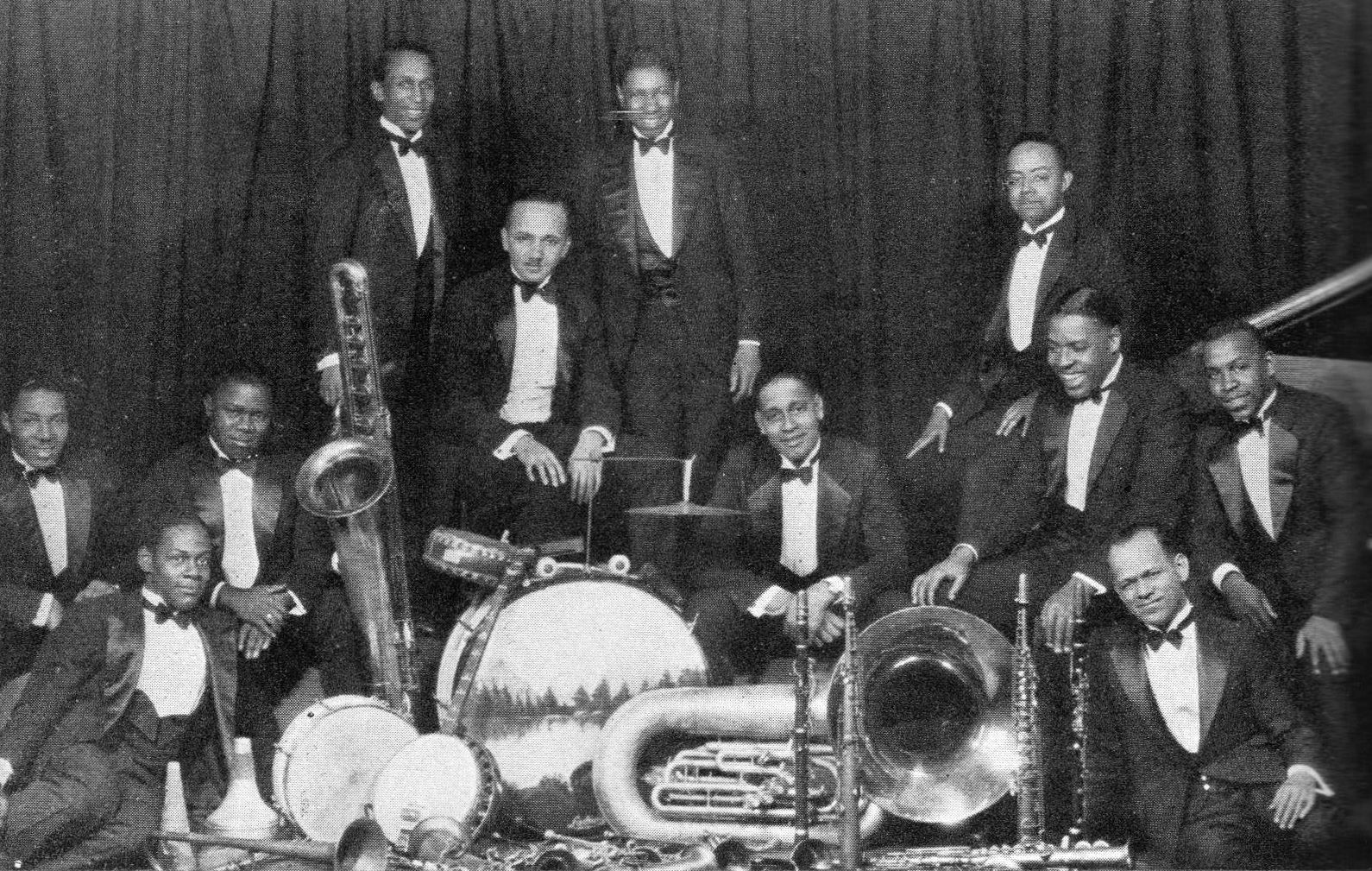
A major figure in 20th century music, writing under a pseudonym for New Masses (he would later be investigated for such articles), the hugely influential John H. Hammond writes near the beginning of his career on his passion. He demanded the musical world take swing seriously, at a time when the first hints of integrated music were appearing from the Black world of jazz.
‘The Development of “Swing”’ by Henry Johnson (John H. Hammond) from New Masses. Vol. 18 No. 10. March 3, 1936.
ALTHOUGH the acceptance of radio almost knocked the phonograph industry off the map, it is the very radio programs sponsored by advertisers which are reviving interest in records. The reason for the come-back of the classical recordings is simple and obvious: there is no medium except the phonograph where good music is on tap whenever one wishes it. Sunday concessions are not enough and the only other extended programs of chamber music, opera and symphony occur on weekday afternoons, a time SO inconvenient for the masses of people that advertisers have wisely left it free.
It is not only in the field of classics that the phonograph has out-distanced its rival. THE NEW MASSES last week spoke of the excellent mass songs of Hanns Eisler and other left musical leaders, naturally taboo on advertiser-sponsored radio, which have recently been recorded. There is also the phenomenon of informal “swing” or improvised jazz, which is considered by the radio moguls too advanced for popular consumption. And finally there is the great mass of Negro blues, stomps and work-songs which air officials have decided are without interest to the vast majority of listeners. Advertising executives have a way of feeling that their own tastes are necessarily those of the public; the result is an endless procession of hackneyed and uninspired entertainment.
In this bi-weekly column on recorded music, much emphasis will be placed on our popular music, particularly the kind that swings. There has been much decrying in the past of the sterility of our serious composers as well as the bankruptcy of American music in general, and if one were to judge it only by the works of such people as Roy Harris and Walter Piston there would be good reason for the gloom. But right at our back door we have not only genuine, unpretentious music that in other countries would be dignified by the prefix folk, but instrumentalists who by their ingenuity and invention are responsible for making it important.
This swing music, we’ll leave out the quotes in the future, was once known as “hot,” which simply meant improvised with rhythmic and technical assurance. It has practically no literature of its own, for its players are quite content to work with the most banal of Broadway tunes or take traditional blues chords and fashion their own improvisation. Sometimes big bands like Fletcher Henderson and Duke Ellington have been able to improvise collectively with magnificent effect, but more often the music comes from a few soloists sitting down together after work and playing either for their own satisfaction or that of a small, sympathetic and very informal audience.
In its own way this music is a revolutionary departure from accepted Tin Pan Alley standards. Its exponent consciously or subconsciously realizes the banality of the material, imposes his own musical and harmonic ideas on its structure and gives it a vitality the unhappy composer never intended. For the great instrumentalists of the day to swing out is an escape, not from essentials, but from the stifling mediocrity imposed upon them by leaders who are primarily showmen and managers who are interested only in commercial returns and scared of anything the public might not grasp at first hearing. The energy and emotional intensity that goes into this kind of playing is not exceeded even by the Szigetis and Feuermanns of the concert world, who have something of the rhythmic fire that belongs to the greatest of the informal improvisers.
Obviously, Negroes are on the whole the greatest exponents of real swing, although the present-day connotations of the word imply a sophistication and subtlety which only the most developed of musicians possess. The technical assurance, melodic invention and inner fire of such individuals as Coleman Hawkins and Leon Berry on the tenor saxophone, Jay Higginbotham on trombone and Bill Basie, Teddy Wilson and Fats Waller on piano, to cite only a few examples, must be heard to be believed. But the influence of Negroes on the best of white musicians has been tremendous, which is at least a partial explanation for the abandon of Benny Goodman, who, though a successful band leader, is undoubtedly the greatest clarinetist in the country, Joe Sullivan, Bunny Berigan and other white virtuosi.
This genuine and vital music has succeeded in doing many strange things, the most amazing of which is the breaking down of the color line. Although there are not yet any organized black-and-white dance orchestras, there are innumerable places, even in the deep South, where white and colored musicians play together in public after work, defying criticism. Almost any night in Chicago one can find someone like Gene Krupa, Goodman’s extraordinary drummer, sitting in with a colored band; even Goodman himself plays spasmodically with the orchestra of Fletcher Henderson, who is his chief arranger.
The phonograph has done wonders in preserving this grand art form from its inception. It was in the early Twenties that the music first developed and at that time it was looked upon with horror, by managers, leaders and cafe-owners alike. The main reason for its great welcome by the phonograph companies is a fairly sordid one: recording managers, seeing that much of the material was original and non-copyrighted, cut themselves in for the lion’s share of the royalties.
Bessie Smith’s blues records were among the first to feature the finest of swing artists. In her early records, Louis Armstrong played the trumpet in a way that he has never since equaled, corrupted as he has been by ideas of chiseling managers; and Fletcher Henderson, Joe Smith and many other greats got their first big opportunity. It is amusing to note that among the lists of “composers” on the labels one can still find executives and managers who cannot read a note of music.
White musicians had a far harder time than the colored in playing as they wished. About the only place that such a genius as Bix Beiderbecke could play was in a recording studio, but he was at his greatest at a time when the companies were still firm in refusing to allow the two races to play together. Inasmuch as there was no place in which Bix could make a living by playing as he wished, he finally had to join Paul Whiteman’s pretentious orchestra, where in the midst of a flock of uninspired, weary musicians he was given a chorus now and then in a hotcha number. He drank himself to death and so did a majority of his unappreciated contemporaries, who found alcohol and poverty preferable to playing music they detested.
The record companies first yielded to the demands of white and colored musicians that they be allowed to play together in 1928, when Louis Armstrong made records with such white luminaries as Jack Tea-garden and Eddie Lang. Ever since then the standard of improvised jazz has improved. At the moment taste is so high that officials in certain of the companies are beginning to see the necessity of preserving the great traditional Negro blues, which are all but forgotten in the success of corruptions like the St. Louis Blues, which owe far more to sophisticated, white standards than to the traditional blues harmonies. The phonograph will soon be the only means we will have for tracing the evolution of our musical culture, since most of the pioneers have either died or changed their styles irrevocably to suit passing tastes.
Up to now there has been absolutely no interest at all expressed in this music by the pretentious, serious American composers. Most of them are not even aware of its existence, as is shown by their work. And it is still difficult to find, for the best of it still flowers in hovels, obscure alley dives, occasionally on New York’s haywire Fifty-second Street and in Negro cafes and dancehalls, none of them fitting places for sheltered, subsidized artists. The phonograph, however, is continually producing samples. of it, robbed, perhaps, of some of the vitality and abandon of unrehearsed real-life performance, but genuine, nevertheless. No matter what else of interest is happening, we will attempt in the future to list the best of the records still available in the market.
The New Masses was the continuation of Workers Monthly which began publishing in 1924 as a merger of the ‘Liberator’, the Trade Union Educational League magazine ‘Labor Herald’, and Friends of Soviet Russia’s monthly ‘Soviet Russia Pictorial’ as an explicitly Communist Party publication, but drawing in a wide range of contributors and sympathizers. In 1927 Workers Monthly ceased and The New Masses began. A major left cultural magazine of the late 1920s and early 1940s, the early editors of The New Masses included Hugo Gellert, John F. Sloan, Max Eastman, Mike Gold, and Joseph Freeman. Writers included William Carlos Williams, Theodore Dreiser, John Dos Passos, Upton Sinclair, Richard Wright, Ralph Ellison, Dorothy Parker, Dorothy Day, John Breecher, Langston Hughes, Eugene O’Neill, Rex Stout and Ernest Hemingway. Artists included Hugo Gellert, Stuart Davis, Boardman Robinson, Wanda Gag, William Gropper and Otto Soglow. Over time, the New Masses became narrower politically and the articles more commentary than comment. However, particularly in it first years, New Masses was the epitome of the era’s finest revolutionary cultural and artistic traditions.
PDF of full issue: https://www.marxists.org/history/usa/pubs/new-masses/1936/v18n10-mar-03-1936-NM.pdf
 Revolution's Newsstand