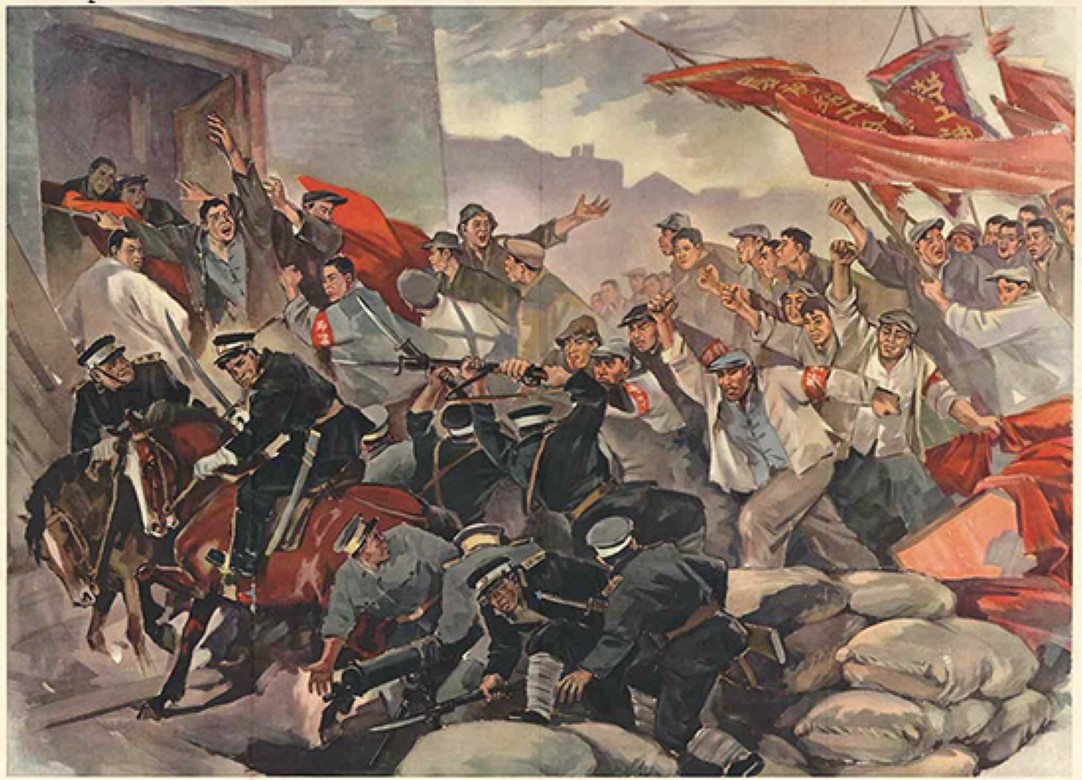
Grigori Voitinsky, first head of the Comintern’s Far Eastern Bureau, and liaison to China central to the formation of the C.C.P. with an informative background on the May 30 Movement written just before Shanghai general strike of 1925 and its subsequent brutal repression.
‘The Struggle of the Imperialists against the Chinese Labour Movement’ by Grigori Voitinsky from International Press Correspondence. Vol. 5 No. 52. June 25, 1925.
The working class in China is at present passing through the most difficult period of its development.
In the peculiar circumstances of China, a semi-colony, an object of interference on the part of world imperialism, the path of the struggle of the working class is very difficult and complicated. At its very inception, at its very first steps on the path to emancipation from slavery, the Chinese proletariat is met by a powerful enemy in the form of the imperialistic groups of Europe, America and Asia, and by their tool, the Chinese militarists.
The most recent development of events during the strike of the textile workers in Shanghai and Tsingtao must be viewed in this light.
Why do the foreign imperialists, in spite of their conflicting interests in every branch of industry and trade in China and in every part of this enormous country, form a united front to attack the Chinese proletariat? Why is it that on Chinese soil the foreign police meet the most elementary demands for the right to exist on the part of the Chinese proletariat, by firing into the unarmed crowds of men, women and children?
Why on the other hand, do the students, the offspring of the Chinese bourgeoisie, join with the working class and likewise sacrifice themselves in the struggle against the foreign capitalists? Why, finally, are even the Chinese chambers of commerce compelled to support the demand of the workers that foreign troops be withdrawn from the most important Chinese ports?
All these questions can be answered by the following formula: The Chinese proletariat is inevitably taking up the position of an outpost in the war of liberation of the Chinese people, and therefore, in the nature of things, assumes more and more the hegemony of the national movement for the liberation of the Chinese people as a whole.
When for the first time, in the beginning of 1922, a part of the working class of China, which was organised not on the model of class trade unions, but in a large guild, the Seamen’s Union of Hongkong, declared war on the English shipowners, it was regarded both by the foreign capitalists and the Chinese public as a duel between the Chinese workers and the foreign oppressors.
At that time, England played the leading role in the political oppression of China. This happened two years after the destruction of the Japanese apparatus in China, the Anfu Club, with the president Siu-Shi-Tsan and his nephew, the younger Siu, the dictator of Mongolia. In the period between the Summer of 1920 and the Autumn of 1922 the English apparatus of colonisation in China had been extraordinarily strengthened.
The Sun Yat Sen Government which had only been formed at the beginning of 1922 in Shantung after Tshen Tsiun Min had been driven out, was a thorn in the flesh of the British imperialists and seemed to cloud their bright prospects of a further enslavement of China. The opposition of the seamen of Hongkong to the English shipowners and bankers at that time, an opposition which paralysed traffic in the Pacific Ocean and the Yellow Sea, which left some hundreds of thousands of tons of goods lying in the docks and on shipboard, which drew the whole of the urban working population of South China into the anti-British movement, was a serious blow to the prestige of the English colonisation apparatus in China and a great help to the revolutionary government of South China.
With gnashing of teeth, the proud Britons had to yield to the Union of Chinese seamen and to comply with its demands, which were, it is true, modest enough. For the first time organised Chinese workers succeeded by means of a six weeks’ strike in obtaining recognition of their Union and compensation for lost working time. Then as now, the whole English Press, was filled with lies and calumnies regarding the seamen on strike, then as now, the press hacks declared the influence of Bolshevist agitation to be the cause of the strike.
In order better to understand the significance of present events in China, it must be remarked that the representatives of American capital, at whose instigation the conference at Washington (end of 1921 and beginning of 1922) was called, with the object of procuring better entry and security for of the workers to England and, in their semi-official organ in American capital into China, “sympathised” with the opposition
China, the “Weekly Review”, reported as follows:
“The strike movement in China is growing slowly but surely…strikes in China are at present just as inevitable as floods and epidemics…China is not yet threatened with strikes involving the whole country, but the time will come when the masses will more clearly understand the significance of the Labour movement.”
The prophesies of the ideologists of American imperialism are perhaps beginning to come true sooner than they excepted. This is the chief reason for their hatred of the Chinese proletariat.
A second characteristic feature of the struggle of the Hongkong seamen was, that even on this first occasion of Chinese workers opposing the imperialists, the treacherous role played by the upper strata of the Chinese bourgeoisie, became evident. The Chinese Comprador (wholesale dealer) and banker Robert Hotun, well-known in Hongkong, who had been knighted by the king of England, cheated the Seamen’s Union in his capacity as negotiator with the striking seamen, in that he first of all delayed payment of the sums agreed upon, and then refused to keep his promise.
As a result of the strike of the Hongkong seamen, a wave of strikes passed over the whole of China. The Labour movement began to take economic shape. So far the workers had not given expression to any political demands, neither had the students demonstrated in sympathy with the movement. This is explained by the fact that during the whole of 1922, the Chinese bourgeoisie and the intelligenzia still cherished hopes that the promises of the Conference at Washington would be fulfilled, i.e. that the Japanese troops would be withdrawn from the province of Shantung with its magnificent harbour of Tsingtao, and that the customs duties would be raised in favour of China.
After the Conference at Washington the reactionary movement in the country grew stronger. Wu Pei Fu carried out the wishes of Ango-American capital. Partly in fulfilment of their wish, he entered into war against his former ally and party comrade (of the Tshili clique) Csang-Tso-Lin. The conflict between these two generals expressed the endeavours of the Anglo-American imperialists to make sure of an actual influence in China, which had been formally achieved at the Conference of Washington. And the victory of Wu Pei Fu over Chang Tso- Lin did, as a matter of fact, establish an extraordinary influence of the Anglo-American imperialists in Central and North China. The end of 1922 and the beginning of 1923 were characterised in China by the growing political reaction which threatened to spread through the whole country and to overthrow Sun Yat Sen’s government in the South.
In the atmosphere of tense political reaction in the country, at the moment when Wu Pei Fu was, with the aid the Anglo-American imperialists, preparing military measures for the destruction of the nationalist revolutionary base in the province of Kwantung and for uniting the country, when he was stifling every appearance of social thought and preparing a new government, the strike of the railwaymen on the main line from Peking to Hankow broke out, in the chief sphere of influence of English imperialism, on the line on which Wu Pei Fu had to transport his troops to the South.
The Workers suffered cruel defeat; they defended their trade unions and their flags, but the armed bands of Wu Pei Fu shot down the workers and their leaders and threw many into prison. The workers’ unions, or rather the embryos of unions, were compelled to become strictly illegal.
But the rise of the railwaymen of the line Peking to Honkow in February 1923 had immense political consequences. Wu Pei Fu was revealed in his true character to the whole of the Chinese people. The students revolted. Wu Pei Fu began openly, to place Chinese policy on the same level with the English apparatus of colonisation. And, regardless of the fact that reaction continued to rage throughout the country, a change took place in the political life of the land; Wu Pei Fu had to abandon his expedition to the South and to pay close attention to events in Central and North China. The heroic behaviour of the Chinese railwaymen in 1923 was a blow to the most reactionary part of imperialism in China, to the apparatus of the Anglo-American imperialists.
There is no doubt that the attitude of the railwaymen of Hankow, which rendered it impossible for Wu Pei Fu to rely on the hinterland, stimulated Chan Tso-Lin to fight against Wu Pei Fu, and was to a certain extent a factor in the overthrow of Wu Pei Fu’s power in the autumn of last year.
Wu Pei Fu’s fall set the nationalist revolutionary emancipation movement in action throughout the country, extended the base of the Kuomintang party and made it possible openly to carry on an anti-imperialist campaign in the whole country for several months.
Of course this process was not systematically organised, nevertheless the Chinese proletariat, when fighting its own battle in its own interests, is, in the nature of things, the most consistent and irreconcilable fighter against the colonial yoke of imperialism, and thus becomes the leader of the whole national movement.
This and this alone explains that unprecedented wrath and cruelty with which the headsmen of Anglo-Japanese imperialism are using their whole apparatus of brigandage in the suppression of the workers’ strikes in Shanghai and Tsingtao. This also explains the other fact that the overwhelming majority of the Chinese people is siding with the Chinese proletariat in its present fight. The struggle of the masses indeed in its totality has now a more consistent and revolutionary character than was the case a few years ago, thanks to the circumstance that the class war of the Chinese proletariat is more and more becoming the backbone of the national emancipation movement.
What then is the most distinguishing feature of recent events in China? That the proletariat of Shanghai and Tsingtao, in the course of their struggle against the Japanese employers, are again striking out at the most dangerous group of i perialists in the country. Japan has in fact in the course of the past ten months, i.e. since the October revolution in Peking, once more become the most important imperialistic power in China, the most important in that the power of the State in China, in the form of Tuan Tsi Tshui and partly in the person of Chang Tso Lin, is on the side of the Japanese imperialists.
To the extent that its influence grew, Japanese imperialism became more and more an aggressive power against the liberation movement in the country, which grew irresistibly in consequence of the victory over Wu Pei Fu and over the Anglo-American colonisation apparatus.
The elementary outbreak of the workers of Shanghai and Tsingtao, which drew the broadest masses of the urban population of China into the fight against the imperialists, can only be explained by the unspeakable insolence of the Japanese imperialists who were convinced that they held a position of supremacy in the suppression of China. The struggle against the Japanese imperialists and the English imperialists who came to their help, is now part of the most dangerous and most important front of the anti-imperialist movement in the country.
All the slogans raised by Sun Yat Sen, the leader of the national revolutionary party, Kuomintang, have now, thanks to the struggle of the proletariat, become essential demands of the whole Chinese people.
The fight in all the great towns of China is being fought round these slogans; it was for them that the general strike in Shanghai, which may in a few days spread to other industrial towns in the country, was declared.
The fight of the Chinese proletariat in these days is a new stage in the emancipation movement of this vast country, a stage which will call forth new, decisive battles against imperialism at its most vulnerable spot.
International Press Correspondence, widely known as”Inprecorr” was published by the Executive Committee of the Communist International (ECCI) regularly in German and English, occasionally in many other languages, beginning in 1921 and lasting in English until 1938. Inprecorr’s role was to supply translated articles to the English-speaking press of the International from the Comintern’s different sections, as well as news and statements from the ECCI. Many ‘Daily Worker’ and ‘Communist’ articles originated in Inprecorr, and it also published articles by American comrades for use in other countries. It was published at least weekly, and often thrice weekly. Inprecorr is an invaluable English-language source on the history of the Communist International and its sections.
PDF of full issue: https://www.marxists.org/history/international/comintern/inprecor/1925/v05n52-jun-25-1925-inprecor.pdf
 Revolution's Newsstand