
Chris A. Kerker, General Organizer of the International Bakery and Confectionery Workers Union, reports on the woeful, and extremely profitable, conditions in the baking industry- one of the first to produce highly processed ‘foods’.
‘Your Loaf of Bread: Anti-Farmer, Anti-Public, Anti-Union’ by Chris A. Kerker from Labor Age. Vol. 13 No. 6. June, 1924.
You cannot get away from it. Bread is the staff of life. Bread-eating is a habit in which we must all indulge. Man has been doing it almost ever since he began doing anything at all.
Today we eat our bread in the sweat of our brow, as we never did before. The Ward Baking Company calls its product, “Tip Top.” That exactly describes the prices which it charges. They are as high as can be charged, without forcing us all to go back to herbs exclusively—and other “fruits of nature.” We sweat to earn the money to buy the bread, and sweat again at the amount it takes to purchase one small loaf.
Then after all this exertion, we find that we have been buncoed on the quality. Alas, what fools we consumers prove to be.
Says a large daily paper, in a recent issue: “You have to buy a newspaper to find out that wheat prices have collapsed. You’d never learn of it by buying a loaf of bread.” Of course not. The same combine that beats the consumer, also trims the farmer at the other end of the line. Is it any wonder that in 1923 the big baking corporations made net profits of from 100 to 200 percent?
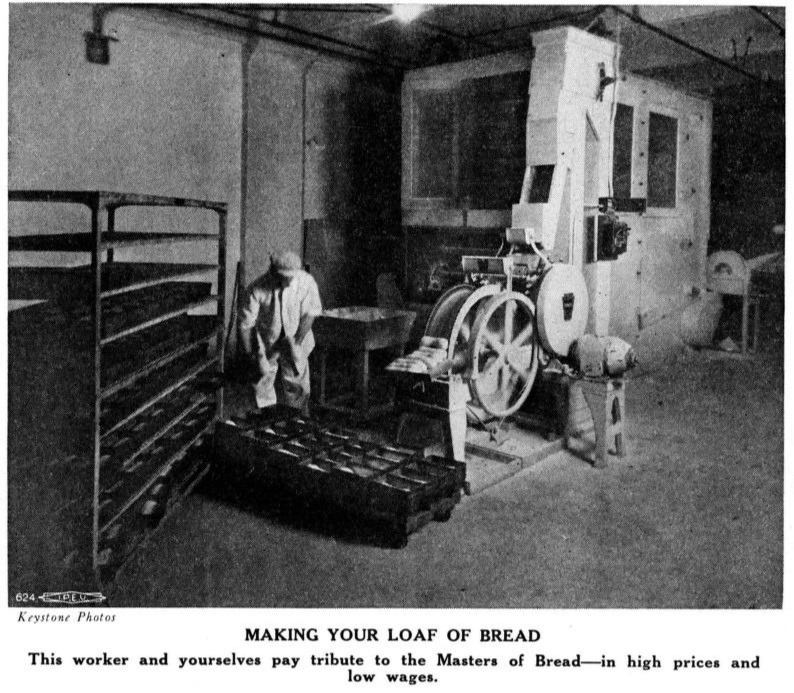
Then, there are the bakery workers. The same big combines, that have waylaid the farmers and consumers, have tried to crush the makers of bread. The Ward Baking Company is fighting the union in its industry tooth and nail. It is not content with the spoils which it has extracted from the wheat growers and the bread purchasers. It is a year ago that Mr. George S. Ward, at that time its President, also said that the bakery workers organization must be destroyed. The challenge was accepted. The Bakery Workers International Union is continuing the fight begun that long ago. Mr. Ward, the dictator of the old system, has been compelled to sell out to a competitor. In connection with his two sons, he has retired, to go somewhere in the South Sea Islands.
Anti-Farmer, Anti-Public, Anti-Union
The sale was to the United Bakeries Corporation, founded by another Ward. He is the son of the man who began the Ward Baking Company, who was also driven into retirement by his fight years ago against the union. Now, we see big advertisements in the daily papers: “I have come back to take charge of my father’s business,” or words to that effect. What it all means, in reality, is that the anti-farmer, anti-public, anti-union combine is strengthening itself—to continue its game of fleecing them all.
The United Bakeries Corporation and the General Baking Company are now the two big concerns in the field. They reach out all over the country. Basil Manly, Director of the Peoples Legislative Service has listed 27 companies in 26 different cities owned by the latter concern. The United is even more extensive, owning 37 companies in 37 different cities. Some of these companies have several plants. The Shults Bread Company of New York, owned by the United, has as many as twelve. Union of the General and the United, which is in the air, would mean one of the most gigantic trusts in the history of America.
An investigation has shown that when wages were at the top-notch in this country the cost of production of bread, that is to say in a dollar’s worth of bread, was only fourteen cents. There you can readily see why the trust concerns of this country paid up those high dividends in the last year or so. These concerns several years ago—sold stock at $2.00 per block. That same stock that they sold for $2.00 per block, after seven years has risen to the present to be sold at the rate of $608.00 per block. Every dollar invested brought $302.00. What does that show? It shows that bread has been turned into gold.
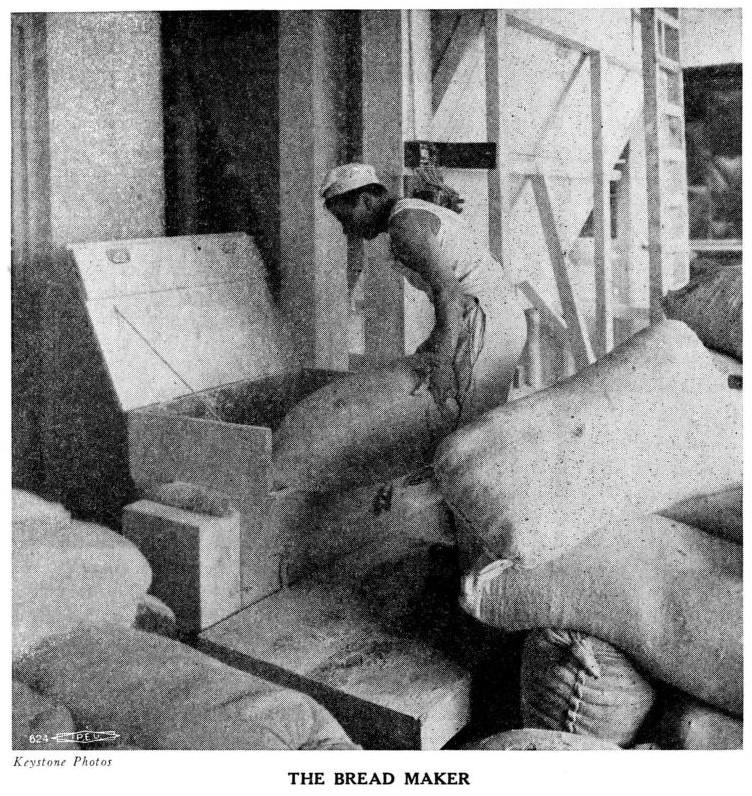
These concerns have piled profits upon profits. As Mr. Manly says: “During recent months the price of wheat has fallen almost as low as it was in the depressed pre-war year 1913, and yet the people in American cities are paying 50, 75 and even 90 per cent more for bread than they did before the war.”
Is it any wonder that the wheat farmer is suffering? He has been deprived of the price he should get for his wheat. At the present price of bread, wheat should be bringing him around $2.00 a bushel. Instead, he is getting less than $1.00 for that amount.
“Plaster of Paris” Bread
He is also suffering—and the consumer more than he—by the adulteration of bread. The baking combine does not use as much flour per loaf as was used in the olden days. Ask your wife to bake a loaf of bread. If she uses the best flour, you will have a nourishing and satisfying loaf on your table. But it will be lacking in one thing. The bread your wife has made will not be as white as the one that comes from the Ward factory or other factories. Your wife did not buy the adulterated product that goes into the making of a loaf of bread that comes from the factory. In the chemical world this is known as “plaster of paris’-—scarcely a fitting diet for any stomach, human or otherwise.
Look up the records of your State Courts of New York and Massachusetts. There you will learn that prior to the war that the Health Departments of both states had hauled Mr. Ward before the Judges in an endeavor to try to stop him from using this stuff. But the war came on and the Judges “reserved their decisions”—and we forgot it. The bakery workers hope to be able to resurrect it. Perhaps we will find some help in other parts of the country than just in the East.
The adulterated product has a value—for the combine. When this stuff is used, the trust bakers can put in an extra bucket of water to every barrel of flour that is to be turned into bread. This means 32 pounds of water more in the bread that you buy. The “plaster of paris” holds it when it gets to the oven, so that the flour and water stay together, and the flour does not float away. You need not be amazed at being hungry, after eating such “food.”
Coming and Going
The new combine, formed by the purchase of the Ward Baking Company by the United, has incorporated itself for the small sum of $75,000,000. Behind this $75,000,000, in the Board of Directors, are men that are known not only in the food trust but in other combinations. There are steel magnates and coal barons. They want to get us, coming and going, as the old saying went.
The Bakers Union has been fighting this combine for many years. As early as 1889 it warned the “public” that a pool was in the making, and that a trust would follow. That was in the year that the Shults Baking Company formed a merger of a number of bakeries in New York. This company is now united with the Ward Company in the United Corporation. It produces the much advertised “Certified Bread.”
The Bakers Union can say that its battle against the trust has not been a matter of yesterday. At the time of its warning 35 years ago, the “public” paid little heed. “It is only a Socialist cry,” they said at that time. “‘We won’t believe the danger.” Today, when the hard facts are knocking us all in the heads, the danger has grown, until it is mountainsize. We pay heavy tribute to it with every loaf of bread.
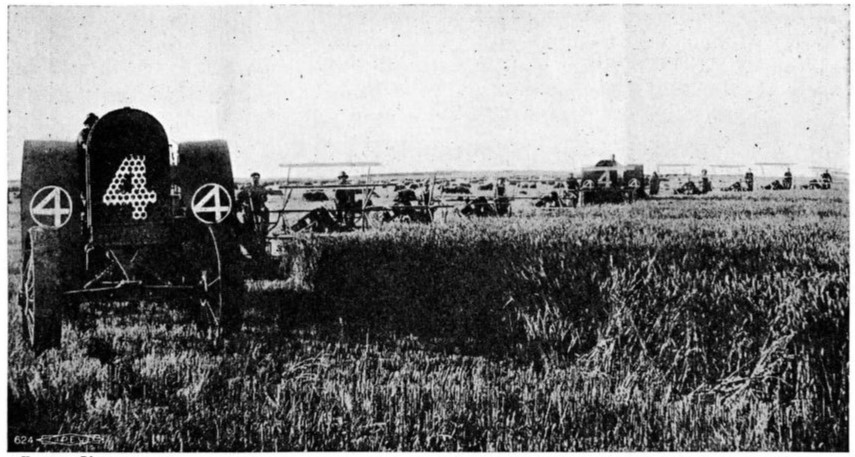
In every battle, the interests of the farmers, the consumers and the workers are the same. They have identical common enemies. No more so is this the case in any industry than in that of producing and baking bread. The bakery workers intend to continue the fight against the combine. They intend to do all in their power to kill the adulteration now going on. The other workers, as consumers, should fight with them. In the courts—and in the use of their purchasing power! The bread of the anti-union combine should be shunned, at all costs. The union men have done this splendidly in the past year. The miners, in particular, have driven the wagons of the trust out of their communities. That is fine work, which must be kept up.
The spirit of the workers is shown by the fact that only 200, out of 2,600 men locked out last May have returned to the Ward Company. The rest are now working in union shops with signed-up agreements.
The bigger program, also, can scarcely be forgotten. Workers and consumers and farmers can join hands in doing more than mere defensive battling. An inventory is now being taken, through Senate investigations, of the looting of the American people. It might well be extended to take in an investigation of the Bread Trust. Let’s have such an investigation. Out of it will come knowledge as to how to make this Trust serve the people and the workers—instead of bleeding them.
With one accord, concerning that investigation, we all vote: “Aye.”
Labor Age was a left-labor monthly magazine with origins in Socialist Review, journal of the Intercollegiate Socialist Society. Published by the Labor Publication Society from 1921-1933 aligned with the League for Industrial Democracy of left-wing trade unionists across industries. During 1929-33 the magazine was affiliated with the Conference for Progressive Labor Action (CPLA) led by A. J. Muste. James Maurer, Harry W. Laidler, and Louis Budenz were also writers. The orientation of the magazine was industrial unionism, planning, nationalization, and was illustrated with photos and cartoons. With its stress on worker education, social unionism and rank and file activism, it is one of the essential journals of the radical US labor socialist movement of its time.
PDF of full issue: https://www.marxists.org/history/usa/pubs/laborage/v13n06-jun-1924-LA.pdf
 Revolution's Newsstand