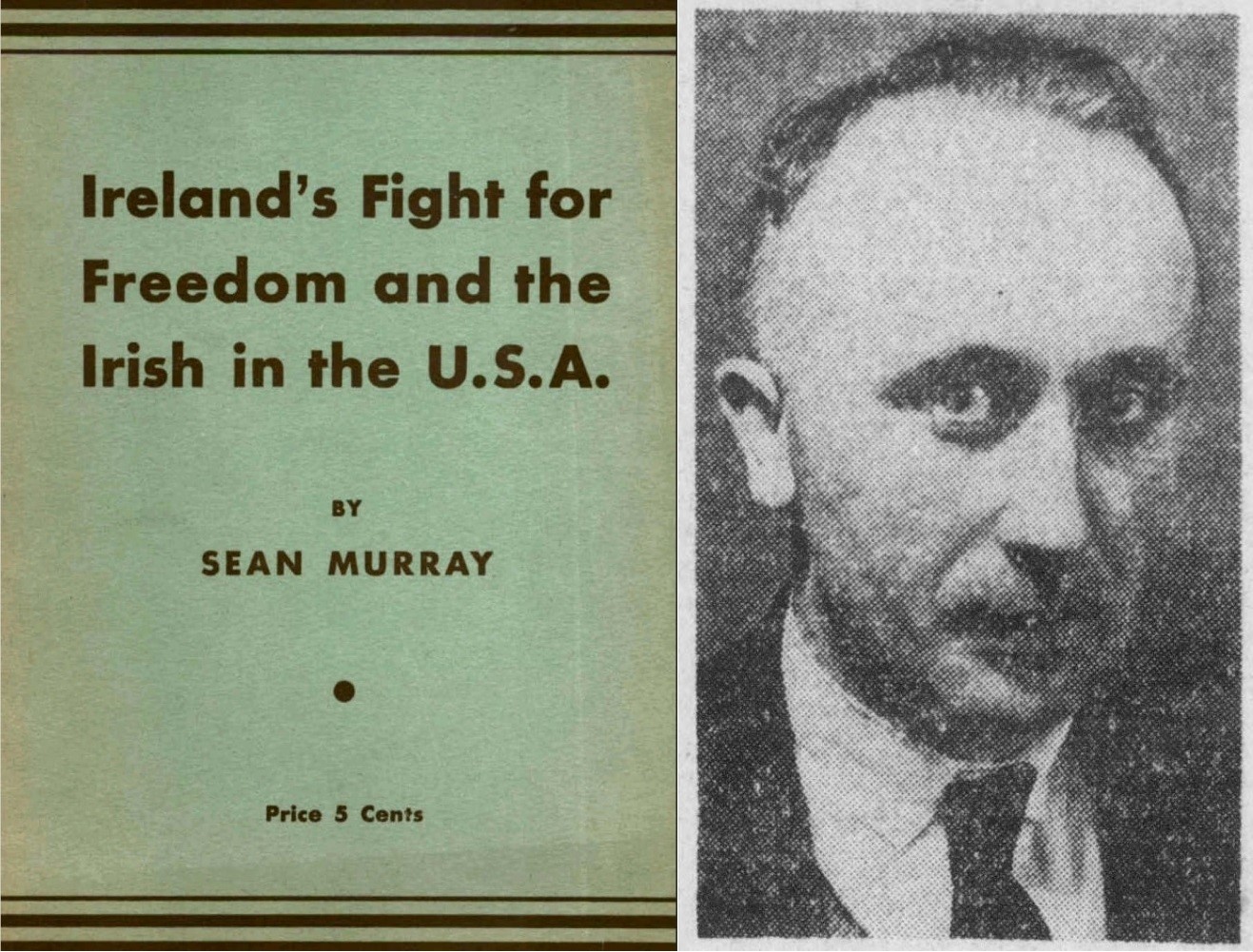
Sean Murray, founder of the Communist Party of Ireland and its first General Secretary from 1933 to 1940, addresses Irish America during the Great Depression, highlighting the state of industries where Irish workers were, as well as the rise of fascism and unfinished revolution in Ireland. Murray, a former IRA volunteer who had fought in the Irish Revolution and Civil War, had recently made a visit to the U.S. to drum up Irish American support for the new Communist Party in Ireland as well the U.S. Party as Irish Republicans moved left with the Republican Congress movement in Ireland. Full text of pamphlet. Published for the Irish Workers’ Club by the Communist Party’s Workers Library Publishers.
‘Ireland’s Fight for Freedom and the Irish in the U.S.A.’ by Sean Murray. Workers Library Publishers, 1934.
NO Irish revolutionary movement has ever challenged the British Empire in Ireland without aid from the exiles driven by imperialist rule over the face of the earth. The “dissenters” of the North–they who struck terror into the hearts of ascendancy landlords when they organized the Hearts of Steel–never surrendered their struggle against the rackrenters even when they were forced to seek religious and civil liberty in the then revolutionary United States. At Bunker Hill, at Germantown and Yorktown, the “wild geese of the North,” spurred on by their bitter memories of eviction and persecution in Down and Antrim, helped settle accounts with the Crown forces.
When the best men of the Young Irelanders set about breaking the British connection in ’48, the exiles who had been driven to the States by the black famine supplied many a gun and many a hard-earned dollar for the revolutionary cause.
The gallant men of the Fenian Brotherhood drilled to the use of arms in the civil war, were the auxiliaries of the Fenians of ’67. And when the British Empire let loose the most ferocious reign of terror in an attempt to crush the struggle for Irish national independence after 1916, the Irish people in the United States organized great mass demonstrations and flooded the press with protests. Their pressure compelled hundreds of Labor and Irish organizations to go on record against British ferocities in Ireland. Two and a half million dollars–this was the splendid contribution of Irish-America to supply the sinews of war at the heights of the Republican movement in Ireland.
The coffin ship of ’48, wholesale clearance to make way for sheep and bullocks in the sixties the hounding and deportation of revolutionists in the Black and Tan and civil war campaigns—nothing could break the bonds between the revolutionary struggle of the Irish people and their exiles and children of exiles in the United States. But in spite of all the valiant struggles of the Irish people at home, backed by such a mighty power as the millions of Irish in the U.S.A., Ireland is still today not a free nation and her territory is divided into two States, with England as overlord. Clearly something has been amiss with our movement, otherwise the mighty efforts and sacrifice of our people would have been victorious long ago. What has been the weakness which has cheated Ireland of victory?
The Weakness in the Irish Struggle
The weakness has been that both at home and in the U.S.A., the Irish struggle has been led by the lawyers, professors, and business men of the Irish middle class, and not by the revolutionary workers and their country allies, and the farmers. These people living in an atmosphere of haggling and barter in business, made the political fight for freedom with Britain a matter of haggling and barter. It was so in the land struggle which, instead of being finished and the farmer freed from the rent grafter, when the land war was on and sweeping all before it, it was turned into a miserable “settlement” which saddled the Irish farmers with the payment of £5,000,000 annually, in annuities to pay principal and interest on the purchase money to buy out the landlord descendants of Cromwell’s and King William’s planters. It was so in the Home Rule struggle when Redmond and the Parliamentary Party bartered the nation’s sovereignty and agreed to carve out a special imperialist compound in the North. It was so in 1921 when the middle class spokesmen signed a “treaty” which was a denial of Irish national rights and a fetter on the progress and unity of the country.
Reflected in the Irish-American Movement
The Irish-American movement suffered from the same defects. The nationalist politicians gave the people to believe that the ruling political cliques of American finance and business and their governments and Presidents would stand up for Irish freedom. The whole course of our movement’s history shows unmistakably that we made
a big mistake in following this course, that in fact the working millions were deceived and betrayed by this policy. President Wilson’s fourteen points and self-determination talk lulled the Irish into a false trust and helped only the British imperialists. The American capitalists and their Irish agents are exposed as being not friends but enemies of Irish freedom, prepared to utilize Irish national sentiment for their own ends, and to keep the Irish masses out of a real revolutionary struggle for Ireland’s freedom and their own interests as struggling wage-earners in their adopted country.
These mistakes must not be repeated in the great conflict now developing. The first step in this is for the Irish workers and farmers to break clear of the huckstering political bosses, Yankee and Irish–and build their own independent revolutionary movement based on the teachings of the greatest Irish revolutionary working class leader James Connolly. In this way, Irish freedom can be achieved. In this way, the poverty and helplessness of wage-earning and farming masses can be banished from the homes of the Irish people. It is to this great task that the Irish Workers’ Clubs are addressing themselves in the U.S.A. today.
The Blue-Shirt Offensive in Ireland
The situation is pressing. A fresh imperialist menace faces Ireland smothering under the crisis which has brought the capitalist system everywhere to the edge of the abyss. The remnants of the old landowning clique, the graziers, bankers and brewers have banded themselves together and organized a fascist movement headed by the ex-police chief O’Duff’y and supported by the old Free State Party of Cosgrove & Co. “Give us back the British market” is their slogan, which means keep the country for England, the graziers, Guinness, and the Bank of Ireland, and stop bothering about national independence. They are gathering around them all the powerful capitalists who see in a fascist dictatorship allied to London the only means of holding down the workers and farmers fighting for wages, maintenance, and a homestead on the land.
They are frightened at the stirrings of social revolt which menace the capitalist system, the basis of British imperialism in the country. In October, 1932, in Belfast, when the Catholic and Protestant workers, under the leadership of Irish Communists and revolutionary labor and militant nationalists forgot their old differences, and directed their combined forces against the imperialist enemy they compelled the latter to grant all their demands (the scales of relief were raised as a result of this great mass upheaval from two dollars per week for a man and wife with no children, to five dollars with corresponding increases for each child). Two workers were killed by the State forces and dozens arrested and sentenced. They (the imperialists} are scared at the demands for confiscation of the ranches in the countryside, and strikes against wage cuts on the railway, docks, and ships and in nearly al! the new factories. And most of all are the capitalists alarmed at the increasing outcry by the Republican masses against the policy of the government on the national struggle and its protection of imperialist privileges and wealth.
Hence the rise of the new Black and Tans–O’Duffy’s Blue-Shirt bandits. O’Duffy himself clearly recognizes his function. At the first Blue-Shirt congress in the Mansion House in Dublin he declared:
“Already parliamentary democracy, even in countries where capitalism is not very noticeably on the decline, has shown itself unable to cope with the economic problems which are being thrust upon it by the very inability of capitalism to solve them in the old way.”
And this is O’Dulfy’s ugly solution: The Corporative State of Mussolini and Hitler. The Corporative State means no trade unions, no weapons whatever of labor’s struggle. Let O’Duffy define himself:
“Wage agreements (in the Blue-Shirt State) will be binding on all the members of the body making it, and disputes, which cannot be settled by agreement, will be determined by an industrial court; so that strikes, which cause so much waste and suffering, will altogether cease.”
Now what does this fascist menace mean to the people of Ireland and their folk in the United States? The plight of the German workers under the rule of the German O’Dulfys and the German Cosgroves gives the answer: Free Trade Unions smashed; Catholic unions destroyed; the labor press broken; hard labor camps for chose who protest the savagery of Hider’s Brown-Shirt hordes. All civil liberty destroyed, and Germany ruled with an iron hand in the interest of big bankers.
Why We Cannot Trust the Fianna Fail
What is the Fianna Fail government of the Free State doing in this situation? This government, it must be remembered, was elected as an anti-imperialist government by the Republican masses and organized workers in the trade union movement. Is it prosecuting the independence struggle for which it was elected? Is it rooting out the imperialists, stimulating and urging forward the discontented masses in the independence struggle? Two years of its rule prove it is doing none of those things. le is conducting a squabble with the fascist Blue Shirrs in the law courts and in Parliament, bur under cover of this it is conducting a very real fight against its own Republican supporters, restricting the freedom of the press (An Phoblacht comes out under police surveillance) filling the jails with Republican workers’ and farmers’ sons, and the police and troops, as at Tralee and Drogheda, are forcibly suppressing demonstrations against the fascists. The Irish Press, the government organ, recently stated: “Mr. Connor McGuire [attorney general of the government] declared that at the moment eighty prisoners had been dealt with by the military tribunal of whom only twelve are identified with the opposition [Blue Shirts] party.” In the Dail recently, Mr. De Valera appealed to the Cosgrove-O’Duffy Party to co-operate with the government and if necessary they would form a joint force for preservation of order.
It would be the utmost folly to continue putting faith in the Fianna Fail government’s policy, or to trust it to save the country from the imperialist-fascist threat. Our government’s policy leads to national disaster, to the triumph of the fascist-imperialists–only a might mass movement of the toiling people under revolutionary working class leadership can clear the fascist menace out of our path and open the way to an independent All-Ireland Republic.
The Six Northern Counties Under the Yoke of the Orange Imperialists
We emphasize “All-Ireland” because the Orange imperialists have made a prison-house out of the Six northern Counties for the nationalist minority and indeed for the revolutionary workers of all persuasions. Under its Special Powers Act, citizens including resident natives of the six counties are deported out of the area.
The Carsonite imperialists visit their vengeance on every section of their political opponents–Republicans, Communists, militant labor men. After doing two years in jail, Arthur Thomby and James Connolly, Republicans, were deported. So was Mrs. Sheehy, Skeffington, the eminent Republican publicist. James Donnelly, a revolutionary labor man of Derry, was jailed and deported with a wife and several children. Sean Murray, leader of the Irish Communist Party, was jailed for disobeying a deportation order and deported. James Kater, a prominent trade unionist, was given five months’ imprisonment for harboring Sean Murray and for failing to inform the police of his whereabouts. (All these are citizens of the Six Counties.)
Tom Mann, the veteran of the British labor movement, and Harry Pollitt, leader of the British Communist Party, were also refused permission to speak in Belfast and were deported.
The Craigavon government has made it a penal offense to fly the tri-color flag in the North, and is passing a law to deprive nationalist laborers, who are not year-long residents in the Six Counties, of the right to vote. The Prime Minister, Lord Craigavon, in the last session of Parliament openly declared that his government stood for a boycott by imperialist employers of nationalist (viz. “disloyal”) workers. Orange fascism is desperate. It sees the growing unity and discontent of the laboring masses, the breaking down of sectarian barriers. It is barricading itself behind the bayonets and fetters of imperialist terror.
For a United Movement Against the Yankee-Irish Political Bosses
A united mass movement of the Irish people under a revolutionary workers’ leadership can defeat imperialism–Orange or Blue Shirt. Irrespective of present political differences, the workers who follow Fianna Fail, I.R.A., and all Irish organizations must unite their forces around the revolutionary workers’ movement for the final struggle with imperialism. In the U.S.A. the entire force of the Irish millions must be mobilized on this basis and away from the Yankee-Irish political bosses, the curse of Irish-American political life.
The Irish emigrants and their descendants have no reason to support the present ruling class in America. The great mass of the Irish in the U.S.A. live by earning a weekly wage or salary. Only a handful have risen into the ranks of the big business men, manufacturing bosses and financiers at the expense of the great working masses. But this handful who have gotten into the ruling class and the smaller fry who follow at their coat-tails have hitherto been able to maintain leadership over the great bulk of the working population, to keep the Irish population as one of the main mass supports of the United States ruling class.
Through the Irish-American politicians and a network of newspapers and organizations they have indulged in an abundance of Irish patriotic sentiment, which in the case of Ireland’s fight never went beyond words, but has been a valuable weapon to the Yankee bosses in internal politics and in the fight against the wide development of the revolutionary labor movement among the Irish in the United States.
Revolutionary Traditions of the Irish in the U.S.
We say “a “wide development” because Irish emigrants have taken a prominent part in the revolutionary struggles in this country. Not only in the War of Independence against the British, in the Civil War, but in the initiation of the American labor movement, a section of the Irish have played a really revolutionary part.
In some cases they have applied to the movement the same fighting weapons which made many a landlord quail at work of the Molly Maguires, the Moonlighters, the Hearts of Steel. Thus the Molly Maguires, fighting the battle of the coal diggers against the Pennsylvania mine barons of the ‘seventies, were among the early martyrs of the American labor movement.
The splendid struggles of the American workers during the ’80s for the “eight-hour day,” that ended in victory and the birth of May Day as a day of international labor solidarity, were actively supported by many Irish workers.
The blood and the labor of the Irish emigrant and his descendants in the United States have made fortunes for millionaires have built their Republic have fought their wars. They have helped in al! phases of American growth and development to its present status of–so the boss politicians cell us–“the richest country in the world.” What has been their reward?
What security have they today in the country they helped to build? These are important questions and must be squarely faced by every Iri h and Irish-American worker.
The Irish in the United States are a vital section of American labor. They coil in the transportation industry, railroad and marine; in the building trades; in the mining industry; in the chain store; in hospital, domestic, and civil service. The conditions today in these industries give the answer to the question–What is the reward?
The Irish-American Workers Under the New Deal
Since the crisis began in the United States living standards of the entire working class have been ruthlessly attacked. Millions are unemployed. The Alexander Hamilton Institute gives the figures on unemployment for March, 1933 at 17 034,000, and even this estimate does not include part-time workers or pauperized farmers. Wages have been slashed, those fortunate in having a job are forced through “speed-up” to turn out more work than formerly. Irishmanned industries are no exception to this general rule–especially in the domestic and building trades and in the civil service. The New Deal has not alleviated widespread distress. In reality, it has cut wages further, directly or indirectly through inflation, which increases the cost of living. The N.R.A. has also attacked the fundamental right of the workers to belong to organizations of their own choosing, the right to strike and collectively bargain with the employers. The New Deal is supposed to grant the workers these rights. But how does the N.R.A. work in practice? Ask the Fifth Avenue busmen! They thought the N.R.A. gave them the right to organize. They wanted to join a union of their own choosing, affiliated with the American Federation of Labor, instead of the Fifth Avenue Coach Company’s union. They voted to join an A. F. of L. union, despite the intimidation of the employers who wanted a company union. At the polling stations, the employers and their agents so intimidated the workers, threatening them with the loss of their jobs if they voted for the “union of their choice,” that only 12 of the 1,450 workers voted. Though the poll was conducted under the auspices of the Regional Labor Board (N.R.A.) its acting chairman, Mr. Elinore M. Herrick, stated: “Familiar a I am with industrial strife, had I not personally witnessed at least several of the forms of intimidation practiced by the Fifth Avenue Coach Company yesterday, I would not have believed that such a situation could be found in the heart of New York City…” (New York Times, March 3, 1934.)
There are thousands of Irish among the 35,000 railroad employees in New York City; a vital service to the city. Has the New Deal improved their conditions? No. These workers have no union of their own choosing but are forced to belong to a company union as on the I.RT. On top of lay-offs and wage-cuts, a higher rate of “speed-up” has been instituted. They work nine hours a day with a three hour “swing” for which they do not get paid. Extras work three days a week at miserable wages and because they have a “job”, they are not eligible for relief though many have large families. In all accidents that usually results from faulty mechanism, under-manning and “speed-up”, the worker is always at fault, so the company investigators say. Old timers are subjected to rigid physical examinations in an effort to find an excuse to fire them. Workers have to observe carefully no less than 600 company rules. They are intimidated and dogged persistently by company “beaks”. The Irish among the tens of thousands of civil service employees throughout the country have received pay-cuts, “furloughs”, and lay-offs from the Federal government. School teachers and other civil servants work for months without pay in many a bankrupt city.
They suffer from actual starvation while they have a “job”.
The classic example of the condition of the substitute post office employees, whose earnings average around $6.00 a week, and whose families are in distress, is revealed in the case of a substitute employee in New York whose mother died: He could not even pay for the cheapest kind of a funeral for her.
There were 428,313 trained and untrained nurses in the United States as reported in the census of 1930. A large percentage are Irish or of Irish descent. They constitute a most valuable section of the working class population. The New Deal has not improved their conditions of long hours and inadequate pay. They must work longer hours now. The crisis has wrought havoc with the health of the worker and his family.
Of the 923,642 Irish non-citizens reported in the 1930 census many are Irish girls. Because of lack of training in other work or because they cannot find work at their trade, they are forced into domestic service. Their conditions? Let the Federated Press of January 15 give us a typical case of a Cleveland girl: “One maid-of-all-work employed by a $10,000 a year family in the aristocratic Shaker Heights figures her wages at 4¾ cents an hour.”
The plight of domestic workers was reported in the magazine Fortune in December, 1932: “For the first time in a generation”, the magazine stared, “the supply of trained domestic workers is greater than the demand. Hundreds of thousands of maids may be hired for as low as $4 a month.”
Under the New Deal domestic workers find that it operates in the interests of the employers, as Collette J. Kelly, president of the Household Workers Welfare Association, points out (Federated Press of January 15, quoted here): “Some mistresses have taken advantage of the N.R.A. talk to cut wages, illustrating the tendency of a minimum wage to become a maximum. Several girls report that their mistresses reading of demands for a $7.00-a-week minimum, immediately cut their wages to $7.00, saying ‘We don’t have to pay more than that under the N.R.A.'”
The Irish who comprised the 30.2 per cent of the armed forces in the World War, together with the veterans as a whole, have suffered by the economy measures of the New Deal. They see the Federal Government hand out millions of dollars to bankers and industrialists through the R.F.C. while it denies the destitute “heroes of 1917” their miserable bonus, or back pay.
To sum up: The reward that Irish exiles and their descendants have received in making the United States the “richest country in the world” is the very same reward received by the American workers as a whole.
Why the Illusion of Democracy Is Spread Among the Masses
Many Irish workers have labored under the illusion that a democratic republic such as the United States functions in the interests of the majority of the population. Such illusions were utilized by capitalist politicians–Democrat and Republican–for their own interests. These illusions conceal from the workers the fact that the “democracy” so loudly proclaimed is a democracy for bankers, industrialists, and landlords, protected by the armed forces of the State, plus its allies the press, jails, courts, schools, and radio. It is a democracy of a class, for a class–the ruling capitalist class-and is opposed to the interests of the masses of the population.
Irish workers who actively took part in the development of the American labor movement learned this bitter lesson when one of the most militant labor leaders in the history of the movement, Tom Mooney, was arrested, framed-up, sentenced to be hanged, and his sentence commuted to life imprisonment through the angry protest of the workers of the world. Mooney was later proved entirely innocent. Yet today, seventeen years after this dastardly crime against a working class leader, and therefore against the entire working class–he is rotting in San Quentin prison. An excellent example of American “democracy”.
Crocodile Tears for “Poor Old Ireland”
Capitalist politicians, Democratic and Republican alike, have exploited the deep sentimental and natural ties that bind Irish exiles and their descendants to the struggle for the national freedom of Ireland. These fakers–Irish and Irish-American capitalist politicians and employers–shed crocodile tears–especially at Sr. Patrick’s Day celebrations–for “poor old Ireland”. But they are not opposed to the brutal exploitation of Irish workers in the United States. The late James Buder could see eye to eye with Henry Ford in wringing profits out of his Irish store clerks. Neither do Irish judges hesitate to send Irish pickets to jail for fighting for a living wage. These same judges at banquets and meetings can speak at length on the beauties of the Emerald Isle, the “nobility, honesty and courage of the Irish race, the virtue and beauty of Irish women”. Lip service they give galore to the fight for Irish national freedom, but to Irish workers on strike they give police clubs and prison.
Another method used by these politicians to exploit Irish workers is in putting Irish against other nationalities: Italians Jews, Germans, etc., and in this manner they can effectively split the ranks of the workers and exploit them by the age-old policy of “divide and rule”.
The Irish have given much to the building of the United States. Generations of Irish workers have helped to create a rich and powerful country that contains an abundance of all the necessities of life, all–for a comparatively small number of bankers, industrialists, and landlords; while the masses of the people suffer from insecurity, want and in some cases they are deprived of the most fundamental necessities of life.
The Irish now have their greatest task ahead of them in unity with all other working class sections of the population, regardless of race or religious beliefs, the task of making the United States a republic, functioning in the interests of the toilers and stamped with the name of their class–the working class.
How can we do it? Look at the situation: Isn’t it clear that this whole struggle for the means of existence is not only the fight of each worker against the owner of that enterprise? It is a fight between all the workers as a class, against all the capitalists as a class–it is, in short, a class struggle. Any worker who has been on strike, or who has studied what goes on during one, can very readily see this.
Why the Irish Workers’ Clubs Are Necessary
How can we help ourselves and our fellow workers in this class struggle? Here we come to the big question–Why every Irish workingman and woman should join the Irish Workers’ Clubs.
The Irish Workers’ Clubs base their policies on the teachings of James Connolly, Ireland’s most illustrious martyr who was murdered by the British for his leadership of the splendid Easter Week Uprising in 1916. Connolly told us: “Ireland will never be free till it has a working class, knowing its rights and daring to take them.” And in the United States, while always giving aid to the Irish national struggle, he insisted: “The same social forces which oppressed us in Ireland oppress us in America.”
The Irish Workers’ Clubs thus inspired by Connolly, recognize and fight against the evil of these “same social institutions”. They at the same time give active aid to the Irish people in their struggle for national and social independence. This is the Clubs’ program:
1. To support the struggle of the Irish people for complete liberation from the British empire, and the establishment of an Irish Workers’ and Farmers’ Republic.
2. To support the Irish revolutionary press.
3. To support anti-imperialist groups in Ireland and America to fight against imperialist war and help defeat the growth of fascism.
4. To support labor’s campaign for unemployment relief and social insurance especially the fight for the Workers’ Unemployment and Social Insurance Bill, H.R. 7598.
5. To support the struggle against deportations, for the protection of the foreign-born in the United States, large numbers of whom are Irish.
This is the program that every one of us–regardless of our political or religious affiliations can support.
The Irish Worker’ Clubs conduct a varied program of cultural athletic, social and political activity. Proceeds of all our functions are sent to aid the Irish revolutionary press. The Irish Workers Clubs will be the gathering ground for revolutionary Ireland in the United States.
Irish workingmen and women! We have glorious traditions of struggle back of us in our fight to end British imperialism and all that it stand for in Ireland. Driven by British landlord-rule over the face of the earth, our folk have given hard labor, life and limb to build a “democratic republic” that is clearly a masters’ republic. We must now devote our energy to securing Connolly’s Republic, the Republic of the working class for Ireland and America. Such a Republic in the United States is the only power that will ever stand by Ireland.
Isn’t it about time that we decided to help the only movement and the only cause which can guarantee national and social freedom for the Irish people–the movement chat is led not by boss politicians but by militant workers; the movement that is out to establish, nor an Irish imitation of the United States, nor a revised edition of the infamous treaty of 1921, but a United Irish Republic of 32 counties a republic of workers and working farmers.
Join the Irish Workers’ Clubs!
Write to Irish Workers’ Clubs of U.S.A., 107 West 100th Street, New York City.
Workers Library Publishers replaced Daily Workers Publishers as the main pamphlet printing house of the Communist Party in 1927. International Publishers was originally meant to translate works into English, but became the CP’s main book publisher.
For a PDF of the full pamphlet: https://stars.library.ucf.edu/cgi/viewcontent.cgi?article=1331&context=prism
 Revolution's Newsstand