
By the time this fine look at the 1927 strike of I.W.W.-led Colorado miners was printed, the Columbine Massacre of November 21, 1927 in the small town of Serene was committed by the defenders of capital. Strikers Jerry Davis, John Eastenes, Rene Jacques, Frank Kovitch, Nick Spanudakhis, and Mike Vidovitch were murdered by state police and mine guards opening fire into a crowd of picketers.
‘Colorado on Strike!’ by Kristen Svanum from New Masses. Vol. 3 No. 8. December, 1927.
Kristen Svanum, who sent this article by wire to the NEW MASSES, is one of the leading figures in the Colorado mine strike. As we go to press, we learn that he has been arrested (for the second time during the strike) along with 29 of his fellow organizers. Svanum has been prominent in the organization of the Industrial Workers of the World for the last ten years ever since he came to this country from Denmark, where he was born. After his arrival he went almost immediately to the Pacific Northwest where he joined the lumbermen’s union of the I.W.W.
A few years later he was called to the Work People’s College in Duluth. There he taught English, bookkeeping, mathematics until about four years ago, when he became secretary and treasurer of the Coal Miners Industrial Union, and also of the Metal Mine Workers’ Union, of the I.W.W. He is still secretary of the Coal Miners Union and in this capacity was one of the first in the field in Colorado.
ON September 4th, 198 delegates from various parts of the mining regions in Colorado met in Aguilar. They had been elected by mass meetings held in various camps. In some camps the attendance had been large, in others several causes had combined to make the attendance small fear of the black list of the mining companies, but most of all the closed camps guarded by company gunmen against labor union organizers. Many of the meetings were picketed by these gunmen to prevent the miners from going.
All meetings and the conference endorsed the demands made by the Industrial Workers of the World without even one dissenting vote, and the delegations were elected likewise without a single vote contesting even one, delegate.
The law of the State of Colorado provides that no strike can be declared until a notice to the Industrial Commission and the employers has been filed and thirty days given in which to reach an agreement. The law was conformed to by the Aguilar conference. The first thing done by the Industrial Commission was to investigate the conference.
The conference was declared not to be representative of the miners and the Commission gave out a report to the press that they would brand the strike as illegal.
The general strike committee elected by the conference answered with an open letter to the Commission declaring that if the Commission would open up the closed camps to mass meetings the general strike committee would meet with the representatives of the operators and have a vote taken on whether the miners would back the demands made and the general strike committee that was elected. The Industrial Commission ignored this demand. At the same time the Colorado Fuel and Iron Company had its company union in the Pueblo Steel Works pass a resolution asking the company to discharge all employes belonging to the I.W.W. and asking the governor to use all legal means to banish it from the state. The Pueblo Trades and Labor Assembly followed the lead of the company union and was, according to press reports, commended for that by Mr. Young “labor’s representative” on the “impartial” State Industrial Commission. At the same time discharging of members of the I.W.W. by the C.F. & I. became the order of the day in spite of a law providing that no employe shall be discharged for belonging to a lawful labor organization. The I.W.W. answered by intensifying organization work and by sparring for time by bringing court action. On September 20th the C.F. & I. answered by having company union representatives ask for an increase of 68 cents a day and 4 cents a ton on contract work. The increase was met with derision. The majority of the miners are on contract work and figured that the company weigh bosses could and would cheat them out of more than the 4 cent increase a ton.
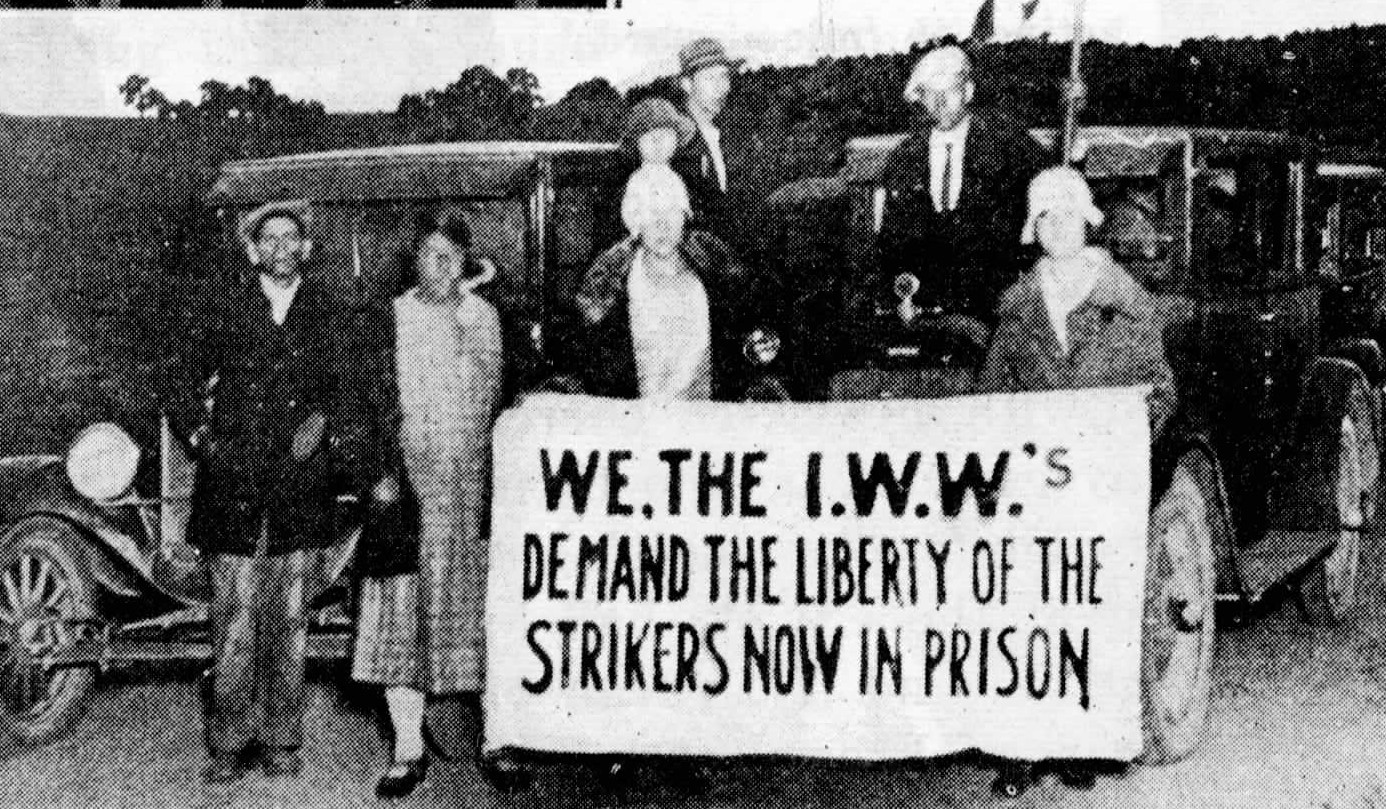
The I.W.W. called an all state conference in Pueblo for October 16th. A week before the conference the Industrial Commission was again quoted by the press in regard to the I.W.W. This time Mr. Annear, the chairman, pictured us as a lawless organization, masquerading as a labor union. On October 15th a report declaring the strike illegal was handed to the governor. On the same date a band of Chamber of Commerce hoodlums, handpicked by Mayor Pritchardt of Walsenburg, met secretly in the court house in the same city. Following the example of the two tailors of Twohey Street, they declared themselves the people of Walsenburg and petitioned the city council of Walsenburg to banish the I.W.W. from their great city. The city council obediently did so. At 11 o’clock at night the brave mayor and his gang of hoodlums sneaked down to the Wobbly Hall. Bryon Kitto, I.W.W. publicity man, was alone, our most active members and organizers being out of town preparing for the Pueblo conference.
The small town imitation Fascisti smashed a window, entered our hall, and burned all our records and other organization property. The police department was guarding the hoodlums so as to protect them from some stray Wobbly that might pass.
The Pueblo conference was carried out as scheduled and by unanimous vote the strike was called.
After a week it was the most complete strike the state of Colorado ever saw. Routt, Weld, Boulder, and Freemont Counties went out 100 per cent. Even the hard-boiled Huerfano and Lasanimas counties are out pretty near solid. They are by the way the only two places where picketing is necessary. In these two counties mass picketing by the strikers is met with mass arrests by the county authorities, who are especially vicious in Lasanimas County, where “friends of labor” were elected.
This article was planned to be written by me yesterday morning, twelve hours after I was released from Lasanimas County jail, but as our intelligence committee advised me that there was a warrant out for my arrest after I had told the Adjutant General that I should continue to advise the strikers to picket in spite of threats of bringing in the militia, I was advised to beat it out of the two counties and reorganize our legal department so as to enable our organizers to get out on bond without undue delay. The last time this advice was given to me I disregarded it, and was held for eight days before I was able to get out on bond due to technical objections to and browbeating of my bondsmen.
The strike is going fine. There is already a coal shortage in Denver. The steel mills in Pueblo have laid off approximately 2,000 men on account of lack of coal. The C.F. & I. stock is taking a tumble on the stock exchange.
We lack only one thing and that is adequate finances for relief and legal defense. If the readers of the NEW MASSES want to help this strike. Do so by rushing funds to Secretary, Relief Committee, Box 87, Walsenburg, Colorado.

THE MINERS’ DEMANDS
Restoration of the Jacksonville wage scale. This scale is demanded for all coal miners of Colorado whether affected by this strike or not.
All disputes arising in any one mine to be settled by the mine committee.
Recognition of mine committees at all coal mines in the state of Colorado and recognition of the state executive board elected by the coal miners of the state and representing all miners of the state.
Recognition of the check weighman at all tipples in all the coal mines of Colorado, such check weighmen to be elected by miners working at the respective mines; check weighmen to be paid by the miners.
Strict enforcement of the eight-hour day.
No discrimination against any employe when he demands enforcement of the state mining laws or complains to the management about working conditions.
No miner shall be discharged until his case is referred to the mine committee.
There shall be no discrimination on account of age when men are employed.
Mine foremen shall not place an inexperienced man with an experienced miner unless with the consent of the latter.
All powder must be delivered at the place by the companies in insulated cars, instead of a coal miner packing.
In order to insure the production of clean and marketable coal, it is hereby provided that it is the duty of miners to load the coal as nearly as possible free from all impurities.
All wage adjustments suspensions or strikes must be settled by the rank and file of Colorado miners through the medium of the state executive board to be elected at the state miners’ convention next year.
All contract work outside the Jacksonville agreement to be abolished.
In work in loading and mining coal there must be not more than two men in two places and always two places for two men.
There shall be no discrimination against any employe in the coal mines of the state of Colorado on account of participation in the present strike.
We demand that all coal mining camps in Colorado shall be open for labor organizers to come and go without interference.
We demand that the coal strike operators withdraw all charges they may have made against miners arrested for picketing and that they use their best influence with the county authorities to set them free immediately.
The New Masses was the continuation of Workers Monthly which began publishing in 1924 as a merger of the ‘Liberator’, the Trade Union Educational League magazine ‘Labor Herald’, and Friends of Soviet Russia’s monthly ‘Soviet Russia Pictorial’ as an explicitly Communist Party publication, but drawing in a wide range of contributors and sympathizers. In 1927 Workers Monthly ceased and The New Masses began. A major left cultural magazine of the late 1920s and early 1940s, the early editors of The New Masses included Hugo Gellert, John F. Sloan, Max Eastman, Mike Gold, and Joseph Freeman. Writers included William Carlos Williams, Theodore Dreiser, John Dos Passos, Upton Sinclair, Richard Wright, Ralph Ellison, Dorothy Parker, Dorothy Day, John Breecher, Langston Hughes, Eugene O’Neill, Rex Stout and Ernest Hemingway. Artists included Hugo Gellert, Stuart Davis, Boardman Robinson, Wanda Gag, William Gropper and Otto Soglow. Over time, the New Masses became narrower politically and the articles more commentary than comment. However, particularly in it first years, New Masses was the epitome of the era’s finest revolutionary cultural and artistic traditions.
PDF of full issue: https://www.marxists.org/history/usa/pubs/new-masses/1927/v03n08-dec-1927-New-Masses.pdf
 Revolution's Newsstand