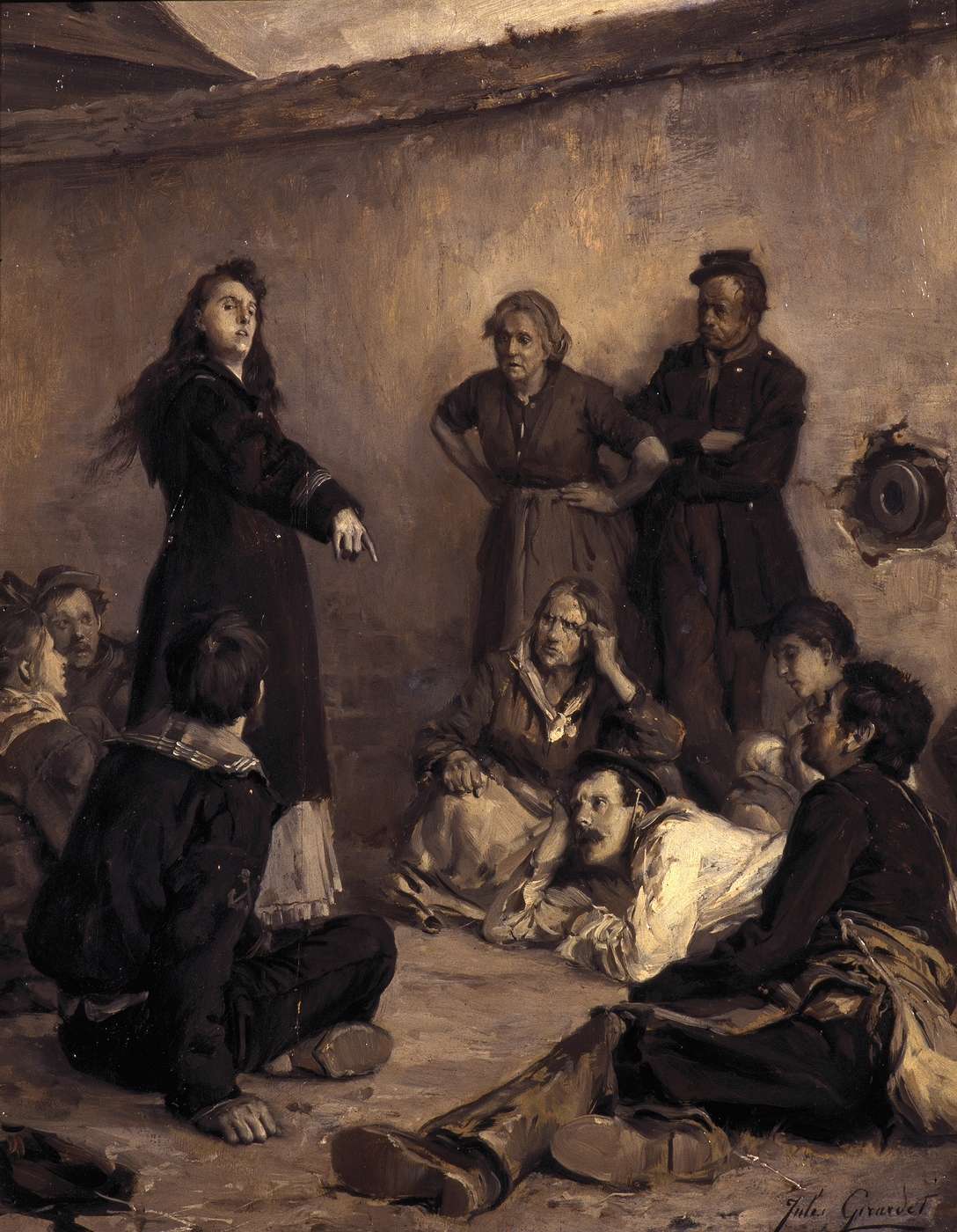
In this substantial letter Liebknecht writes of Jules Favre’s war against the International, repression in the German states, and the trial of the Communards.
‘Letter from Leipzig, XXIII’ by Wilhelm Liebknecht from Workingman’s Advocate (Chicago). Vol. 7 Nos. 50 & 51-52. September 2 & 23, 1871.
Leipzig, August 19, 1871
To the Editor of the WORKINGMAN’S ADVOCATE:
Jules Favre’s terror-inspired and fanciful circular against the International Workingmen’s Association has found an echo in most parts of Europe. Though it is a fact patent to everyone acquainted with the socialist movement, and though it has been proved by the declaration of the General Council, in the London Times, that the French minister’s dispatch contains nothing but distortions of the truth or downright untruths–yet Favre’s denunciation has become the signal for an International crusade against Socialism in general and the International Workingmen’s Association in particular. The country which took the lead was Hapsburgian Austria. After having played such a sorry and pitiful part during the late conflict between Prussia and France, she seems to have resolved upon showing the world that there is still some strength left in her, and be it only strength for suppression and oppression. You recollect that the first act of the new ministry (Hohenwart Schäffle), when they entered office, was a general and unconditional amnesty for all political crimes and derelicts. This measure, which chiefly benefited our party, together with the political party of Schäffle, the new minister of commerce, who had been one of the hottest Democrats of South Germany, gave rise to the hope that the Austrian government had become conscious of its former folly, and had determined on a truly popular and liberal policy. However, this hope soon turned out to be unfounded. The ministry, after a few weeks shuffling, dropped the mask of liberalism and opened a regular campaign against parliamentarism and the constitution–quite in Bismarckian style, and up to the present moment with Bismarckian success.
It is so easy to manage a German burgher, and the Austrian representatives of the people are made of the same stuff as their Prussian composers, who allowed themselves to be killed and insulted for fully three years, and finally proved their superhuman Christian meekness by granting their tormentor indemnity. But there is one difference between Bismarck and Hohenwart–the former understood from the beginning the importance of the socialist movement and did all in his power to get the direction of it; Mr. Hohenwart, on the contrary, is firmly convinced that socialism is an artificial creation, the produce of a parcel of discontented fellows, whose principal aim is to cause difficulties to the Austrian Monarchy, and who, most of them at least, are in the pay of Mr. Bismarck, Austria’s arch enemy! This stupid idea is firmly rooted, not only in Mr. Hohenwart’s head, but also in that of many of his colleagues and predecessors in office, and the effect of it is that they promote just what they want to prevent, and by their silly persecutions drive Austria into Bismarck’s nest. Well–the first victims of this hallucination are the champions of the working classes. Under a miserable pretext, Scheu, editor of the Volkswille (Will of the People), at Vienna, has again been arrested with several others, while these so-called outlanders, non-Austrians, were sent out of the country, amongst them our brave friend Most, who, like Scheu, had only three months before left the prison. Not satisfied with that the Austrian ministry has given orders to watch the socialists closely, for which honorable occupation an extra sum of 250,000 florins has been set out; no meeting is allowed to take place, the aim of which does not please the authorities; meetings allowed are dissolved when a word is spoken which is not to the taste of the police officials present, who, in fact, are the real presidents (chairman) of the meetings; workingmen’s societies are permitted only under conditions which render all healthy development impossible; the party organ–Volkswille–is confiscated three times out of every four times it appears, or rather it is to appear, for it is often seized before any copy is issued from the printing establishment, consequently, before anything dangerous to state and society can have been discovered in it by the prying eye of the Staatsanwalt–the public accuser, so that it is quite clear the police want to ruin the paper, and thus to deprive our Austrian friends of their intellectual center. I must mention here that the Hungarian government acts in complete harmony with the government of Austria proper–Scheu, for instance, was arrested in Hungary (Pest), and from there handed over to the Cisleythanian authorities, and altogether the workingmen are in Hungary, treated with a brutality even greater than in the German Slavonism, half of the Empire. I hope this will cure some of my readers of the erroneous notion, which, I think, is still prevalent in England and the United States: that the Hungarian government was a liberal, even democratic government, and the Hungarian constitution a bulwark of liberty.
This belief, into which public opinion has, to a great extent, been humbugged by the marvelous tongue of the marvelous humbug Kossuth, stands in about the same contrast to stern reality as the phantasms of my American countrymen concerning the Bismarckian glories differ from the true state of that big structure, half prisoned caserne, called the New German Empire. Hungary is an almost purely agriculture country without any modern industry, and without any middle class; the government and administration correspond to this patriarchal and primitive condition of society, and in spite of a large store of democratic phrases and outward trappings, Hungary much more resembles Turkey than any of the western civilized countries. This en passant.
This example, set by Austria-Hungary has speedily been followed by Italy, where the sections of the International Workingmen’s Association existing there have been dissolved by a fierce ukase–by the by a rather harmless amusement of Re Galantuomo’s (King Gentleman’s) government, since the International Workingmen’s Association is so organized, or rather not organized, that no government of the world, even if it had in its service ten thousand Fouches, Pietris and Stiebers, is able to dissolve it.
At the same time the Spanish government, under the impression of the same fears, forbade the meetings of all workingmen’s societies connected with the International Workingmen’s Associations. And to strike terror in the minds of the Spanish socialists, our brave friend, Dr. Sentiñón, whom the editor of the WORKINGMAN’S ADVOCATE will recollect from the Basel Congress, has been arrested in company with some other members of the International Workingmen’s Association.
Of course we had no right to expect that the rulers of our German fatherland would be backward in this anti-socialist crusade, and it might be confessed they have set to work in right earnest! The head spy of modern times, Mr. Stieber, father of numberless plots, conspiracies, false documents, etc., has received orders to collect material, incriminating the German socialist; and he is not the man to return empty handed from such an errand. If he does not find the material required, he will produce it, as he did in the trial of the Communists in 1851, when he fabricated the minutes of a secret society; or he will bring forward convenient witnesses, like Lieutenant Heintze, who, at the trial mentioned above and at several other ones, gave evidence based on which many men were convicted, and which is now known to have been undoubtedly false;1 or else he will cause compromising letters to be sent to persons he wishes to catch, letters (like the one lately addressed to Liebknecht and published by him in the Volksstaat) preaching high treason and put into thin envelopes, so that the contents may be read through-and such like tricks, indispensable to the model government of pious and chivalrous William.
But Stieber’s work proceeds rather slowly, the natural result of its complicated nature, and the German government, which could not afford to wait, has in the meantime taken a few strong measures. Most, a bookbinder, who after his expulsion from Austria came to Leipzig, has been forbidden to speak in any public meetings, and then expelled first from Leipzig and then from Saxony, with injunctions that, if he is found on Saxonian soil, he will be put in prison! Most is a Bavarian, and as such a citizen of the New German Empire! You see from this what precious rights a German citizen (civis Germans) has in his own country, and what an impudent lie the Freizügigkeit–the right (!) to take one’s abode where one likes–your language has no word for this right, which is characteristic of a police-ridden country; what an impudent lie the Freizügigkeit is, of which the admirers of Mr. Bismarck cant so much.
The same decree has been launched against Mr. Dittmar, a bootmaker, and also a native of Bavaria, who last year, after three months’ preventive prison, was sentenced to three months more for an innocent remark on a religious subject, and who, for nearly three-quarters of a year had been working quietly in Saxonian towns. He, too, had been sent out of Saxony! Mr. Ufert, a weaver, a native of Saxony, and who for that reason could not be driven out of Saxony, has been forbidden to live in Chemnitz, the industrial capital of middle Germany, and is to be removed forcibly to his birthplace, Wurzen, a small town, where he has no opportunity of earning a farthing. If I add to this that the general amnesty, which was already elaborated, has been retracted; that the right of meeting is daily being infringed upon by the local authorities; that letters from and to persons are frequently lost on the road, and more frequently still, are delivered with evident marks of having been opened; that all places of public resort are swarming with spies; that at Königshütte a riot of workmen, brought about by the clumsy and brutal behavior of the royal Prussian authorities, has been quelled by a body of Uhlans, who, without any previous warning, rode among the unarmed workmen, and speared them with their lances, killing twelve on the spot and wounding twenty more dangerously, not to mention fifty slightly wounded. If you combine these pretty traits, you have a faithful, though by no means complete, picture of Bismarck’s creation. The work is worthy of its author.
II.
At Versailles the trial of the Communialist prisoners has begun at last. The Court Martial is to murder in the name of the law those that the brutalized soldatiska were unable to kill–vae victis! Our civilized bourgeoisie stands on the same level as the most barbarous nations and tribes; it has no other way to deal with its enemies but to slaughter them. And a class, or a political system, which exists only by sheer brutal force, and which to sustain itself is obliged to shed human blood wholesale–is doomed to perdition. From the earliest times of history we see all empires based on brutal force going to pieces with the unfailing certainty of a scientific law. That which alone is eternal in history is Progress, is Development; intellectual, economical and founded on both, moral. Every attempt to trammel this progress, to cripple or resist this development proves futile, and the foolish criminals or criminal fools, who make the attempt are covered with infamy and ridicule. And the further humanity is advanced the sooner retribution overtakes them. How completely was the Commune conquered. Every spark of socialism seemed to be stamped out in France. And lo! the recent municipal elections at Paris–elections taking place under the state of siege, on ground still reeking with the blood of 40,000 socialists, and in the sight of prisons and dungeons in which 40,000 more are confined–have resulted in a signal triumph of socialism, five members or adherents of the Commune having got an absolute majority, and one of them even in three electoral districts! Either Mr. Thiers and his accomplices must speedily organize a new massacre, or the victorious idea of the Commune will swallow them up. And a new massacre could not be more radical and successful than the last one. Thus our bourgeoise society is moving in a cercle vicieux of stupid terror and civil repression, until the spell is broken by the final resurrection of the martyrized proletariat.
In Germany the different governments are really at their wits’ end with regard to the working class movement. The scribes of the Prussian press bureau contradict themselves and one another in the most ludicrous manner. One day socialism is to be annihilated with fire and sword, the other day we are told violent measures are of no use and the government has no reason to interfere before they are attacked. The latter being the more sensible course, will just for that reason not be adopted; and, as I told you already, we must be prepared for a vehement police crusade against social democracy. The first step will probably be the introduction of an imperial law of meeting and associating still more reactionary than those now in power–though I must own it will be a rather difficult task to frame such a one.
In the meantime our principles are spreading fast. Here in Leipzig, for instance, a commercial town of about 80,000 inhabitants, with industrial suburbs containing some 100,000 inhabitants, our party may be said to predominate now. During the last months we have had three immense mass meetings–one concerning municipal abuses, the two others the Commune of Paris–and in neither of them have our adversaries dared to oppose us, so crushing was the weight of the facts and arguments produced on our part. A large portion of the smaller middle class are sympathizing with us, and I have not the slightest doubt that the next elections will be in favor. And Leipzig is perhaps in all of Germany the town which was most hostile to us yet a short time ago.
In the position of our great strikes some important changes have to be reported. The Cigar Makers have had the best at Waldheim and the worst at Offenbach, while at Halberstadt things are in the old state; but in consequence of the firmness of the Masters’ Association, I am afraid the men will have to give in there also. Nothing better is to be said of the Berlin strike. The number out of work is so great, that the necessary funds for their sustenance cannot be procured, and the small savings on which most of the families are living at present, are well nigh, if not totally exhausted. The only chance left to the men is, that the term for the execution of many large building contracts is fast approaching, and that, in case the buildings are not finished at the stipulated time the Masters will have forfeited large sums. If the men can hold out a fortnight longer, then their conditions will have to be accepted by the Masters. But will they be able to hold out so long? I have my misgivings, and I know that people at the head of the strike have theirs, too.
The Barmen strike looks very promising so far; the brisk state of the business is greatly to the advantage of the men. Some of the Masters that formed the Lock-out Association have left the League and consented to the demands of their hands, and from the news we received this morning it appears that only the Metal Workers are on strike still, to the number of about a thousand. As they are assisted by the other workmen of Barmen, Eberfeld, with whom they had made common cause at the beginning, and who partly owe them their victory, and as collections are being made for them all over Germany, it is to be hoped that the Barmen iron manufacturers will not succeed in starving their men into submission.
It is now the season of the Anniversaries of the glorious events of the Prussian-French war, and the government journalists do their utmost to blow the cinders of national enthusiasm into flames again. All in vain. The people have come to their sense. Hard facts have driven out the soft illusions. Of what use are victories, by which nothing has been gained? What reason have we to rejoice over battles which must be fought again in a couple years, and, if won afresh, fought a third time, and so on without any prospect of lasting peace? There is no man now in Germany, who is not convinced of the inevitability of a new war with France, and the admiration of Count Bismarck’s statesmanship has decreased remarkably since this conviction has become general. I spoke with a national liberal of the purest water a few days ago, and he confessed that the annexation of Alsace and Lorraine was a political blunder. And well he may say so. The discontent and exasperation of the inhabitants of these two pro inces is so deeply rooted that two generations at least would have to die away before a more loyal feeling can arise. In Austrian Italy the opposition was not fiercer and not by far so dangerous. The Alsatians and Lorrainers by far surpass the Venetians and Lombardists in energy and they are excellent soldiers. If the war recommences, Prussia will require an army of 200,000 to keep them down–more than the Frenchmen will require to neutralize the fortresses of Metz and Strassburg. And this is not the only danger. Perhaps more dangerous still to Prussian Junkerdom is the republicanism of the Alsatians and Lorrainers, which will be communicated by them to the other parts of the empire they have been chained to; and so, instead of serving the ends of despotism, as Bismarck in his narrow mindedness had thought, the annexation will in reality promote the downfall of absolutism and the triumph of democracy.
However, at present the order of the day is: preparations for the coming war. Of the milliard paid by France not a groschen will be spent for the interest of the German people; it will go exclusively to defray the expenses of the enormous, but yet constantly swelling military budget. And it will not be sufficient unless soon a second milliard is paid by the French; a fresh loan must be contracted and fresh taxes imposed upon us. A standing army like ours is an insatiable monster, the more it gets the more it wants. It will devour, devour until nothing is left to devour, or the people lose patience and knock it on the head. The latter I am confident will be the case one fine morning, in spite of the proverbial meekness of Michel. I don’t mean tomorrow. But this much is sure, the monster has become too exacting and too impudent even for meek Michel, and thanks to the mad proceedings of our success-drunk rulers, the day is not distant when the nation must either make an end of it, or emigrate to America.
A friend of mine who is in the regular army and knows the organization thoroughly has calculated our losses from July, 1870, up to the present day. The result is pretty well in accordance with what I wrote repeatedly. Of the soldiers that were employed in the war with France, fully one half have been killed (by iron, lead and diseases) or rendered unfit for service. As we had more than 1,200,000 in the field, this signifies six hundred thousand men dead, crippled or otherwise invalided! And that on the conquering side! The Frenchmen have surely not lost less, and we shall not exaggerate if we estimate the total of the military losses in human life and health on both sides at one million and a quarter. A heavy price indeed for the blessing of being governed by Bonapartes and Bismarcks.
Note
1. This Heintze was promoted to a fat sinecure at a public savings bank, and he managed it so well that a few weeks ago he died-probably by his own hand-leaving a deficit of 100,000 Thalers. which he had embezzled from the savings of the poor. Those are the “saviors” of modern society!
The Chicago Workingman’s Advocate in 1864 by the Chicago Typographical Union during a strike against the Chicago Times. An essential publication in the history of the U.S. workers’ movement, the Advocate though editor Andrew Cameron became the voice National Labor Union after the Civil War. It’s pages were often the first place the work of Marx, Engels, and the International were printed in English in the U.S. It lasted through 1874 with the demise of the N.L.U.
PDF of issue: https://chroniclingamerica.loc.gov/lccn/sn89077510/1871-09-02/ed-1/seq-1/
PDF of issue 2: https://chroniclingamerica.loc.gov/lccn/sn89077510/1871-09-23/ed-1/seq-1/
 Revolution's Newsstand