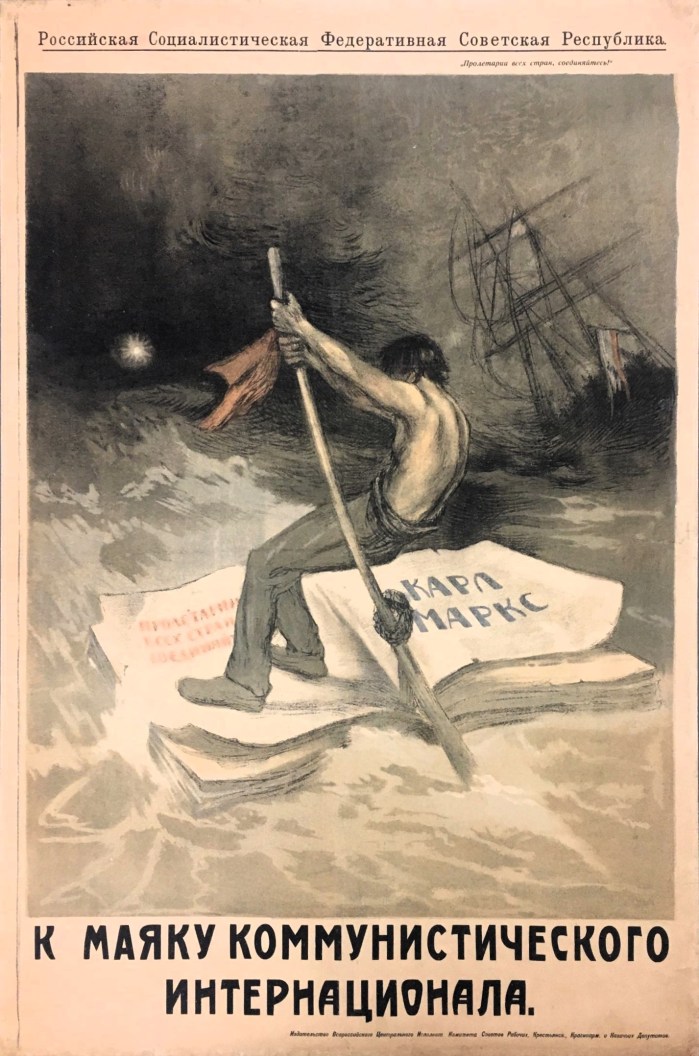
To understand the response to the Russian Revolution, it is necessary to grasp the depth of darkness felt after the collapse of the Socialist project and in the midst of the most destructive war in human history. It was a light shining a way out of the greatest impasse human society had known until then. It was hope after all hopes were dashed.
‘Socialism and the Russian Revolution’ by Louis C. Fraina from The Communist. Vol. 1 No. 7. November 15, 1919.
IN the midst of terror and agony, its and frontiers bristling with cannon and aflame with the fires of war, compelled to bend its industrial resources to purposes of war instead of peace and isolated by the Allies from the world,–in the midst of immemorial travail Soviet Russia is constructing the Communist order.
Soviet Russia appears to the imagination as a Titan, defying chaos and creating a new world out of the fragments of the old. Beleaguered on all sides, fighting on a dozen fronts and meeting a thousand perils, Communist Russia throws back the enemies and incites civil war in the countries of the enemy. The Russian revolutionary proletariat inspires the proletariat of the world; it reconstructs its own social system anew while it encourages the workers of Europe to crush the old and build the new.
Objectively, the assurance of the world revolution is in Capitalism itself. The old order is in collapse; the contradictions of Capitalism are multiplying; the productive forces are in revolt against the fetters of Capitalism, and conditions are feverishly developing a crisis that; unless met by the dictatorship of the proletariat, must mean the collapse of all civilization.
Subjectively, the world revolution is assured by the ideologic response to the Russian Revolution–by the fact of the Communist International.
Socialism as an organized movement broke down miserably under the test of the war. But this great catastrophe was the necessary phase of revolutionary development, since it glaringly exposed the evils of the old Socialism. What the theoretical criticism of the revolutionary minority in the old International could not accomplish, was accomplished by life itself. Under the test of war, the old Socialism revealed itself as a fetter upon the emancipation of the proletariat, a cancerous perversion of real Socialism.
But while the war exposed the reactionary character of the dominant Socialism, this was simply the negative side of the task, it gave the revolutionary Socialist minority material for ample criticism, but there was still missing a great dynamic force to reconstruct the forces of Socialism into a mighty revolutionary power. The Russian Revolution performed this positive task of reconstruction, placing Socialism upon the unshakable basis of revolutionary experience and reality.
Marxism is the soul of Socialism, as it is equally the technique of Socialism. Marxism is a revolutionary unity of theory and practice, a system of revolutionary action. But the representatives of the old dominant Socialism perverted Marxism into an instrument of historical research; more, Marxism was used as a means for justifying the miserable compromises of the parliamentary Socialist movement. Some clung to Marxism as an abstract theory, while violating its spirit in action; others, more realistic and sincere, repudiated Marxism completely, as outworn and not in accord with the actual developments of Capitalism. The struggle was abandoned in favor of class reconciliation; revolution was scorned as a product of diseased imaginations, and reformism idealized as the real tactic for the realization of Socialism. The class struggle against Capitalism was substituted by the policy of agreement with Capitalism. The modification of class antagonism and class reconciliation were to realize Socialism; the modification of national antagonism and national reconciliation were to realize universal peace.
Socialism was divested of its revolutionary urge; it was peaceful, respectable, counter-revolutionary…
But the Russian Revolution, the violent product of the antagonism of Capitalism and the war, proved all these ideas of reconciliation the most reactionary illusions. By means of a magnificent expression of revolutionary energy and audacity, the Russian Revolution proved the truth of the Marxian conceptions of the class struggle and revolution.
It is indisputable that the proletarian revolution in Russia is in accord with Marxism. Its tactics are not peculiar to Russia: they are the universal tactics necessary in the process of the proletarian revolution. But the Russian Revolution is more than simply in accord with Marxism; in making Marxism life, the Russian Revolution supplements Marxism, indicates how the theory of Marx may become realized in actual practice.
Marxism projected the dictatorship of the proletariat as the objective of the revolutionary class struggle the necessity of destroying the bourgeois parliamentary state and replacing it with a proletarian state. The Paris Commune was a partial realization of the form of the proletarian state; but it remained for the Russian Revolution to show the final means–the organization of the workers in shop, mill and mine into Soviets, which would constitute the newer proletarian state functioning temporarily as a dictatorship of the proletariat.
The concept of the Soviet state is the realization of the Marxian theory of proletarian dictatorship. All attempts to show that the Soviets are à peculiar Russian development are futile, since the Soviet is possible only where Capitalism has thrown the workers together in masses in large industrial establishments. The Soviet is not a product of Russia’s undeveloped industrial conditions, but a product of the highly developed industry in Russia–for while Russia is still largely agrarian, its industry is the typical industry of modern concentrated Capitalism. During the Paris Commune the Soviet was inconceivable, since industrial development had not yet massed the workers together industrially. That the Soviet is peculiar to Capitalism, to the modern revolutionary struggle of the proletariat, is attested not only in theory, but in practice: wherever the revolutionary proletariat engages in the struggle for political power, there it rallies to the call of all power to the Soviets of Workers and Peasants.
The most vital accomplishment of the Russian Revolution, accordingly, is the impulse it has generated making for the reconstruction of Socialism. Socialism has become action, Socialism has again become Communism. United in the Communist International, this new Communism calls the proletariat to the final struggle against Capitalism.
Emulating the Bolsheviks who changed the name of their party in 1918 to the Communist Party, there were up to a dozen papers in the US named ‘The Communist’ in the splintered landscape of the US Left as it responded to World War One and the Russian Revolution. This ‘The Communist’ began in September 1919 combining Louis Fraina’s New York-based ‘Revolutionary Age’ with the Detroit-Chicago based ‘The Communist’ edited by future Proletarian Party leader Dennis Batt. The new ‘The Communist’ became the official organ of the first Communist Party of America with Louis Fraina placed as editor. The publication was forced underground in the post-War reaction and its editorial offices moved from Chicago to New York City. In May, 1920 CE Ruthenberg became editor before splitting briefly to edit his own ‘The Communist’. This ‘The Communist’ ended in the spring of 1921 at the time of the formation of a new unified CPA and a new ‘The Communist’, again with Ruthenberg as editor.
PDF of full issue: https://www.marxists.org/history/usa/pubs/thecommunist/thecommunist3/v1n07-nov-15-1919.pdf
 Revolution's Newsstand