A lengthy, extremely informative report to the Second Comintern Congress on the founding and activity of the Communist Party of Bulgaria.
‘The Communist Movement in Bulgaria’ from Communist International. Vol. 1 No. 11-12. June-July, 1920.
I.
BULGARIA is a country of small peasant owners. Therefore it is customary to think that the Communist movement in Bulgaria will not meet with success, and the Bulgarian bourgeoisie assures Europe that Bolshevism has no chance in that country.
Notwithstanding this, however, the Communist movement is very strong there and steadily developing.
What are the reasons for this condition and what are the possibilities of a proletarian revolution in Bulgaria?
After the peace treaty the population of Bulgaria will hardly exceed four millions. Eighty per cent. of this number are peasants and twenty per cent. inhabitants of the towns.
The lands in private ownership constitute about forty five million decars and are distributed among 495,000 agricultural estates; that is, a farm averages about 91 decars of land.
Eighty thousand farms have up to 20 decars of land; 145,000 farms have from 20 to 50 decars of land; 175,000 farms have from 50 to 100 decars of land; 95,000 farms have 100 and over.
About 936 large agricultural estates have over 1,000 decars.
In social respects the first two categories of farms, with fifty decars and less, are worked by peasants with little or no land at all, those who work for wages, or while working their own farms, are still obliged to seek work in order to live. This is the class of the rural proletariat and semi-proletariat.
The third group are the middle peasants, with from 50 to 100 decars of land; they farm their own land without employing hired labour; this is the class of the peasant workers.
The fourth group, with landed property measuring 100 decars and more, constitutes the category of rich peasants, who employ hired labour; this is the class of the village employers, “regrators.”
These three social groups in the villages (counting the labour and other population) make up the following proportions: The landless peasants and smaller owners, 45 per cent.; the peasants workers, 36 per cent., and the group of peasant employers about 29 per cent. of the whole rural population.
The town population, amounting to about 900,000, is distributed approximately as follows: The proletariat and poorer classes constitute about 62 per cent. the small bourgeois workers who do not employ hired labour, about 25 per cent., and the rich bourgeois employers, about 13 per cent.
Thus in the whole ‘country the class of workmen, poor people, constitutes more than 50 per cent. of the population; the workers who do not employ hired labour, about 33 per cent., and the village and town bourgeoisie, not over 17 per cent. of the entire population. The purely proletarian class constitutes a little over 20 per cent. of the entire population. Such is, approximately, the relation of the different classes in Bulgaria.
Before the war [1911] the national wealth of the country was ‘reckoned at 10,500,000,000 leos, and the national debt amounted to 1,650,000 leos.
The commercial balance of the country in 1911 was: imports, 199,000,000 leos, exports; 185,000,000 leos. Three-quarters of the imports were industrial products, and four-fifths of the exports were agricultural products.
II.
Before the Balkan War the economic life of the country suffered from no special crisis. Industry was gradually developing and attracting the proletarian masses of the towns and villages, especially the women and children. The poorer peasants found work on the railways, etc. The peasant workers were busy with their farms. Although the indirect taxes were rather heavy, they were not above the paying capacity of the masses. Public disaster and discontent only occurred when the harvests were bad.
But such conditions underwent a complete change after the wars of 1912-1918.
The live and dead agricultural stock was partly destroyed, partly worn out, owing to the cultivation of a much less quantity of land than before the war. Consequently, part of the peasant workers joined the category of poorer peasants and were compelled to seek employment as a supplement to their income; the same 2au be said of the greater part of the smaller bourgeoisie in the towns. On the other hand, the possibilities for the application of wage labour are greatly narrowed at present. No new industry is developing, the existing industrial enterprises are half ruin, the transport is destroyed or greatly diminished; the construction of railways and roads, wharves, etc., is completely suspended. No employment is to be found in the towns and villages, a state of things which creates the best conditions for the development of pauperism.
At the present moment the country is producing much less than before the war, and the imports is three times as much as the export. The state expenses (not including the payments on the new liabilities) for 1919 have increased to 2,300,000,000 leos, and the national debt, according to the Bulgarian economist Geshow, amounted to 27,000,000,000 leos by the end of 1919. The paper currency increased from 110,000,000 leos in 1911 to 3,000, 000,000 by the end of 1919. The Bulgarian exchequer knows no other way of covering its current expenses than issuing more and more paper money. Owing to this fact the Bulgarian leo is now quoted on the Swiss Exchange at 6 to 7 centimes. The financial situation of the country is so desperate that no bourgeois government undertakes to improve it, and there can be no talk of its revival.
The chief burden of the situation falls naturally on the workers and poorer classes, which are succumbing under the high prices. They have risen, on the average, 25 per cent. The poorer classes in the towns and villages are unable to buy sufficient food. In consequence of this the commercial self-governing organisations have received the order to supply the population with bread at a low price, but even this measure cannot be carried out, because the commercial organisations are not in a position to bear the enormous expense which it demands. Milk (at 8 leos the litre) is quite inaccessible for the children of the poorer classes, and they are wearing out their last clothes, left from the pre-war period, because the prices for clothes are completely above their means.
The working peasants are also suffering. Although the prices of all agricultural products have also greatly increased, those of the industrial products which the peasants need have increased in a still greater measure. Besides they are only just beginning to pay the colossal debts of the bankrupts state, which put the heaviest burden on the Jabour and land of the peasant. Work above his strength, the most unlimited exploitation and slavery await him in the nearest future.
On the contrary the bourgeoisie is faring very well. It has grown rich, and is growing richer at a vertiginous rate. In the hands of separate persons fortunes of quite American proportions have become concentrated. A countless number of banks and joint stock companies have been opened and formed, a mad speculation is going on throughout the whole country, everything is bought and thrown upon the market at the most insane prices. The life of riotous pleasure and luxury led by the plutocracy is a sharp contrast to the miserable poverty of the workers.
On the other hand, the bourgeois parties have Jost all political credit with the masses. They have not only not realised the “national ideals” by which they attracted the masses, but they have brought about consecutively two catastrophes for the country.
III.
Immediately after the war the bourgeois parties felt their powerlessness. They prolonged the military régime and censorship and used the protection of the expedition forces of the Entente. At the same time they made an attempt at political transformation by forming a union with the left parties, which had not been in the government before the war, namely, with the “Broad Socialists” and the Agrarian Union. This strategy of the bankrupt bourgeoisie met with success. As the discontent of the masses had not had time yet to assume a definite revolutionary programme; the “Broad Socialists” and the Agrarian Union managed to play the part of safety-valves. As a matter of fact this coalition, the majority of which were left parties, ruled successfully during a whole year, and delayed the explosion of national indignation.
The first to “waver” were the “Broad Socialists.” The worker masses of the towns, more directly experiencing all the disasters and more open to ideas, were the first to come under the influence of the Communist Party and to acquire a revolutionary consciousness. They soon turned away from the “Broad Socialists,” after which the latter became of no use to the bourgeoisie. At the present moment the party of the ‘Broad Socialists’’ is a political corpse. Its leaders, dishonoured in the eyes of the worker masses and cast off by the bourgeoisie, were compelled to seek a union with the Communist Party. While extending a brotherly hand to all the healthy labour groups and organisations of the party which accept the programme and tactics of the Communist International, the Communist Party declared that it could not enter in a union with the dishonoured and bankrupt social traitor leaders of the party. There is no doubt whatever that the complete and final association and union of all the labour and revolutionary forces in Bulgaria under the banner of communism is a question of the nearest future.
After the star of the “Broad Socialists” had set, the turn came for the Agrarian Union. Having sprouted in the soil of peasant discontent with the government of the bourgeois parties, the Agrarian Union usually flourished during economic crisis, and grew weaker after their disappearance. As representative of a popular movement, it had a democratic programme, but as an expression of the interests of the backward village life, it carried into the programme a reactionary social spirit. During the war the Agrarian Union voted for war credits and supported the government, desisting from all opposition. Only at the and of the war when the bankruptcy of the government became evident, did the union resume its activity as an opposition party.
By this time, however, an essential change had taken place. The village bourgeoisie had become rich during the war, because the rise of prices for agricultural products and by speculation with the latter. The richer peasants came to the towns, began to take part in commercial transactions and participate in the creation of banks and joint-stock enterprises. They soon felt the importance of power for their own interests, and in this way they acquire an appetite for it. After the fall of the bourgeois parties, the only suitable road to power was by way of the Agrarian Union. As the union had not yet entered the government it had still some credit with the general masses, but as the Agrarian Union supremacy in its ranks fell into the hands of the village bourgeoisie. The attempt of Dragviev, promoter and acknowledged leader of the union, to preserve its small peasant and democratic character, was wholly unsuccessful, and Dragviev himself was ejected from the union by the village bourgeois, the “regraters” and speculators. The only leader left was Stambolisky. The was the personification of the striving after power ignorant village bourgeoisie and speculators, and possessed the demagogic qualities necessary to attract the dull, unenlightened peasantry.
The bourgeois parties, frightened by the advancing wave of communism, cowered under the wing of the Agrarian Union. But at the same time they made it their business to influence the union and to persuade it to share the power with them. They succeeded in making the Union bourgeois, and the Communist Party’s increase of power compelled the Union to enter into a coalition with the bourgeois parties to rule together.
Thus, at the present moment, the Agrarian Union is in the decline of its political career. True, it proved to be more steadfast than the “Broad Socialists,” because the peasant masses are slower to react than the proletariat of the towns; but its fall is an event of the most immediate future. It is not sufficient to shake a fist at the Communists and call forth the raptures of the bourgeoisie; it will be necessary to proceed to the business that will not bear deferment any longer, to the solution of the more urgent economic and social problems. But as the union will not be able to do anything, except to give the bourgeoisie an opportunity to rob and plunder, the crisis will grow more and more acute, and the discontent of the masses will increase. The Agrarian Union has managed already to alienate the town masses. A larger part of the village population is also discontented with it. Its activity will very soon repel the remainder of the peasantry.
The bourgeoisie has lost footing in the towns; very soon it will loge the support of the rural population. There will be only an open abyss before it.
IV.
The Bulgarian Communist Party understands well the actual revolutionary epoch, and is deeply conscious of its own revolutionary tasks. It is not a question of more or less important reforms within the limits of the bourgeois order; the entire power must be wrenched out of the grasp of the capitalists, and the power of the workers organised. The dictatorship of the workmen and poorer peasants must be established, as a means towards the realisation of communism. The form of such dictatorship can only be the power of workers’ and peasants’ soviets. The whole propagandist activity of the Bulgarian Communist Party is imbued with this spirit. The Communist mottoes are widely spread among the masses, who are willingly assembling under the red banners of the party. In its mad greed the bourgeoisie is undermining the ground beneath its feet, and the Communist Party is diligently preparing the forces which are to hurl it into the abyss.
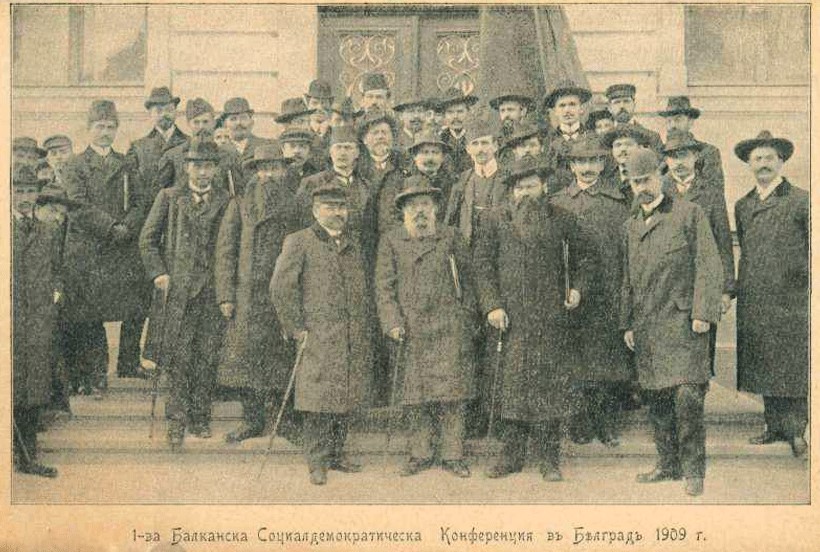
The party tried to renew relations with the other communist and socialist parties of the neighboring countries. It succeeded in convening the Balkan Communist Conference, which was held in Sofia in January, 1920, with the participation of delegates of the Bulgarian Communist Party, the South Slavic and Grecian Socialist parties, and at this meeting the Balkan Communist Federation was renewed. The Roumanian Socialist Party was prevented from taking part in the conference, but we do not doubt that it will join the Balkan Communist Confederation. The Balkan Communist Federation must serve as the first defensive rampart of the Balkan revolution against the international counter revolution.
V.
Already at the time of the division of the “Broad Socialists” in 1903, the Bulgarian Revolutionary Socialists, the “Tesniaks,” laid the following fundamental basis for revolutionary socialism:
1. An implacable class struggle as opposed to class collaboration or coalition.
2. A struggle for the realisation of the final aims of socialism, as opposed to reformism and opportunism.
3. A unity of the labour and political movement of the proletariat as opposed to the neutrality of the labour movement.
In order to organise the awakening labour movement on the above basis, the “Tesniaks” needed:
A closely united, disciplined party; a powerful propaganda of the ideas of revolutionary socialism; a close union between the party and the labour unions.
In carrying out their programme on these three points they met with the individualism of some of the intellectuals of the party and the small bourgeois ideology of the artisan-workmen, as a result of which certain groups, with a very limited number of members, however, left the party. These groups found a place in the ranks of the “Broad Socialists.”
In this way, at the price of constant self-criticism and acute inner strife the Bulgarian Tesniak Social Democratic Party was formed, and presented, notwithstanding its small numbers, a model organisation as to discipline, theoretical preparation and activity of its members.
Considering the economic backwardness of the country and the small numbers of the proletariat, the political influence of the Bulgarian Revolutionary Social Democracy could not be very great. The Tesniaks understood this perfectly well and therefore they never strove to acquire a rapid increase in numbers. They used all their efforts to spread their influence among the ‘rapidly increasing proletariat, to organise and educate it in the class spirit, and laid all their hopes for the increase of their political influence in the country on it alone.
In 1903 the Bulgarian nationalist and monarchist bourgeoisie organised the so-called “Macedonian uprising,” which was to serve as a pretext for war with Turkey. We were strongly agitating against this adventure, denouncing the appetite for conquest of the Bulgarian bourgeoisie and monarchists, and pointing out all the dangers with which such a policy threatened the Bulgarian people.
In 1908, after the declaration of Bulgarian independence, the crisis came. The Tesniaks again denounced the Bulgarian monarchists and imperialists, who, under the pretext of a struggle for the “independence” of Bulgaria, practically placed the country in a greater dependence on Russian absolutism, and gave an opportunity to Austro-Hungarian imperialism to consolidate its influence over the Balkan states by the annexation of Bosnia and Herzegovina.
When the Tripolitan war broke out, the Balkan bourgeoisie, foreseeing the favourable moment for military operations against the Turkish Empire, began to prepare for war. At the same moment the movement in favour of a union of the Balkan nationalities began to increase.
The Tesniaks were not mistaken as to the importance of these facts; they saw all the dangers of this conspiracy on the part of the Balkan monarchists and bourgeoisie, together with Russian militant absolutism, against the liberty of the Balkan nationalities, and they started an implacable campaign against Russian pretensions in the Balkans, and against the imperialist intentions of the Balkan bourgeoisie. On the eve of the Balkan war the Tesniaks published an appeal which contained a prophetic warning, truly justified by the further development of events.
Up to this moment the influence of the Revolutionary Social Democrats in Bulgaria was too weak to be able to tie the hands of the politicians of the ruling classes. The popular masses were too much poisoned by nationalism, disunited and inert, to show any resistance to monarchism and imperialism.
The Balkan wars, however, brought a radical change in the situation. They dealt a terrific blow to monarchism and militarism, revealed the complete unfitness and stupidity of the Bulgarian bourgeoisie, and helped to deepen the class contrasts between the bourgeoisie and the working class. At the same time the prestige of the revolutionary Social Democrats continued to grow, and the first signs of influence over the popular masses began to be felt. As far as the influence of the party can be judged of by the votes at the elections the following figures may serve as witness of its sudden growth: in 1908 the Tesniaks obtained only 3,000 votes; in 1911 the votes in their favour amounted to 13,500; in 1912, to 14,000; after the Balkan war the votes for the Tesniaks amounted to 52,000, which gave them eighteen seats. Three months later an unheard of government persecution only brought this number down to 438,000.
A powerful socialist wave passed over the whole country, and in all the questions of the life of the country the attitude of the revolutionary Social Democrats had a great significance. In the Parliament our group carried on an implacable war against the Germanophile government, as well as against the Russophile bourgeois and small bourgeois opposition. We denounced the militant policy of both bourgeois camps. Notwithstanding the state of war conditions our party developed a powerful campaign against the involving of the country in the war and against the plans of the monarchist and bourgeois parties. Just before the mobilisation we published an energetic protest against the war. This campaign brought good results: the mobilisation proceeded very slowly and the mobilised would not submit to discipline. The terrified government made an open assault on the party, arresting the entire parliamentary group who had signed the protest.
VI.
Subsequent victories compelled the Russophile opposition to lower their colours and to proclaim “a sacred unity” (political truce); the “Broad Socialists” joined in this. The Communist Party, however, remained the implacable enemy of the war. It voted against all war credits, opposed most decisively all military measures, and at the most critical moments firmly kept its revolutionary position. The party considered that only a revolutionary uprising of the masses could put an end to the war, and was deeply convinced that the imperialistic war would stir up the elements of the proletarian revolution. Therefore it conducted its revolutionary campaign on the battlefronts and in the country, and beyond the limits of the latter it used its greatest efforts for the revival of a revolutionary International. Its revolutionary demonstrations developed especially after the Russian Revolution, and most of all after the October one. It managed to introduce the Bolshevik revolutionary mottoes and precepts on to the battlefronts and in the rear, and created a Bolshevik frame of mind in the army. All this maddened the government and the bourgeois parties. All parties, from the government ones t0 the social-patriots inclusively, united for a struggle against Bolshevism and the Bulgarian Bolsheviks. A period of countless arrests, sensational trials, cruel verdicts and death by shooting at the front began.
VII.
Under such conditions the debacle at the front occurred (September 15th, 1918). The frame of mind of the soldiers was such that at the slightest reverse they left the battlefront and rushed home. In the environs of Sofia the so-called Radomirsky mutiny broke out, in which our party took no direct part. This induced some persons to accuse it of a lack of revolutionary zeal. Such an accusation is, however, perfectly unfounded. The revolution, which the Communist Party strove to provoke, was not to be thought of at the time for the following reasons:
1. The troops of the Entente were moving on the heels of our retreating forces, and in two days’ time they might he in Sofia. The small territorial dimensions of Bulgaria did not permit of the revolution deploying and fortifying itself under the fire of the numerous advancing troops of the enemy. A single mutiny of the soldiers was of advantage to the Entente, but they would not have permitted a proletarian and peasant revolution for a single day.
2. A considerable number of German troops were stationed in Sofia, especially artillery; they were moved against the revolted soldiers and defeated them. During the German occupation of Bulgaria no revolution was possible.
3. The Tesniak Communist organisation had at the time not more than 600 non-mobilised members in the whole country, out of which about 50 were in Sofia. As there was no munitions or other war industry, there was no concentrated proletariat in Sofia. Under such conditions the party was incapable of undertaking any action with the masses. The mutiny itself was too short lived to give a possibility of deploying any activity whatever.
4, The soldiers engaged in the mutiny were mostly peasants, who were burning with the desire to return to their homes. They came to Sofia because their way lay through it. They stopped near Sofia because the government was frightened, and after having failed to persuade them to return to the front, it had met them with rifles and machine guns. They advanced on Sofia with their arms because there was no other way of getting home. Even if they had succeeded in occupying Sofia, they would have quitted it all the same. It was only a meeting that in the best of cases would have led to the power of the Agrarian Union, which is even now the ruler of Bulgaria. It could in no wise have developed into a proletarian Soviet Revolution, which could not be thought of in parliamentary Bulgaria.
When the mutiny had been quelched, even before the arrival of the troops of the Entente at Sofia, Tsar Ferdinand abdicated the throne. The Agrarian Union swore allegiance to the new Tsar and proved thereby that it had only been against Tsar Ferdinand, not against monarchism in general. And at the present moment the leaders of the Agrarian Union are getting on very well with Tsar Boris, and occupy the posts of Ministers.
The military occupation of the country by the troops of the Entente placed our party under extremely difficult conditions. The military dictatorship and censorship were prolonged. But just the same the party entered upon a period of tremendous activity.
It was necessary first of all to revive and bring together the organisations, to develop and adapt them to the conditions of a struggle in masses; it was necessary to develop the revolutionary consciousness of the demobilised and mutinously inclined soldiers who kept flowing into the party’s ranks, and within a short time transformed the hitherto small party into a powerful revolutionary organisation. Thus, before the mobilisation (1915) the party contained eighty-two town and twenty-two village organisations, with a total number of 3,435 members; but by the 1st of May, 1919, it had added 582 new organisations with a total number of 21,577 members. The whole attention of the party was concentrated on this important instructional and organisation work, and it had formed a strong and perfectly acting organising apparatus, which was constantly developing and carrying on an indefatigable campaign by word of mouth and in print.
The coal miners in the mines of Pernik began to murmur, to demand that their condition be improved. The Bulgarian bourgeoisie opened a base campaign against this movement, spreading a deliberate lie to the effect that the Entente had refused to give up our prisoners, because of the coal miners strike. The “Broad Socialists” (Mensheviks) whose leader, J. Sakizov, was the Minister of Labour and Industry, endeavoured by means of dirty insinuations and intrigues to break up the union of the coal miners and also our own party organisation. The coal miners were militarised, they were provoked systematically, until at last, the authorities succeeded in creating an incident which the government, with the assistance of the Mensheviks, made use of to send troops with artillery and machine guns against the coal miners, so as to crush our organisation in their midst; and arresting and sending some hundreds of the most enlightened workmen to the “Slivnitza” fortress. At the same time the government began legal action against the leaders, demanding sentence of death for them.
This base attack on the part of the government called forth a storm of indignation throughout the whole country. The opening of the trial in Sofia gave rise to ceaseless demonstrations…Under their influence, and the impression caused by the victorious advance of the red troops in the Ukraine in the spring of 1919, the trial ended with comparatively lenient sentence. The coal miners’ organisation had grown much stronger, and the influence of our party among them greater.
The 1st of May was a day of most imposing popular manifestations of the working masses all over the country. The government was compelled to make concessions in this question and to allow the manifestation to take place. On that day all production was practically stopped, all the governmental institutions were closed, aid the working population demonstrated under our revolutionary banners.
On the 27th of July the party organised demonstrations and meetings of protest against the reactionary policy of the government and with our Communist Party mottoes, our rural organisations and groups also took part in the demonstrations and meetings. The government discerned the commencement of a revolution in this party demonstration. The “Socialist” Minister, Pastoukhoyv, who had the pretension to be the Noske of the Balkans, not only forbade all meetings but literally raised all the military police forces of the country, so that the Tesniak attempt at a revolution should be strangled at all costs. He united all the bourgeoisie around his ‘‘salvation’’ activity, inviting the bourgeois parties to help the troops, and charged his own patty of “Broad Socialists” with the honourable duty of organising a spy service. The workers of Bulgaria, who had prepared to demonstrate on the 27th of July with empty hands, were surrounded on all sides by a tremendous military force. The workmen were pronounced to be rebels, each one of them was arrested as soon as he showed himself in the streets, and thus the demonstrations could not take place either in Sofia nor in the other towns. The Central Committee issued orders to avoid unnecessary sacrifices and to adapt itself to the local conditions. Notwithstanding all this, however, the demonstrations did take place in many towns, and in some places bloody incidents arose.
The “Broad Socialists” showed themselves to be desperate counter revolutionaries, and they became entirely dishonoured in the eyes of the masses. All ties between them and the masses were broken. The elections, appointed for the 17th of August, gave a startling proof of this assertion.
At the same time the whole country was flooded by a wave of systematic strikes. The workmen of almost all the trades and professions struck work consecutively for an increase of pay, and all the strikes were carried through and ended with full success. Thanks to this all the industrial organisations grew considerably stronger.
Our party, which had received the name of Communist Party, did not exaggerate the importance of the election bulletins and the bourgeois parliament, which we always considered as a weapon of the bourgeoisie; but nevertheless carried on an energetic election campaign, looking upon it only as a means of propagating our revolutionary doctrines. The most remarkable feature was our influence in the villages. The rural proletariat and the poorer peasants received all our speeches with the greatest enthusiasm. The entire election campaign became one continual triumph of Communism. The workers would not listen to any other orators, they drove them away, and in some places even prosecuted them. The elections gave the Agrarian Union 180,000 votes, 86 seats; the Communists 120,000 votes, 47 seats, and the Police Socialists 80,000 votes, with 39 seats. This was a defeat for both the Agrarian Union and the party of the ‘‘Broad Socialists, each of which had hoped that it would have the majority. The most important fact was that almost in all the towns the party of Communists came out first, and the “Broad Socialists” were quite in the background. This was a well-deserved slap in the face, which the proletariat of the towns gave them for their treacherous policy.
Directly after the elections, a movement of the houseless people arose, owing to the lack of dwellings in Sofia. The maddened “Broad Socialist” police fired on the workers and killed three of them. A terrible rage took possession of the working classes. During the funerals of these victims the crowd fought the troops and the police in order to arrive at the cemetery.
In September, on the occasion of the giving of the peace conditions to our delegation, the Bulgarian Communist Party organised again imposing meetings and demonstrations throughout the whole country. This time the government preferred not to interfere, notwithstanding our most scathing denouncements of the murderous and treacherous policy of the Bulgarian bourgeoisie.
On the 25th of May, 1919, the yearly Congress of our Party was convened—the first time since the demobilisation. This congress showed the tremendous growth of the party in all respects, but it will remain historical for the second reason that in the course of the congress the party adopted its new revolutionary programme, changed its name into that of a Communist Party, and unanimously joined the Third International. The sessions of the Congress were one continuous manifestation in favour of Communist doctrines. During the Congress the so-called anti-parliamentary tendencies among some members of the party were done away with. The Bulgarian Communist Party had never been a parliamentary party, in the sense that it was never believed that a proletarian revolution could occur through the means of a parliament. It took part in the elections, because it considered the election campaign to be powerful weapon for an energetic criticism of the bourgeois parties and for a campaign in favour of the Socialist programme, while it looked upon parliament as an excellent means of propagation of Socialist ideas among the working masses. And in the present revolutionary epoch, until the moment for an open struggle for power will have arrived, the parliamentary tribune can play a most useful part. These were the views of a great majority. One small group, however, insufficiently informed on the subject, was of the opinion that the Communist International repudiated the parliamentary weapon, and demanded that the Party should not become a member of the same. After a detailed discussion of the question the Congress decided unanimously that the Party ought to take part in the elections, reserving to itself the right, however, at any moment when events should demand it, to leave the parliament and have recourse to revolutionary action en masse. Further events confirmed the correctness of the decision of the Congress, and at present there are no more “anti-parliamentarians” among the members of the Party.
After the elections, which proved the Agrarians to be the most numerous group, the “Broad Socialists” still endeavoured to hold the power. They proposed to form a labour block, which was to include the Agrarians as the right side, the “Broad Socialists” as a centre party and the Communists as the left group. The Communists were included only for the purpose of quieting the opposition within the party of ‘‘Broad Socialists.’’ In reality the “Broad Socialists” hoped to form a coalition with the Agrarians alone, but their hopes were not fulfilled. Not only the Communists rejected their proposals but the Agrarians also, after long negotiations, turned away from them and preferred to form a cabinet with the Narodniks and Tsankovists—two conservative bourgeois parties.
People have a false idea of the Agrarian Union abroad. It is considered almost a revolutionary organisation, something like the Russian Social. Revolutionists. Such an impression was created in consequence of certain revolutionary methods of its leaders. The “Broad Socialists” also joined in the spreading of this delusion. Such a view is most incorrect. We Communists always considered the Agrarian Union to be the party of the rural bourgeoisie and speculators. Its actions, as a ruling party, have fully confirmed our opinion.
Feeling itself incapable of assuaging the economic crisis and mitigating the public disasters, the government decided to put down the discontent of the masses by brute force. It created a numerous gendarmerie, published a series of Draconian police orders, and decisively set about exterminating the Communist movement, in which purpose it was supported by all the bourgeois parties.
The municipal elections were appointed for the 7th of December. Out of apprehension that the communal councils might fall into the hands of the Communists, the government with the concurrence of the bourgeois parties, passed a law regarding obligatory voting. By bringing the unenlightened and indifferent masses to the elections the bourgeoisie hoped to drown the Communists movement. Alas, the elections brought a great disappointment! The Communist Party was victorious again. We carried the day in a great number of towns, and in the rest we emerged a powerful Party. The municipal councils in the following towns and well as many rural communities were in our hands: Varna, Rustchuk, Shumla, Pleven, Loveteh, Lom, Troyan, Dubnitza, Plovdiv, Sliven, Burgas and Yambal. Our victory was so distinct and striking that the government deemed it necessary to adjourn the elections of the Circuit Councils, appointed for the 21st of December, to a more favourable moment.
Under the pressure of the Entente, the government gave Denikin arms in exchange for flour. Lofer on such a transaction again took place. Both in the first instance and in the second the “Broad Socialists” were in the government, and they are fully responsible for the assistance rendered to the Russian counter revolutionaries. The Communist Party found occasion to denounce the fact in Parliament, and protested energetically. But even after this the sending of arms and ammunition continued. The more critical the position of Denikin became, the more obliging was the Bulgarian government.
There was a representative of Denikin in Bulgaria, and Commissariat; a military camp was established, registers were opened for the enrollment of Russian counter-revolutionists. A number of gents arrived who set up a Russian telegraph agency, which fed the public on lies. The bourgeoisie gladly welcomed these counter-revolutionists, but the popular masses hated them.
The Bulgarian Communist Party decided to organise meetings of protest on the 21st of December against the actions of these counter revolutionists and their accomplices in Bulgaria. A special appeal was published to this end and demonstration were held on the appointed day throughout the whole country. In Sofia an encounter took place between the demonstrating masses and the gendarmerie, who threw a bomb into a group of persons, killing one and wounding several. This provocation was the precursor of a new course of the government.
VII.
The high prices in Bulgaria have exceeded all limits. There is plenty of bread and other food products in the country, export is prohibited, but in spite of all that prices are most abnormally high. On the average the prices for food have increased twenty-five times, and are still rising. We have not heard of such prices in any country, except perhaps in Austria, where they are justified by the lack of products. The principal reason of the high prices in our country is speculation. During the war enormous fortunes were amassed by the business men through plunder and speculation. Over 200 new banks were opened and joint stock companies formed with enormous capital. No less than 1,000,000,000 francs are concentrated in these banks and businesses. This financial capital seized the whole industry, but that was not enough, so it turned to foreign exchange and stock trading, in which a monstrous speculation was organised. The banks are buying everything, exporting contraband goods and raising the prices immeasurably by speculation. All the eminent members of all bourgeois parties have a personal share in the banks, and an interest in this state of things. Therefore they are the advocates of “free trade.” The Agrarian Union is no exception. When the power passed into its hands it proceeded with even more zeal to the liquidation of all limitation regulations which had been issued during the war. It is true, the Agrarian government threatens to hang all speculators, and sometimes even makes conspicuous arrests, but this is all done for demagogic purposes. Practically it has lent a helping hand to speculation, and its eminent leaders are interested in various enterprises. Owing to this a new rise in the prices of all products is to be noted at present.
The population of the towns suffers most of all through this. Part of the rural population, which does not produce enough for its needs, is also a sufferer. But the worse fate is that of the government and other employees with a fixed salary. In some cases the employees of private concerns and other hired workers manage to obtain an increase of salary in accordance with the rising prices; but the governmental clerks, depending on the State budget, are in a helpless condition.
All the popular movements in the country are brought about by the high prices and lack of products. The government clerks also take an active part in such movements, striving to obtain an increase of salary. All the governments have been stubbornly deaf to their complaints, but the most stubborn have proved to be the Agrarians, who always by tradition treated the governmental employees as parasites.
The railway employees had been giving trouble for some time, and at last, in July, 1919, a strike was threatened. This was avoided by the “Broad Socialists,” who were in power at the time; a strike would have compromised their government. In December a new crisis occurred. This time the government employees were the originators. On the occasion of the opening oi Parliament, December 24th, the neutral organisation of employees invited all the employees to take part in a demonstration before the Parliament. The Bulgarian Communist Party organised big meetings throughout the whole country. The government chose to look upon these demonstrations as rebellion and an attempt at revolution, prohibited them and pronounced the country to be in a state of siege. To prohibit these demonstrations, not quite trusting the troops, it formed a White Guard from the unenlightened peasants, paying them highly, armed it and on the 24th of December set it against the demonstrators. In Sofia the demonstration was unable to break through the compact military cordon which enclosed the central parts of the town. In some towns the demonstration did not take place, in order to avoid bloodshed. In most places, however, the demonstrations were very imposing and some of them ended in battles, with many killed and wounded. Although the Central Committee always recommended the avoidance of bloodshed, in some places it was impossible to avoid it. In some towns the authorities capitulated completely, allowing to the demonstrating masses freedom of action. All this finally enraged the government and it decided to dismiss all the employees who had taken part in the demonstrations. But bloodshed and threats only made the employees more stubborn. On December 27th the railway service men went on strike in several towns. On the same day in Sofia they succeeded in making a demonstration in the central part of the town and laid their demands before the government. The Bulgarian Communist Party and the Syndical Union both supported them. The government haughtily refused to enter into negotiations. On December 27th a general strike of the railway workers and the post and telegraph employees was declared, in which the coal miners of Pernik joined. A few days afterwards the strike movement was joined by the labourers at the ports, the workmen of many private enterprises and governmental institutions in many towns. The strike became. general and political. The pressure put upon the government was tremendous. The workmen showed a wonderful readiness for struggle and self-sacrifice. In the transport and postal departments the strike was a general one; in the provincial private enterprises also. Unfortunately in Sofia a general strike could not be carried out in the private concerns, Owing to the treachery of the “Broad Socialists.” Thanks to their protection, the press was full of the most slanderous lies, accusing the strikers and inciting the masses against them, acting with complete impunity. The proletariat of Sofia was paying a high price for many years of conciliatory policy. A week later the general political strike was discontinued, and only that of the railway service and post and telegraph employees went on.
In order to break the strike the government militarised the railroads and the post office and mobilised the staffs. But these measures had no great effect; many of the strikers did not appear at the mobilisation and those who did refused to work. They were court martialed and condemned to severe penalties, but this did not bring any particular results either.
One may judge of the discipline of the party and the spirit of the masses under its influence by the circumstances that during the elections to the Circuit Councils, which the government had appointed on the 25th day of January, 1920, that is to say, during the most terrible crisis and at the time of the military-political dictatorship, the Communist Party, although deprived of the possibility of holding a single election meeting and in some places even of registering its candidates, obtained 150,000 votes, 30,000 votes more than the legislative elections had given it in August of the preceding year.
The government and the bourgeois parties were defeated. The Communist Party, which they considered dead and buried, had again revived before their eyes, with greater power than before.
The strike of the railway men and the post and telegraph employees, however, was still continuing. The government decided to put an end to it by any means in their power. It used the foulest methods; it succeeded in “bribing” and persuading the “neutral” engine-drivers thus creating a breach in the strike; the spirit of the strikers was undermined. The strike collapsed on February 18th, without any result and to the great rage of the strikers, especially in the provinces, where all were for the continuation of the strike.
IX.
After the strike the prestige of the government rose again in the eyes of the bourgeois and military circles, which had formerly mistrusted it. The Agrarian Union had shown its strong fist, which was able to manage the Communists, and would consequently save the bourgeoisie from a revolution. The Union decided to profit by the favourable moment, dissolved Parliament, and appointed new elections to be held on the 28th of March, fully assured that the Communist Party would be nowhere, and the Union would receive an absolute majority of mandates, which would enable it to form its own uniform Parliament.
For this purpose the government directed all its efforts against the Communist Party, which it practically declared to be outside the law. On March 3d, 1920, a terrible explosion took place at the Odeon Theatre during a public lecture given by the Russian counter revolutionist, P. Ryss; ten persons were killed and wounded among the public. Soon after this an indictment was drawn up against the following members of the Central Committee of the Bulgarian Communist Party: Comrades Blagoev, Kolarov, Kabakchiev, Dimitrov, Lukanov and Penev, in consequence of the appeal published by them, in December, 1920, against the actions of the Russian counter revolutionists in Bulgaria, and the participation of the Bulgarian government in the same.
This served as a signal for a general persecution. The government temporarily annulled all the laws, suppressed all rights and liberties, cancelled the powers of all authorities, transferring the whole of the power to the gendarmerie, which was placed at the disposition of the Agrarian Union. The government proclaimed the dictatorship of the Agrarian Union, and the latter declared war against the Communist Party. Many arrests were carried out in the villages, Communist lecturers and speakers were beaten and arrested. An order was issued for the confiscation of Communists appeals and election bulletins and their destruction. All the government automobiles were placed at the disposition of the Agrarian canvassers The Ministers admitted openly and cynically that the struggle against the Communists was a matter of life or death to them, that they would not stop at anything in order to crush them, and called upon the bourgeois parties for assistance. The government declared officially that the property of the Communists would be confiscated, and an order was issued to make an inventory of such property, that all the Communists would be sent to Russia and their families employed on the public works, the draining of swamps, etc. Lastly, the Agrarian Union sent a forged “secret circular letter” to the Communist Communal Councils. The elders and members of the Councils were arrested, and partisans of the Union introduced into the Councils. This unheard-of terror, shameless violation of all rights and laws, which were intended to prove the power of the Agrarian Union in reality only demonstrated its powerlessness and defeat.
The result of the elections proved this. In spite of all, the number of votes in favour of the Communist Party grew from 118,000 to 182,000, and the number of seats from 47 to 50 (the total number of national representatives being 229. The Agrarian Union had no majority again and was compelled to seek collaboration with one of the bourgeois parties.
Even more symptomatic and remarkable in these elections was the fact that the ‘‘Broad Socialists’’ were completely and finally defeated. The number of seats obtained by them fell from 89 to 9. This party was almost totally banished from the towns which had become the fortresses of Communism. The bourgeois parties were also defeated.
The ECCI published the magazine ‘Communist International’ edited by Zinoviev and Karl Radek from 1919 until 1926 irregularly in German, French, Russian, and English. Restarting in 1927 until 1934. Unlike, Inprecorr, CI contained long-form articles by the leading figures of the International as well as proceedings, statements, and notices of the Comintern. No complete run of Communist International is available in English. Both were largely published outside of Soviet territory, with Communist International printed in London, to facilitate distribution and both were major contributors to the Communist press in the U.S. Communist International and Inprecorr are an invaluable English-language source on the history of the Communist International and its sections.
PDF pf full issue:
PDF of full issue: https://www.marxists.org/history/international/comintern/ci/old_series/v01-n11-n12-1920-CI-grn-goog-r3.pdf
 Revolution's Newsstand