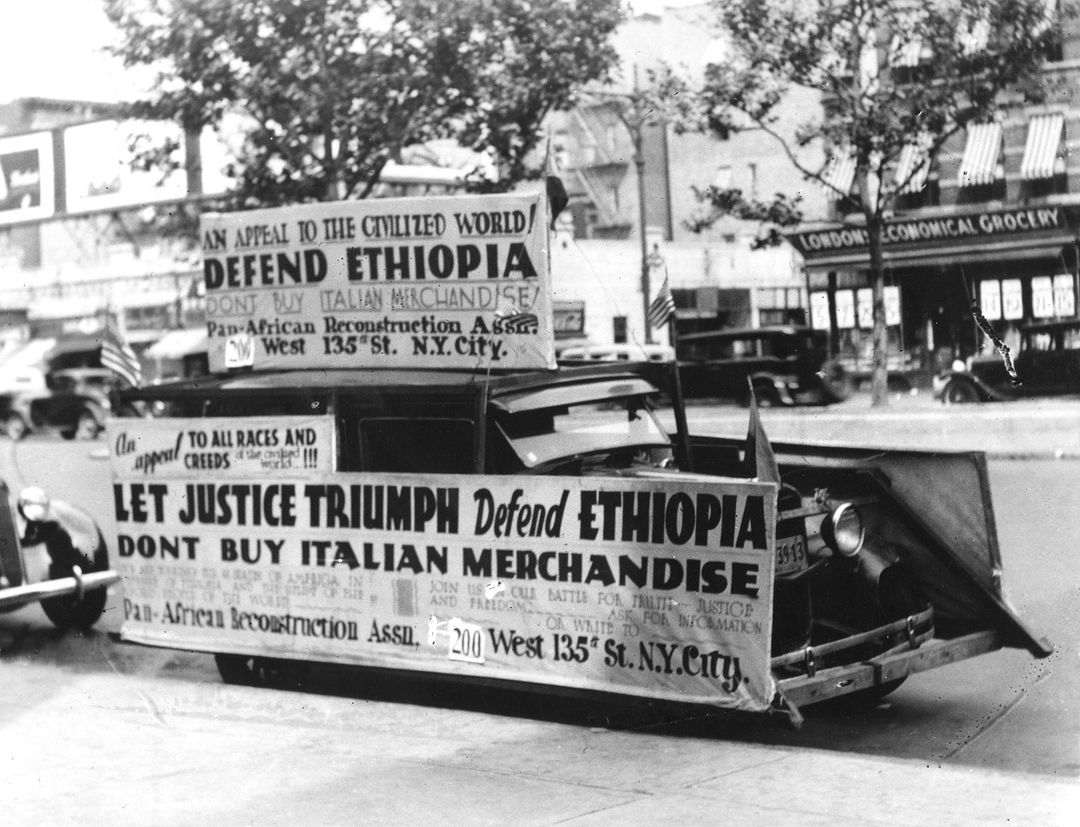
Ford reports to the Party on work in Harlem building opposition to the Italian fascist invasion of Ethiopia.
‘The United Front on Ethiopia in Harlem’ by James W. Ford from Party Organizer (Internal Bulletin of the C.P.U.S.A.). Vol. 8 No. 7. July, 1935.
Section Organizer, Harlem
There are a number of questions today that show the development of the struggles of the Negro people and the desire for unity, as well as the actual fact that Negroes are entering into broad united fronts in connection with the Party, or through the activities of the Party.
One of the first of these is the Ethiopian question. This is a question that has aroused the Negro people in this country to a movement as nothing else has in recent years. It has aroused them because Ethiopia is the first and last African independent state, and because they still pride themselves both on the culture of the Ethiopians and the long history of struggle of that nation, particularly because the people are struggling against. an imperialist power. AS a result of this feeling we were able in Harlem to begin immediately to initiate a movement for a united front with the most nationalist people on this one issue—the defense of Ethiopia.
It is very interesting to see how this united front was developed, particularly when you remember that a little more than a year ago the Communists and the Garveyites were fighting each other on the streets, because we did not understand how to work with these people. This time we organized a broad united front on the issue of the struggle for the defense of the Ethiopian people, which ultimately involved at least 60 Negro organizations.
The first problem we had in developing this united front was the question of the Communists. Some of the Negro nationalists wanted to raise the Red scare. Others said, as long ag they are Negroes, we will work with them, but we will not work with white Communists. We went into the united front on this basis, because if these people are ready to work with the Negro Communists and are not yet ready to work with the white Communists, we could not hold back.
The Italian Bureau sent a representative to the united front conference. When he came to the conference, these people got up and discussed the question. They sent him out and discussed whether or not to allow these whites in and finally a vote was taken—8 to 7—stating that while we welcome the whites, now is not the time to bring them in. In spite of this, the work of the committee went forward.
Our white comrades in the Italian Bureau sent greetings and letters of friendly cooperation to all of these meetings. At the same time we began to develop the issues around which we were fighting for the defense of the Ethiopian people, and to develop action. The first action was on May 7 in Harlem at the Abyssinian Church. There were 3,000 Negroes present, most of whom were not Communists. There the Communists spoke from the same platform as these other people. We were able at this meeting to show who are the friends of Ethiopia, and there we brought out the role of the Party of Italy, the strike struggles of the workers to prevent the transportation of troops to Ethiopia, etc. We also raised the question of the enemies of Ethiopia inside the United States, such as LaGuardia, Corsi of the Relief bureau who was at that time active in the relief hearings in Harlem, and who stated that there was no discrimination against the Negro people on the question of relief. We contrasted these people with the workers who had come from Italy to escape the fascist terror, and therefore were potential allies of the Negro people.
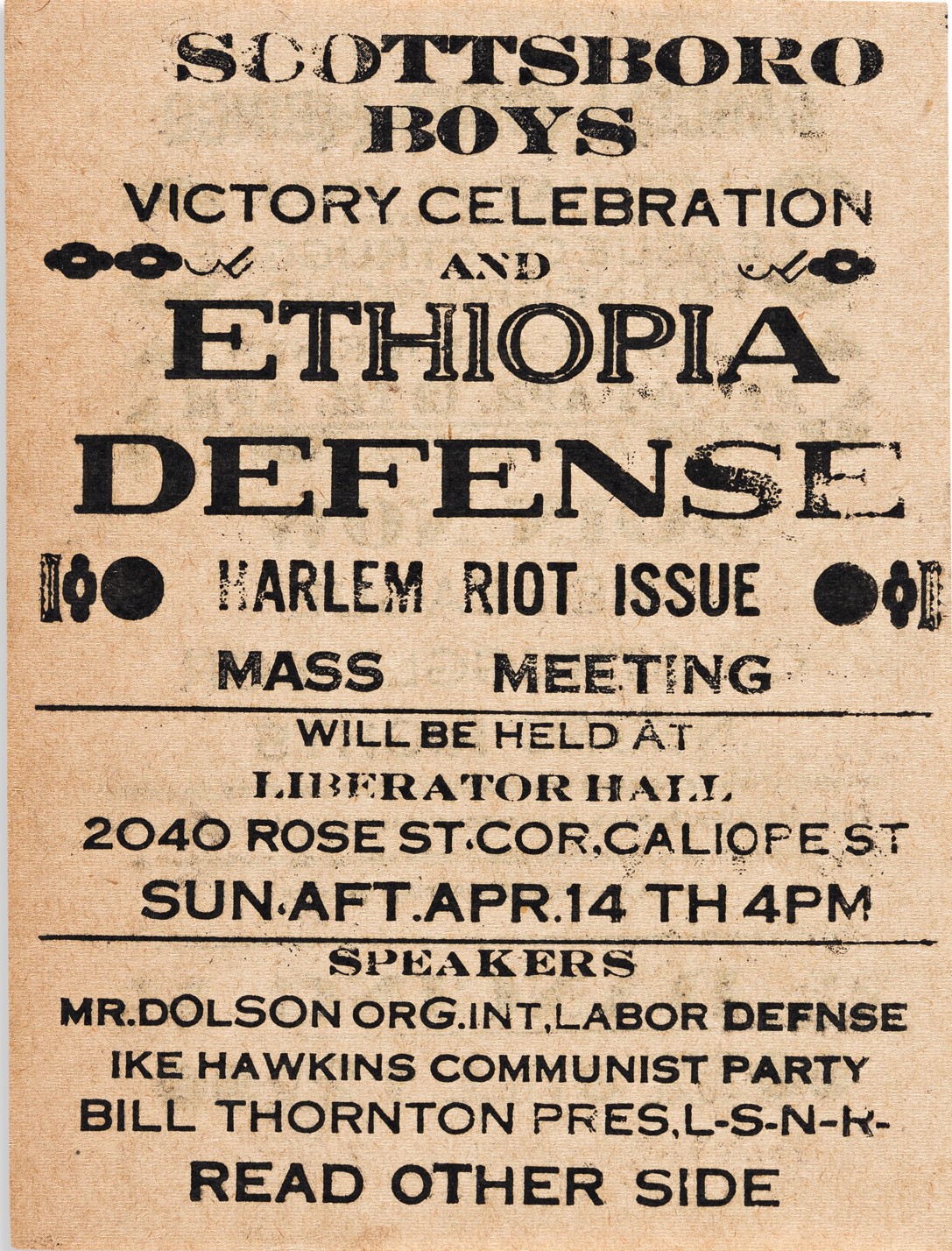
Later we took up the question of sending a delegate to the meeting of our Italian comrades where they were inaugurating the Italian paper, and one of the Negro nationalists greeted the paper. At the next meeting, we sent a number of the Garveyites to the Italian Workers’ Center where our comrades discussed the Abyssinian question. They were so afraid of their reception that they went there armed with knives. Of course, our Italian comrades received them very well and donated $5.00 to the fund, and they came back and made a wonderful report and said, “Yes, we have friends, and we must try further to broaden the united front and get the whites who want to assist us in Ethiopia. It is along these lines that we must work among the Negroes, patiently overcoming their suspicions and hesitations.
This experience in Harlem opens up a perspective of wider actions not only in Harlem, but throughout the country. Committees on Ethiopia should be set up on a nation-wide scale. We have the possibility of raising the whole political level of our work on this particular question. Here we deal with international politics and imperialism, where we can show concretely what imperialism means on a national and international scale.
Another question that is bothering a number of comrades in New York is the Father Divine movement in connection with the united front. The efforts we are making with Father Divine in the direction of a united front shows that the comrades in Harlem have taken very seriously the question which was raised at the last plenum—of going into the church organizations, making friends with these people. Through our united front with Father Divine we have been able to effect the penetration of a mass organization of the Negro people. A very important fact to remember in connection with the Father Divine movement is the fact that the followers of Father Divine are workers, toiling people; that is why we are attempting to penetrate into this movement.
The united front with the Father Divine movement has been made on the basis of certain concrete issues. Our first united front was on the basis of the struggle against war, for peace, against fascism. This was on National Youth Day Over a year ago. Then they elected eight delegates to the Washington Conference on Unemployment Insurance. They support the fight for H.R. 2827. Father Divine has branches throughout the country, and these people come to New York by various means—auto, train, etc. As they go through Washington, they are instructed to stop at Washington, contact their Congressmen and demand of them that they support the passage of H.R. 2827. They have also participated in the struggle against police brutality, and against discriminatory practices in Harlem.
We have been the subject of much criticism from the S.P. for making a united front with the Father Divine movement, and even in the ranks of our own comrades there has been hesitation, because they have not been able to “break the shell of sectarianism” that Comrade Browder spoke about. It is true that we have to guard against opportunism in this, as in all other united fronts, but that does not mean that we should not make them.
The Party Organizer was the internal bulletin of the Communist Party published by its Central Committee beginning in 1927. First published irregularly, than bi-monthly, and then monthly, the Organizer was primarily meant for the Party’s unit, district, and shop organizers. The Organizer offers a much different view of the CP than the Daily Worker, including a much higher proportion of women writers than almost any other CP publication. Its pages are often full of the mundane problems of Party organizing, complaints about resources, debates over policy and personalities, as well as official numbers and information on Party campaigns, locals, organizations, and periodicals making the Party Organizer an important resource for the study and understanding of the Party in its most important years.
PDF of issue: https://archive.org/download/party-organizer_1935-07_8_7/party-organizer_1935-07_8_7.pdf
 Revolution's Newsstand