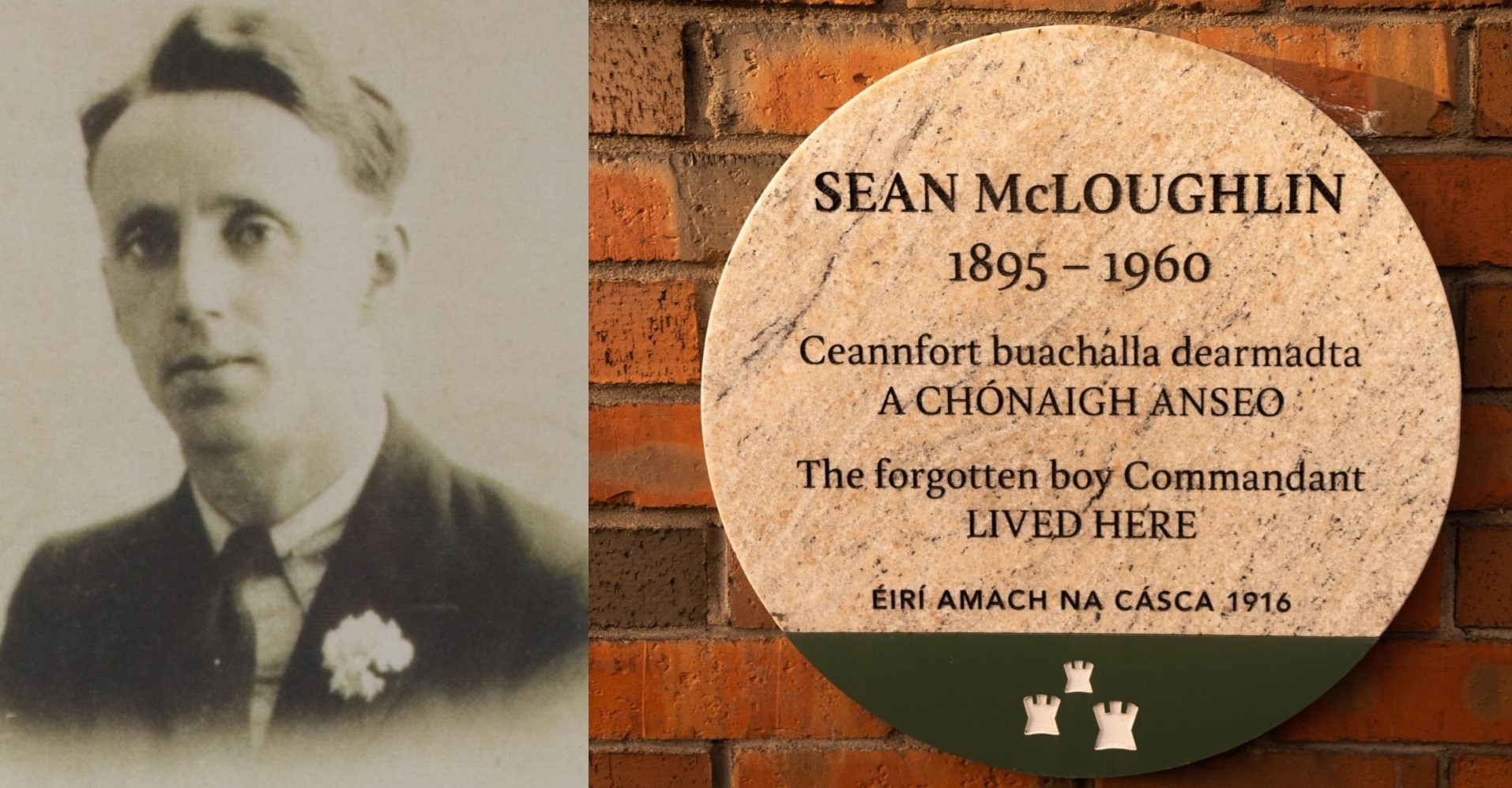
A remarkable piece of history here. Seán McLoughlin was already a veteran Irish Republican when he fought in the Easter Rising and took over from the wounded James Connolly commanding the G.P.O. and, at just 21 became, Commandant-General of the Irish Republican Army in the field. After release from internment he rejoined the Volunteers and became active in Ireland and Scotland’s revolutionary Socialist movements. At the time of this article he was involved in smuggling arms to the Irish insurgency while organizing the short-live Communist Labour Party. Below he offers insights on Ireland’s position in the larger fight against imperialism and for workers’ rule, as well as how Socialists should approach the struggle.
‘Britain and the Struggle in Ireland’ by Seán McLoughlin from Truth (Duluth). Vol. 3 No. 25. June 18, 1920.
“Is a Christian to starve to submit to bow down
As at some high consecrated behest,
Hugging close the old maxims, that ‘weakness is strength,’ And ‘whatsover is, is the best’?
O, texts of debasement! O, creed of deep shame!
O, gospel of infamy treble
Who strikes when he’s struck, and takes when he starves,
In the eyes of the Lord is no rebel.”
O’DONNELL.
In the world-wide move towards Working Class Freedom Ireland is destined to play an important part and it is well that this should be realised in time. At the present moment every country in the known world has witnessed some form of internal conflict between the different interests of the workers, on the one hand, and the ruling classes on the other. Blood has been shed in these conflicts, and many lives have been lost. As a result of this the issues involved have become very much clearer, and the workers generally are waking up to the fact that if they desire to be free they must be prepared to face realities, and be prepared to use any and every means to accomplish their ends. In Russia the Soviet Republic is compelled to defend its adherents against capitalist aggression, and as the capitalists are using machine-guns, bombs, poison gas, and other “constitutional” methods to convince the Russian people of the value of “real democracy,” the Red Army is endeavouring (and very successfully) to refute the arguments thus advanced by replying in the same manner. (Of course, now that Mrs. Snowden and the British Labour delegates have arrived in Petrograd, Lenin and Trotsky will be shown the error of their ways, and it is quite possible that the Red Army, acting on the advice of the delegates, will lie down and let the Allied armies make a doormat out of them.) Wherever the workers have risen they have been met with force, and these lessons have not been lost. The challenge thrown down by the ruling classes is being generally accepted–everywhere, that is, but in Great Britain. In that country the working class still stick to the methods and ideas that died in every other country years ago, and as a result Britain is the least revolutionary and the moat backward of all the nations striving for Social Freedom.
To those who have studied the conditions and history of Britain there are many explanations for the lack of class- consciousness, and it is a general belief that it is the success, or otherwise, of the Social Revolution on the Continent of Europe that will ultimately determine Britain’s attitude. On the other hand, if the British Empire can be broken up into its component parts, and every country under the control of Britain can repudiate the Empire and secure its own salvation, the resulting economic crisis would precipitate a revolution in Britain.
If we examine the present situation we will find that the policy of the rulers of the British Empire shows that they are aware of these things, and they act accordingly. Money, munitions, and troops are being sent to aid the Polen, not because the Churchills or Curzons believe they can defeat Russia, but in accordance with the policy of limiting Bolshevism to as small an area as possible, and to prevent it spreading to Austria, Germany and Italy. If the Allied armies could secure possession of the Ukrainian wheat belts and the oilfields in Baku, the Bolsheviks would be very much handicapped, and capitalisms in the West could breathe more freely for a longer period.
In dealing with the break-up of the Empire the same idea predominates. The ruling class are determined to prevent it at any cost. India has had her Amritsar as a warning, and the same fate will be meted out to any country that disregards that warning. That in spite of this organised brutality the task of keeping the Empire Intact is becoming increasingly difficult, and the so-called “subject” races seem determined to break away, and in no country are they succeeding so well as in Ireland.
Now, this question of breaking away from the Empire provides every Revolutionary Socialist with a formidable weapon. If the capitalists in Britain are firmly entrenched, and if they are too strong to beat on their own ground, then they must be weakened from outside. It is not very difficult to understand that if Britain lost her colonies and if an Irish Republic were established on her flank, that the workers would have a much easier task in assuming control. Every factor must be utilised if we are to succeed, and for that reason it would mean a tremendous accession to our strength if all the discontented elements had a common ground to meet on. Unfortunately, we cannot have the common ground, because there are too many suspicions to be overcome. The Irish Republican Movement is composed of too many divergent elements to enable them to participate in Socialist tactics, and a good many Socialists hold as the Irish fight for Freedom is a bourgeois movement they could not agree to help it. But this is a mistaken policy and cannot be justified. In the struggle for Irish Freedom many elements take part, and quite naturally, as the fight is still a National one. No particular economic programme emerges as yet from the leading sections, for the simple reason that the country is in a state of war, and no constructive work can be accomplished. Everyone devotes his or her energy to getting the Army of Occupation to withdraw, and until that is done the class struggle will be overlooked as is inevitable. The real Socialists in Ireland are endeavouring to point out the true meaning of freedom, but they are voices in the wilderness. You cannot propound Marxian theories to men who carry their lives in their hands.
Valuable lessons can be learned from history, and the one thing that we can learn from the history of the Russian Revolution is that it is not always necessary to declare a Revolution, the Social Revolution, in order to put the workers into power. In Russia the first upheaval was due to the breaking-down of the bread supply. Of course the conditions for Revolution had been present in Russia for a long time, but the failure of the bread supply hastened the crash, and the first Revolution was accomplished, but it was more or less of a political character. The revolutionary atmosphere remained, intensive propaganda was carried on, until at a later stage the Revolution was transformed from a political fight into a change in the condition of society. Now, the same thing is quite possible in Ireland, The same conditions, to same extent, prevail, and it a successful Revolution takes place, and if the same vigilance is maintained as in Russia, it will be possible to transform the Irish Republic from a political State into a Workers’ Republic.
If once a Workers’ Republic were established in Ireland the effect on Britain would be tremendous. It would practically mean that the same thing must occur in Britain. The Irish workers might have to assist to bring this about. If they were not successful there would have to be war, for Ireland could never exist as a Workers’ Republic while Britain and American remained in the hands of the capitalist class. Therefore, owing to her geographical position, the pace of the Social Revolution in Ireland will be measured by the pace of the Revolution in Britain. This is a very unpalatable fact, yet it cannot be surmounted. There must be unity of action between the conscious Irish and British workers if they are to succeed. It is quite possible to maintain a political State in Ireland under a capitalist form of government; that is, if there were a working agreement between the Irish and English capitalist class, or between Ireland and America. But we do not think that will happen. We believe Ireland will only attain her Freedom through the collapse of Capitalist Imperialism, whether of British, American, or French manufacture. In the meantime the fight goes on. Irishmen are losing their lives, but they are maintaining their position. They cannot be beaten. The War Office may send armies to Ireland, proclaim martial law, even blockade the country, arrest and shoot all around them, but they will surely be defeated. If they try starvation or a wholesale massacre the reaction will probably smash down the Empire. An empire is a peculiar thing. It depends upon its prestige to maintain itself. Britain could cope with an Irish revolt in the field, but she could never cope with a general uprising throughout the Empire; and that is what will happen if they provoke a revolt in Ireland. It is not what would happen in Ireland, but its effect outside. They could never keep it quiet. There is no doubt about it that the rulers of Britain realise quite well that an uprising in Ireland, brought about by provocation, would strike them a blow, from which they never would recover, morally and materially. They will temporise as much as possible until the approaching economic collapse smashes all their schemes in the downfall of capitalism.
If the workers of Britain could be made to realise these things, if they could only appreciate the significance of Ireland, they would be willing to act. But we know they will not, nor cannot, act until the material conditions are ripe, and that will not be for some time yet. It seems a hopeless position until the scientific interpretation is applied to it and as Marxians we can rest assured that, no matter how they try to avoid it, the rulers of the world will not rule much longer, and that the workers are coming into their own. In the meantime the fight goes on. Here in Ireland the situation is becoming tense. The men of the Volunteers hold steadily on, despite attacks from within and without. They compel admiration. Their position is difficult. The moment they weaken, down come the “Castle” and the forces of reaction on them to crush them out, and even the very dogs would rend them. Let us hope they will never be crushed. They are the only honest section in the country, the only section who have the strength and courage of their opinions. If the Working Class Movement in Britain could only produce such an organisation there would be no fear of the future. There is no other movement in Ireland to-day that matters, and if we are to make a Workers’ Republic in Ireland we must convince them of the necessity for it. We who are Internationalists and Communists will see our ideals through to the end, but while we can it is our duty to assist to make an Irish Republic, not to hinder it. But we will not agree to stop at an Irish Republic. Help them now while a life and death struggle is on! That is our duty. We do not sink our principles when we do that. When the Imperialist armies have evacuated Ireland, then on to the Workers’ Republic! And nothing can deter us from insisting that those who produce shall rule, and the fear of a bullet in the back will not prevent that being done. Sooner or later the workers will come into their own. “The future belongs to the workers”
SEAN MCLOUGHLIN
Truth emerged from the The Duluth Labor Leader, a weekly English language publication of the Scandinavian local of the Socialist Party in Duluth, Minnesota and began on May Day, 1917 as a Left Wing alternative to the Duluth Labor World. The paper was aligned to both the SP and the I.W.W. leading to the paper being closed down in the first big anti-I.W.W. raids in September, 1917. The paper was reborn as Truth, with the Duluth Scandinavian Socialists joining the Communist Labor Party of America in 1919. Shortly after the editor, Jack Carney, was arrested and convicted of espionage in 1920. Truth continued to publish with a new editor J.O. Bentall until 1923 as an unofficial paper of the C.P.
Access to full issue: https://www.mnhs.org/newspapers/lccn/sn89081142/1920-06-18/ed-1/seq-6
 Revolution's Newsstand