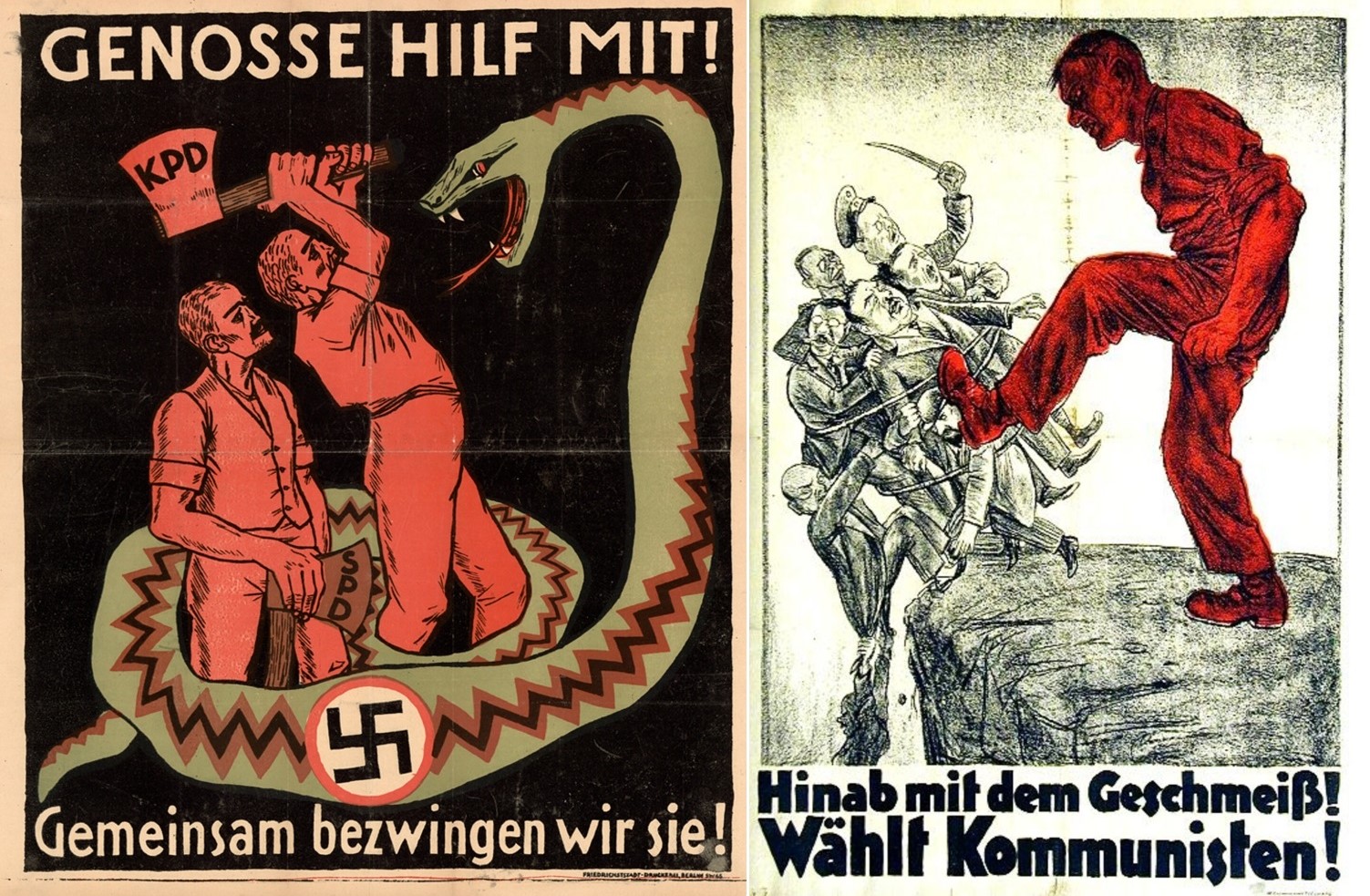
Report given of the enormous work done by the German Communist Party to the Comintern’s 1925 Organization Conference.
‘The Activity of the Central Agitprop Department of the German C.P.’ by Max Engel from International Press Correspondence. Vol. 5 No. 29. April 29, 1925.
The activity of the Central Agitprop of the German C.P. has passed throughout three epochs since first coming into existence, each epoch representing a definite stage of development.
The first epoch comprises the time during which the department was founded: August 1923 till December 1923; the second epoch extends from January until December 1924; the third from January 1925 until now.
In August 1923 it was decided to form a special Agitprop department for the centralisation of the whole of our agitational and propagandist work. At the time of the founding of the Agitprop no definite working plans had however been made; the limits of the field of activity had not yet been drawn. The vaguest ideas circulated as to the extent of work, and especially as to the coordination of work with the various departments of the Party. Questions of method and technics were dealt with solely by means of small discussions on special examples (the organisation of a meeting or demonstration, debates on the method of educational work in the Party.) The essential difference between propaganda and agitation was not even clear to the leaders of the Party.
One example of the defective organisation and deficient knowledge of the essential character of Agitprop work may be seen in the fact that although the Party publishers were subordinate to the Agitprop in every branch of their work, the other departments of the Party Central (trade unions, cooperatives, land propaganda etc.) were not coordinated to the Agitprop in any way. And it was not until November 1923 that the whole of the printing orders received by these Agitprop departments were carried out by the Central Agitprop. The Agitprop was however responsible for the technical side only (make up, printing, etc.) Material for agitation was produced in large numbers. Leaflets ran into editions of millions, and pamphlets such as “Civil War”, “Hooked Cross or Soviet Star” were issued in editions of 100,000 each, almost all of which were sold, as the prices had been rendered exceedingly low by the inflation. A systematic use of the material did however not take place.
In the first epoch of Agitprop work it was not yet possible to achieve any substantial progress in the centralisation of our whole agitation and propaganda. The Agitprop was affiliated to the organisation bureau; the political bureau issued handbills without previous consultation with the Agitprop, published appeals, and carried on every description of this kind of political work quite independent of the Agitprop.
This lack of system was not changed by the events in October, and the first months of Agitprop activity passed without that more being done than placards and posters being brought out, and attempts being made by the Agitprop to create for itself an independent printing apparatus, and to centralise the printing possibilities already offered by the Party printing offices all over the Reich.
In January 1924 a member of the Central was appointed to lead the Agitprop department. The Agitprop was brought into closer contact with the entire work being done by the Party central and its organs.
In the course of the epoch lasting until December 1924 the Agitprop had three great tasks to accomplish:
a) the electoral campaign for the Reichtag election on 4. May 1924, b) the international campaign against war in August 1924, c) the electoral campaign for the Reichtag election on 7. December 1924.These last two campaigns had to be carried on in the midst of the struggles of the German Party against the Experts’ Report, against the London Conference, and against the Dawes Plan. During this year the Agitprop accomplished the task of drafting in detail the plans for the campaign, of transmitting corresponding instructions to the other departments of the Party, of producing the whole of the material, and of controlling the organisation and execution of the campaigns in the Party organs (districts and local groups). The political slogans and campaigns, leaflets and appeals, were passed on to the Agitprop department by the political bureau. The Agitprop was affiliated to the organisation bureau; the contact with the collective work of the Party became much closer than during the first epoch.
The best example of more systematic and concentrated agitation work was furnished by the anti war campaign in August 1924. This was thoroughly prepared for weeks beforehand by the whole Party. The Central Agitprop issued a detailed plan of campaign, containing concrete instructions for every sphere of work (trade unions, cooperatives, parliaments, women’s secretariat, cultural and sporting clubs, etc.). This plan of campaign was introduced by political instructions given by the political bureau, organisatory instructions from the organisation bureau, and special instructions from the Central Agitprop department. The complete working plan comprised a pamphlet of 32 printed octavo pages, and an edition of 8000 copies was distributed gratis among the most important Party functionaries a few weeks before the campaign opened.
Thus the whole of the Party functionaries were not only informed on the political slogans of the campaign (including the international ones, since the political instructions issued by the Executive were included in the pamphlet as appendix), but were enabled to obtain a comprehensive survey of the work falling to their share in their capacity as trade union, cooperative, or other functionary, and of the work which their fellow functionaries were called upon to perform. This coherent formulation of the whole plan of the campaign prepared the way for the highest possible degree of coordination in the cooperation among the different organs of the Party. Special instructions were also given for the most important branches of agitation (press, meeting campaigns, organisation of demonstrations, etc.).
The Central Agitprop published the following agitation material for this campaign:
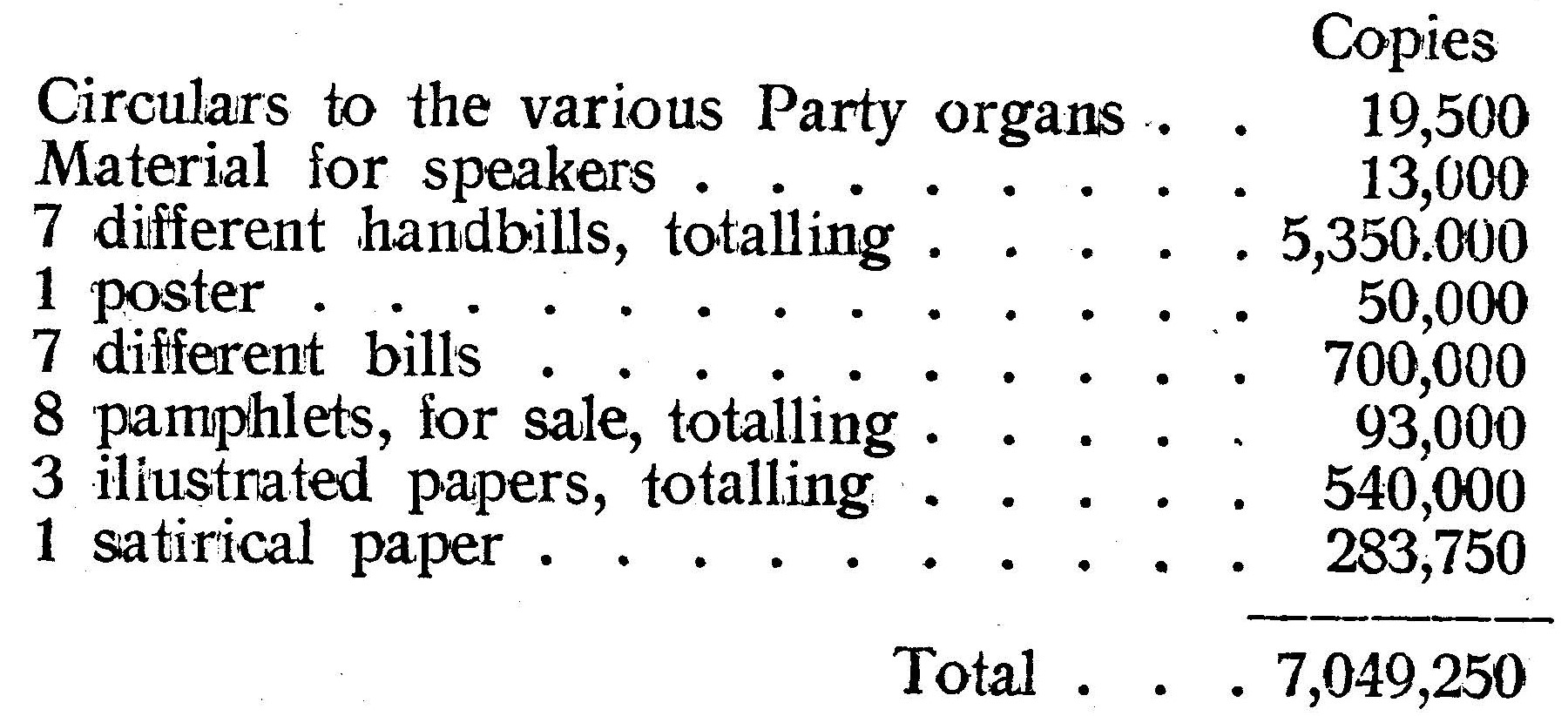
As a result of this excellent organisatory preparation, the campaign was exceedingly successful, although we were obliged to state in our final report to the E.C.C.I. “that a serious defect in the organisation of the campaign consisted of the fact that coordination was still insufficiently developed with respect to the work of the different Party organs”.
We give below a further table showing the material provided for the Reichstag election on 7. December 1924:
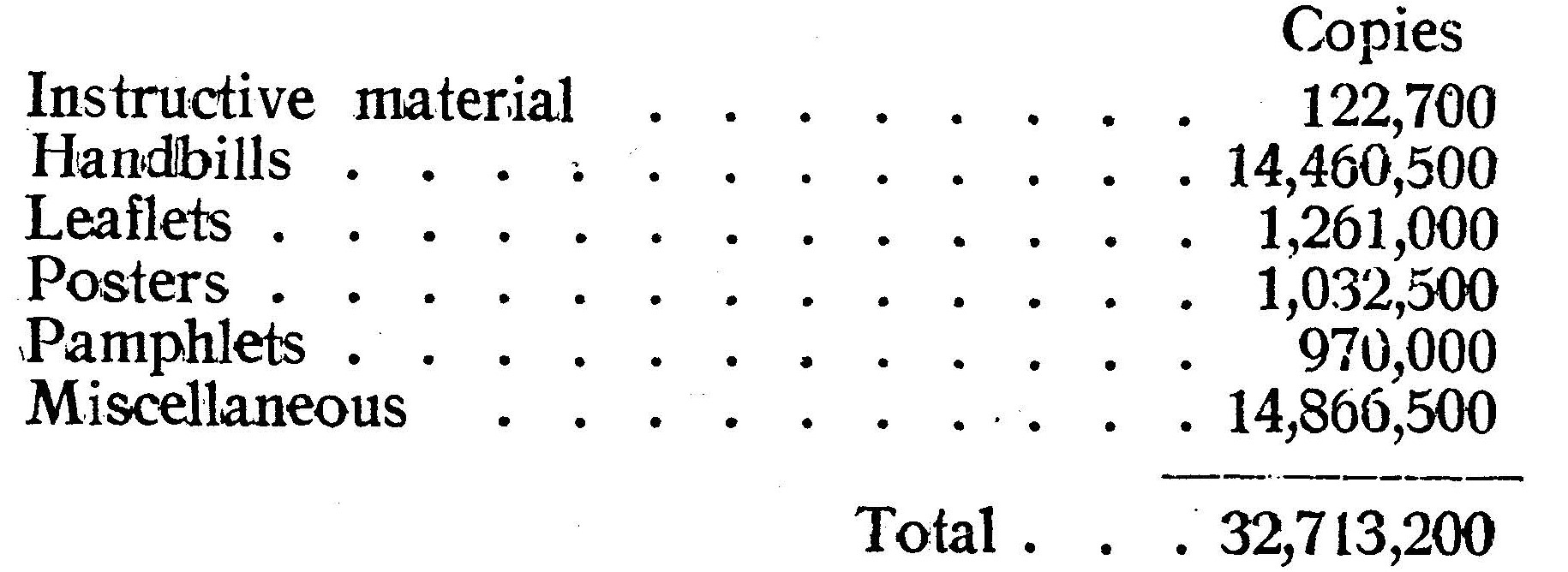
The Agitprop thus emerged in its second epoch from the embryonic state of its first, established the confines of its sphere of activity, secured its influence upon every branch of work. Questions relating to the method and technics of agitation and propaganda were discussed upon the basis of actual experience. The chief defects still hampering the work of the department lay in the circumstance that the subordination of the Agitprop under the organisation bureau forced organisatory and technical questions into the foreground so that propaganda (educational work in the Party) was accorded too little attention.
The third period of Agitprop work began in January 1925 with the reorganisation of the Agitprop department. The Agit-prop became the organ of the political bureau, organising, carrying out, and controlling the whole of the agitation and propaganda conducted by the Party in every department of work.
This fundamental definition of the actual sphere of work, and the position of the Agitprop department in the apparatus of the Party as a political organ, as an organ of the political bureau, was the most important prerequisite for thorough and systematic agitational and propagandist work throughout the whole Party. This form of organisation is the only guarantee of a consistent centralisation of all agitation and propaganda, ensuring their political guidance, and bringing the individual tasks of the other departments into correct relations with the plans and principles of the Party Central. The work of agitation and propaganda within the trade unions, cooperatives, etc., must be subordinated in methods and technics to a central leadership which sees not only the narrow limits of Agitprop work. The slogans and aims of this work must be consistently coordinated with those of the work of the other departments, in accordance with the principles laid down by the decisions of the Party Central. This centralisation is the sole guarantee that the whole of the forces in the Party, the whole of our means and possibilities of agitation, are concentrated and directed under the consistent leadership of the Party Central towards our ultimate aims.
The work falling to the share of the Agitprop may now be classified under two main headings, these being again subdivided into various minor categories.
The chief department of agitation comprises the whole of the general agitation carried on by the Party in every sphere, the organising of international and national campaigns, the organisation of elections, etc.; it further comprises the subdepartments for press and publishing work, and a special subdepartment for the production of the whole of the material required for the work of agitation and propaganda. The chief department of propaganda comprises the whole of the educational work carried on within the Party, in related and sympathising organisations, and in trade unions, cooperatives, etc. This department controls the editorship of the theoretical organ issued by the Party Central. It possesses a subdepartment for archives and libraries. It organises the courses of instruction in Leninism and the educational circles in the whole Party. A further subdepartment for statistics has recently been added. This last department not only collects and publishes important political and economic statistical material, but compiles statistics on the results of elections, census of the population, etc.
The actual Central Agitprop department organises and leads both the whole of the general agitation and the special campaigns (at present: for the unity of the trade unions, factory council elections, election to the presidency). The Agitprop draws up the plans for these campaigns, and after these have been approved by the Party Central they are sent (8000 copies) to the leading Party functionaries. The whole of the material required for these campaigns, the Party material needed by public speakers and debaters, for the press service, and the posters handbills, etc., required as agitation material, are produced and published on the instructions and under the control of the Central Agitprop, in accordance with the established plan of campaign. Besides these tasks, the organisation of suitable Agitprop departments in the districts, local groups, and factory cells, is an urgent necessity, and must be carried out by the central Agitprop department. The organisation plans for the German Agitprop, as also the principles to be pursued in the systematic organisation of international campaigns, are submitted to the International Agitprop Conference which will be held in the middle of March. The work of organisation must be made to run parallel with the giving of instruction on the method and technics of propaganda and agitation within the functionary corporation and among the members, by means of instructive pamphlets, conferences, and courses of study.
The gigantic apparatus in the hands of our opponents (press, cinema, theatre, school, family, army) is something with which we cannot in the least compete as far as quantity is concerned. If we are to break the influence of this apparatus, this can only be by enlisting everything and everybody in our service; that is, when every functionary in the Party, every member, and every person in sympathy with the Party, ceases to carry on the work of agitation in a merely accidental manner, but pursues it in accordance with a definite plan concentrating all forces under one consistent leadership; when we have learnt to make use of, and organise the use of, every technical auxiliary means available for agitation (leaflets, posters, bills, handbills, placards, factory nuclei newspapers, theatres, cinemas, wireless) in such a manner that the highest degree of success is ensured. The success of these efforts towards increasing and deepening the influence of the Communist Party is not so much dependent upon the material means available, as upon the degree of organisation, the utmost acme of centralisation in the whole of the work of agitation and propaganda. Accident is but a feeble ally. It is the organisation of all available powers, the systematic utilisation of all available forces, and the central leadership of agitation which will enable us to defeat our adversaries.
International Press Correspondence, widely known as”Inprecorr” was published by the Executive Committee of the Communist International (ECCI) regularly in German and English, occasionally in many other languages, beginning in 1921 and lasting in English until 1938. Inprecorr’s role was to supply translated articles to the English-speaking press of the International from the Comintern’s different sections, as well as news and statements from the ECCI. Many ‘Daily Worker’ and ‘Communist’ articles originated in Inprecorr, and it also published articles by American comrades for use in other countries. It was published at least weekly, and often thrice weekly.
PDF of full issue: https://www.marxists.org/history/international/comintern/inprecor/1925/v05n29-apr-09-1925-inprecor.pdf
 Revolution's Newsstand