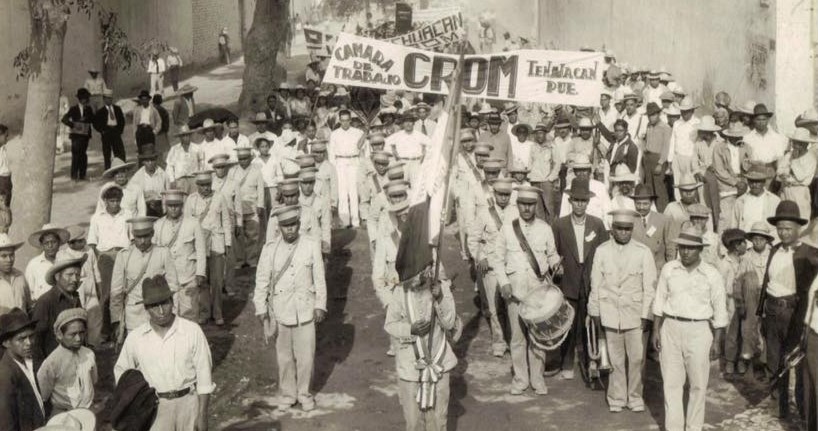
This report to the 2nd Trade Union Educational League Conference held in Chicago during September, 1923 covers the general political and economic situation of Mexico along with its labor movement, possibilities of the united front, the formation of a Mexican T.U.E.L. and the role of the small Communist Party.
‘Report on Mexico’ by A.M. from Labor Herald. Vol. 2 No. 8. October, 1923.
GENERALLY speaking, agricultural capital in Mexico is native and industrial capital is foreign. Agricultural capital as represented in land is owned chiefly by Mexicans and Spaniards with a sprinkling of American, British, and German holdings. The typical rural property is the hacienda, or large estate, running from a thousand to hundreds of thousands of acres. The majority of the fifteen million inhabitants of the country are tillers of the soil and labor on the large estates living sometimes in villages situated on or near them and sometimes in little colonies clustered around the landlord’s mansion. Prior to the recent Mexican revolution the agricultural worker was generally in a state of peonage or enforced debt, which bound him as firmly to the soil as were the medieval serfs. The result of the revolutionary period has been to cancel all debts of this sort and to return large tracts of land to the villages. But as yet the majority of rural workers labor for the haciendado, for shares or for wages. These wages, altho in general higher than before, are still pitifully inadequate, and in some sections of the country remain practically as before. Strong unions of protest are being formed both among the village and hacienda peasants.
Industrial capital in Mexico is divided roughly as follows: American capital predominates in the ownership of mines and oil wells with the British a close second. The latter dominate light, power, and electric traction. The French control the field of textile elaboration and are powerful in the printing industry and in banking. The Germans have been active in the hardware and other lines of business. The Spaniards run food and grocery stores. Americans are increasingly important in retail business and in maintaining sales offices. This is by no means an exhaustive analysis, but merely illustrative of the fact that the large majority of industrial capital in the extractive industries as well as in banking, manufacturing, light, power, transportation and even general business is in the hands of foreigners. The two activities which remain practical monopolies for the Mexicans are government and labor.
The Catholic Church
The priest once ruled Mexico spiritually, intellectually, and economically. The church was the chief landowner. Today, though shorn of much power, the church is still strong. It instinctively sides with the landowner against the peasant, with the foreign capitalist against the worker. It has exercised its power of superstition to prevent the consummation of the agrarian program, threatening peasants with eternal hell if they accepted expropriated land, etc. Latterly the church has been organizing labor unions under church control and has lent aid in the formation of fascist groups. Some labor leaders have alienated workers from the union idea by directly attacking the church and its beliefs. Much sounder is the propaganda of the communists in this respect, which shows the peasant that early Christianity was on the side of the workers and that it is the priests, not the government or the labor unions, which are “un-christian.” The church, native landlordism, and foreign capitalism form an unholy trinity working against the liberal government and the workers and peasants.
Politics and Government
With capital chiefly foreign and labor entirely native, it is evident that government must reach some equilibrium between national and foreign interests if it is to exist at all. During the period of Diaz this was solved by the ruthless military suppression of working class rights and needs. But the disruptive force of ten years of civil war has brought it about that the government that finally emerged and pacified the country, found itself largely dependent upon an aroused proletariat. Carranza had come into power in the same way and had fallen when he broke faith with the people. Obregon also found himself pledged to support the masses. But the foreign capitalists commenced a boycott of Mexico which has continued to the present date and which has gradually been forcing the government more and more to the right. Social principles and labor laws, the product of the revolution, have been applied only partially and extensive interpretations in favor of the capitalist interests have been made.
But with the revolution the masses entered the arena of political consideration, leaders swept into power and obtained followers who would fight their battles upon the strength of promises of agrarian and labor reform. The leaders in turn spread socialistic and revolutionary ideas among their followers and assisted them in the formation of agricultural and workers unions. In approximately eight years Mexican labor organization was created. But the price of this mushroom growth was a certain pauperization in the unions. The workers had little above the amount necessary to eat and often not that. In return for their military and political support of a leader they received financial aid from public monies when he got into power. The leader became the financial supporter of the union and so in the long run its dominator. The worker could discard one leader and take up with another but the result remained more or less the same; it was similar to the American worker and the Democratic and Republican Parties, except that in Mexico the leader did actually pass laws and often apply them favorably to the workers. But the very political importance and strength of the workers has made them now subservient to the politicians and if labor is to make further revolutionary advances toward a better state of society it has to adopt a rigid discipline for the support of its own organization and a technique for the control of such of its leaders whom it wishes to keep in governmental activities. The problem of Mexican labor politically (and economically because “safe and sane” leaders are now often acting as economic policemen for the capitalist and bidding covertly for his support) is to find a technique for the control of political action.
Labor Organization and Tactics
There are certain fundamentals which are common to practically all labor organizations in Mexico but which differ from ideas and practices current in the United States.
1. Being born of revolution, Mexican unionism retains revolution as a slogan, even when the revolutionary ardor has died. While there may be necessity for education as to what constitutes revolutionary action at Mexico’s present state of economic development there is little need to sow abstractly the idea of revolution.
2. Mexican labor organization takes the shop and not the craft as a unit, and is adopting the plan of industrial and regional federations, and national confederations. Mexico is not greatly in need of industrial union vs. craft union propaganda, in general the tendency being toward national organization of industrially organized units and a parallel geographical federation. The temperament of the people is such that probably federation will have the same practical results as what is known as amalgamation in this country, the Mexican workers being easily moved to sympathetic strike action.
3. The federal constitution grants the right to strike and picket, and a large number of strikes are called in order to enforce by economic action certain other of the labor rights granted in the constitution but not enforced by the government, such as the eight hour day, the right of three months pay upon unwarranted discharge, sick and accident benefits, etc. It is provided by law that a labor dispute may be referred to an arbitration commission composed of employer and employee representatives meeting with a representative of the government. Should no agreement be reached, then the strike is in order. Should a protracted strike endanger the community or the living conditions of the strikers, the government is empowered to take over and run the establishments until a settlement is effected between the owners and the men.
Existing Organizations
1. The largest labor organization in Mexico is the Mexican Federation of Labor. It claims a membership of over 600 organizations and 800,000 members which is probably an exaggeration. The leaders of the Mexican Federation of Labor are all employed in government jobs, some of them holding positions of almost cabinet rank. It swings a large political patronage and gets results for the workers thru governmental channels bringing political pressure to bear to gain its ends. Occasionally it employs strikes and economic pressure, but as the leaders have become more and more a part of the governmental machine, the tendency has been to soft pedal strikes. The Mexican Federation of Labor is run by an inner clique known as the Grupo Accion of which the chief members are Luis Morones, Celestino Gasco, Ezequiel Salcedo, Jose Guttierrez, Eduardo Moneda, Juan Rico, Salvador Alvarez and others. The Mexican Federation of Labor maintains close relations with the American Federation of Labor and has used the latter to assist it in the campaign of the Mexican government for American diplomatic recognition. The Mexican Federation of Labor has been strongly partisan to General P.E. Calles as a candidate for the presidency of Mexico.
2. The General Confederation of Workers was organized in 1921 at the instance of the Communists but later fell into the control of the Anarchists, under whose leadership it voted affiliation with the Berlin Syndicalist International at its last annual convention. The General Confederation has a membership of from 50,000 to 75,000 with its chief strength lying in the capital. In the last year it has been the subject of attack not only from intransigent groups of British and French capitalists, but also from the Mexican Federation of Labor and from the Communists. The General Confederation is strong in the port of Vera Cruz and has been gaining strength in the textile districts of Puebla and Orizaba, due partly to the activity of the anarchist leader Enrique F. Magon. The General Confederation at its last convention adopted a program of industrial unionism and set out to organize the country on a basis somewhat similar to that of the I.W.W. in the United States. Altho scorning political action and ordering its members to abstain from voting, the General Confederation has been the subject of political intrigue no less than the Mexican Federation of Labor. Its leaders have covertly worked its influence for Adolfo de la Huerta and latterly its support is being bid for by the Co-operatista Party, which is the dominant political party in the present Mexican Congress, and which appears to be backing General Calles.
3. The Federation of Mexican Railroad Unions comprises about 45,000 workers, or perhaps 90% of all the men employed on the railroads of Mexico. It is a Federation of 15 different craft unions which includes all departments from section hands to train dispatchers and locomotive engineers. It is the only national organization of labor which is somewhat free from the taint of political control, because its officers are full time men whose salaries are paid by the union. It does not therefore have to depend upon the political patronage and handouts of politicians. Like railroad workers in many countries it is chiefly concerned with railroad organization altho many of its leaders have a revolutionary point of view. It has no official relations with either of the foregoing organizations altho many of its leaders. sympathize with the General Federation, while most of them are enemies of the Mexican Federation of Labor because the latter backed out on its promised support of the national railroad strike of 1921.
4. In addition to these three major organizations there are a number of regional groups of importance. There is a portworkers federation which has endeavored to enlist all port units but has only partially succeeded. In Vera Cruz the portworkers’ organization dominates a number of the other labor groups in the city and had formed the League of the Maritime Zone, which works in harmony with the Mexican Federation of Labor. In the north, the state federations of Chihuahua and Sonora are independent, and in Monterey, the railroad workers control an independent local federation which is attempting the formation of a Federation of Labor of the North. The workers of the peninsular states of Yucatan and Campeche have a separate organization which, however, works more or less in conjunction with the Mexican Federation of Labor.
5. The Labor Party is the political reflection of the Mexican Federation of Labor. It places locals where there are local unions of the Federation and it is the political machinery used by the Grupo Accion to keep and extend its political power. It is backing General Calles for President of Mexico.
6. The Communist Party of Mexico has not as yet entered the active political field. It is small numerically and confines itself to educational propaganda. It believes in the importance of the agricultural workers as compared with the city laborer, and is bending its efforts to the job of fostering the communal idea among villages who have received government land. The Communists were the controlling factors in the extensive tenants’ movements which swept the larger cities of Mexico during 1922, and which has now largely died out with the exception of its point of initiation and greatest virulence, the city of Vera Cruz. Latterly the accretion of certain intellectual elements to the Mexico City communists has given their activities added strength.
The United Front
This question has been one of the most acrimonious topics of debate at every convention of Mexican labor during the past year. Insurgents who introduced the matter in the last convention of the Mexican Federation of Labor were met with the argument “We are the united front. If all organizations would join the Federation, which openly invites everybody, the United Front would be a fact.” So it would, of course, but it would mean coming under the domination of the ruling clique of the Mexican Federation against whom great animosity is felt. The General Confederation meantime has been engaged in trying to split off certain sections of the textile workers from the Mexican Federation and invites all workers to join it in its industrial union program. The fusion of these two bodies would mean that many ‘leaders’ would lose their power, and power is sweet. Meanwhile the Communists have been urging a united front of the workers and attacking the leaders of both the above mentioned groups. A manifesto to Mexican workers from the headquarters of the Red Trade Union International at Moscow was given great publicity by the Communist Party. At present the General Confederation is leading a movement for a “united front,” encouraged by the Co-operatista Party, which wants to gain influence among the voters for the coming presidential elections.
Suggestions for Trade Union Education
The foregoing considerations indicate that an independent and united front of the Mexican proletariat, peasant and workers, presupposes:
1. The eradication of pauperism in the unions. This includes instruction in the necessity and technique of a proper collection and management of union finances. It means rank and file discipline.
2. Conservation and harnessing of leaders. It will not suffice to condemn present leaders. All men of ability that can be marshalled are needed by Mexico today. There must be education as to the correct sphere and function of leaders and the development of a technique for their effective control. This point is intimately connected with the previous one.
3. Practical instruction as to how the capitalist system works in Mexico at the present time. This means a first-hand study of what foreign capital is doing in Mexico, what relations it has with domestic capital and the government, what the real relations are between city workers and peasants and how practical co-operation can be developed between them.
4. Skillful emancipation of the peasant and worker intellect from the drugging influence of the church.
5. Persistent effort toward a practical co-operation and the actual achievement of united action between the various workers’ and peasants’ groups; first in small areas and then in larger, until the advantages become apparent. Each union needs its group of keen-sighted workers who will support every sound movement for co-operation, federation, and amalgamation. In this connection an important field is that of the implantation of peasant co-operative and communal groups in lieu of a system of small proprietorship in land.
6. Diffusion of general and technical education.
In Mexico there is stirring a great wave of feeling toward a new system of production and distribution. But some have felt that Mexico must first be industrialized, like America or Europe, before a revolution can come; others, on the contrary, have thought that Mexico could achieve an Anarchist-Communist revolution next week or next year. Both of these points of view are faulty. Mexico will be industrialized to a certain extent, but it is to the advantage of the people to retard rather than hasten that end: industrialization should come only at such a speed that the reviving people can control it and make it serve social ends. On the other hand, Mexico is already so tied up with the international capitalist system that no complete overturn is possible until that system is more weakened than it is today. “Mexico for the Mexicans” if properly understood, is the course of safety today for the Mexican people. This requires an alert and independent workers’ and peasants’ movement which shall continually force the government into line and prevent the recurrence of another period of Diazism under control of United States capitalists.
Trade Union Educational League
In June a Mexican Trade Union Educational League was formed. The secretary general is Rafael Mallen and other officers, are Diego Rivera, Jose Allen, Jorge J. Crespo, and Manuel Ramirez. These men are all known as active communists. There are sincere men in the other labor organizations who wish honestly for a united front. It is unfortunate that some of them were not secured at the outset to form a part of the directive body of the new organization, because a united front must come thru a fusion of elements and cannot now be achieved under communist leadership alone. There should be a left block. This difficulty may have been remedied since the writer left Mexico. At the time of his departure the league had just been organized and the writer can give no report of what has occurred since. The above is simply his analysis of the present situation in Mexico and has value only as a personal observation.
The Labor Herald was the monthly publication of the Trade Union Educational League (TUEL), in immensely important link between the IWW of the 1910s and the CIO of the 1930s. It was begun by veteran labor organizer and Communist leader William Z. Foster in 1920 as an attempt to unite militants within various unions while continuing the industrial unionism tradition of the IWW, though it was opposed to “dual unionism” and favored the formation of a Labor Party. Although it would become financially supported by the Communist International and Communist Party of America, it remained autonomous, was a network and not a membership organization, and included many radicals outside the Communist Party. In 1924 Labor Herald was folded into Workers Monthly, an explicitly Party organ and in 1927 ‘Labor Unity’ became the organ of a now CP dominated TUEL. In 1929 and the turn towards Red Unions in the Third Period, TUEL was wound up and replaced by the Trade Union Unity League, a section of the Red International of Labor Unions (Profitern) and continued to publish Labor Unity until 1935. Labor Herald remains an important labor-orientated journal by revolutionaries in US left history and would be referenced by activists, along with TUEL, along after it’s heyday.
Link to PDF of full issue: https://www.marxists.org/history/usa/pubs/laborherald/v2n08-oct-1923.pdf
 Revolution's Newsstand