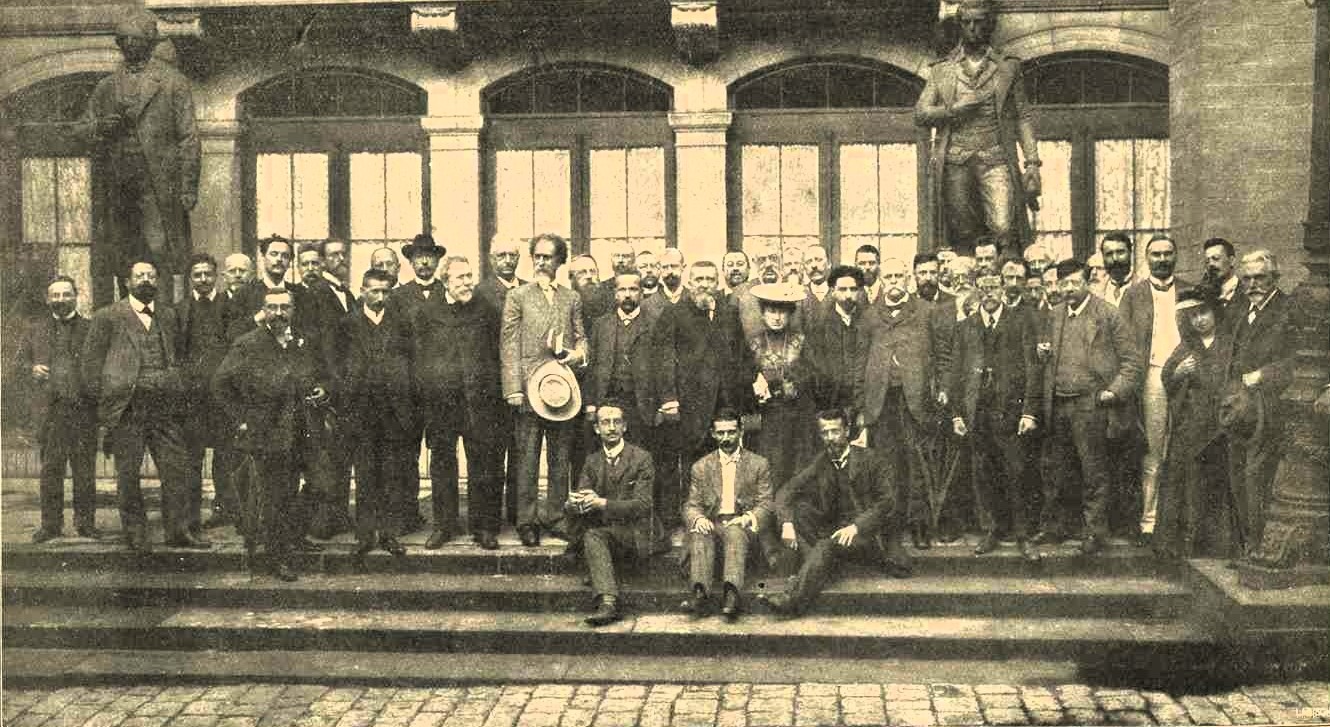
Resolution adopted by the International Socialist Congress held at Stuttgart during August, 1907.
‘Socialism and Militarism’ from St. Louis Labor. Vol. 6 No. 346. September 28, 1907.
The Congress confirms the resolutions by the former International Congresses against militarism and imperialism, and it again declares that the fight against militarism can not be separated from the Socialist struggle of classes as a whole.
Wars between capitalistic states are as a rule the consequence of their competition in the world’s market, for every state is eager not only to preserve its markets, but also to conquer new ones, principally by the subjugation of foreign nations and the confiscation of their lands. These wars are further engendered by the unceasing and ever increasing armaments of militarism, which is one of the principal instruments for maintaining the predominance of the bourgeois classes and for subjugating the working classes politically as well as economically.
The breaking out of wars is further favored by the national prejudices systematically cultivated in the interest of the reigning classes, in order to turn off the masses of the proletariat from the duties of their class and of international solidarity.
Wars are therefore essential to capitalism; they will not cease until the capitalistic system has been done away with, or until the sacrifices in men and money required by the technical development of the military system and the revolt against the armaments have become so great as to compel the nations to give up this system.
Especially the working classes, from which the soldiers are chiefly recruited, and which have to bear the greater part of the financial burdens, are by nature opposed to war, because it is irreconcilable with their aim: the creation of a new economic system founded on a Socialistic basis and realizing the solidarity of the nations.
The Congress therefore considers it to be the duty of the working classes, and especially of their parliamentary representatives, to fight with all their might against the military and naval armaments, not to grant any money for such purposes, pointing out at the same time the class character of bourgeois society and the real motives for keeping up the antagonisms between nations, and further, to imbue the young people of the working classes with the Socialist spirit of universal brotherhood and with class consciousness.
The Congress considers that the democratic organization of national defense, by replacing the standing army by the armed people, will prove an effective means for making aggressive wars impossible, and for overcoming national antagonisms.
The International can not lay down rigid formulas for the action of the working classes against militarism, as this action must of necessity differ according to the time and the conditions of the various national parties. But it is its duty to intensify and to co-ordinate as much as possible the efforts of the working classes against militarism and against war.
In fact, since the Brussels Congress, the proletariat in its untiring fight against militarism, by refusing to grant the expense for military and naval armaments, by democratizing the army, has had recourse with increasing vigor and success to the most varied methods of action in order to prevent the breaking out of wars, or to end them, or to make use of the agitation of the social body caused by a war for the emancipation of the working classes: as for instance the understanding arrived at between the English and the French trade unions after the Fachoda crisis, which served to assure peace and to re-establish friendly relations between England and France; the action of the Socialist parties in the German and French parliaments during the Morocco crisis; the public demonstrations organized for the same purpose by the French and German Socialists; the common action of the Austrian and Italian Socialists who met at Trieste in order to ward off a conflict between the two states; further the vigorous intervention of the Socialist workers of Sweden in order to prevent an attack against Norway; and lastly, the heroic sacrifices and fights of the masses of Socialist workers and peasants of Russia and Poland rising against the war provoked by the government of the czar, in order to put an end to it and to make use of the crisis for the emancipation of their country and of the working classes. All these efforts show the growing power of the proletariat and its increasing desire to maintain peace by its energetic intervention.
The action of the working classes will be the more successful, the more the mind of the people has been prepared by an unceasing propaganda, and the more the Labor parties of the different countries have been stimulated and drawn together by the international.
The congress further expresses its conviction that under the pressure exerted by the proletariat the practice of honest arbitration in all disputes will take the place of the futile attempts of the bourgeois governments, and that in this way the people will be assured the benefit of universal disarmament which will allow the enormous resources of energy and money wasted, by armaments and by wars, to be applied to the progress of civilization.
In case of war between imminent, the working classes and their parliamentary representatives in the countries concerned shall be bound, with the assistance of the International Socialist Bureau, to do all they can to prevent the breaking out of the war, using for this purpose the means which appear to them the most efficacious, and which must naturally vary according to the acuteness of the struggle of classes, and to the general political conditions.
In case of war being imminent, the working classes and their bound to intervene for its being brought to a speedy end, and to employ all their forces for utilizing the economic and political crisis created by the war, in order to arouse the masses of the people and to hasten the downbreak of the capitalist class rule.
A long-running socialist paper begun in 1901 as the Missouri Socialist published by the Labor Publishing Company, this was the paper of the Social Democratic Party of St. Louis and the region’s labor movement. The paper became St. Louis Labor, and the official record of the St. Louis Socialist Party, then simply Labor, running until 1925. The SP in St. Louis was particularly strong, with the socialist and working class radical tradition in the city dating to before the Civil War. The paper holds a wealth of information on the St Louis workers movement, particularly its German working class.
PDF of full issue: https://www.marxists.org/history/usa/pubs/missouri-socialist/070928-stlouislabor-v06n347.pdf
 Revolution's Newsstand