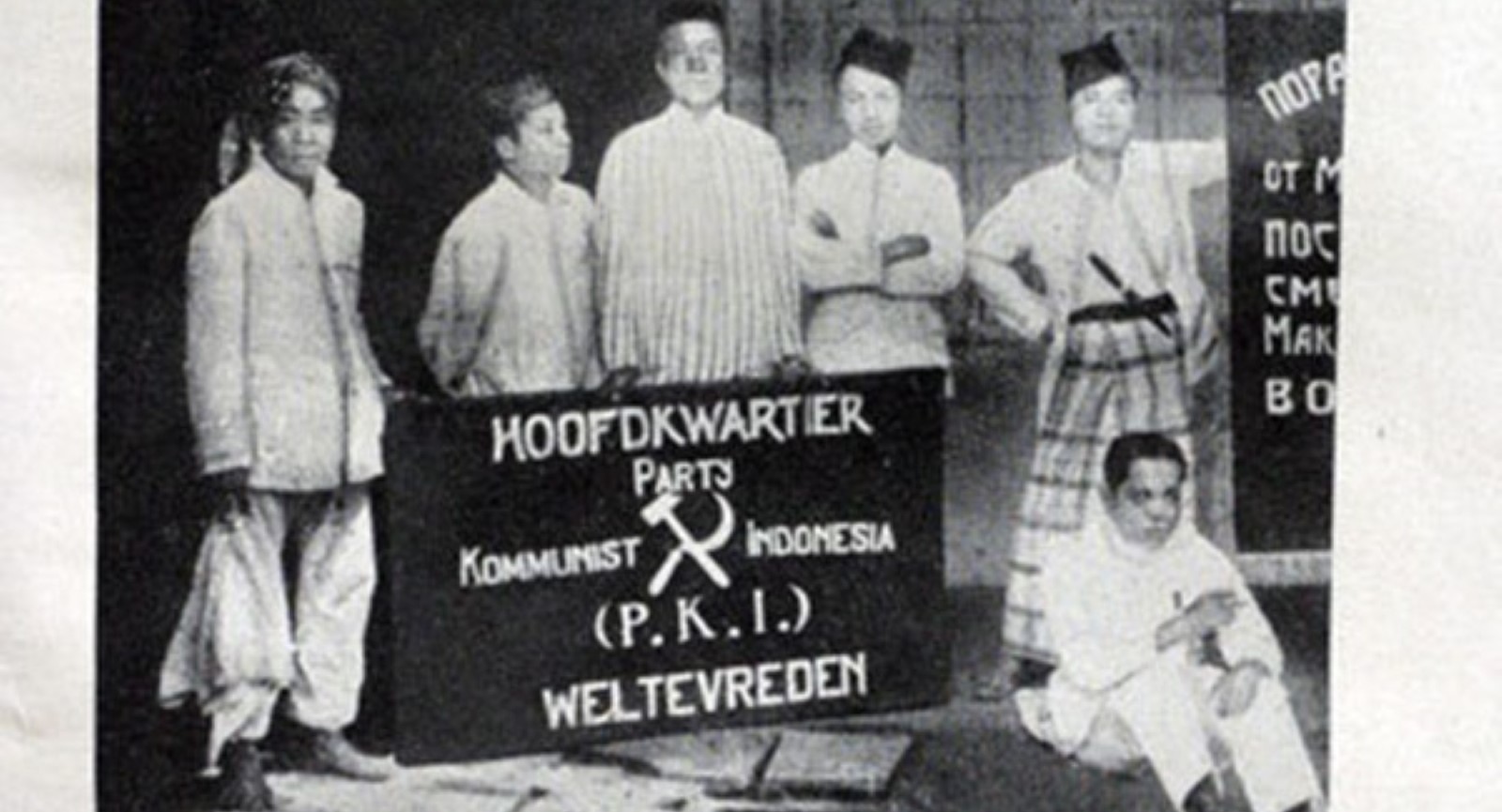
The P.K.I. was among the most vital and influential of the early Communist Parties in a colonial country. With a history far predating the Russian Revolution, it was the first Asian Communist Party to join the Comintern it was, in the first half of the 1920s, the largest Comintern section in Asia. Here is a valuable brief background on its origins.
‘The Communist Movement in the Dutch Indies’ by Prauiero from International Press Correspondence. Vol. 2 No. 68. August 12, 1922.
Before 1900, 95% of the population of the Dutch Indies consisted of peasants, most of whom owned parcels of land which were in communal possession. The Indian Nobility which is the lackey of the Dutch bourgeoisie, succeeded in subjecting this peasantry to its rule.
Because there was plenty of land, and because the economic living-conditions were generally satisfactory, the political oppression was not felt so strongly. The populace was satisfied, it lived simply and brotherly, and it was very peaceful and hospitable. The people of Java were the most patient people on earth. Thus it slept a peaceful, beautiful sleep that lasted decades.
In 1908, however, a great change began to take place.
The seeds of capitalistic development, carried by foreign (Dutch) capital, began to take root in the Dutch Indies. Numerous plants, small factories and workshops began to spring up as after a Spring rain. In 1916 there were already 200 million gulden of European capital invested in the Dutch-Indies; at present this sum has more than doubled.
It is self-evident therefore, that due to this speedy capitalization, the Indians became proletarianized. According to government reports, 45% of the population in 1921, were proletarians. This is the direct cause of the present movement in Dutch India.
And when European imperialism in India was so widespread that it was compelled by the European labor-shortage, to fill the slave-driving posts (superintendents, office-employees, bookkeepers, etc.) with natives, it chose for these positions the native nobility, (Pri-Ja-Ji). In 1918, this class founded the Bodi-Oetomo Society for the purpose of giving their children an education, a commodity heretofore monopolized by the European peoples. Up to this moment, 95% of the population are analphabets. Gradually the Bodi-Oetomo developed into a national party. Having remained faithful to their slave-driving tasks, this group sympathizes with the European imperialists, and is more militant than passive towards our revolutionary movement.
In 1912, the Indian Party was organized. This is the party of the Indos (hybrids), who dreamt of a free India. These Indos are to be put on a basis of equality with the natives, so that they may be of greater use in the oppression of the people. This party was at first revolutionary in its propaganda; gradually, however, particularly since 1913, when three of its foremost leaders were arrested, all that was left of its revolutionary development was a revolutionary phraseology.
Almost coincident with the formation of the Indian Party, arose the Sarikat-Islam in 1912. The Sarikat-Islam is the party of the native bourgeoisie, which preaches Mohammedan fanaticism, and which in this wise attempted to mobilize the people against all foreign capital. However, the native bourgeoisie stands no comparison with the European bourgeoisie or even with the British-Indian bourgeoisie. Domestic industry and commerce are still in their childhood of development, and they were nearly forced off the market by the appearance of European goods. Moreover, the policy pursued by the European capitalists had for its object, the elimination of the natives from the commercial field, and for this purpose to use Chinese, thus forcing the disarmed and oppressed people to a lower economic standard. For this reason, there is no chance for the existence of a strong national capitalist movement in the Dutch Indies, as is the case in British India.
But the Indian bourgeoisie is still in the attempt to displace the Chinese and European bourgeoisies; for this task it needs the aid of the masses. It was therefore necessary to create the Sarikat-Islam or People’s Party. As a result of this party’s propaganda, there occurred in the years 1912 to 1914, pogroms against Chinese. The Government stepped in, and suppressed the Sarikat-Islam, which since then, turned against the government. In the years of 1914-1916, the Sarikat-Islam broke down altogether, deserted by the peasant masses and semi-proletarians, who constituted its mainstay. These masses left the Sarikat- Islam and joined the Socialist and Communist movement.
In 1915, a little group of Dutch Socialists organized the Indian Socialist Society, which since the split of the social- patriots, bears the name: Indian Communist Party, Section of the Third International.
In 1915 the native members of the Party, partly workers, partly of the proletarianized gentry, began to proclaim and propagate the class-struggle in the Sarikat-Islam. In this work they were quite successful among the workers and peasants belonging to the party (mostly owners of land in communal possession). Thus in the years 1916-1921, the Indian Communist Party was the spiritual spur to all strikes and peasant movements. Under the pressure of the Communists, it was brought about that in 1921, the Sarikat-Islam adopted a resolution of principles, in which it proclaimed as its goal, a free Socialist India. In the program, many concessions are made to national and religious sentiment, but in a country like Dutch-India, this is historically comprehensible.
However, the Communists supplemented their activities in the S.-I. with a sharp critique directed against the old leaders. In this wise the Communists roused the ire of the old leaders, and in 1921, the latter succeeded in ejecting the “godless” and “international” Communists from the S.-I. The result was the splitting of the party into a wing led by the Communists, which is constantly expanding and is always prepared to fight, and another wing which is gradually losing the masses. The 200 members of the Communist Party in Java, have a greater influence upon the masses than the old leaders.
International Press Correspondence, widely known as”Inprecorr” was published by the Executive Committee of the Communist International (ECCI) regularly in German and English, occasionally in many other languages, beginning in 1921 and lasting in English until 1938. Inprecorr’s role was to supply translated articles to the English-speaking press of the International from the Comintern’s different sections, as well as news and statements from the ECCI. Many ‘Daily Worker’ and ‘Communist’ articles originated in Inprecorr, and it also published articles by American comrades for use in other countries. It was published at least weekly, and often thrice weekly.
PDF of full issue: https://www.marxists.org/history/international/comintern/inprecor/1922/v02n068-aug-12-1922-Inprecor.pdf
 Revolution's Newsstand