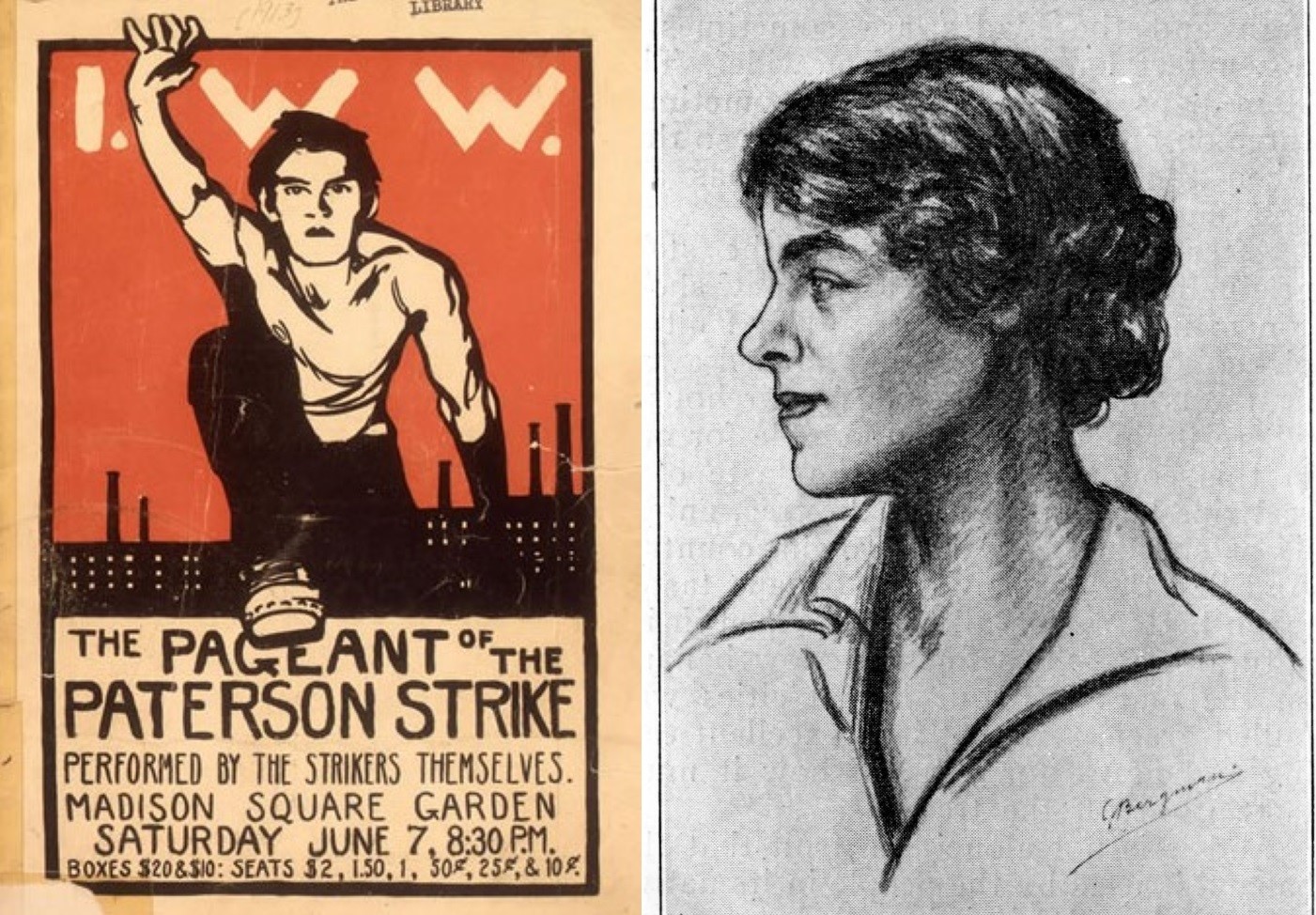
An editorial from Mary E. Marcy on the lessons of the 1913 Paterson Strike.
‘The Paterson Strike’ by Mary E. Marcy from International Socialist Review. Vol. 14 No. 3. September, 1913.
After a twenty-two-week display of the most wonderful solidarity ever shown in the United States, the Paterson strikers have gone back to work. They have gained a shorter workday and a militant organization that will put them in a far better position in the next battle.
Many of the demands of the strikers were not granted by the manufacturers, although it is acknowledged by all authorities that they would have gained all they fought for, in spite of every odd, if they had been engaged in the production of one of the necessities of life. Perhaps some day, when another tool of the National Manufacturers’ Association turns state’s evidence, we will know the true inside story of the Paterson struggle. It is certain that manufacturers stood together to withstand the strikers in an unprecedented manner, and doubtless the whole strength of the capitalist class was organized behind the scenes to aid the silk manufacturers and defeat the I.W.W.
The Paterson (N.J.) Press, a constant and violent enemy of the strikers, has the following to say about the strike:
“The strike has had one remarkable feature which the people of Paterson will never forget. It is, that although many thousand workers stayed away from the mills for five months, not only was there practically no violence, but the rank and file of the strikers behaved themselves during a trying time in a manner that entitled them to admiration. The Press believes that this phase of the great strike of 1913 stands without a parallel in this or any other country.”
The truth of the matter, in the judgment of The Globe, is that not the strikers, but the officials of Paterson, are the lawless ones, and it continues:
“Paterson is afflicted with anarchistic administration officers and with a judge and a public prosecutor who recall Jeffreys and his hanging-assistant. These stupid and wicked persons, when the strike began, thought to suppress it by breaking up peaceable meetings and preventing free speech and by making arbitrary arrests. The result has been the struggle has lasted five months and the estimated cost to the city is $5,000,000. As often as it was about to collapse the public authorities started it up again…Is it strange that the workers of Paterson are bitter of heart?
“Lawlessness does not pay. It does not pay labor organizations, as they have discovered, and hence the advice of Haywood to his pickets, “Keep your hands in your pockets!” Lawlessness does not pay in public officers, as Paterson’s five months of purgatory abundantly prove.”
Strikers declare that only the first part of the strike is over, as they mean to return to the silk mills with the full intention of cutting down their output, since they were unable to increase their actual wages. In other words, wages are to remain the same for a smaller product.
Meanwhile election time in Paterson is drawing near and the municipal officials are suffering anticipatory chills in the fear that the strikers will punish their enemies and vote their own comrades into office. Mayor William Brueckman, of Haledon, has given the Paterson workers a splendid example of how Socialists in office can practically serve the working class in their struggles against wage slavery.
If the Socialists in Paterson understand that they can offer the workers of that city actual help in times of trouble, and if they will discard the reformist junk that a Milwaukee administration would offer in such a crisis, they may have a good opportunity of carrying out their program.
But we Socialists must remember that, even if we had been in possession of the entire state and municipal government, we would have been unable to raise the wages of the Paterson strikers as long as the silk manufacturers OWNED the mills and capitalism endured. But Socialists in office can turn the clubs of policemen against the employing class instead of against the workers; they can render decisions against capitalist conspirators and anarchists and protect strike pickets. In other words, their only excuse for holding office would be to HELP THE WORKERS IN THE CLASS WAR.
Long ago Haywood said, “It is almost impossible for a small group of workers to win against the capitalist CLASS. This is why we advocate the GENERAL STRIKE. From now on we predict that it will be more difficult to win class conscious strikes in America, for the employing class is learning to make the battle of one small group of capitalists the business of ALL capitalists. In Paterson unheard of efforts were made to defeat the strikers. The capitalists stood together as one man.
The Paterson strike taught the workers from many lands the class character of all existing social institutions. It taught them that there are only TWO great nations–capitalist and working class–and that the interests of all workers lie in abolishing the Profit System. Every struggle of this kind adds thousands of revolutionists to the ever growing army that will be satisfied with nothing less than the final triumph of the working class.
M.E.M.
The International Socialist Review (ISR) was published monthly in Chicago from 1900 until 1918 by Charles H. Kerr and critically loyal to the Socialist Party of America. It is one of the essential publications in U.S. left history. During the editorship of A.M. Simons it was largely theoretical and moderate. In 1908, Charles H. Kerr took over as editor with strong influence from Mary E Marcy. The magazine became the foremost proponent of the SP’s left wing growing to tens of thousands of subscribers. It remained revolutionary in outlook and anti-militarist during World War One. It liberally used photographs and images, with news, theory, arts and organizing in its pages. It articles, reports and essays are an invaluable record of the U.S. class struggle and the development of Marxism in the decades before the Soviet experience. It was closed down in government repression in 1918.
PDF of full issue: https://www.marxists.org/history/usa/pubs/isr/v14n03-sep-1913-ISR-gog-ocr.pdf
 Revolution's Newsstand