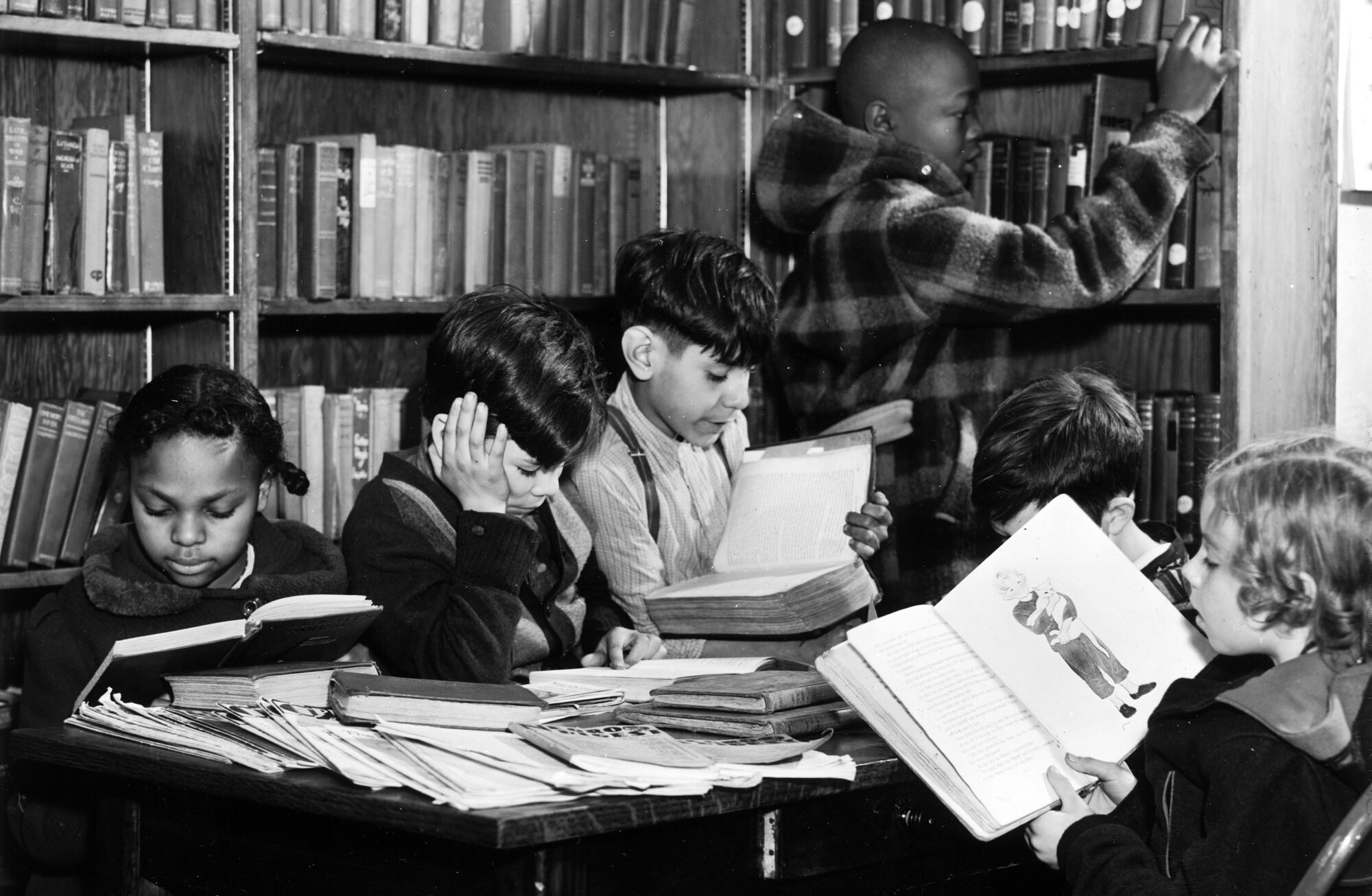
The inoffensive public library has long been the site of major class battles; in the fight for services and the appropriation of funds; for organizing rights and good conditions for public employees; and, most dramatically, as a site of ideological conflict and access to education. A report on a gathering of librarians facing the Great Depression below.
‘The Myth of the Free Public Library’ by Jean Simon and Paul Reynolds from New Masses. Vol. 20 No. 2. July 7, 1936.
“The free public library is a distinctly American contribution to civilization…” President Roosevelt, in his radio address to the Friends of the A.L.A. Library Luncheon (from which Negro delegates were excluded).
TEACHERS and campaign orators are fond of quoting the saga of Abraham Lincoln, who walked many miles in wind and rain to borrow–and return–a tattered copy of the Life of George Washington. Those were pioneer days. The inference is, of course, that today, under our “distinctly American” library system, books are everywhere available for those who can read them.
This cherished myth of the democratic Free Public Library–the slogan of the American Library Association is “the greatest number of books for the greatest number of people” was definitely exposed, as such, at the recent conference of librarians which was held in Richmond, Virginia. The desperate plight of the libraries ran like a disturbing stream through the entire convention, burying itself temporarily in endless reports on cataloguing and microphotography, public documents, bibliography, rising again in meetings on Federal aid to libraries, rural library service, adult education.
In the keynote opening address by Louis Round Wilson, president of the A.L.A., it rose like a flood, rousing the delegates, assembled to hear a polite speech of welcome, from the half stupor engendered by Richmond heat and habitual inertia. One delegate fainted and was carried out, and still Dr. Wilson continued quietly with his politely damning analysis:
“…until 1929 all our energies were absorbed in the expression of library activities incident to the rise of library incomes. Then with a suddenness that was breath-taking we plunged into the most profound depression America has known…In this maelstrom library revenues dropped to unprecedented depths, circulation mounted to unprecedented heights…The first task which confronts the A.L.A. today is to provide library service to the 45,000,000 people who are now without it…”
Those who shuddered when news reached them that Nazi Germany, in an attempt to cauterize its economic and political wounds, burned books may find worthy of consideration the fact that under our present “distinctly American” library system 45,000,000 Americans (or one person in three) have no access to books at all so far as public library facilities are concerned. Over 80 percent of the people of North Dakota, Arkansas and West Virginia are without library service. The same tragic situation holds true for 60 to 80 percent of the population in thirteen states, from 40 to 60 percent in eleven states, from 20 to 40 percent in ten states. In the remaining eleven states 20 percent are without such service. Of the estimated 55,000,000 of our rural population 40,000,000 people are without libraries.
According to American Library Association estimates, adequate library service demands a minimum of one dollar per capita per year. Yet in 1935 the country spent only 37 cents per capita. The expenditure of certain southern states is indicative of an appalling and cynical disregard of the cultural needs of human beings: Mississippi and Arkansas, 2 cents; New Mexico, 5 cents; Alabama, North Carolina, West Virginia, Louisiana, 6 cents. (When we realize that in the South Negroes are not permitted to use the public library except in Jim Crow branches we can only assume that under such pitifully small appropriations, Negroes have no library facilities whatsoever except in a few large cities.) Only ten states in the United States spent more than half the necessary minimum. Massachusetts, with an expenditure of $1.08, ranked highest.
Only $10,000,000 has been added to the library income from 1925-1935 but the increase in book circulation has been 215,000,000. Books have been used 200 percent more but there has been an increase of only 45 percent in library income. While hundreds of millions of dollars are being spent for “defense,” public libraries received a bare $45,000,000 in 1935.
Obviously then, the A.L.A.’s avowed democratic aim of “the greatest number of books for the greatest number of people,” and, they did not neglect to add, “at the least possible cost,” is still mere convention talk. With budgets cut to the bone the librarian finds himself faced with the problem: books for whom? services for whom? Some librarians find it simple enough to make a choice. Ralph Munn, director of the Carnegie Library of Pittsburgh, categorically stated that branch libraries in slum areas were not a “proper charge of a public library.” He suggested that such work might be turned over to the Salvation Army! Perhaps Mr. Munn’s too intimate contact with the Mellons and his other steel corporation trustees has somewhat dulled his social viewpoint.
At an Adult Education roundtable at Richmond, to which librarians eagerly flocked to participate in what promised to be one of the few free discussions, this problem of inadequate appropriations faced them at every turn. In the midst of much fine talk on expanding the functions of the library to adult educational movements, Miss Flexner, readers’ adviser of the New York Public Library, protested the futility of reaching out for new readers when libraries are unable to take care of readers on their own doorsteps. It becomes clear then that in the American free public library system, as in American education generally, democracy is still a luxury.
What is to be done? Before the convention had closed many librarians were reaching their own conclusions. Dr. Frank P. Graham, president of the University of North Carolina, suggested that wealth should be taxed to provide for the “45,000,000 Americans now without books.” In some cities committees of workers and professionals have organized to demand larger appropriations to provide adequate library facilities for themselves and their children. The A.L.A. is definitely committed to a demand for Federal aid. But the ultimate answer to the problem is militant organization of the rank-and-file librarians themselves who, realizing that their situation is inseparable from the public which they wish to serve, will demand, as part of their professional program, sufficient appropriations for (1) the service to the public, which includes not only books but adequate personnel; (2) better wages and working conditions for themselves; (3) security in the form of tenure and pensions.
At present, the number of militant staff associations is small when compared with those in other professions. Everyone knows that Library employes are notoriously underpaid, but the general public scarcely can be expected to realize the pressure under which most of them work. The increase in the number of borrowers and in book circulation, the curtailment of staffs either by firing or failure to hire more workers to meet the growing needs have resulted–to borrow a term from industry–in terrific speed-up. The resentment of library workers was expressed in a letter recently written by an indignant librarian to The Wilson Bulletin:
“But don’t we work? All the calloused feet, the broken arches, the roughened, ink-stained hands, are painful proof. As for the air we breathe, the dirty books we handle, long hours and low pay checks, our working conditions and scale of living are not far above those of the proletariat we are supposed to scorn.”
Some official figures recorded in the American Library Association Bulletin for April, 1935, might serve as further “painful proof.” Among the professional library workers the largest single group is the professional assistant. According to the A.L.A. definition, he is one who has had (1) a bachelor’s degree plus a year of professional education or (2) including a year of professional education or (3) an informal education considered as the real equivalent of four years of college work plus five years of experience in a library of recognized professional standing.
Just what do these highly-trained professional assistants receive in dollars and cents? They work, on an average, forty hours a week. Their schedules are abominable; few of them work less than one night a week, many two or three nights. For this they receive from $540 a year (as in Muskogee, Oklahoma, population: 32,026) to $2,640 (as in New York City). This maximum of $2,640, which is received by incredibly few, is astonishingly small in comparison with maximum salaries in other professions. And New York City also pays many of its professional assistants as low as $1,320 a year. Boston pays salaries ranging from a minimum of $870 to a maximum of $1,510; Birmingham, from $851 to $1,027. Tampa pays as little as $600; Kansas City, $760. A rough national average might fall between $20 to $25 per week–a munificent recompense for the expensive investment in training. And the salaries of clerical workers and other non-professionals are proportionately lower.
In the Committee’s report the observation that “in a majority of cities librarians are expected to consider gentility and love of work to be a large part of their compensation” is indeed a depressing commentary. But this may explain why librarians have not organized as widely as their fellow professionals in the schools, social services, newspapers, etc. While teachers marched on City Hall, librarians meekly submitted to pay cuts and outrageous speed-up. It is necessary to remember the composition of the average library staff to understand this. Library work has always been considered the ideal way of life for the minister’s daughter, the “bookish” girl, the spinster dependents of the richest trustee, with all the implications of their tradition.
But this type of personnel is rapidly changing. The influx into the profession of young, trained workers, many of whom have waited on tables to support themselves through college, of young men who find other professions more and more difficult of entry, of the W.P.A. workers, trained in militant action, working shoulder to shoulder with the professionals, is creating a new type of librarian–one who thinks in terms of organization and protection for himself and his fellow workers, rather than of “gentility and love of work.”
One of the clearest indications of the growing importance of organization among librarians—more euphoniously termed, for library consumption, “staff associations”–is the fact that for the first time a meeting was called at an A.L.A. convention to discuss staff-association policies. The wide response to the call surprised even its sponsors. Answers to the questionnaire distributed at a staff association dinner indicated that the staff associations had gone far beyond the stage when they existed primarily to plan picnics and compile lists. Staff associations are now recognized as a definite means of protecting pensions, improving working conditions, raising salaries, establishing credit unions and for compelling increased appropriations–for the dual task of protecting themselves and providing adequate service to the public.
Some of these young organizations already have a history of struggle behind them. The Library Workers Union of the New York Public Library, with a membership drawn chiefly from pages and stack boys, was organized to combat wage-cuts and dismissals and to obtain better conditions. The New York Public Library Staff Association, composed of professional workers, has succeeded in creating out of an inflexible, half-moribund Staff Association, one of the truly representative and democratic staff organizations in the library world. (It is significant of the change here, that at the moment the Union is contemplating a merger with the professional organizations.) The Library Discussion Group of Seattle, by an active program of publicity and education, succeeded in forestalling a budget cut. The first Librarian’s Union has been chartered under the A.F. of L. (local 19178) at Butte, Montana. “I do not think it is possible,” writes the secretary in The Wilson Bulletin for June, “to describe the feeling of security that came to us, when we knew that we had backing in our fight for the only free institution available to everyone in our community.”
The New Masses was the continuation of Workers Monthly which began publishing in 1924 as a merger of the ‘Liberator’, the Trade Union Educational League magazine ‘Labor Herald’, and Friends of Soviet Russia’s monthly ‘Soviet Russia Pictorial’ as an explicitly Communist Party publication, but drawing in a wide range of contributors and sympathizers. In 1927 Workers Monthly ceased and The New Masses began. A major left cultural magazine of the late 1920s and early 1940s, the early editors of The New Masses included Hugo Gellert, John F. Sloan, Max Eastman, Mike Gold, and Joseph Freeman. Writers included William Carlos Williams, Theodore Dreiser, John Dos Passos, Upton Sinclair, Richard Wright, Ralph Ellison, Dorothy Parker, Dorothy Day, John Breecher, Langston Hughes, Eugene O’Neill, Rex Stout and Ernest Hemingway. Artists included Hugo Gellert, Stuart Davis, Boardman Robinson, Wanda Gag, William Gropper and Otto Soglow. Over time, the New Masses became narrower politically and the articles more commentary than comment. However, particularly in it first years, New Masses was the epitome of the era’s finest revolutionary cultural and artistic traditions.
PDF of full issue :https://www.marxists.org/history/usa/pubs/new-masses/1936/v20n02-jul-07-1936-NM.pdf
 Revolution's Newsstand