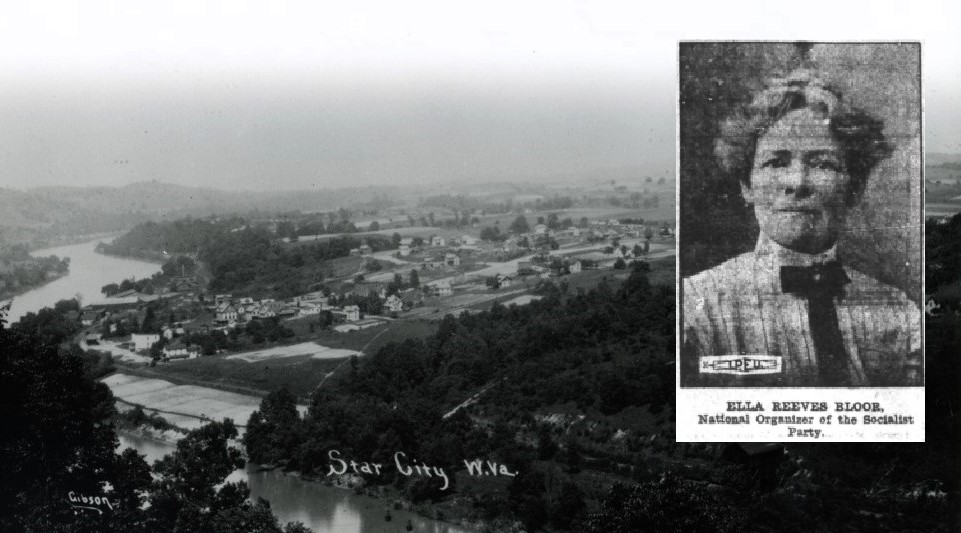
The small glass-producing town of Star City, West Virginia was politically dominated by the Socialist Party for a decade, winning the mayor and four of five council seats in 1910.
‘The Socialist Women of Star City, West Virginia’ by Ella Reeve Bloor from The Chicago Daily Socialist. Vol. 5 No. 102. February 23, 1911.
You have heard, no doubt, of the “Little Milwaukee” Star City. W. Va., but do you know how the women helped to elect the Socialist mayor and five councilmen?
In the first place, these women, wives, mothers and sisters of glass blowers, gradually being displaced by the machine, had for many months studied Socialist literature and regularly taken two papers, the Appeal to Reason and the Chicago Daily Socialist.
They went from house to house talking Socialism to their neighbors and helping the men to organize a Socialist local long before any speaker had ever been sent to then.
Finally, when the election day came, with a full Socialist ticket in the field, they went to the polls and made coffee all day long for the voters, and they did not mind at all when some of the men called it “Socialist coffee.”
We know that those women at the polls, with their earnest, determined faces, with red ribbons on their breasts, must have been a powerful influence in making the glass blowers of Star City rote for their class interests and their home interests that day when the Socialists won.
A Socialist organizer has many joyful and some sad experiences, but never a more inspiring one than mine at this place.
Arriving after dark, homesick and tired, after an all day’s journey, as we stood on the platform looking for a red button, about thirty men, with their wives and mothers, decorated with red badges, rushed forward and right there at the railroad station gave three cheers for Socialism.
The whole town knew that the Socialist speaker had come. And the long tramp up the steep, muddy hill seemed like a triumphal procession.
What mattered if our shoes did have to be washed off in a bucket of water before we could go on the platform, or that we fell many times in the yellow mud.
It was a time for joy.
Here were militant men and women actually conquering the political forces together.
At the meeting which followed, nearly every woman in the town attended, in some cases carrying their babies. The men were very proud to think that the women understood this striving after industrial freedom through the political party of Socialism.
We talked of our vision of the days to come when women will have a chance to be better mothers, and children have a right to be born into the world as “welcome children,” when the workers can give their children all the beauty and joy and culture that the owning class in society lavishes on their children so freely today.
The faces of these mothers lighted with hope shining through their tears, and they, one and all, pledged themselves to work more earnestly than before for the cause of Socialism, and the men of Star City vowed that they would work with all their might to secure for these brave women comrades the right to VOTE with them.
It is a noticeable fact that every where along the line the women, especially of these terribly exploited states, are lining up with the men.
In the coal mines of West Virginia, the oil fields and the railroad centers, everywhere, are the women eager to take up their political responsibility and to help the men to redeem our class from child slavery and all the hideous forms of wage slavery.
The Chicago Socialist, sometimes daily sometimes weekly, was published from 1902 until 1912 as the paper of the Chicago Socialist Party. The roots of the paper lie with Workers Call, published from 1899 as a Socialist Labor Party publication, becoming a voice of the Springfield Social Democratic Party after splitting with De Leon in July, 1901. It became the Chicago Socialist Party paper with the SDP’s adherence and changed its name to the Chicago Socialist in March, 1902. In 1906 it became a daily and published until 1912 by Local Cook County of the Socialist Party and was edited by A.M. Simons if the International Socialist Review. A cornucopia of historical information on the Chicago workers movements lies within its pages.
PDF of full issue: https://www.marxists.org/history/usa/pubs/chicago-daily-socialist/1911/110223-chicagodailysocialist-v05n102.pdf
 Revolution's Newsstand