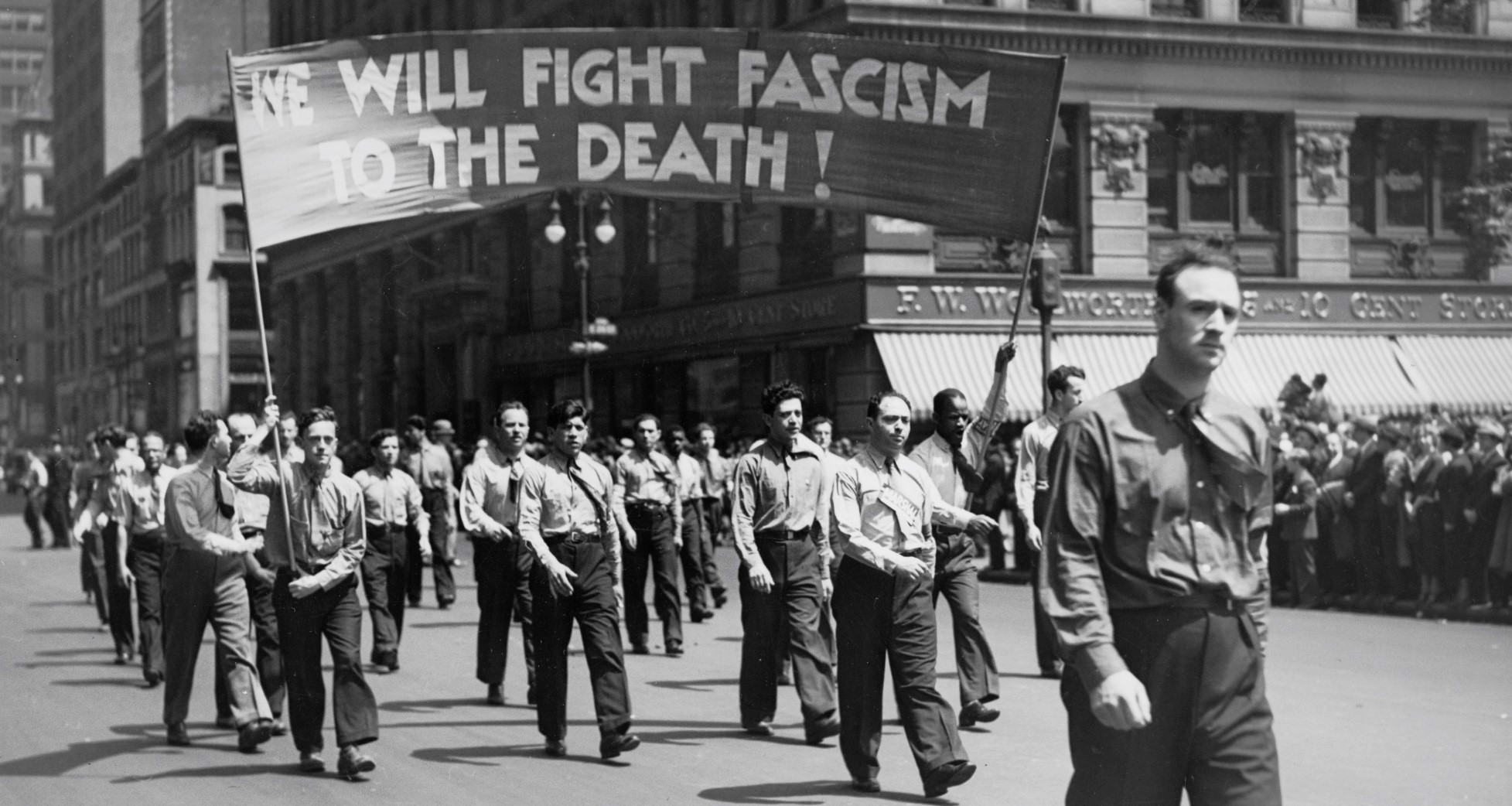
Foster analyzes a growing, confident U.S. fascism in light of the changed framework and shift in orientation codified at the Comintern’s Seventh, and last, International Congress in 1935. Gone was the category of ‘social fascism’ and in came an appeal for an ‘anti-fascist’ front of Communists, Socialists, and non-working class forces, including farmers and the ‘city petty bourgeoisie,’ to be united in a new political party; the Popular Front.
‘Fascist Tendencies in The United States’ by William Z. Foster from The Communist. Vol. 14 No. 10. October, 1935.
FASCISM, in its semi-developed American forms, is now beginning to loom up as a real danger in the United States. This is a matter of grave concern, not only for the American revolutionary movement but also for the whole Communist International. For a serious advance of fascism in the United States would stimulate fascism in all capitalist countries and would gravely accentuate the danger of war against the U.S.S.R.
The immediate cause of the growth of American fascist tendencies is the inability of the capitalists to overcome the prolonged crisis and the present special type of depression. The capitalists have been quite unable to restore industry to a “prosperity” basis. Both the Hoover and Roosevelt governments have poured out billions of dollars “to prime the industrial pump”, but industry stubbornly lags far below 1929 levels and farming remains in a profound crisis.
The deep and protracted economic crisis is rapidly sharpening all the inherent contradictions of capitalism in the United States, including antagonisms (a) between the working class and the capitalist class; (b) between the urban petty bourgeoisie and the capitalists; (c) between the farmers and the capitalists; (d) between various groups within the ranks of the monopoly bourgeoisie itself; (e) between the decisive part of finance capital and groups of the bourgeoisie representing local and state interests (silver, cotton, tobacco, etc.); (f) between the U.S. and other imperialist and colonial countries; (g) between the bourgeois world and the U.S.S.R.
These sharpening contradictions are intensifying the American struggle on every front. They are narrowing the social basis of the bourgeoisie by bringing it into conflict with growing millions of workers, farmers and city petty bourgeoisie. Thus the big capitalists are finding it more and more difficult to rule by their traditional methods of parliamentary democracy, concessions to the labor aristocracy, international diplomacy, etc. Consequently their most decisive section, finance capital, in order to re-establish its narrowing social base, is being compelled to strengthen its offensive against the masses by policies which tend in the direction of fascism.
THE RADICALIZATION OF THE MASSES
The most decisive facts in gradually pushing monopoly capital towards a fascist course are its settled policy of thrusting the burden of the crisis upon the workers and other toiling masses and its fear of their growing resistance which it realizes is a serious threat to the bourgeois dictatorship.
With crassest brutality, the big capitalists have compelled the toiling masses to bear the brunt of the economic breakdown. Although they have greatly increased their own profits (the National City Bank reports that 1,453 companies with a deficit of $97,000,000 in 1932 made profits of $1,051,000,000 in 1934), they have forced the masses of workers and small farmers down to an unheard of pauperization. Living standards have fallen catastrophically and continue to decline. From twelve to fifteen million workers remain unemployed. Great multitudes of farmers and small businessmen have been utterly bankrupted and this process continues. About 22,000,000 toilers and their families are eking out a miserable existence upon the niggardly government relief, and at least one-third of the whole American people have been reduced to standards that mean not only hunger and misery, but actual physical degeneration.
But the toiling masses have not submitted to this monstrous pauperization without resistance. On the contrary, the United States for the past three years has been a scene of intense and increasing class battles, both economic and political.
Among these struggles are: the most intense wave of strikes in American history; a broad struggle of the unemployed for unemployment insurance and relief; strikes and other struggles of the poorer farmers against low farm prices and monopoly control; a wide and insistent movement among war veterans for the soldiers’ bonus; a strong agitation among the Negro masses for equality; big anti-war strikes and other demonstrations among students; an extensive movement of the aged for government pensions; struggles of the petty bourgeoisie against trustification and high taxes; wide radicalization among intellectuals, etc.
Never were the masses so stirred. They are conducting their struggles with unparalleled tenacity and bitterness. They are awakening politically and manifestly beginning to shed their capitalistic illusions. They are starting to think, however confusedly, in terms of revolution. The U.S.S.R. gains in popularity among them. The trade unions have grown and strengthened their position in industry. A new spirit of unity and militancy grows on all sides.
In this rising wave of struggle the Communist Party is playing a considerable and an increasing role. Although our Party has only about 30,000 members, its influence extends over many times the number. Upon various occasions it has been able, despite its many palpable weaknesses and failures, to utilize its opportunities, to lead, wholly or partially, very important struggles. Examples of the growing extent of its influence are: (a) Communists and their united front allies led the big maritime general strike on the Pacific Coast in 1934, out of which grew the great San Francisco general strike; (b) the Party has so successfully popularized its Unemployment Insurance Bill that it has been directly supported by at least a couple of million workers; (c) in New York City, where the Party has 8,000 members, it staged a demonstration of 200,000 on May First, 1935; (d) our Young Communist League comrades were prominent leaders in the recent united front youth conference at which there were represented 1,300,000. These are, of course, the very best examples of our Party’s work in leading the mass movement; but they serve to give an idea of the growing influence and possibilities of our Party, especially in those situations where it is able to overcome its traditional sectarianism and militantly to carry through the united front policy.
THE FASCIST DANGER
The bourgeoisie are amazed and shocked by their inability to overcome the economic crisis and the multiplying political difficulties growing out of it. They are alarmed at the rapid radicalization of the workers, the rising tide of struggle, the growing strength and influence of the Communist Party. In years past, especially during the “prosperity” period of 1923-29, the capitalists had confidently assured themselves that the workers were hopelessly poisoned with bourgeois illusions; and, as during the first three years of the crisis, the workers, misled and demoralized by their trade union and Socialist leaders, took blow after blow without resistance, the capitalists hypocritically gloated over them, praising them for their patriotism, good sense and courage in accepting the crisis burdens placed upon them.
But now these same capitalists are astonished and alarmed to see the great American working class beginning to arouse itself and to go into battle with real militancy and solidarity. Such a situation interferes badly with the capitalists’ plans further to slash living standards and to keep the whole weight of the crisis on the toilers’ shoulders. So they are proceeding to try to crush the growing struggle by developing a demagogy and violence which takes on more and more of a fascist character.
The history of the American class struggle is full of violence against the workers; indeed, prior to the World War, in no country, except tsarist Russia, was there such a record of bloody and hard fought strikes as in the United States. But never was the violence against the workers so extensive as during the past three years. In scores of strikes and other struggles there has been an extreme use made of troops, police, murderous gangs of vigilantes, etc., against the toilers in struggle. This reached a high pitch in the San Francisco general strike, when the greatest mobilization of armed forces in American labor history took place. In line with this use of violence against the workers are the facts that, as never before, the industries are infested with strikebreaking arbitration boards and the legislative bodies of the country are cluttered with bills calling for the outlawing of the Communist Party, undermining of the trade unions, etc.
In sum, the capitalists in the United States are developing a growing political reaction in order to combat the developing class consciousness and struggle of the toilers. And among the most decisive section of the bourgeoisie, finance capital, this political reaction tends to develop definitely in the direction of fascism.
FASCIST TENDENCIES
What we have to deal with in the United States is not a well-defined fascist movement, but a series of more or less definite tendencies making towards fascism. These tendencies range from quite conscious fascist groups to movements which, while not definitely fascist, nevertheless create favorable conditions for the growth of fascism.
Let us begin with the Roosevelt government. Today this government is increasingly under fire from the most reactionary groups of monopoly capital, which are the main source of fascist tendencies and organizers of the fascist movement; because these elements, in first line, resent Roosevelt’s trade union policy which they hold responsible for the many strikes. The liquidation of the N.R.A. means the victory of the most reactionary elements which demand the most unmerciful and open offensive against the working class. This victory strengthened the position of the fascist group among the monopolist capitalists. The most reactionary group of finance capital consider the N.R.A. has exhausted its benefits for them. But for the first two years of his term they gave Roosevelt substantial support. And despite Roosevelt’s liberal trends, phrases and demagogic promises (and of the group of finance capitalists which he represents) there are tendencies also in his policies which give direct stimulus to fascist growth. Among these tendencies are: strengthening of finance capital through trustification, support of economic nationalism, increased war preparations, reductions of living standards of the masses, encouragement of company unionism, extensive use of legal and extra legal violence against the workers and farmers, discrediting of parliamentary government and popularization of the notion of a one-man savior of the country, pouring out a flood of demagogy about the “forgotten man”, etc. And it is significant to note that the Roosevelt industrial code policies (the N.R.A.) originated in the United States Chamber of Commerce (organ of finance capital) and were hailed by many of their supporters as first steps towards a fascist corporate state in the United States.
But the main stream of fascist development is at present to be found in a series of other more or less definitely fascist or semi fascist demagogues, groupings and organizations of extended mass influence. Among these are:
The American Liberty League group of capitalist ultra-reactionaries, headed by Herbert Hoover and Al. Smith. This powerful organization supported by Dupont, General Motors and other big capitalist concerns, has in its ranks many large Wall Street financial interests that are actively propagating fascist tendencies.
The American Legion. The leadership of this strongest of the war veterans’ organizations (769,908 members), is saturated with fascist spirit and constantly carries on violent anti-red agitation.
W.R. Hearst, America’s greatest newspaper publisher. He is a crony of Hitler and prosecutes a rabid anti-Communist, anti-Soviet campaign through his vast chain of publications with several million readers, especially among the city petty bourgeoisie and more backward workers. With huge personal resources and powerful financial capitalist support, he tends to become the main center of the growing fascist agitation. He has big influence among the leadership of the American Federation of Labor and American Legion and he maintains working relations with the Right-wing leaders of the S.P.
Father Coughlin, a Catholic priest. He speaks weekly over the radio to millions of listeners and claims (doubtlessly exaggerated) a definite membership of 200,000 and a following of five millions in the National Union for Social Justice. A powerful and dangerous demagogue, he specializes in pseudo-attacks upon the great bankers and violent assaults upon the Communist Party and the Soviet Union. His cure-all is inflation and his motto is “shoot the Communists”. He has a huge influence among the farmers, city petty bourgeoisie and Catholic immigrant workers and is credited with having defeated Roosevelt in the latter’s attempt to affiliate the United States to the World Court of the League of Nations.
Huey Long, U.S. Senator from Louisiana. This semi-fascist demagogue has a dictatorship in his own State, such as no other American State has ever before seen. His demagogic program is to expropriate partially the great capitalists and to “share-the-wealth”, giving everybody an income of $5,000 yearly. He has behind him a nebulous organization of “share-the-wealth” clubs, with fabulous membership claims. He has a broad mass following throughout the South among the impoverished small farmers and workers. His popularity nationally is growing and he nourished presidential ambitions.
Matthew Woll, Major Berry and some other top leaders of the American Federation of Labor, who form a definitely reactionary clique. They are allied with various semi-fascist groups and, doubtless, as the fascist movement develops they will play a leading role in it.
Besides the foregoing, there are many more popular ultrareactionary demagogues whose agitation goes to feed the growing fascist stream: such as General Johnson, first chief of the N.R.A.; Raymond Moley, former head of Roosevelt’s “Brain Trust”; Hamilton Fish, wealthy New York Congressman; Bernarr MacFadden, rich magazine publisher, etc.
Then there are various fascist and semi-fascist organizations of vague membership, but growing influence. Some of these, such as the Crusaders, Ku Klux Klan, Order ‘of 76, Silver Shirts, Grey Shirts and many others with ambitious would-be Hitlers and Mussolinis at their heads, are made up chiefly of native American elements. Others, such as the Friends of New Germany and similar organizations among the Italians, Poles, Bulgarians, Jugoslavs, etc., are more definitely fascist and are working energetically among their respective nationalities.
Besides all these fascist, semi-fascist and part-fascist tendencies and groupings, there have sprung up like mushrooms several broad mass bourgeois reformist movements, such as Sinclair’s “Epic”, Townsend’s old age pension movement, the Utopians, etc. While the leaders of these organizations cannot be classed as fascists or even semi-fascists, undoubtedly their demagogic programs, denunciations of Communists, etc., create favorable conditions for fascist agitators.
The many fascist and semi-fascist demagogues and organizations penetrating the masses constitute a real menace. Vast numbers of the hungry, confused and politically unorganized and inexperienced masses, seeking a way out of their intolerable situation, are falling victims to the increasing flood of reactionary and fascist demagogy. These masses consist not only of the urban petty bourgeoisie and farmers, but also workers. No reliable statistics or other clear indications are yet at hand to show to what extent this specifically American fascist agitation has penetrated the masses, but that it has made such headway is manifest. The Communist Party is making considerable progress in winning the masses, but the fascist, semi-fascists and other reactionary capitalist demagogues are going much faster. They are undoubtedly establishing a broad mass base; the plain lesson of which is that we Communists must double and treble our united front fight against fascism.
The rapid growth of fascist tendencies in the United States emphasizes what a great error it is to suppose that there can be no real danger from fascism unless there is a far advanced revolutionary crisis or unless the country is one of those defeated or semi-defeated in the war.
THE PRESENT PROGRAM OF FASCISM
The finance capitalist character of American fascism is plain. Many of the most outstanding fascists and semi-fascist demagogues, such as Hearst, MacFadden and Fish, are wealthy capitalists themselves and linked up with the most powerful financial interests in America and the others, such as Coughlin, Long, Woll, Johnson, etc., have had their big capitalist connections fully exposed. Also the recent Dickstein Congressional Committee (a very reactionary body) was compelled reluctantly to show that big New York banking interests are permeated with fascist sentiments and that some of them had actually planned a mass march upon Washington, to be led by General Smedley Butler. Wall Street is clearly the home address of American fascism.
The present-day activities of the fascist and semi-fascist agitators and groupings conform to the interests of finance capital. It is true that the American fascist trend, as I have already indicated, is unorganized and not fully defined. Its status is one of confused ideas and loose organizations. Often the fascist tendencies are contradictory and antagonistic to each other. These contradictions reflect the conflicts with the bourgeoisie itself. “They indicate that the bulk of monopoly capital has not fully embarked on the road to fascism as the only way out of its increasing difficulties. Nevertheless, there is a gradual process of coming closer together and clarification of fascist aims going on. Out of the welter of fascist and semi-fascist tendencies the following propositions, which dovetail generally with finance capitalist interests, may be taken as the immediate, actual program of the incipient American fascism.
a. A gigantic campaign of demagogy to hoodwink the toiling masses in order to prevent them developing programs, organizations and struggles of their own. Outstanding features of this demagogy are: sharp verbal attacks on the trusts and “Wall Street”, and the “international bankers”; programs of inflation; “share-the-wealth”; “soak the rich” tax measures; unemployed “self-help” schemes, fantastic old age pensions; illusory “security” programs; utopian plans to abolish poverty; ridiculing of parliamentary government; vague talk of “a new social order”, etc.
b. Behind this barrage of radical demagogy, however, the fascists and semi-fascists pursue actual policies that result in direct or indirect support of the big bourgeoisie’s program of wage-slashing, strikebreaking, company unionism, trustification, hostile labor legislation.
c. In general, they also display an intense economic and political nationalism, exemplified by intransigent support of all the major objectives of American imperialism, including increased war preparations, high tariffs, collection of war debts, conquest of foreign markets, hostility to the League of Nations, etc.
d. The growth of fascist sentiments is marked by an increased use of violence against the masses in struggle, not only of troops and police, but also of vigilante groups, lynch mobs, etc.
e. Violent attacks upon the Communist Party and attempts to illegalize it or wreck it by violence.
f. Violent slander campaign against the Soviet Union.
g. Intensification of prejudices against Negroes, Jews and foreign-born.
h. Cultivation of sectional chauvinism—Long’s stimulation of anti-Northern prejudice in the South, which is still smarting from its defeat in the Civil War; and Coughlin’s incitement of the agricultural West against the industrial East.
i. General cultural reaction, including intense cultivation of religion, reactionary trends in literature and science, and censorship of motion pictures, radio and theatre.
SPECIFIC CHARACTERISTICS OF AMERICAN FASCISM
American fascism develops under its own special forms and slogans. It is vitally necessary that our Party study these specific characteristics, their hidden and masked forms and maneuvers. This, however, it has not yet done adequately. It has not sufficiently analyzed the process of American fascization as a whole, especially to evaluate those features that are peculiarly American. Consequently, a number of wrong tendencies have developed in our fight against fascism, which the Central Committee strives to overcome. Among these are:
a. A tendency in our mass agitation to separate the question of fascism from that of the general employers’ offensive against wages, hours, working conditions, etc.; that is, to make of fascism only an anti-red issue, instead of a broad class issue. Such a tendency, if continued, would lead to the isolation of the Party from the masses and make impossible a broad united front fight against fascism.
b. A tendency to concentrate attention upon Italian and German types of fascism in the United States, instead of upon the special forms, because of different objective conditions, that fascism as a mass movement is assuming in America. This tendency fails to see the really dangerous section of the fascist movement, the specifically American expressions of fascism.
c. A tendency to class definitely as fascism all forms of bourgeoisie reaction, including such movements as Sinclair’s, Townsend’s, etc., and also to apply the term “fascist” indiscriminately to reactionary and reformistic trade union leaders and organizations. This tendency would concede to the fascists valuable forces that we can readily win for struggle against fascism.
We must correct these theoretical weaknesses at once. We must look closely to the special features of American fascism; it is not enough to know the trend of fascism in general. Therefore, in the following pages I shall discuss four specific phases of American fascism. These are the questions of the tempo of fascist development, the central fascist slogans, the fascization of the State, and the organization of a fascist party.
1. The Question of the Tempo of American Fascist Development. A major specific feature of fascism, or semi-fascism, in the United States is its rapid tempo of development; that is, its appearance as a mass movement at a relatively earlier period in the class struggle than fascism occurred in either Italy and Germany. In those countries when fascism assumed mass form the revolutionary crisis was far developed and the bourgeoisie faced a menacing threat of imminent proletarian revolution. But fascism, in its American forms, is developing on a mass basis in the United States under much less acute conditions of class struggle. Although in the United States the economic and political difficulties of the bourgeoisie are great and the class struggle is being rapidly intensified and while the American capitalists are viewing with great alarm the stubborn economic crisis, the radicalization of the masses, the growing wave of struggle, the strengthening of the hated and feared Communist Party and the revolutionary example of the Soviet Union, they nevertheless do not yet possess the mortal fear of impending revolution to the extent that the Italian and German bourgeoisie did, nor the Spanish or Austrian capitalist classes.
The American imperialist bourgeoisie are gradually seizing upon fascist methods more for the purpose of intensifying their drive to reduce the present living standards of the toiling masses and break their growing resistance. It is chiefly in this sense that they are seeking to confuse the masses, isolate and destroy the Communist Party, weaken the trade unions, prevent the organization of a Labor Party, etc. But more and more, also, they are coming to look upon fascism as the Italian, German, Spanish and other bourgeoisie do, as the only way to save them from proletarian revolution.
This growth of the American incipient fascism at a relatively earlier stage in the class struggle is to be explained chiefly by the following facts, taken in connection with the rapid sharpening of the economic and political situation.
a. Fascist demagogy and violence dovetails readily with the traditional ultra-ruthlessness of the American capitalist class in exploiting the toiling masses and repressing them politically; as evidenced by its long-time policies of extreme use of the police, army and gunmen in strikes; suppression of trade unionism and establishment of open shop and company unionism in the most basic sectors of American industry; brutal suppression of the Negro people; brutal herding and murderous exploitation of the foreign-born workers; refusal to set up even an elementary system of social insurance; crass methods to keep the toilers mobilized in the two capitalized parties; ruthless elimination of the small business men and farmers; cynical corruption of elections, government officials, etc. A capitalist class historically guilty of such barbarities, in its hour of real need turns easily to fascism for still more ruthless measures to maintain its rulership and exploitation.
b. American monopoly capital tends to adopt more readily fascist methods of demagogy and terrorism also because it is definitely conscious of the lack of a great, solidly entrenched reformist party on the model of German Social-Democracy or the British Labor Party to paralyze the workers’ resistance. To meet this deficiency in their situation of sharpening class struggle the bourgeoisie displays two tendencies: some sections of it favor the development of the American Federation of Labor unions, but its more decisive sections, noting the radicalization of the workers in the American Federation of Labor, the great wave of strikes (which they blame on Roosevelt) and the growing united front movement, tend to move more towards developing the mass basis of the bourgeoisie on fascist and semi-fascist lines.
c. Another important factor in pushing American big capitalism toward a fascist course is the fact that they have learned many lessons from Germany, or believe they have. They saw Hitler easily wreck the German political and trade union organizations and thus hamstring the working class. So, increasing numbers of them are coming to believe that his policies can be profitably used against the workers in the United States. Nor are they going to wait until they are confronted with a great revolutionary crisis. They are, so to speak, trying “to take time by the forelock” and by the early application of fascist methods throw the working class helpless before their exploitation and nip the revolution in the bud.
An important result of the fast tempo of American fascist development, that is, its appearance as a mass movement at a relatively earlier stage in the class struggle, is to put a stamp of immaturity upon the entire fascist movement. This immaturity, which masks and makes more insidious the whole approach of American fascism, is evidenced by its theoretical and organizational incompleteness, such as, conflicting groupings, failure to develop more than embryonic theories of the corporate state (the N.R.A.), failure to build up a separate fascist party, to develop a well-organized youth movement, to organize storm troops, etc.
These manifestations do not mean, however, that American fascism has limited objectives; that it will not develop beyond a sort of half-fascism. On the contrary, American fascism already indicates that, like German, Italian, and other types of fascism, it is striving towards a fascist dictatorship, with all that this implies. Its specific features indicate simply that what we have in the United States is an undeveloped fascism, which, although adapted to the present stage of the class struggle and already playing an important role in sharpening the employers’ offensive, has not yet fully developed its program and organization. As the class struggle sharpens, however, American fascism will mature with it.
The present immature state of American fascism and its important role in the employers’ offensive make it all the more necessary for our Party to understand the special forms the movement takes, and to link the fight against it closely with the everyday struggle of the workers. The main immediate fascist danger lies not in a victory of the ready-made mature types of fascist programs and organizations dogmatically patterned after fascist Germany or Italy or Poland, but in the raw, scattering and immature native American fascist growth, trends and tendencies, such as in the Hearst, Coughlin and Long movements.
2. The Question of the Central Fascist Slogan. The second important specific characteristic of American fascist tendencies which I shall comment upon is the most general slogan, which sums up the demagogy of Hearst, Long, Coughlin, Woll, etc. This slogan is, “Against Communism, Against Fascism, For American Democracy.”
This openly capitalistic slogan reflects the still backward state politically of the American working class. Hitler and Mussolini, confronting rapidly developing political crises and powerful revolutionary movements, each found it necessary, in order to camouflage their true aims, to put out fake slogans of socialism and revolution. But the American fascists and semi-fascists, sensing at this time no such deep revolutionary movement among the masses and knowing that the latter are still afflicted with many capitalistic illusions, believe their capitalistic slogan can fool them as well as the petty bourgeois masses. But when, with an intensification of the class struggle and a further revolutionizing of the masses, the fascists feel the necessity for more radical or pseudo-revolutionary slogans, even with a Communist ring to them, we may be assured that they will put them forth.
Now let us analyze this central fascist slogan, “Against Communism, Against Fascism, For American Democracy”, in which the program of this menacing movement is compactly expressed.
a. The “Against Communism” phrase of the slogan indicates that the fascists and part-fascists see in the Communist Party their chief enemy. It also shows they have no fear of the Socialist Party and that they realize the bourgeois character of the American Federation of Labor top leadership. Under this slogan the fascists and near-fascists of all stripes and degrees wage a fierce attack against the Communist Party and the Soviet Union. Every sign of aggressive struggle by the masses is labeled the work of Communists, and fought relentlessly. The main purpose of this is to isolate the Communist Party from the masses by frightening the latter with the “Red scare”, so that the Communist Party may be outlawed or destroyed and the toiling masses be left without revolutionary leadership in the sharpening struggle.
b. The “Against Fascism” section of the slogan is an evidence of the disrepute into which fascism has fallen among the American masses, especially since the advent of Hitler in Germany. Such demagogues as Hearst and Coughlin are in reality apologists for Hitler and Mussolini, and their opposition to fascism is either in words only or upon minor phases of it. Nevertheless, the mass resentment against fascism compels them demagogically to disavow it openly by name in their main slogan. The chief implication from this maneuver, however, is to emphasize the insidious danger of American fascism developing under new names and slogans.
c. The “For American Democracy” part of the central fascist slogan indicates the path by which the fascists are trying to ensnare the masses in their nationalist-chauvinist demagogy. It expresses their attempt to harness the revolutionary and democratic traditions and aspirations of the American toiling masses to the chariot of American imperialism for the establishment of a fascist dictatorship.
Although the main body of the American proletariat and other toiling masses have historically not looked beyond the framework of capitalism for emancipation, they have nevertheless accumulated a great tradition of struggles, aspirations and illusions about a greater freedom and a better life. These traditions play a profound role in their present-day outlook upon the class struggle and their activities In It.
Among such mass traditions are: the revolutionary struggle of the war of 1776, in which the American republic was founded and when the poor farmers and workers provided the main fighting troops and the revolutionary spirit; the Civil War of 1861 with its breaking of the power of the great Southern landlords and the formal liberation of three million Negro slaves; ringing utterances of the bourgeois revolutionaries, Paine, Henry, Jefferson, Lincoln, Douglas, etc.; the pre-Civil War slave revolts and the upsurge of the Negro people in the reconstruction period; the pioneering epic of the great West, with its rough democracy based on free land, small homesteads, and the absence of strongly centralized government; the hopes of the millions of immigrants who, for generations, poured into New York from all over the world, hypnotized by the lure of America, “the magic land of freedom and opportunity”; the broad mass bourgeois democratic illusions, based on the existence of extensive formal democratic rights and fictitious legal equality; the widespread capitalist prosperity illusions, created by the free land, the rapid industrial expansion, the higher living standards and the passage of large numbers of workers into the ranks of the petty bourgeoisie and some even into the big bourgeoisie; the hundred years of trade union struggle, often becoming armed conflicts, for elementary rights and better living conditions; many years of struggle by various revolutionary organizations, especially among the masses of foreign-born workers, large numbers of whom had a Socialist background in Europe; the three generations of persistent struggle by the small farmers and petty bourgeoisie against the encroaching trusts and the “Wall Street money power” etc.
The ideologists of American capitalism have always been skillful to utilize these mass revolutionary and democratic traditions and illusions for the enslavement of the toilers. Their Daughters of the American Revolution, special guardian of revolutionary traditions, is the most reactionary of all organizations; the bourgeoisie have made a capitalist saint out of the abolitionist rebel, John Brown, who was hanged by the government; they build schools as monuments to the labor traitor, Samuel Gompers; they sedulously cultivate every capitalist democratic and prosperity illusions afflicting the masses; they twist the toilers’ love of the homeland into a blatant patriotism; they fought the great war under the pretext of making the world safe for democracy.
But the new fascist demagogues far outdo these older ideologists of capitalism. Under their slogan, “For American Democracy”, with brazen effrontery and in a framework of rabid nationalist chauvinism they grossly distort the mass traditions and twist them into a violent defense of the very tyranny they were developed against. With the power of the press, the radio and the pulpit behind them, these demagogues bring themselves forward as the continuers and spokesmen of the great traditions and aspirations of the masses. They present their crude “share-the-wealth” and similar demagogy and their sham fight against monopoly capital as the logical outcome and extension of the historical struggles of the toiling masses.
With chauvinistic fury the fascist demagogues picture the barbarous rule of finance capital, their fetish “American Democracy” as the very summing up of all the traditions and hopes of the toiling masses; as a sort of God-given social order, the very essence of freedom, one which stands superior to all classes, which is above criticism and which must be militantly defended, not only against the machinations of “Wall Street” and against the “greedy foreign countries” that are ready to pounce upon “good-natured”, “altruistic”, “defenseless” America, but above all against that arch-enemy of American democracy, of the people, of progress and of civilization, the Communist Party. Thus, with themselves once recognized as the champions of the masses’ traditions and demands, and with the people shot through with a rabid nationalism, fascist demagogues hope to deflect the masses’ fight away from their true enemy, the capitalists, and to carry through finance capital’s growing program of hunger, terrorism, fascism and war.
The central fascist slogan, “Against Communism, Against Fascism, For American Democracy”, also, with different stress on its component parts, sums up the attitude of the liberals. It emphasizes the left-handed alliance between incipient American fascism and liberalism. The American liberals are always on hand to help lead every reactionary step of capitalism. It was the liberal Wilson who dragged the American people into the World War; it was the liberal (and Socialist) officials who took the lead in cultivating the intense capitalistic illusions and class collaboration of the trade unions during the Coolidge prosperity period; it was the liberals who made up the reactionary Roosevelt “Brain Trust” and logically enough, many liberals are now placing the stamp of “Progressivism” upon some of the worst forms of semi-fascist demagogy.
3. The Question of the Fascization of the State. Another specific characteristic of incipient American fascism to be remarked is its concentration upon the fascization of the existing state. It is true that there is a growing agitation against parliamentary government, the Congress being widely ridiculed as an impotent body of babblers and the President’s demand for more power in the crisis being willingly conceded; but still there is little talk, except among the smaller, more dogmatic and sectarian fascist tendencies, of abolishing the present form of government and establishing a corporate or totalitarian state.
This is chiefly because: (a) the structure of the American government, with huge powers in the hands of the President and the Supreme Court, lends itself readily to the development of a fascist dictatorship; and (b) the government is now almost completely in the hands of big capital and the upper bourgeoisie; there being no important Social-Democratic, Communist, or militant trade union representatives for the fascists to contend with in utilizing the government for their purposes.
But because permeation of the present state apparatus is now the main political path of fascism, it does not follow that the fascists plan to pursue a legal road to power or to maintain the existing form of government. On the contrary, the vigilante terrorist gangs of the San Francisco general strike, the Wall Street planned march upon Washington, etc., should teach us that the fascists will use every form of violence, including, if they think it practical, a coup d’etat, in their fight for power. And their present crassly expressed antidemocratic tendencies are enough proof that should the fascists and semi-fascists secure the power they would find even the present undemocratic form of government too democratic for them and would supplant it by a state form leading towards a fascist dictatorship.
4. The Question of a Separate Fascist Party. It is another specific characteristic of incipient American fascism that the fascists and semi-fascists have not formed a party of their own, but are affiliated to the two old capitalist parties. The main reason for this is that the masses of workers, city petty bourgeoisie and farmers still follow these two parties and the fascists find it necessary to work where these masses are. Furthermore, the decentralized character of these parties makes it relatively easy for fascist or semi-fascist demagogues to seize sections of them to use as their political organization. There is no maze of minority political parties struggling for control as in Italy and Germany, paralyzing the legislative branch of the government, and offering a plausible pretext for organizing a fascist party to supplant all the others.
But the danger of the fascist tendencies forming a separate party becomes more and more imminent. Under the blows of the crisis and the consequent sharpening of class antagonisms, the traditional two-party system is now undergoing a great strain. It will face a severe test in the national elections of 1936. If the monopolist capitalists become convinced that they can no longer hold the masses of toilers under the hegemony of the old parties (either by a conservative Republican ticket, or a “Left” demagogic Roosevelt program) they will probably have their fascist and semi-fascist demagogues (who can count on the support of such trade union leaders as Woll, Green and Lewis) either take the initiative in launching a semi fascist party in order to canalize the toilers’ rising discontent into counter-revolutionary channels; or, they will have these part-fascist agents go along with the toilers’ mass breakaway movement from the old parties to try to capture or demoralize the new party from within.
THE PEOPLE’S UNITED FRONT AGAINST FASCISM
The Seventh Congress of the Comintern correctly laid great stress upon the creation of a broad united front of workers and all other toilers against the fascist danger as the main immediate task of the international revolutionary movement. This policy applies with decisive force in the United States. There is urgent need for such a broad people’s front against fascism and war, and awakening masses are at hand out of which to form it. Politically, the united front should take the form of a mass toilers’ party, to bring into struggle the anti-fascist forces of the proletariat, the poorer farmers and the lower city petty bourgeoisie.
The reason why the anti-fascist united front must take the form of such a new mass party in the United States is because the American workers, petty bourgeoisie and small farmers have not yet broken with the bourgeois parties and formed a mass party, or parties, of their own, which could serve as the basis of such a united front of several parties as there is in France. In fact, the new mass party must be the crystallization of the historically necessary mass breakaway from the two capitalist parties.
The main cause why the American working class has not yet broken from the capitalist parties and formed a separate political party is the fact that the bourgeois revolution in the United States accorded the workers a relatively high degree of formal democratic rights, thereby sowing among them many capitalistic illusions. Consequently, they were not conscious (as, for example, the workers of Germany, Austria, etc.) of a program of burning immediate political issues (right to vote, to organize, etc.) around which a mass party could be built. Their grievances, mostly over wages, hours, etc., loomed up to them chiefly as economic questions. Many other factors, such as relatively higher wage levels, free government land over a long period, the presence of a broad labor aristocracy, etc., also contributed to checking the class consciousness and political organization of the working class, but the question of democratic rights was the fundamental cause why the American workers formed no mass political party of their own and fought out the class struggle historically almost entirely on the economic field.
The city petty bourgeoisie, like the working class, has never been able to form its own party, although it has displayed much political activity, as evidenced by such movements as the Bryan campaigns, the Roosevelt Bull Moose campaign of 1912, the support of Roosevelt in 1932, etc. The explanation why the petty bourgeoisie has not differentiated itself politically from the two old parties is to be found, among other factors, in the fact that although considerable sections of it were being constantly crushed by the advance of the trusts, other and larger sections, the so-called “new” petty bourgeoisie in new and luxury industries, large numbers of people with petty bourgeois ideology (doctors, lawyers, technicians, chain-store managers, etc.) were being created by the industrial expansion. This fact tended strongly to produce illusions among the petty bourgeoisie that it had common general political interests with the big capitalists.
The farmers have displayed much political activity. Confronted by sharp problems arising out of the intensely capitalistic character of American agriculture, they have conducted many organized political struggles, including such movements as the Greenback Party, Populist Party, Non-Partisan League, the Farm Bloc, many State Farmer-Labor Parties, etc. The chief reasons why they have not been able to break definitely with the two capitalist parties are (a) because of the widespread system of small land holdings, fed for many decades by free government land, the basic question of the ownership of the land had not become sufficiently acute, and (b) because the decentralized nature of the two capitalist parties made it possible for the farmers to utilize these organizations to elect many representatives in the agricultural districts—an important reason also why the workers formed no separate mass party.
But the long, deep economic crisis has greatly politicalized the proletariat, the lower city petty bourgeoisie and the poorer farmers by throwing these masses increasingly into an intolerable pauperization. As for the workers, faced by huge mass unemployment, wage slashes and attacks upon their unions, they have developed a whole series of burning political and economic demands, chief among which are: unemployment insurance, unemployment relief, government works, 30-hour week, government seizure and operation of closed factories, government recognition of the right to organize, old age pensions, abolition of child labor, against the sales tax and the high cost of living, against fascism and war, etc. These political and economic demands have the support of millions of workers. Thus, for the first time in American history, there is in the minds of great masses of workers a series of urgent political demands, providing a sufficient basis upon which to organize a mass party. And for the first time also a broad wave of revolutionary sentiment, confused but militant, is developing in the ranks of the proletariat.
Among the lower city petty bourgeoisie a rapid process of radicalization is also going on. The crisis has bankrupted vast numbers of them, the “new” petty bourgeoisie as well as the “old”, forcing them down into the ranks of the workers and into the bread lines of the unemployed. Consequently, they are raising most urgent political demands against trustification, against the growing tax burden, for home owners’ relief, for relief for impoverished professionals, against war preparations, against the curtailment of civil rights, etc.
The radicalization process also goes on very fast among the lower strata of farmers who are being pauperized by the prolonged agricultural crisis. These farmers are enraged against the high prices they have to pay for what they buy and the low prices they get for what they sell, against the staggering tax burden, against the usurious grip of the banks and mortgage holders. And, most important, the basic question of the redistribution of the land becomes an urgent issue among them by the rapid spread of share-cropping and tenantry and by the seizure of the land by hundreds of thousands of farmers for mortgage debts, and non-payment of taxes.
Besides the political awakening of the foregoing classes, the Negro people, pressed heaviest of all by the crisis, and increasingly demanding equal rights in all fields; the student youth are developing broad movements against war, the suppression of academic freedom and their generally hopeless economic perspectives; the war veterans are fighting for the soldier bonus; the elder generation are demanding pensions, etc.
In short, the toiling masses of the United States are in sharp and growing ferment. The political basis thus exists for a broad coalition party of the workers, the lower petty bourgeoisie and poorer farmers. These masses are losing hope of security relief either through a material improvement of the economic crisis, or through the activities of the old parties. Increasingly, they are showing a determination to break away from the two capitalist parties. This is evidenced by rapid growth of labor party sentiment among the trade unions, Socialist Party and petty bourgeois intellectuals; by the formation of the Progressive Party in Wisconsin, the strengthening of the Farmer-Labor Party in Minnesota, etc.
Evidently a great party of the toiling masses is struggling to be born in the United States. But such a party cannot come into existence spontaneously; it can only emerge as a result of sharp struggle. For, as I have already indicated, the capitalists and their fascist agents will make a determined effort, by radical demagogy, to prevent a mass break from the old parties and the formation of a fighting toilers’ party, and, if this fails, they will then either try to canalize the revolting masses into a semi-fascist third party, or seek to demoralize the new party from within.
The task of leading the fight for the establishment of the new anti-fascist party falls largely upon the young Communist Party, and it is one that will require all its Bolshevik understanding, skill and strength. But it is in the carrying out of this task that the Communist Party will find its broad path to increased strength and mass prestige as the vanguard of the proletariat.
THE ANTI-FASCIST MASS PARTY
The new mass party should constitute a great united front of the toiling masses against finance capital’s program of hunger, fascism and war. It may be called the Workers’ and Farmers’ Party, as Comrade Dimitroff suggests, or the Farmer-Labor Party, although it will probably have different names in various localities. The name Farmer-Labor Party has much prestige among the trade unions and farmers’ organizations.
The anti-fascist mass party should be based on the trade unions and should include farmers’ organizations, the Communist Party, Socialist Party, state Farmer-Labor Parties, veterans’ organizations, working women’s organizations, workers’ and farmers’ cooperatives, workers’ fraternal societies, tenants’ leagues, anti-war societies, groups of intellectuals, etc. It should pay especial attention to winning the youth, without whose ardent support victory over fascism is quite impossible, and whom the fascists and semi-fascists are now trying hard to capture. The Party should also exert all efforts to win the Negro and foreign-born, especially the Germans, Italians, Poles and Jews. These groups, who number many millions, will be greatly stimulated to anti-fascist struggle by the fascists’ anti-Negro, anti-Jew and anti-foreign-born agitation.
The new mass party of toilers should also strive to include sections of the sprouting fascist or partly fascist organizations and tendencies; such as company unions, American Legion posts, and groups of the Coughlin and Long movements, etc. It should also pay special attention to winning the masses in the demagogic Sinclair, Townsend and similar movements. These groups are loosely organized and undisciplined, and many can be easily won over. It would be a great mistake to simply lump all these groupings together and concede them to the fascists.
The party program should be based upon the every-day demands and struggles of the masses, and the party should be the political united front expression of these struggles. It must oppose the fascists’ anti-civil rights and government centralizing tendencies by demands for limiting the powers of the President and Supreme Court, giving Negroes the right to vote, abolition of head tax and other voting qualifications, free right to place candidates on the ballot, etc. It must also raise the demand for a united front government upon the basis of the united front anti-fascist program.
In the fight to establish the new mass anti-fascist party, the Communist Party should by all means link up its whole struggle with the historical traditions of the American masses against capitalist oppression, which it is now beginning to do. Our Party must ruthlessly expose the brazen fascist national-chauvinist demagogy and show that the present anti-fascist struggle is the logical inheritor and carrier on of these traditions and mass aspirations, and that only by the overthrow of capitalism and the establishment of Socialism can the historical struggle of the American toiling masses for a fuller and richer life be realized. In this respect, the popularization of the revolutionary role and achievements of the Soviet Union become a matter of most vital importance. The large foreign-born membership and immigrant background of our Party and its traditional narrow sectarianism in such matters make it doubly important that it pay close attention to the question of American mass traditions.
Reformists and semi-fascists of all stripes will surely fight to dominate or wreck the new united front party, and it would be the gravest error to underestimate the reformist illusions existing in the working class. But with the masses traveling so fast leftwards, this Right danger can be overcome and the new party used to draw the masses forward into anti-capitalist struggle. Such a mass united party in the United States in the present stage of mass upheaval and with an active Communist Party in the field could hardly be steered by reformists into any such conservative course as that of the German Social-Democracy or British Labor Party.
All efforts must be extended to get the new party in the field, or every possible local section or preliminary form of it, at the strategic period of the 1936 fall national elections. American workers, trained in the two capitalist parties, are not accustomed, like Social-Democratic or Communist workers, to the slow building of a party. They want quick results and they object to “throwing away their votes” on weak parties. The new party must and easily can win many local victories in the 1936 elections. Our Communist Party was tardy in re-issuing the Labor Party slogan, which it had shelved several years before, and this means that, by increased activity, it must make up for lost time.
In the United States there is now a race on between the fascists and the Communists for the leadership of the politically rapidly awakening masses. Despite some Communist Party united front successes, fascism in the United States develops with a fast tempo. Fascism has become a real danger. But it would be sheer madness to conclude therefrom that the victory of American fascism is inevitable. On the contrary, the political elements are at hand to deal fascism a decisive defeat. It is the task of our Party to organize these anti-fascist forces.
In France, the Communist Party, correctly applying the Comintern united front policy, has scored some real victories against fascism. As good or better can be achieved in the United States. The awakening masses will fight against fascism if we can give them proper leadership. We can confidently fight for victory in the United States that will deal a crushing defeat to fascism. And we can win that victory if the Communist Party knows how to apply in life the line and lessons of the Seventh World Congress of the Communist International.
There are a number of journals with this name in the history of the movement. This Communist was the main theoretical journal of the Communist Party from 1927 until 1944. Its origins lie with the folding of The Liberator, Soviet Russia Pictorial, and Labor Herald together into Workers Monthly as the new unified Communist Party’s official cultural and discussion magazine in November, 1924. Workers Monthly became The Communist in March, 1927 and was also published monthly. The Communist contains the most thorough archive of the Communist Party’s positions and thinking during its run. The New Masses became the main cultural vehicle for the CP and the Communist, though it began with with more vibrancy and discussion, became increasingly an organ of Comintern and CP program. Over its run the tagline went from “A Theoretical Magazine for the Discussion of Revolutionary Problems” to “A Magazine of the Theory and Practice of Marxism-Leninism” to “A Marxist Magazine Devoted to Advancement of Democratic Thought and Action.” The aesthetic of the journal also changed dramatically over its years. Editors included Earl Browder, Alex Bittelman, Max Bedacht, and Bertram D. Wolfe.
PDF of full issue: https://www.marxists.org/history/usa/pubs/communist/v14n10-oct-1935-communist.pdf
 Revolution's Newsstand