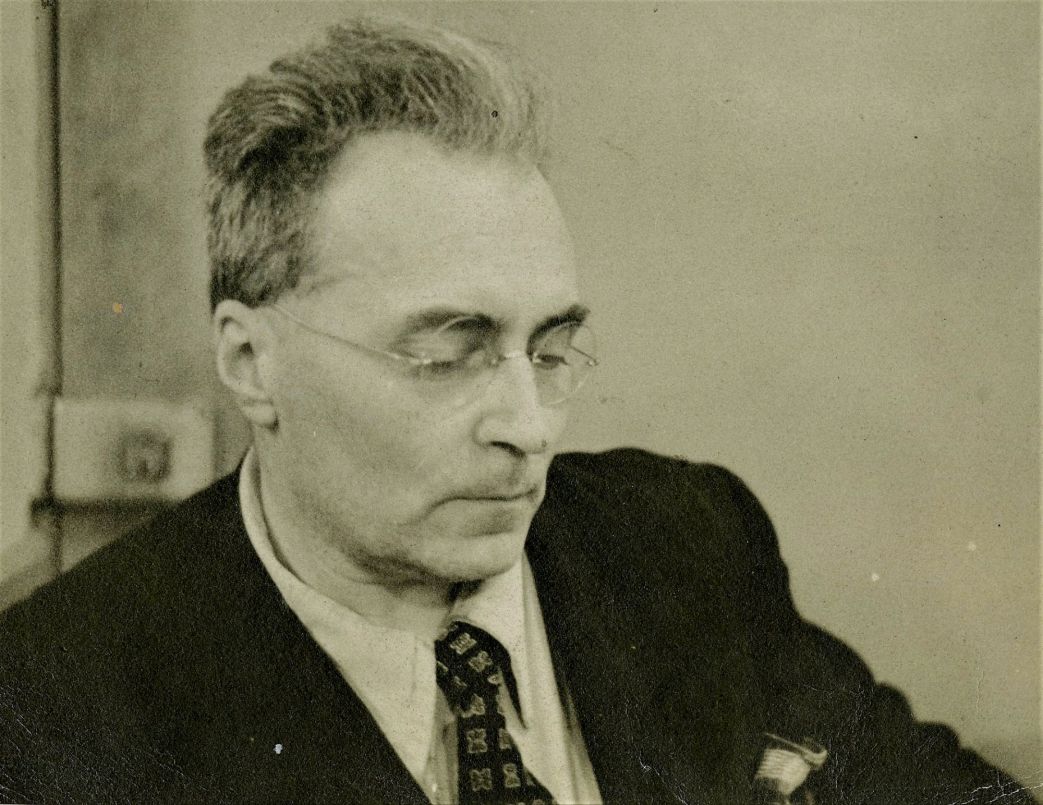
Victor Serge, recently arriving in Belgium from the Soviet Union after three years internal exile, responds to the First Moscow Trial and sees many, many more coming. Serge almost certainly would have been killed had he not been released following an international campaign led by Romain Rolland shortly before the trials began. In the ‘Trial of the Sixteen’ or the Zinoviev-Kamanev Trial, Andrey Vyshinsky, former Menshevik who had once signed an arrest order for Lenin led the prosecution of sixteen Bolshevik and Comintern leaders; Grigory Zinoviev, Lev Kamenev, Grigory Yevdokimov, Ivan Bakayev, Sergei Mrachkovsky, Vagarshak Arutyunovich Ter-Vaganyan, Ivan Nikitich Smirnov, Yefim Dreitzer, Isak Reingold, Richard Pickel, Eduard Holtzman, Fritz David, Valentin Olberg, Konon Berman-Yurin, Moissei Lurye, and Nathan Lurye. Accused of organizing an international terrorist organization to kill Stalin and conduct mass murder of workers in the USSR, all were found guilty and shot on August 25, 1936 by prolific NKVD executioner Vasily Blokhin.
‘Proofs, Comrade Executioner!’ by Victor Serge from International Review. Vol. 1 No. 8. November, 1936.
IF, UPON reflection, the crime of August 25, 1936, has been a revelation to those who follow the Russian Revolution—a revelation even to those who have followed it for some time without illusions—it is evident that for Stalin it was only an episode in a vast operation. The executions have shaken many consciences. But in a world accustomed to mass executions by dictators; and in a labor movement that is divided between a desire to believe in the U.S.S.R. and the influence of the far-flung Stalinist hookup, the executions have not immediately evoked reactions that could have stopped or even slowed up the continuation of Stalin’s operation.
Accused under exactly the same conditions as several of the executed, as Trotsky and his son, as Sokolnikov, whose life (if he is still alive) hangs on a thread, Rykov and Boukharine have been freed, Radek has been put in prison, and silence has descended on Piatakov and Ouglanov. Here is a strange and slightly excessive cynicism. Do they mean to make us believe that the executed lied in certain cases and told the truth in other? How do you explain the “not guilty” granted to Rykov and Boukharine? But Rykov, who is officially declared to be innocent, disappears from public life, he is relieved of his position as People’s Commissar of Communications without getting a new appointment. Hardly had he been declared innocent, when he was treated as if were guilty. It would be strange if justice, logic and truth played a part in the mess.
Rykov was in the Council of People’s Commissars. He was Lenin’s friend and companion. He had spent fifteen or twenty years of struggle of illegality, of imprisonment of Siberia, as a member of the old Bolshevik organization. He had undergone the greatest perils with total equanimity. He directed the statized economy during the heroic period. When Lenin died, he took his place as the head of the Soviet government. Here is a man who is being strangled quietly. Here is a man who is quite happy he has not as yet been thrown into a hole in the Souzdal. Does he recall the speech he made against us, leftists, at the time of our expulsion in 1927, when he menaced us with all the rigors of State repression? Like the rest of his generation, Rykov no doubt sees more clearly today. But it is too late.
I don’t know how Boukharine will be eliminated, but he will be eliminated. With the exception of certain totally enslaved individuals and several hostages, all the old Bolsheviks will have to go. After the crime of the 25th of August—no matter what professions of fidelity they make to the genius-leader publicly—it would be impossible to permit them to remain in life, in the political sense of the word. For it is impossible that deep down in their hearts they have not themselves become desperate judges. The infamous things they are made to say, they say with their lips. But what do they think? Consider the case of Radek. He is arrested immediately after expressing his adoration of the leader, immediately after calling, in no less than four Izvestia columns, for the death of men who were his comrades for thirty years, arrested after he has dragged himself, by command or zeal, in mud mixed with blood before the genius-leader. Yagoda and Prokofiev are thrown aside. Lomoy, the People’s Commissar for Light Industry, is thrown aside. Kerjentsev, the man who interested himself in everything, from radio to the arts, the disheartened old Bolshevik, haunted by despair and remorse, old Kerjentsev is thrown aside.
When Antonov-Ovseenko—the insurrectionist of 1905, the leader of the attack on the Winter Palace in the evening of the 7th of November 1917, the director of the first red armies in the Ukraine, a Trotskyist faithful to the Old Man as long as there was political life in the party and then a capitulator, most probably because he hoped to survive to serve the cause again, for I do not think he is the kind of man who is bought off by the luxuries of Pullmans—when a man with the revolutionary past of an Antonov-Ovseenko is made to give his name to an article calling for the execution of his old friends, we can suppose that we are dealing here with an attempt to compromise the man for good in sticky ignominy, which he is not in the position to combat. (Antonoy-Ovseenko was recently sent to Barcelona as the counsel-general of the U.S.S.R.)
The demotion of Yagoda, the People’s Commissar of the Interior, the chief of the OGPU after Stalin’s rise, and the simultaneous demotion of Prokofiev, a Chekist of the first period, who has proved himself to be ready for any job, have several explanations. In spite of all they have done for Stalin, Yagoda and Prokofiev are still men of 1917. They have much personal authority. Ejov, who replaces Yagoda, is nothing on his own account. He is a creature of the bureau staffs picked by the secretary general. Four or five years ago this Ejov had, the job of keeping an eye on the literary folk of Moscow. He is an unimportant clerk of the Central Committee. He has neither a past nor personality. Yagoda knows too much. The Zinoviev trial has opened many eyes. The customary thing is to find a scapegoat. Yagoda himself, after the 1931 trial of the engineers accused of sabotage (and after many executions without trial), judged that his staff had played too great a part in preparing the ground for the mentioned trial and executions. He then purged his offices, not without punishing some subordinates for having too well executed his own orders (there were even executions among the inquisitors themselves.) Finally, Yagoda was nominally compromised by the “‘conspiracy” that was recently built up on the basis of really existing sentiments and resentment. In the Boukharine-Kamenev conversations of 1928 (described in Chapter IV of Souvarine’s Staline), which gives the key to yesterday’s trial, Yagoda is mentioned by Boukharine as one of the Soviet dignitaries who would have been tickled at the elimination of the Georgian who “will devour us all…” Now he is in apparently permanent retreat in the department of Posts and Telegraph. The black cabinet will no doubt function as admirably without Yagoda.
With Ejov’s promotion, the generation of Stalinists careerists acquires another key position. This set holds power in Leningrad with Jdanov, totally unknown yesterday, at the helm of things. In Moscow Stalin’s generation is represented especially by another unknown, Khroustchev, now the secretary of party organization. In Caucasus we have Lavrenti Beria, another unknown, who suddenly revealed himself to the U.S.S.R. several years ago through his bold falsification of the history of the party in Transcausasia and who is now achieving a brilliant official career.
I end these notes with a warning and a question. The Soviet press has just launched against the Trotskyists of the Ukraine the accusation of preparing in conjunction with the Gestapo the separation of the Ukraine for the benefit of Poland and Germany.
(Yes, you have read that.) This crazy accusation can mean only one thing. People are going to be shot. Who? (Without doubt, Yuri Kotzioubinski and others. Perhaps Drobnis.) It is obvious that a new killing party is being prepared. Proofs, comrade executioner, we want proofs!
And here is the question. Is it true that Maria Joffe has committed suicide? I refuse to believe it. I know her as a valiant woman. She was the wife of the red ambassador Joffe, who rendered such great service to the revolution in Germany, China and Japan, before he himself committed suicide in Moscow upon being pushed to the wall. Since her husband’s death in 1928, Maria Joffe has been alternately in prison and in exile. I can prove to you, dear monsieur Romain Rolland, that she did not kill Kirov. But is it possible that she herself has been murdered after being kept in a Stalinist cage for eight years? What great official conscience, what illustrious mouthpiece of Stalinism abroad would like to ask the Stalinist government this question?
Translated by John Haddon
International Review was a short-lived, independent Marxist journal edited by Herman Gerson, pen name Integer, which hosted writers of the anti-Stalinist left, best known for its translation and publication of Rosa Luxemburg’s ‘Reform or Revolution’.
PDF of full issue: https://archive.org/download/international-review-1936_1936-11_1_8/international-review-1936_1936-11_1_8.pdf
 Revolution's Newsstand