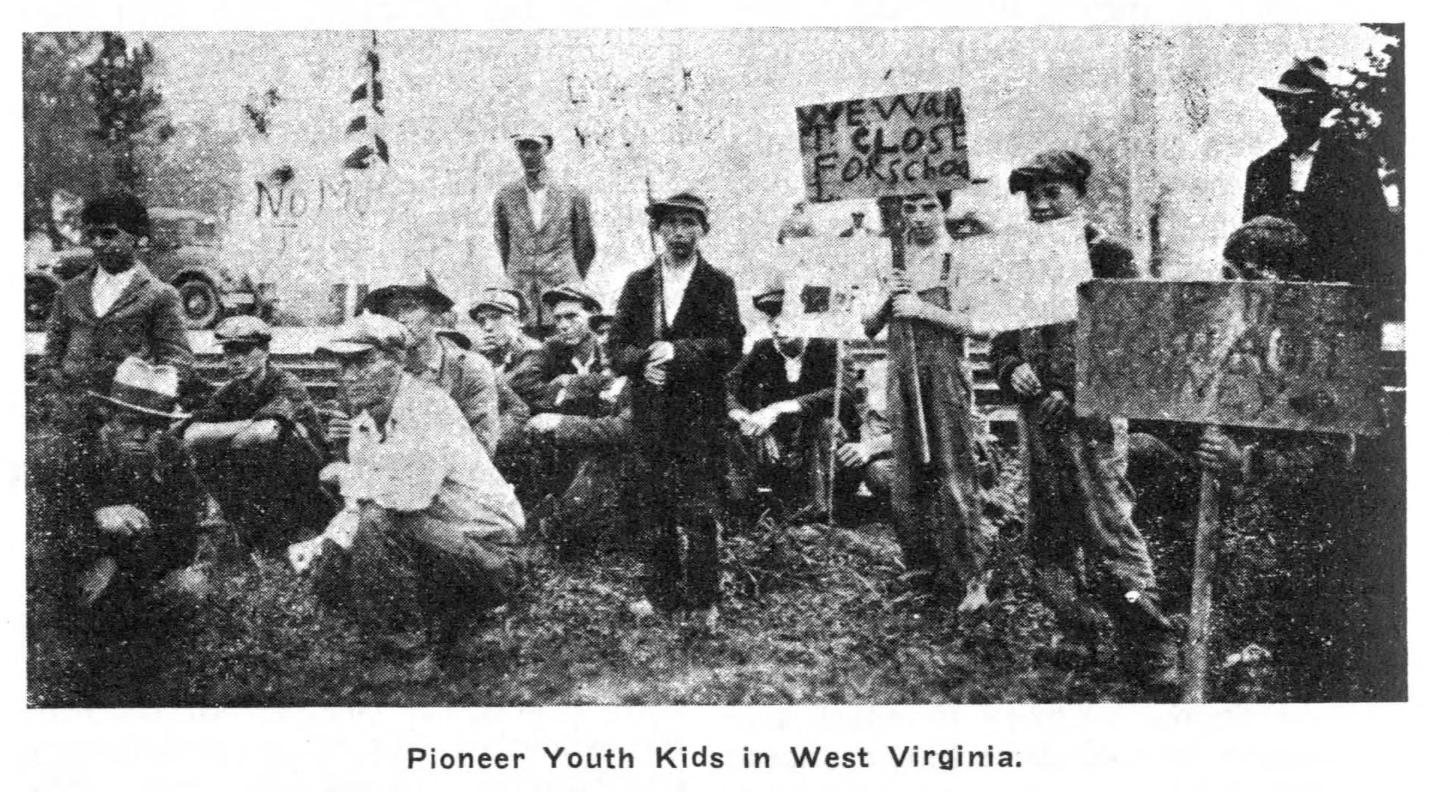
A project of A.J. Muste’s Conference for Progressive Labor Action, the Pioneer Youth worked in the mining communities of West Virginia during the early 30s as part of a general workers’ education drive by the C.P.L.A. there.
‘Pioneer Youth and the Labor Movement’ by Lucille Kohn from Labor Age. Vol. 21 No. 11. November, 1932.
THE story of two ventures in adult education among the West Virginia miners has already been told in Labor Age, but last summer there was a third educational branch functioning in the Kanawha Valley. That was the set-up organized by Pioneer Youth for the children of the miners.
Three summers ago Agnes Sailer, shortly after the Marion strike, conducted a project for the youngsters of North Carolina textile workers. Encouraged by her success down there and spurred on by the obvious needs of those southern communities, she worked with a regular staff in several more mill towns the following year. Last summer the suffering and starvation among the West Virginia miners lured the ambitious group of Pioneer Youth to take on that section of the country as well as the textile south.
So during the summer months in Ward and on Paint and Cabin creeks, a group of sixteen young men and women, some of them just out of college, some still undergraduates and several teachers launched their twofold experiment of progressive education combined with a definite trade-union drive.
From the tent colony in Ward or in the area where floods were raging the children swarmed around “teacher” either to hear a story, mold a vase, model a boat, act in a play or write a group letter to a Pioneer Youth camp in another part of the country.
Mothers and fathers looked with amazement and interest at these new activities that were springing up around them. “Whatever will my children do,” they would say, “when Pioneer Youth leaves here? They sure are never hanging around at home any more, but always playing or working with the group.”
This work and play carried on by Pioneer Youth is very definitely based on the creative urge theory of progressive education. The leaders are resourceful in developing any signs of interest, along all sorts of lines, that they detect in the children. They combine an intelligent control with a wide range of freedom—a difficult mating, but one which they seem to achieve with a considerable degree of success.
Its Philosophy
Naturally the phase of Pioneer Youth which has the most vital interest for readers of Labor Age is its attitude on labor and its stand on propaganda education. Like all live organizations, Pioneer Youth reflects the various shades of opinion of its leading spirits. It is, however, fair to sum up the collective opinion which form the guiding star of the set-up as being definitely against indoctrination of the children and just as definitely for surrounding them with an atmosphere which the leaders believe will in the long run make children in their “schools” not only class-conscious, but also eager to go out into the world to fight against the abuses under which their class labors.
Pacifism, internationalism, interracial harmony and understanding are the objectives always in the minds of Pioneer Youth leaders and when one small boy in North Carolina suggested the first project of his group should be “to drive all the niggers out of town,” that suggestion served as a useful starting point for the resourceful leader to introduce some less drastic projects of her own.
Although Pioneer Youth leaders are set against indoctrination of the young, they make their own stand on social and economic questions in the communities where they work so clear that last summer the use of schoolhouses was denied them, because of their close affiliation with the West Virginia Mine Workers. And perhaps participation in the 1931 hunger march was not technically speaking indoctrination, in that “creative urge” impelled the youthful participants to make good militant standards with which they marched. But undoubtedly the effect of the hunger march on the boys, who lived through it and later worked it up into a play, was to make them keenly alive to the need for such demonstrations and to give them an understanding of the reaction of the powers that be to the moderate demands of a band of hungry miners.
The possibilities of what Pioneer Youth may accomplish in its chosen field seem almost without limit, for in the hinterland of American industrial life there are thousands of communities where for a vast variety of reasons, it is extremely difficult to work with adults, but where there is still hope of accomplishing much for the children. So it lies in the realm of Pioneer Youth to be a useful element in laying the foundation for such a labor movement as all progressives envisage.
Labor Age was a left-labor monthly magazine with origins in Socialist Review, journal of the Intercollegiate Socialist Society. Published by the Labor Publication Society from 1921-1933 aligned with the League for Industrial Democracy of left-wing trade unionists across industries. During 1929-33 the magazine was affiliated with the Conference for Progressive Labor Action (CPLA) led by A. J. Muste. James Maurer, Harry W. Laidler, and Louis Budenz were also writers. The orientation of the magazine was industrial unionism, planning, nationalization, and was illustrated with photos and cartoons. With its stress on worker education, social unionism and rank and file activism, it is one of the essential journals of the radical US labor socialist movement of its time.
PDF of full issue: https://www.marxists.org/history/usa/pubs/laborage/v21n11-nov-1932-labor-age.pdf
 Revolution's Newsstand