An epitome of Mary Marcy’s writing, written under one of her many pen-names, traces capitalism’s selfish technical transformations and tendency to conglomerate and systematize industries, both a result of the labor of workers, urging us to retain our ‘fighting instincts’ and wrestle it from the usurpers to develop them in the interests of our class, the vast majority of humanity.
‘Carrying Things’ by Max Roemer (Mary E. Marcy) from International Socialist Review. Vol. 16 No. 8. February, 1916.
WHEN in the very early days of primitive man, people had some sort of transportation; they had to carry necessary things from one place to another; they had to move from one place to another themselves.
Man’s first means of locomotion, of passenger service, of moving from one tribe to another clan, from one hunting ground to another, was by means of his own feet. He walked. Many men never get anywhere today without using Nature’s oldest passenger service.
People have always had to go where were the necessities of life, or have these necessaries brought to them. Our early ancestors crept to the brook or spring for a drink of water, and our grandfathers and grandmothers carried water to their cabins or houses. The same was true of food and the things with which clothing were made and with which cabins or houses were built. Man’s back was the original traffic department and man himself, the first power engine. Now we turn on the faucet when we want a drink. I have often wondered why the breweries do not pipe houses with beer lines as the water companies pipe water lines. Doubtless they will if the drys do not win out before long. Then the man of luxury can have his Pabst on tap the whole year ’round without having to ring for “Hawkins” to bring it to him.
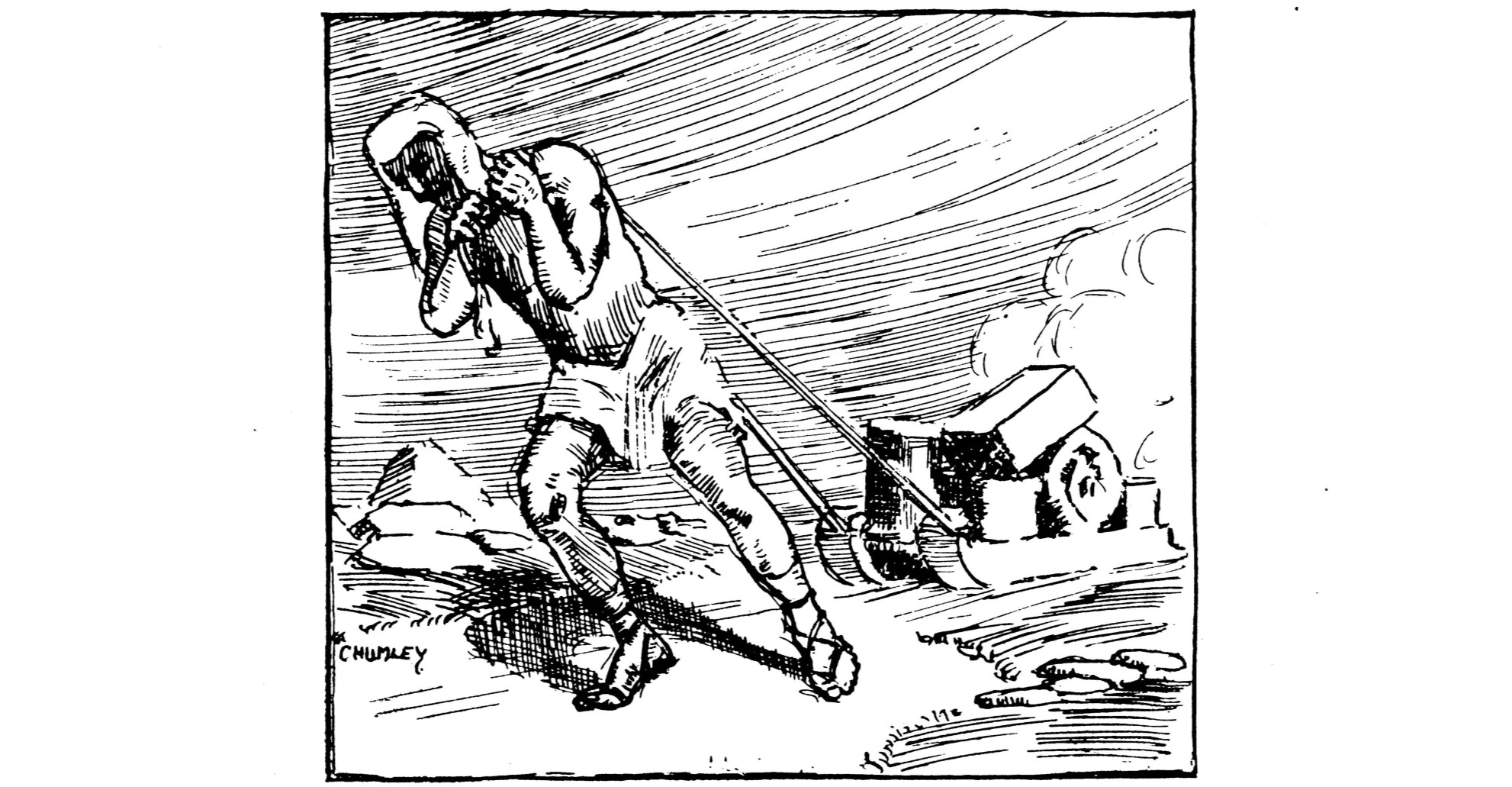
Long ago man learned to use rough sledges made of branches from the trees to transport things from one place to another. Then came the wheel, and along about this time wild oxen were domesticated, and wolves were tamed, and dogs and oxen were harnessed to the sledges or the two-wheeled carts and, behold! A revolution in the transportation industry.
And by and by man himself, climbed into the carts and rode about from one place to another. Then came horse power and boats propelled by oars or sails and the currents of rivers, and finally came steam and gas explosion engines. And now men have learned to harness the great natural waterfalls and to make them turn the wheels that carry the wheat and flour, the cattle, the wool, the clothing and the coal from one end of a nation to another.
As one railroad man recently said in the Review, every day those great delivery wagons—the railroads—pull up to the back yards of the cities of the modern world and discharge their great cargoes of food, clothing and fuel to supply the needs of the people.
And down deep under the surface of the earth gigantic pipe lines flow from one state to another over valleys and through mountain ranges, carrying oil to supply fuel for propelling the machinery of some of the shops and mills—great and small.
And thus water is borne into the houses of the people, and we no longer make candles or clean lamps, but merely turn on the light which comes to our very hands. Whole villages are* now heated by one or two enormous hot water heating plants and a large portion of the garbage and waste material is carried from the houses to distant points where it is made over into fertilizer for nearby farms and truck gardens. We no longer carry “slops.”
Your grandfather probably hitched up the buggy horse and drove fifteen or twenty miles when he wanted to impart a bit of news to one of his neighbors. His grandfather probably walked as far to see his friends. We call them up by telephone, or send telegrams, and now men are sending messages around the whole world by wireless and we have promise of an international telephone service.
I suppose the first man who built a second story to his house made a sensation in the early cities. Think of one room being piled on top of another! People doubtless came from miles around to see the new show place and talked about how crowded the world was becoming, and folks took their country cousins to see the new building along with the cemetery. Now we have flat piled upon flat, until the large apartment buildings are from forty to fifty stories high and one family living above another is one of the commonest sights in the big towns.
But people continued to pour into the cities and the streets which had previously been mere public highways began to be strewn with street car tracks. And then somebody organized a company to build elevated railroads in order to relieve the street congestion. Next came tunnels and subway car service, and now New York City is being undermined to make a subway, or tube, beneath the old subway, while all the multifarious and complicated life of the city hums on above the hive of workers digging new tunnels and laying new tracks far below the sewerage systems, and the gas lines with the traffic of the old subway going on above, as usual. Probably corporations will be fighting for areo-service franchises next year.
And after all, when we consider the machine and transportation progress that has been made in the world, we will have to admit that most of it has been made for the sake of private gain, or profits first, and for service afterwards. Which causes one to wonder whether these grafting, stealing financial and industrial pirates who were able to appropriate the labor of workingmen have not been of real service in the world’s advance. Not intentionally, to be sure, but entirely in the interests of themselves.
Personally I have always wanted to say a good word for the world’s greatest thieves, for the oil hogs who have refused to be satisfied until they had garnered the oil of the different countries under one management, who have lied and bribed and deceived and murdered, in order to organize the big industries and to centralize them into a few hands, their own hands.
We must grant that they have stolen these railroads and oil wells and coal mines, these lands and forests, but they have hired men to systematize industry, to centralize production. Modern machinery has thrown the workers out of jobs and increased the loot of the big capitalists. But it has organized industry so that it will be possible for the working class to seize it and control it and run it in the interests of their own class.
Sometimes I think we are in the last stage of mighty concentration or socialization. Sometimes I believe that to fight the German system is as foolish as were the riots of the old hand-weavers who hoped to keep their jobs by destroying the new machines.
The only way to beat Germany is to become more German than the Germans themselves. The only way to avoid being Germanized is to adopt the German methods—social methods, and improve upon them.
Concentration and organization and socialization are coming. But it must be for the working class to say for whose benefit. So far every step in progress has been to the profit of the capitalist class at the expense of the working class.
It would have been a difficult, if not an impossible feat to organize the workers of the world for the control of industry a few years ago, because industry was so disorganized, so scattered; because classes were not clearly defined. Centralization has emphasized class lines. It has made the interests of the vast majority of the men and women in the civilized world today identical, because these workers are robbed of their products by so small a group of capitalists. The more national and international, in other words, the broader the scope on which industry is organized, the easier will it be for those who make things to take over these industries.
I have always admired the successful modern financial Bandits. They have so cleverly forced more brilliant men to do their dirty work for them. They have been filled with so colossal a greed that they found no rest, will find no rest, can find no rest, until the industries of the whole world are systematized, organized, for their own aggrandizement.
It is their ruthlessness, selfishness, utter lack of sentiment and mercy that has enabled them to accomplish some of these things. It is these same characteristics that will bring countless allies to the ranks of the workers every day, expropriated, stripped, robbed men and women who are thrown into the ranks of propertyless labor.
The giant robbers have organized the loot—or industries—into a few great centers. It ought to be easy for us to take back what has been stolen from us—what we have made with our hands and brains, provided we do not permit the fighting instinct to die out of us altogether. We want to encourage, use, limber up this instinct. We want to take it out into the fresh air and give it a little exercise occasionally. We want to strengthen it and train it and organize it.
That Fighting Instinct is a precious heritage handed down to us from our savage ancestors. Don’t let it die out. Cherish it; nourish it so that when you are called upon to use it, it will be there healthy and strong. And so we will need to keep up our Fighting Spirit by practice. Practice will teach us the weak spots in the armour of the enemy and it will keep us in “condition” to take over and operate the industries when the opportunity comes.
The International Socialist Review (ISR) was published monthly in Chicago from 1900 until 1918 by Charles H. Kerr and critically loyal to the Socialist Party of America. It is one of the essential publications in U.S. left history. During the editorship of A.M. Simons it was largely theoretical and moderate. In 1908, Charles H. Kerr took over as editor with strong influence from Mary E Marcy. The magazine became the foremost proponent of the SP’s left wing growing to tens of thousands of subscribers. It remained revolutionary in outlook and anti-militarist during World War One. It liberally used photographs and images, with news, theory, arts and organizing in its pages. It articles, reports and essays are an invaluable record of the U.S. class struggle and the development of Marxism in the decades before the Soviet experience. It was closed down in government repression in 1918.
PDF of full issue: https://www.marxists.org/history/usa/pubs/isr/v16n08-feb-1916-ISR-riaz-Holt-ocr.pdf
 Revolution's Newsstand