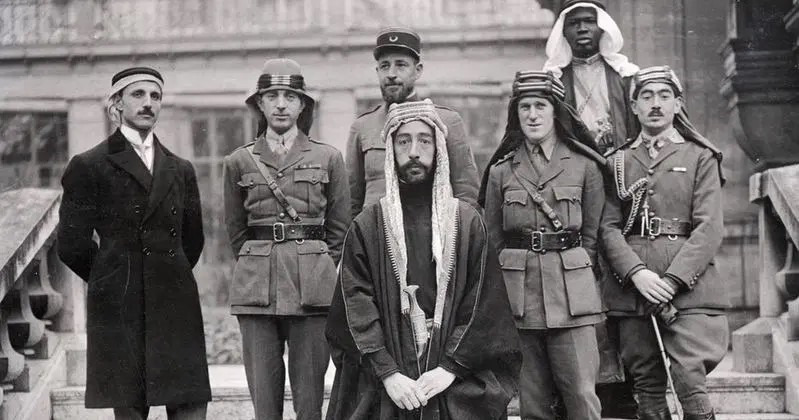
A decade after ‘freedom’ from Turkish imperialism, the Arab nation is divided and repressed while British and French imperialisms entrench themselves.
‘Ten Years of “Liberated” Arabia’ by Joseph Berger from International Press Correspondence. Vol. 8 No. 87. December 7, 1928.
“The goal toward which France and England have striven in their war in the East, unchained by German ambition, is the complete and final liberation of the peoples hitherto oppressed by the Turks, the formation of national governments and administrations deriving their power from the initiative and free choice of the native population.”
This was the announcement made by those proclamations which were spread broadcast ten years ago, in November 1918, over those districts of Arabia which had just been conquered by the combined arms of British battalions, Australian cavalry, and Arabian volunteer troops. “National liberty”, “Equality and justice for all”, “Free self-determination”…these were the hopes for which hundreds and thousands of Arabs fought and fell on the side of the Allies. They dreamed of a free and united Arabia; of independent development; of their own government, democratic administration, popular education, economic progress.
Scarcely ten years have passed since then, bu today there is no one left in the “liberated territories” who does not realise that in 1918 the conquerors of the country sought no other goal than the establishment of their own dominion under a pretense of national emancipation, and that the old oppression remains, the only difference being that the new oppressors belong to more “civilised” nations than the former Turkish rulers.
National liberty has been curtailed step by step in Arabian territory, and today, after the lapse of scarcely ten years, there is no trace of it to be found.
Syria, dismembered and mutilated by the French, has undergone in succession the driving away of the national Feisal government, the bloody suppression of the national insurrection of 1925/27, and the dissolution of the Constituent Assembly convocated by the French themselves in 1928. The brutal force of 30,000 bayonets rules and subjugates the country, and the population, already suffering severely under the economic crisis, has to pay for this occupation in addition.
In Palestine the Zionist adventure forms a welcome excuse for simply depriving the population of their right to take part in their own government, and the whole legislative and executive power has been appropriated by half a dozen British colonial officials.
In Transjordania the Emir Abdallah was dispossessed of the last remnant of independence by the treaty concluded in March 1928, and the country was converted into a British colony, without having regard to the protests and resistance of the overwhelming majority of the population.
In Iraq in 1920/21 the English held a bloody settling day with those tribes who strove for real independence. Since this time the country has become more and more a British dominion. The power of the vassal king Feisal and his ministers has been reduced to the execution of British decisions, and to the preparation of advantageous conditions for the penetration of British oil and cotton companies.
Hussein, once king of Hejaz, to whose address a very considerable part of the British war promises was directed, has long been a prisoner in Cyprus. And now feverish preparations are being carried on for robbing his successor on the throne of Hejaz, the Wahabite Ibn Saud, of what is left of his already limited independence. In the extreme south of Arabia the persuasion of shells and “punitive expeditions” is being applied to the Yemenite Iman Jihje, the second ruler of the Arabian peninsula.
In every Arabian country in which the victors of the great war have found a footing, war preparations are being carried on with intense energy: war harbours and military bases are being constructed, railways forming strategic connections laid down, fortified centres erected, and all this chiefly at the expense of the “liberated” native population.
Arabia, after its ten years of enslavement, is to form a favourable base for the coming war. Once this has broken out, then fresh proclamations on “complete and final liberation”, “national governments and administrations”, and so forth, can be issued, and the most friendly of intentions asseverated.
But the experiences of these ten years have not been quite in vain; it is very doubtful whether the population will fall for a second time into the snares laid by Anglo-French ideals. It is very probable that a fresh war in the countries of Arabia will be the signal for a great movement for “liberation from the liberators”.
International Press Correspondence, widely known as”Inprecorr” was published by the Executive Committee of the Communist International (ECCI) regularly in German and English, occasionally in many other languages, beginning in 1921 and lasting in English until 1938. Inprecorr’s role was to supply translated articles to the English-speaking press of the International from the Comintern’s different sections, as well as news and statements from the ECCI. Many ‘Daily Worker’ and ‘Communist’ articles originated in Inprecorr, and it also published articles by American comrades for use in other countries. It was published at least weekly, and often thrice weekly.
PDF of full issue: https://www.marxists.org/history/international/comintern/inprecor/1928/v08n87-dec-07-1928-Inprecor-op.pdf
 Revolution's Newsstand