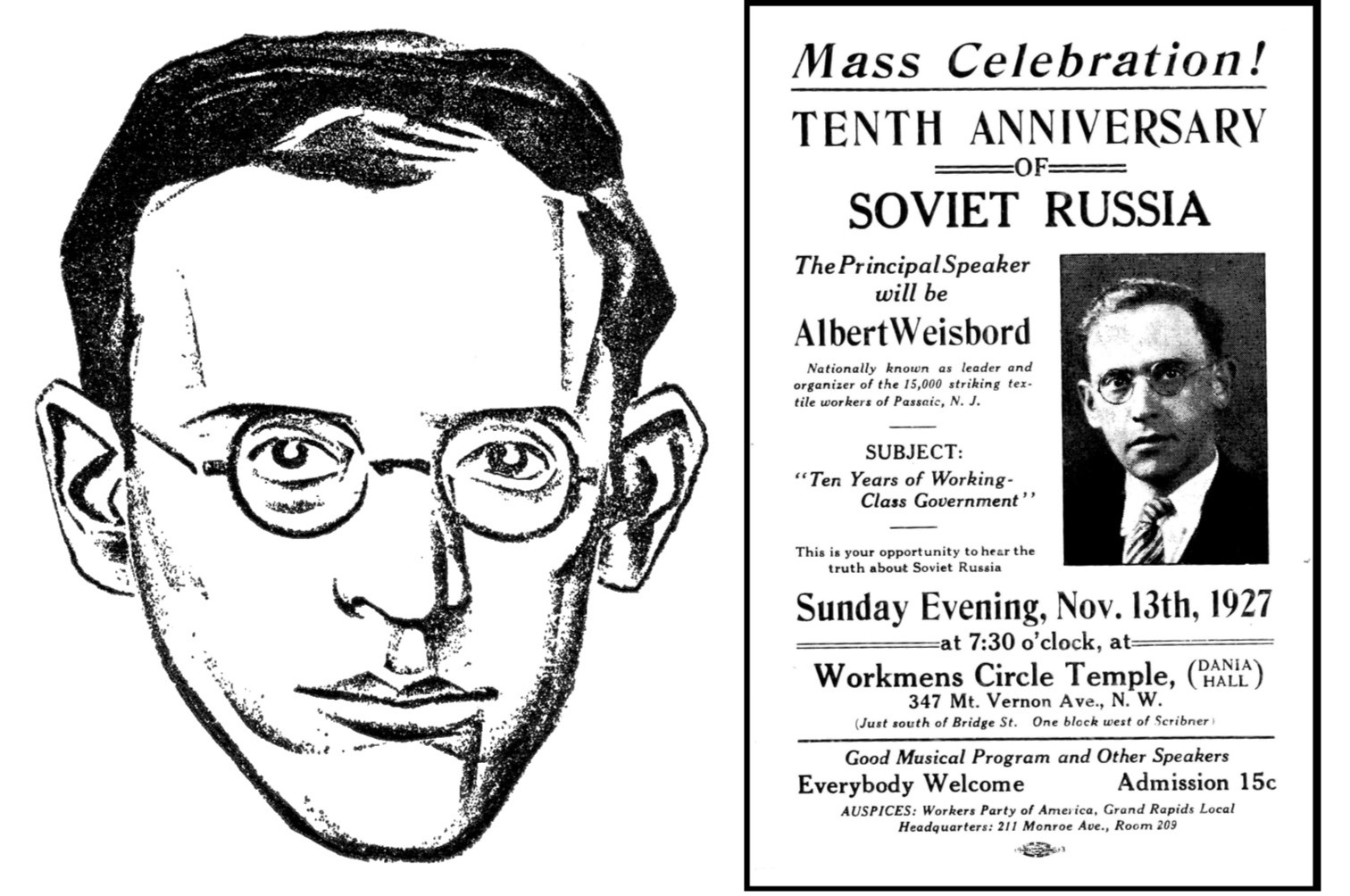
A valuable document for understanding Albert Weisbord’s politics and perspective. Starting activism in the Y.P.S.L., he quickly became National Director in 1921, but left the Socialist Party for the Communist Party over the S.P.’s relations with the LaFollette movement. In the later-20s, Weisbord was a leading face of the U.S. Communist movement, heading the important Passaic strike in 1926. On the left of the Party, Weisbord would be expelled with his partner Vera Buch and their supporters in 1929. In 1931, they formed the Communist League of Struggle publishing Class Struggle. Here, Weisbord gives his analysis of the foundation of the Communist movement and comes to terms with the factional struggles of the 1920s.
‘History of the Communist Movement in the U.S.A.’ by Albert Weisbord from Class Struggle (C.L.S.). Vol. 2 Nos 1 & 2. January & February, 1932.
The first definite crystallization of a Communist Party in the United States occurred in 1919 when the “Left Wing” split away from the Socialist party. Yet long before, with the extremely rapid and intense industrial development of the preceding century, radical and even revolutionary tendencies both in the economic and political fields had begun to manifest themselves among the American workers. The strike movements of the 1870’s were bitterly fought battles. Such organizations as the American Railway Union, the Western Federation of Miners, the United Mine Workers, the I.W.W. were born and nurtured in bloody strikes.
The first bitter struggles for the eight hour day took place in the United States. American soil was able to produce a rich crop of labor leaders, among them such outstanding figures as Bill Haywood, Eugene V. Debs and Mother Jones.
From 1848 on, socialist, anarchist and even communist influence emanating from Europe found here a wide field of development. Let us not forget that the seat of the First Communist International under Karl Marx was located here for a time. It was in the United States that May Day originated.
The extraordinarily rapid capitalist industrialization of the United States necessarily generating grave economic contradictions and social antagonisms, the world war, and the Russian Revolution, brought together all revolutionary tendencies within the ranks of the working class. The mixture of these tendencies made the Communist movement extremely confused and heterogeneous. Let us briefly examine each of the principle patches of the mosaic, which put together comprised the Communist movement in 1919.
The Socialist “Left Wing”
The main body of the Communists originated from the Socialist Party, where, for some time, a “Left Wing” revolutionary section had been ripening. The “Left Wing” had first appeared in 1905, when it favored the launching of the I.W.W. against the policy of the “Right Wing” which favored the officials of the American Federation of Labor. Again, the “Left Wing” loomed large in 1912 when it fought against the adoption of “Article Two, Section Six” of the socialist party constitution expelling anyone who favored sabotage. The revolutionary element showed itself in 1917 when it compelled the “Right Wing” socialists to declare themselves against the war, and finally it raised in the sharpest manner, the support of the Soviet regime in Russia and struggled for adherence of the Socialist Party to the Communist International under the leadership of Lenin.
The “Left Wing” was not without its publications. In 1917 to 1918 was started the “Class Struggle”, a magazine printed in New York City, the editors of which were E.V.Debs and Ludwig Lore. It was among the first papers in America to publish the works of Lenin and Trotsky.
At about the same time the Socialist Propaganda League began to issue the “New International” also printed in New York with Louis C. Fraina as editor and L.S. Rutgers as associate editor. It was published monthly in five cent newspaper form and also printed articles by Lenin and Trotsky.
The “Revolutionary Age” was the official organization of the Boston local of the Socialist Party. Louis C. Fraina and Eamon Macalpine were its editors, with a long list of contributing editors including John Reed and Scott Nearing.
We must not consider this “Left wing” as having the same internal composition at all times throughout the period of 1905 to 1919. The old fighters were Americans rooted among the masses and leading their struggles. On the contrary, by 1919 the revolutionary group was almost all foreign born with a few American intellectuals giving it an “American face”. Differing radically from the old “Left Wing” leaders such as Bill Haywood and Eugene V. Deb. The new “Leading lights” (Horwich, Cohen, Fraina, Lovestone, Wolfe, Bedacht, et al.) had had nothing to do with the real struggles of the American proletariat, Bill Haywood went to Russia, Jim Larkin to Ireland, Debs was in the Atlanta penitentiary. Of the recognized revolutionary fighters in the old socialist party, only two were active factors in the 1919 “Left Wing”, namely Chas E. Ruthenberg (died 1927) and Benjamin Gitlow.
The Disappointed A.F.Lers
The second group to join the Communists was a group of disappointed A.F. of L. organizers headed by Wm. Z. Foster, I. Johnstone, Wm. Dunnes and such. The case of Foster is typical of these leaders. He was a syndicalist before the war and a member of the I.W.W. When things grew hot, he became an ardent patriot, and a right hand man of Samuel Gompers, a “regular fellow”. So far did he swing, that even the Interchurch Report of the Steel Strike of 1919 had to declare that the A.F. of L. helped to break the steel strike and that Foster was one of the principle agents responsible for the bad policy carried out. To the skilled workers Foster posed as a “theorist”. To the college boy leaders of the “Left Wing”, he posed as a “plain worker”. In reality he was neither. Yet he was an American, knowing the American labor movement, and having many contacts. And thus he was to be welcomed.
What brought this group to the Communists? The post-war deflation, the smashing of many A.F.L. unions, the drastic cuts in wages, the levelling of the skilled workers more and more to the level of the unskilled, the international revolutionary wave after the war, etc., all these factors drove the skilled workers more to the “Left” and brought some of them, followed by these “leaders” into the ranks of the Communists.
The Greenwich Villagers
Added to these two groups was a certain small number of former anarchists, Greenwich Village habitues, free-thinking Bohemians, pianists, artists, writers, and such, who seeking the “new and unconventional” were attracted to the Russian Revolution. This group published a monthly magazine known as “The Masses”. Later this paper became “The Liberal” and is published today as the “New Masses”.
Fortunately these dilettantes are being pushed more and more to the rear. About them Trotsky has aptly written: “These groups, sufficiently variegated in their composition, busy themselves on the one side with fringes of the bourgeoisie, on the other with fringes of the proletariat and offer no guarantee whatever as to their own future. From the standpoint of time, their radicalism is chiefly directed toward the past. From the standpoint of space it is directly proportional to the square of the distance from the scene of action. In relation to their own country, these bold boys always were and always will be infinitely more cautious and evasive than in relation to other countries…especially those in the east. The essence of these people from the Left Wing of the bourgeois Bohemia is that they are capable of defending the revolution only after it is accomplished and has demonstrated its permanence.”
The 1919 Splits
With such a collection of heterogenous groups it was very natural that the Communist movement should have been rent with factions and splits from the very beginning. The isolation of the movement from the American workers, the many foreign language federations, the lack of proletarian membership, and the low political ideological level of both membership and leadership—these defects were bound to insure a hectic life for the Communists. This does not mean that the splits did not occur around important issues. We must remember it was Lenin himself, who wrote “The history of the working class movement now shows that in all countries it must experience (and has already begun to experience) a struggle before it grows and gains strength in its progress toward the victory of Communism.” And this struggle is internal as well as external. The factions and splits inside the U.S. Communist movement are milestones on the road of this struggle.
The first big fight came even before the Communists had organized separately and while they were still a “Left Wing” of the Socialist Party. The “Left Wing” in 1919 had grown so strong that it threatened to win the entire Socialist Party membership for the Bolsheviks. At once the “Left Wingers” were met by wholesale expulsions. The whole state memberships of Massachusetts and of Michigan found themselves suddenly outside the official Socialist Party. The first question was then, what was to be done? One group in Michigan believed it was necessary to form a new party, a Communist Party at once, and so they issued a call for a national convention to be held in the fall of 1919.
During the summer, however, a convention was held in New York City of “Left-Wing” elements. There the fight waxed hot. Should they split from the Socialist Party or not, or rather try to get back into the Socialist Party? These and similar questions agitated and split the “Left wing” convention. One section of the convention declared it would organize a Communist Party forthwith in September. the other section declared it would go back to the Socialist Party convention in Chicago and fight to win the Socialist party membership for its position.
September first came and in Chicago, the Communist Party of the United States was formed. Just before this Communist convention, the National Convention of the Socialist Party was held. The “Left-Wingers” who were trying to enter the Socialist party again and to protest their expulsion were met at the door by policemen, who ejected them from the hall. This group at once held a convention of their own and baptized the group the Communist Labor Party. Thus the Communist movement began its very existence with two Communist Parties, a Communist Party and a Communist Labor Party. Each began a violent polemic against the other.
Both Communist Party and Communist Labor Party were far removed from American life. Their invectives against each other were sharp in proportion as their phrases covered their lack of actions. For almost a year, a costly fight was waged over such questions as, “When workers are mobilized, is it mass action or action of the masses?”
Soon after the first Communist Party convention, one of the groups, the Michigan group, broke away and formed another party—the Proletarian Party, and thus there were three.
Early Communist Papers
The literature of these early Communist groupings for the most part continued former “Left Wing” publications. The Communist Labor Party took over the “Class Struggle” as its the theoretical organ with Carney and Weinstein as editors. It also had as its organ “Communist Labor”. When the Communist Labor Party went into hiding the “Class Struggle” disappeared although the other paper continued publication. In Ohio the Communist Labor Party was able to get control of a weekly socialist paper, the “Ohio Socialist” and, under the editorship of Wagenknacht and Allison, published it as a “legal” paper, known as “The Toiler” later became the “Voice of Labor.”
The Communist Party founded its official organ, “The Communist combining a weekly paper of that name, which had begun to appear a short time before in New York as the official organ of the “Left wing Section of the National Council of the Socialist Party” (editor John Reed) with the “Revolutionary Age” of Boston. “The Communist” was published in Chicago. L.C. Fraina and I.E. Ferguson were its editors. When later the Communist movement became illegal, John J. Ballam became editor, one of a long series of editors. The paper lasted until 1921 when again the movement appeared above ground. During the existence of the Communist Party, it also printed a weekly agitational paper called the “Workers Challenge” and issued as its “legal” organ another weekly paper called “The Toiler.”
Leftist Tendencies
Both the Communist Party and the Communist Labor Party were gravely sick of what Lenin called the “infantile sickness of leftism”. They were against work in the trade unions, they were against participation in parliamentary campaigns, they were for immediate formation of Soviets (by leaflets) and for the immediate transformation of every strike into an armed insurrection.
What were the bases for such views? It is very easy to laugh at the exaggerated actions of the Communists then, but at bottom there was a correct thesis, namely: At the end of the world war the world was aflame with revolution. (The Bolsheviks still held power in Russia, civil war was raging throughout Europe, in Italy, in Hungary, in Germany, in Finland, and so on). America was part of this dying economic order, part of a world torn to pieces by revolutions. American troops were then fighting on Russian soil. Should the revolution hold its ground in Europe, it was bound to lead, in time, to a revolutionary situation here in America.
What the Communist Party and the Communist Labor Party did not see was how to prepare for the eventuality, how to root the Party deeply among the most oppressed sections of the working class, express their needs, fight their concrete battles, recruit its forces from their best elements, patiently strive to win the confidence of those revolutionary workers who are willing to give their lives for the movement.
From the very start, the Communist movement in this country encountered many obstacles. The objective difficulties that hindered the growth of a revolutionary movement may be briefly summed up as follows: First, the domination of capitalism came rather late in America. The great frontier, the large amount of free land, and the slavery in the South, all delayed the conquest of capitalism. Further, America at the same time experienced the unchecked development of capitalism. With the exception of the slave remnants of the Southern economic regime, there were no decisive feudal barriers to overcome. Capitalism thus made great steady strides forward. Again, working conditions were relatively better here than in other countries, and this fact, coupled with the many opportunities for individual advancement in a young country, and the disunity created by the vast wave of immigration greatly retarded the growth of a class conscious proletariat. Finally in the period since the war, the growth of class consciousness was further retarded by the great strength of American imperialism, and the consequent corruption with high wages and special privileges, of an upper section of the working class.
Yet in America there are extraordinary opportunities for the growth of a Communist movement. Nowhere else is the rate of exploitation so high, the relative wages so low. Nowhere else are the workers worn out so quickly. In no other developed country have the workers so little security through social insurance. In no country is there the racial oppresion that exists against the Negroes, the downright peonage of the agricultural masses, etc.
The normal growth of a Communist movement could come about only if the party understood thoroughly American conditions and the relation of those conditions to the international situation.
Foreign Federationism
However the Communist Party was not destined to have that normal growth. Inside of the socialist party there had been organized many foreign language speaking federations composed of immigrants, who had but recently come to America. With the fall of Czarism, thousands of Russians, Jews, Ukrainians, and others joined the Communist movement, not because of the battles to be fought here, but as a reaction to the events in Europe, which were shaking the world. These foreign language speaking federations controlled the new-born Communist movement and these federations in turn were controlled not by coal miners, nor steel workers, nor textile workers, but by intellectuals far removed from the workers’ life.
These foreign language federation leaders, knowing that they themselves could not attract the American masses, tried to push forward any intellectual who could speak “American” to be their “American face.”
Where Were the Revolutionary Section
Such intellectuals took the easy way out and compromised with these non-revolutionary sections of the party. Indeed only such compromisers had any chance for leadership. Instead of entering into the serious work of winning the great mass of unskilled workers (e.g. the poorest sections of this foreign-born, Negroes, Mexicans and poor whites of the South) the “American” leaders agreed to allow the foreign language federations to continue their isolated nationalist lives and yet remain the base of the movement.
The Proletarian Party group saw the evils of foreign language federationism. But, they, on the other hand, took the anti-Leninist position that what the masses needed was more abstract education, that the revolution was far away, etc. Outside of publishing its monthly periodical, “The Proletarian,” its activities are negligible. And we leave it here to stew in its own juice.
Red Raids and Illegality
The Palmer “Red Raids” of 1919-1920 soon drove both the Communist Party and the Communist Labor Party “underground.” While the wisdom of this retreat by the Communists may be questioned, yet there was ample reason for it. Thousands were being arrested and deported. A general campaign of terrorism had been launched by the Ku Klux Klan, the American Legion, and above all by the United States government. The blows of reaction separated the shaft from the wheat. While the Communist membership of 50,000 or so rapidly dwindled away, yet many remained loyal to the movement and braved the constant danger of prison and deportation. The Communist forces were compelled to come together. Soon they amalgamated to form the United Communist Party.
The party, at that time, was organized in small groups, meeting secretly each under the direction of a captain. In spite of the vigilance of the police, leaflets calling upon the workers to seize arms and to overturn the government were widely distributed. An intense study of Lenin’s works was carried on by these circles.
Now a new issue began to divide the communists. Many felt that being in hiding moved them further and further from American life and from the American working class. They therefore began to agitate for a “legal” party. Soon they did form a “legal” organization—first the American Labor Alliance, later a “legal” party, the Workers Party of America. All this did not happen, however, until another split had taken place.
Out of the Underground
Some of the “undergrounders” refused to liquidate their organization. They felt that their revolutionary purity might be sullied by contact with the masses. They formed their own organization, the United Toilers. This little group also had its organ, the “Workers Challenge” edited by Siskin, Lifschitz and Ballam. Not long afterward the United Toilers itself split, most of the members joining the Workers Party. The United Toilers at least stressed one correct idea—that the Communists have to prepare for the time when they will again be driven into hiding.
In the meantime, other events were taking place to strengthen the ranks of the Communists. A new split had occurred in the Jewish and Finnish Socialist Federations. These groups together with the Workers Council group in New York joined the ranks of the Workers Party. The Workers Council group had issued a bi-weekly paper called the “Workers Council” edited by J. Louis Engdahl, Wm. Krause and A. Trachtenberg. With the formation of the Workers Party a “Weekly Worker” was issued which later combined the “Workers Council” and “The toiler”. Engdahl was the first editor of the “Weekly Worker”. In January, 1924, the “Weekly Worker” became the “Daily Worker”.
At about the same time as the above political regrouping, the A.F. of L. Syndicalist group headed by Foster and his company, having left the A.F.of L., had organized themselves into a Trade Union Educational League and had finally landed in the camp of the Communists.
The Swing to the Right
With the formation of the workers Party and the liquidation of the “underground”, the Communist movement entered into an entirely different phase of its activity. To generalize a bit, we can say, the first period was one of propaganda. It was a period when the works of Lenin were to be translated and learned, when the Communist International was just forming, when the broad distinctions between the Communists and the socialists, the revolutionists and the mere reformists had to be sharply drawn. Even the artist group had some justification for its existence in the time when all there was, was “discussion”. To some extent a sectarian life was inevitable in the beginning.
By 1922 it became plain a Communist movement could not remain a debating society. The big strikes and ferment among the workers showed clearly the gap between the working class and the Communists.
Characteristically, the leaders, who yesterday were so “left”, so “revolutionary”, now swung far to the “right”. Perhaps this process was accelerated by the government’s raid on the Bridgeman, Michigan convention. Hitherto the Communist leaders had been against working in the American Federation of Labor. Now they called the American Federation of Labor the only place in which to work. Hitherto they had been against reforms. By 1923, they were for a compromising support of La Follette.
And in this violent swing to the right, the Workers Party leaders behaved quite like those in the Socialist Party, whom they were denouncing. Like the socialists they ignored the 25,000 unorganized workers and emphasized solely the 3 1/2 million members in the American Federation of Labor and in the few independent unions outside of the A.F. of L. The Communist leaders’ sole aim within the A.F. of L. was to amalgamate the craft unions. Their sole method of work was maneuvering with the officials of the A.F. of L. in the Chicago Federation in the Amalgamated Clothing workers Union, etc. Not only did these heads of the Workers Party overlook the unskilled unorganized masses, they tended to overlook even the rank and file workers within the A.f. of L. itself. All they saw, apparently, were the “progressive officials”.
In the political field their policies were just as amateurish. In 1921 the organized labor movement and the socialist party had organized a Conference for Progressive Political Action looking towards a Labor Party. The leaders of the Workers Party also came out for a Labor Party. But they went even further. They were for a FARMER-Labor Party and some even were for giving the farmers the lead in the movement. Others committed with LaFollette and when La Follette refused to play, organized a paper “Federated Farmer Labor Party” of their own!
The collapse of the conference for Progressive Political Action and the LaFollette movement in 1924-25 brought about a deep crisis within the ranks of the Workers Party. Disappointed again, the Foster group at once became very “revolutionary”. They said, we want no Farmer-Labor Party movement. The workers do not need to be won away from the capitalists for independent political action of their own. The Communists by building a Farmer-Labor Party, are building a substitute for a Communist party. On this basis an intense factional fight began to rage, threatening to lead to a direct split in the convention of 1925.
Fortunately the Communist International stepped in and by its pressure prevented a split. The Communist International declared it was wrong to agitate for a Farmer-Labor Party, and to give the farmers a leading role, incorrect to support La Follette in the manner some Communists (Cannon) had proposed, but it was correct to keep the slogan for a Labor Party. Not every country is at the same level of political development. Different countries, different conditions; different slogans. In Germany the workers may be raising the slogan of workers’ control over production. In England the labor Party already formed may be in the process of exposing its limitations to the workers. In the United States while it was not absolutely inevitable that a Labor Party had to be formed, yet here the Communists had the elementary task of winning the workers from the capitalists for independent political action of their own.
The Foster group was thus pushed aside by the Communist International which declared that group to be less politically correct and less loyal than the Ruthenberg group. The latter group then took over the leadership of the Workers Party. Not that all the opportunist errors were on the side of the Foster group alone. The opposite faction led by Ruthenberg, also contained leaders who went far astray. These men, headed by Lovestone, began to preach the exceptional development of America, the great power of American capitalism, which in their eyes, made the revolution something very far away. They failed to stress the close economic and political connection of the United States, with the rest of the world and the possibility of the near approach of the revolution. They emphasized the “backwardness and docility” of the American working class.
The Lovestone group was not called to account, because by this time (1925) Lenin had died. And with the death of Lenin, the CI itself began to swing to the right. A terrible fight began to be waged against Trotsky. Lovestone promised to be a good Trotsky-killer. He was needed therefore. Besides, these opportunist views of Lovestone had not been allowed full development under the leadership of Charles E. Ruthenberg.
The Foster group did not take its stinging defeat pleasantly. It reasoned, since the CI itself was moving to the right, why not go it one better? It therefore elaborated its previous argument. It had been against the Labor Party, it declared, not because America was so near to revolution, but really because the American workers were so “bourgeoisie”, that they were not even conscious for the need of a Labor Party. Look at the autos in America, the plumbing, the salesmen, the wealth etc., cried the Foster group. And so a new factional fight began. And to cap it all a third faction arose, led by Cannon, on the grounds that there should be no factions!
With the convention of 1927, all these factions came to a head. Ruthenberg having died, Lovestone took the lead. The name of the Party was changed to the Workers (Communist) Party. The Foster group was cut down to a small minority. The Lovestone group prepared to deal crushing blows to the other factions. First to destroy the “third factions”, “the faction against factions” to drive it out of the Party, and then to smash the Foster group to bits.
By 1928, this program was well on the way to fulfillment. Cannon, the leader of the faction against factions decided to withdraw and suddenly espoused the cause of Trotsky, who by now had been expelled from the Comintern. They now exist as the Communist League of America, (Opposition), a pure propaganda Society, whose sole real value consists in that they actually publish the works of that old revolutionary fighter, Leon Trotsky.
As for Foster, as the ground became hot, he began to capitulate and actually had abandoned his own group when a new development gave him his long sought for opportunity. Ever since the death of Lenin, Stalin had played the rude disloyal game Lenin had predicted he would play. First Trotsky was expelled by Zinoviev. Then Zinoviev was expelled by Bucharin and Stalin. Now it was Bucharin’s turn to be expelled. In all of these cases of “Off with his head”, Lovestone had added “Good by me.” This time he could not do so.
In the first place, he had promised himself too much in favor of Bucharin and against Stalin. In the second place, the Foster group beat him to it. They declared Lovestone was a “right-winger”, that American imperialism was on the decline, that the masses were radicalized all over America and in a new revolutionary up surge were counter-attacking the American capitalists, ready to seize state power. Only Bucharin in Moscow and Lovestone in New York stood in their way.
With the 1929 convention, came the order from Moscow—Lovestone was to be removed from office, and Foster was to be made executive secretary. How the Lovestone leaders howled. They tried all their tricks. They cabled Moscow. They cursed Bucharin. They lauded Stalin. All to no avail. While Lovestone mobilized his forces and went to fight it out in Moscow, his own leading lieutenants began to desert him. When he was expelled to form his own “Communist Party U.S.A. (Majority group)” the most he could muster was a couple of hundred or so.
Stalin, in his inimitable way describes this unprincipled fight as follows: “What are the main defects in the practice of the leaders of the majority (Lovestone) and the minority (Foster)?
“Firstly, that in their day to day work, they and particularly the leaders of the majority, are guided by motives of unprincipled factionalism and place the interests of their faction higher than the interests of the party.
“Secondly, that both groups and particularly the leaders of the majority are so infected with the disease of factionalism that they base their relations with the CI not on the principle of confidence but on a policy of rotten diplomacy, a policy of diplomatic intrigue.”
An Estimate of the Communists
We are now able to estimate the progress of the communist movement. It is plain that the Communists are no more contented with a mere propaganda association (the tiny Cannon group, the Proletarian Party, and the United Toilers sect, to the contrary notwithstanding). Since 1923 Communists have attempted to build a real party. They have entered into election campaigns both presidential and local. Members of the Communist Party have led big and important strikes. Their organization has spread over half the states of the union. They have groups in nearly all the big cities and nearly all the smaller towns of importance. Besides the English Organ of the C.P., the Daily Worker, numerous foreign language Communist papers reach a considerable number of workers. The “Majority Group” (.00005 of 1% of the American working class) now puts out a weekly paper “The Workers Age”. The Communist League of America (.00002 of 1% of the American working class) now issues a weekly “Militant”, while the Communist League of Struggle (still tinier) has its paper, the “Class Struggle”. In these and in other ways the Communists have attempted to win over the revolutionary workers and to develop a vanguard political party. Have they succeeded?
In my opinion they have not. We have never had a genuine Communist Party in this country. We have none today. First of all, a genuine Communist Party must be built on a thorough and comprehensive knowledge of works and methods of Marx. I dare say there are not many leading lights in all the Communists groups today, who have even read, no less understood, the three volumes of Marx’ Capital, for example. No large outstanding economic or political work has ever been penned by an American Communist. To this day many important works of Marx and Engels still remain untranslated. Most of the works of Lenin have never seen English print. Under the name of Leninism indeed, Stalin has actually suppressed Lenin’s writings, especially Lenin’s last words advising the Party to remove Stalin as secretary!
In the second place, a Communist Party must be built on a certain confidence. There must be a certain revolutionary idealism, honesty, integrity, courage. The contemptuous opinions held by Stalin of the American “leaders” are the opinions of the whole Communist International.
In the third place, a Communist Party must be rooted in the factories. It was only in 1925 that the dominating control of the foreign Language speaking federations began to be loosened. Even this could not take place without a fight. Several groups had to be expelled for resisting this and similar efforts of the Communist International to turn the attention of the Communists to American conditions and American work. But to this day these efforts have failed. Even now, there is really no “shop nuclei”, branches of Communists in the factories. There is constant talk from the leaders of organizing factory nuclei, but few of such nuclei actually exist. The composition of the Party is still predominantly intellectual, non-worker, and small-property, skilled-worker, elements.
In the fourth place, the Communists must undertake the task of organizing the unorganized workers. Yet all the leaders of all the Foster-Lovestone-Cannon groups have steadily shirked this work. Indeed they have at times opposed it “on principle”! They themselves had never risen to Communist leadership on the basis of their participation as Communists in mass struggles. They were totally unfamiliar with such work. They felt lost when it was proposed. For example, when the Passaic Strike began, all the leaders were opposed to this strike and to the organization of new unions under Communist control. It is not an accident that none of the Communist leaders ever led a single strike after they became Communists. During the New Bedford textile strike they obstinately refused to enter into the struggle. During the Gastonia strike, they all literally ran away, to Moscow.
And yet, in spite of the leadership on all of the principle Communist groups, the Communist movement has undoubtedly advanced in this country. The writings of Lenin, whatever there had been translated have become known to many. Bitter lessons have been learned. The persecutions and terrorism of the government have tested and hardened some. Many members have participated in strikes. They see their task more clearly than ever before.
It is true that the leadership drove away thousands and thousands of workers by their foolish antics, that they destroyed so much the worker members had built up, or that they often criminally mishandled or abandoned struggles which the workers called upon them to lead. It is true that numerically the Party today is as weak as it ever was, that its influence among the workers is relatively small, that it has made little headway in all these years in winning the American working class. Nevertheless, all of these costly mistakes have left their indelible impression on the tested fighters, who still remain in the Communist movement. Gradually a corps of hardened members is being built up. This is what the Fish Committee is worried over.
The Communist movement is based on the social antagonisms created by the capitalist made of production itself. The Communist Party stands for the social revolution not as an “ought”, but as a “must”. The capitalist contradictions inevitably develop a genuine communist movement. Such a movement will soon rid itself of the puffed-up subsidized ignoramuses foisted upon it. The very blows of reaction, this time, will make the Communist movement really find itself, will make it grow stronger than ever.
The Communist League of Struggle was formed in March, 1931 by C.P. veterans Albert Weisbord, Vera Buch, Sam Fisher and co-thinkers after briefly being members of the Communist League of America led by James P. Cannon. In addition to leaflets and pamphlets, the C.L.S. had a mostly monthly magazine, Class Struggle, and issued a shipyard workers shop paper,The Red Dreadnaught. Always a small organization, the C.L.S. did not grow in the 1930s and disbanded in 1937.
 Revolution's Newsstand