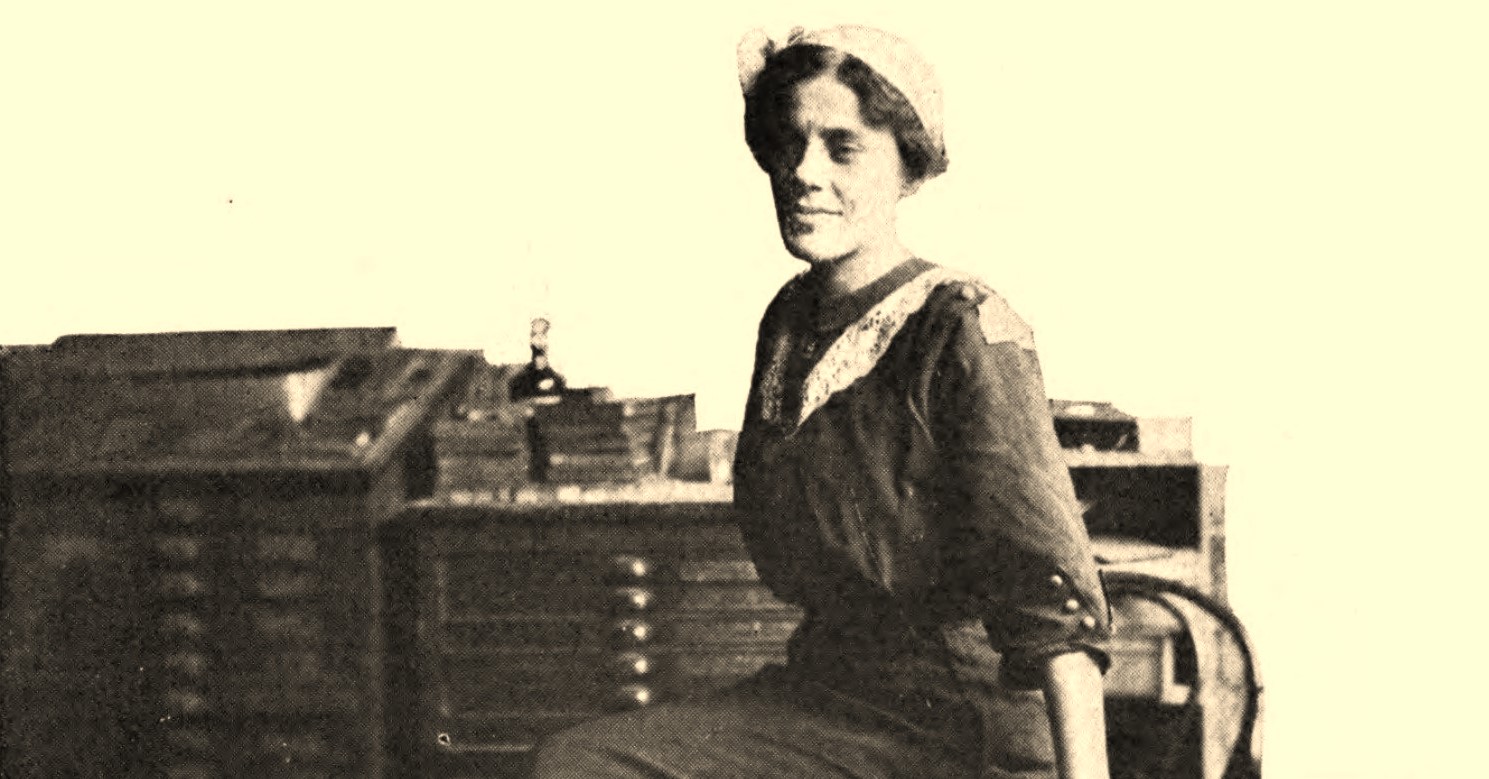
Marcy on the fight against unemployment, and organizing the class in and out of work for a common struggle.
‘Make an Ally of Your Enemy’ by Mary E. Marcy from International Socialist Review. Vol. 15 No. 7. January, 1915.
SOMETIMES I wonder what people will say about us a hundred years from now. They will write books about us and dig up our skulls to find out if they were ivory clear through. They will read the records of what we said and did and how we lived and sweated to make beautiful and useful things—for somebody else to enjoy. And I expect they will finally give up the problem and decide that our poor heads just never developed any gray matter.
Then some wise old owlish professor of biology will probably come forward and say we couldn’t have had all the natural instincts, either, because even the lowest forms of animal life have enough sense to eat when there is food. Nobody ever heard of a monkey picking cocoanuts and going hungry. Perhaps some of our poor skulls will wind up in a museum devoted to the relics of the days when workingmen and women fed the whole world and starved themselves, and built houses and slept in lumber yards. This is going to be our fate unless we wake up and show a glimmering of intelligence occasionally.
It is easy to see what the trouble is even if we are not yet strong enough to stop it.
We know why we are working for ten, twelve, eighteen and twenty dollars a week and permitting the boss to keep the coal we dig, the clothes we make, the food we raise, the houses we build.
We know why the idle capitalist is BOSS of the factory and is able to take all the profits. We know why we slave long hours at starvation wages.
It is not because the capitalist OWNS the mill or mine, but because he BOSSES it. Nobody would care if he treasured his little old ownership papers till the crack of doom, provided that WE, who do the work, could GOVERN the plant, provided we could RUN the factory; in fact, if we could control the conditions under which we work, could keep our products and BOSS THE JOB.
If there were not a hundred men at the factory gates, at the mill, mine or shop every morning TRYING TO GET OUR JOBS, we COULD RUN the shop.
We saw a traction gang at work last week. About every five minutes, in full view of the crew, an out-of-work would file up to the foreman and apply for a job. Every time the gang saw these job-seekers, they humped over a little farther and quickened their pace in order to show the boss they were accomplishing more than the half-starved applicants could do. And when the foreman’s back was turned and these “unfortunates” happened to pass near the gang, the men glared and swore at them. And one or two kicked out viciously to speed the departing failures.
And the out-of-works had accomplished something for the boss. At the end of the day the foreman gave the crew their choice between being thrown into the ranks of the unemployed and accepting lower wages. Most of them took the lower pay and went away cursing “that scab lot” who had wrought the cut.
And that is precisely how your boss keeps you down. The fellows out of work don’t get any help from you and they are compelled to beg, or scab, to steal, or starve.
And when it comes right down to going without three meals a day and carrying the banner indefinitely, most of us would work for a meal ticket and room rent—if not for ourselves, for a wife and kiddies.
We can’t blame the man who is out of work and hungry. We have to blame ourselves. If we exerted our reasoning powers at all, we would join forces with the unemployed to fight the capitalist or employing class. We would make the unemployed our ALLIES and not our enemies.
We can’t expect a man or woman to jump into a river or go off quietly to some secluded corner and starve to death just for our sake. If they are not to take our jobs or lower our wages we must expect to give them something in exchange for their help and co-operation. The employing class are their enemy just as they are yours and mine.
In this connection we want to remember that the bosses cannot reduce wages or lengthen hours at their own sweet will. It is the needs of the unemployed that do this. ‘Wages and hours are determined by the number of unemployed who are after a job. When men are scarce, the men on the job are able to raise wages and shorten their hours. When men are plentiful and there are more men than jobs, the competition for work among the working class forces wages ever lower, forces hours that are ever longer.
Now the boss cannot run the factory or the shop or mill without human labor power—men and women who will operate the machines and produce commodities to sell. It is to our interests to control the supply of labor power. We will act like the commission merchants who threw several cargoes of bananas into the lake in order to raise the price of bananas. We will WITHHOLD some of the laborers from the market and raise the price of the labor power of those on the job. We will then be able to shorten hours and thus put some of the unemployed to work. And this is only for a beginning.
Nobody imagines there are more than ten per cent of the available workers unemployed in America today. Probably the number is much less, but, at any rate, it is up to US, who HAVE work, to feed, house and clothe every single person out of a job who will refuse to work unless he gets HIGHER wages and SHORTER hours than we are getting.
We will not have to SHARE our WAGES long. As soon as the bosses fail to find scores of desperate people, begging for a chance to work every day, they will HAVE to give us shorter hours. And this will put some of the unemployed to work at once.
It is true your boss may refuse to grant you shorter hours, but you can all quit at 4 o’clock and go home. And what will the boss be able to do about it if he has nobody else to put in your place? In this way we can institute NEW shop LAWS. We shall have begun to practically control our labor power and the shop or plant in which we work.
We shall be able to refuse a cut in wages when we get the shorter work day for the same reason that we were able to shorten hours—the boss will: be unable to get anybody else to take our jobs.
And when we are strong enough (well enough organized with our unemployed friends) to cut down our working day two hours, we shall be able to put every man and woman to work. Shorter hours means more jobs.
MAKE YOUR EMPLOYERS PAY
Our good friend, Joe Hill, asked last month in an article in the Review, who was going to pay the big bill for taking care of the unemployed. Why the employers, of course!
You and I and the other folks on the job, may have to share up for a few weeks, but as soon as we are organized with our friends who are “‘laid off” so that they insist on demanding higher wages and shorter hours than we have before they will accept a job, we can force the bosses to put more and more of them to work.
NOT ENOUGH JOBS?
Somebody said the other day, “Well, but my goodness gracious! There are not enough JOBS for EVERYBODY!” He was wrong. We will cut the ten-hour day of the steel mill worker in HALF, if necessary, and MAKE TWO GOOD JOBS at good pay where there was only ONE ROTTEN JOB BEFORE!
And then when we have learned to regulate the supply of labor power (workingmen and women) we can begin to put on the screws. We wort have to BUY the capitalist out, or build competing railroads. We will just be so strong in the shop, on the railroad, in the mines and mills that we will KEEP the value of our own products and eliminate the profits or rake-off of the capitalist class. Then ownership papers will not bring thirty cents on the stock exchange.
* * * * *
Now, of course, a few of us can’t do all this alone. Our wages would not buy breakfast for half the jobless men we meet every morning on Clark street. But we CAN buy breakfast or dinner for one or two. And chiefly we can spread the propaganda for organization with the unemployed instead of organization AGAINST them and the employing class.
It is true it will not do much good to try to help and co-operate with the unemployed in a single city, for the unemployed go from town to town and from country to country in search of work. We must start organizing with the unemployed every where as fast as possible. The alliance between men on the jobs and the men who are “laid off” cannot work out perfectly in an isolated point. But it will improve conditions wherever it is inaugurated. And every time it is tried the idea will grow a hundred fold. The movement will’ be stronger.
We can each and all help the unemployed today and we can tell why and how we need their help. We can all give one jobless man a meal every day. We can help to find shelter for them. We can force all unions to come to their assistance, we can turn over the socialist party headquarters and union headquarters into soup kitchens, propaganda meeting places, organization head-quarters, and lodging rooms for the out-of-works.
And tell every workingman everywhere you go to ORGANIZE WITH THE UNEMPLOYED AND FIGHT THE BOSSES! Tell them to share with their friends who are out of work until the men on the jobs can shorten hours and MAKE JOBS for them. You can boss the boss if he can’t get a man to take your place when you strike for shorter hours and higher pay.
Organize with the UNEMPLOYED and you can put all men and women to work; you can control the shop and mill and mine and some day you can keep the value of your products and abolish the profit system!
The International Socialist Review (ISR) was published monthly in Chicago from 1900 until 1918 by Charles H. Kerr and critically loyal to the Socialist Party of America. It is one of the essential publications in U.S. left history. During the editorship of A.M. Simons it was largely theoretical and moderate. In 1908, Charles H. Kerr took over as editor with strong influence from Mary E Marcy. The magazine became the foremost proponent of the SP’s left wing growing to tens of thousands of subscribers. It remained revolutionary in outlook and anti-militarist during World War One. It liberally used photographs and images, with news, theory, arts and organizing in its pages. It articles, reports and essays are an invaluable record of the U.S. class struggle and the development of Marxism in the decades before the Soviet experience. It was closed down in government repression in 1918.
PDF of full issue: https://www.marxists.org/history/usa/pubs/isr/v15n07-jan-1915-ISR-riaz-ocr.pdf
 Revolution's Newsstand