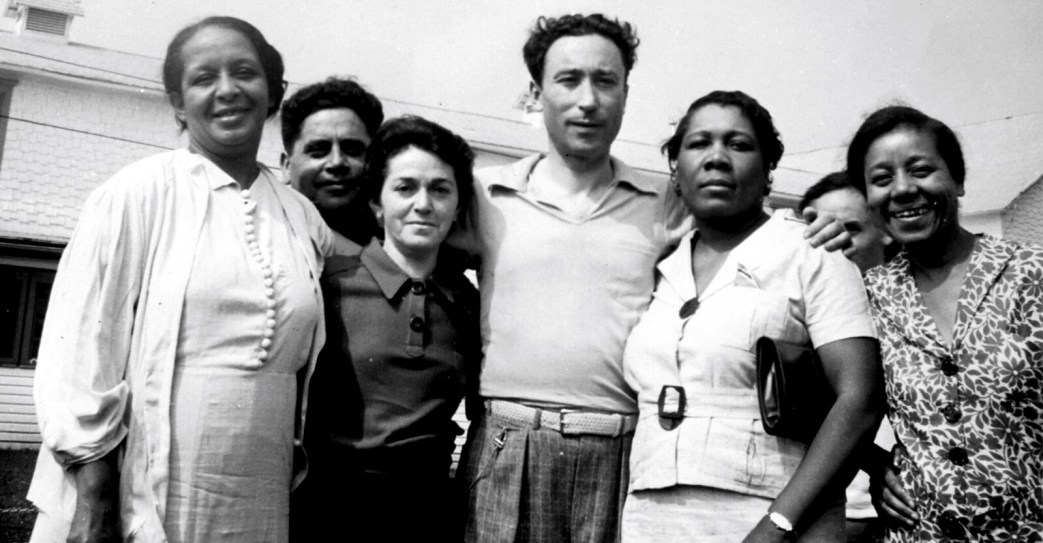
Among the most important, and militant, union locals in U.S. working class history was New York City’s Local 22 of the International Ladies Garment Workers Union. Long a site of contested leadership with numerous factions, including revolutionaries and gangsters, veteran Communist and leading militant of Jay Lovestone’s ‘Communist Party (Majority Group)’ won an April, 1933 election for leadership helping to give Local 22 a dynamism that made it a force in left-wing unionism of the 1930s. Zimmerman would remain in leadership of the Local for 40 years. A report of the new still divided new leadership of the union.
‘The Installation in Local 22’ by B.L. from Workers Age. Vol. 2 No. 14. May 15, 1933.
Zimmerman Outlines Program of Unity and Struggle.
New York City. The meeting to install the newly elected administration of Local 22, I.L.G.W.U., was held on April 20, 1933. President Dubinsky, on behalf of the General Executive Board, made an extensive speech “explaining” the position of the G.E.B. in ordering the local to postpone the elections for two weeks. He criticized the action of Local 22 in refusing to obey the decision of the G.E.B. and proceeding with the elections but he stated that, taking into consideration the appeal made by a number of active shop chairmen, the G.E.B. had decided to overlook the violation of discipline and recognize the newly elected Executive Board.
Dubinsky Speaks For The G.E.B.
Referring to the friction of the previous Bluestein administration of Local 22 with the G.E.B. Dubinsky stated that it had not been a fight of principle. Of course he realized, he said, that there were fundamental differences between the G.E.B. and the “Lovestone” elements. He expressed the hope that the local executive would carry on the work of organizing the dressmakers and building up a strong dressmakers union.
After the speech of Dubinsky, Bluestein was elected chairman of the executive board for the coming year against Rosenberg, the candidate of the so-called “left block.” In replying to Dubinsky’s speech, Bluestein stated that the struggle that Local 22 had carried on against the G.E.B. had been based on real questions of principle. It was the opinion of Local 22 that the present organizational form of the union did not serve the workers. It was necessary to give up the craft divisions in the union, where some crafts were getting better conditions at the expense of the workers in the other crafts and that industrial unionism was the medium thru which the workers would improve their conditions. The chairman then read telegrams of congratulations that came from nearly every local of the I.L.G.W.U. of the city and from many dress shops. There was a variety of speakers at the installation: Hochman, the secretary of the dressmakers Joint Board, Antonini, manager of Local 89, Levy, manager of Local 1, and Cooper, manager of Local 9. Hochman was quite pessimistic in this talk.
Strangely enough, the speech of Levy of Local 1 did not differ much from Hochman’s in the estimate of the situation. The whole tenor of his speech was to place the entire responsibility for the present conditions of the cloak-makers and dressmakers on the workers leaving the conservative leaders out of any responsibility.
On The Question Of Unity
On the question of the proposals for unity made by the Needle Trades Industrial Union to the G.E.B. and to the various locals, all the speakers for the administration, Dubinsky, Hochman and Antonini, stated that sooner or later the union would have to face the question of the so-called “united front”, that is, of the situation in which members of the I.L.G.W.U. were active in organizing shops and then turned them over to the Industrial Union, that while they were members of the I.L.G.W.U. they are working for the destruction of the union.
Quite characteristic was the speech of Cooper, manager of Local 9, a member of the “Left group.” He dealt with the unity proposals made by the Needle Trades Workers Industrial Union. He criticized the G.E.B. for not allowing the committee to present their proposals. He had, however, to admit in his speech that he too, realized that two unions could not carry on one strike but that one strong union could do it. He based his argument, however, on the premise that there were two unions in existence, even tho one union might not have as many members as the other, it was necessary for the union to confer with the Industrial Union and find a basis for joint action. He failed, however, to state definitely and concretely how the unification should take place.
Zimmerman Presents The Program Of Unity And Militancy
In introducing Zimmerman, the newly elected manager, Bluestein said: “When the Zimmerman group came into our union, we watched them, but we soon saw that they came in to work for the dressmakers. Tho there were very serious differences between Zimmerman and myself, we worked together in the union. This proves that there is a possibility of cooperation between Communists and other elements.”
“Installation meetings”, began Zimmerman, “are not holidays but gatherings where problems are to be discussed. All those who spoke tonight remarked that they did not raise any controversial questions but everyone of them raised precisely these questions.
“Brother Antonini spoke about a truce in the union but there can be no truce. The struggles in the union revolve around the questions of policy and tactics. These differences of opinion exist and they cannot be stopped. However, regardless of differences, there are certain elementary points that all must unite upon, such as fighting the boss, picketing, organizing the unorganized workers, improving the conditions in the shops.
“All speakers raised the question of one union. We have at the present time four distinct proposals: from the Industrial Union, from the “Left Group,” from the G.E.B., and the one we put forward during the campaign. We oppose all so-called unity that really leads to further splits.
“It is possible for two unions, let us say in the building trades (for instance the electrical union and the steamfitters), to participate in one strike, but we cannot conceive of two different electrical unions, fighting one another, calling one strike. Such a situation would not establish unity but rather friction and sharp fights during the strike.
“The ‘Left Group’ also came out with a proposal for unity–that Local 22 should take the initiative in calling a conference of both unions. International and Industrial. This proposal, unfortunately, can lead only to further splits. Let us say that Local 22 accepts this proposal and calls such a conference. Let us also say that the International will not come (and it is certain that they will not come as long as the dual union policy is continued). Then it would only be a conference between the Industrial Union and Local 22.
“How then can this lead to one union? It would only mean that Local 22 would split away and unite with the Industrial Union. This would increase the chaos because only a section of the dressmakers would go into the Industrial Union, the other section remaining with the International. It would therefore bring further splits and not unity.
“As far as the proposal of the G.E.B. is concerned. I believe that the G.E.B. is not justified in issuing an ultimatum that the Industrial Union must first liquidate itself and only after that a conference can be held on the question of unification. The important proposal is unity and not the form. If the Industrial Union leaders should come out and state that in principle they were willing to give up the dual union policy, then we could get together at a conference to take up the question of merging the two unions by taking in the members of the Industrial Union in a block. having new elections and recognizing those elected as the new administration of the unified organization.
“We should be interested in remaining a part of the American labor movement, precisely because the A.F. of L. is so reactionary. Those who have forgotten these principles will have to learn them again.
“We must remind those who are proposing a class struggle policy for the union, that you don’t merely demand from the reactionary leadership that they carry on a class struggle policy but that you must organize the membership to fight for it.”
Zimmerman also pointed out that the form of the organization alone would not make a union more militant or aggressive. He showed that the United Mine Workers, an industrial union, had the most reactionary leadership which paralyzed the workers struggle, and cooperated with the employers to defeat the workers and that the furriers union in 1926, tho a craft organization, was revitalized by a real leadership.
“The policy of the joint board of the dressmakers,” he said, “must be such as to enable us to carry on the fight against the employers. Don’t worry so much about the agreement. Do the bosses carry out all the points of the agreement? Organize a stoppage. Demand resettlement.”
Zimmerman took up the problem of organizing the newer elements that have entered the industry, Negro, Spanish and other groups. All of the elements must be drawn into union activity.
“In connection with the struggle against the out-of-town sweatshops we must propose that the joint board and the International should call a conference of all needle trades unions to organize and fight against those sweatshops. The dressmakers must become the spearhead of the movement.
“It is necessary to change the system of the union, the structure of the organization, to enable us to carry on a real effective struggle against the employers.’
Politics And The Union
Referring to the remarks of Hochman that the question of politics could not be raised in the union, Zimmerman remarked: “It depends what kind of politics you have in mind. If we want to function as a real labor organization, we cannot say that we will not take part in questions that affect the whole labor movement, questions such as the liberation of Tom Mooney, unified action of the workers on May First, the struggle against Fascism in Germany, defense of the Scottsboro boys, etc. It is up to us to see that all of these questions are taken up in the union in a manner that will strengthen our organization, extend the class consciousness of our members and make a strong militant union.”
It is interesting to note that when Zimmerman was introduced it was very late, and a number of members were on their way out, but his speech was so effective that all of them remained with their coats in their hands and listened to his every word.
The speech was very favorably accepted by all those present.
Workers Age was the continuation of Revolutionary Age, begun in 1929 and published in New York City by the Communist Party U.S.A. Majority Group, lead by Jay Lovestone and Ben Gitlow and aligned with Bukharin in the Soviet Union and the International Communist (Right) Opposition in the Communist International. Workers Age was a weekly published between 1932 and 1941. Writers and or editors for Workers Age included Lovestone, Gitlow, Will Herberg, Lyman Fraser, Geogre F. Miles, Bertram D. Wolfe, Charles S. Zimmerman, Lewis Corey (Louis Fraina), Albert Bell, William Kruse, Jack Rubenstein, Harry Winitsky, Jack MacDonald, Bert Miller, and Ben Davidson. During the run of Workers Age, the ‘Lovestonites’ name changed from Communist Party (Majority Group) (November 1929-September 1932) to the Communist Party of the USA (Opposition) (September 1932-May 1937) to the Independent Communist Labor League (May 1937-July 1938) to the Independent Labor League of America (July 1938-January 1941), and often referred to simply as ‘CPO’ (Communist Party Opposition). While those interested in the history of Lovestone and the ‘Right Opposition’ will find the paper essential, students of the labor movement of the 1930s will find a wealth of information in its pages as well. Though small in size, the CPO plaid a leading role in a number of important unions, particularly in industry dominated by Jewish and Yiddish-speaking labor, particularly with the International Ladies’ Garment Workers’ Union Local 22, the International Fur & Leather Workers Union, the Doll and Toy Workers Union, and the United Shoe and Leather Workers Union, as well as having influence in the New York Teachers, United Autoworkers, and others.
PDF of the full issue: https://www.marxists.org/history/usa/pubs/workers-age/1933/v2n14-may-15-1933-WA.pdf
 Revolution's Newsstand