
A rare English translation of an article by senior Bolshevik, Red Army commander, literary critic, and leading Soviet economist Ivar Smilga. At the time of this writing Smilga was a C.C. member, Director of the Institute of National Economy, Deputy of the State Planning Committee (Gosplan). Among the most prominent Left Oppositionists, Smilga argued, as he does here, for abandoning the New Economic Policy in favor of planned industrialization. Expelled in late 1927 with other Oppositionists, like a number of others, Smilga recanted and were readmitted to the Party in 1929 with the inauguration of the Five Year Plan. Rejoining Gosplan as its Deputy Chair in 1930, he would be arrested after the Kirov assassination in January, 1935. Refusing to confess to ‘counter-revolutionary terrorism,’ Smilga was one of the most prominent Bolsheviks to be executed without a public trial in the Purge years. He was shot on January 10, 1937.
‘The Economic System of the U.S.S.R.’ by Ivar Smilga from International Press Correspondence. Vol. 5 No. 78. November 3, 1925.
In the Union of Soviet Socialist Republics, the economic year commences on October 1st. The economic achievements and difficulties of the Soviet Union are always reckoned up from this date. The past year has shown considerable economic attainments, despite the unfavourable situation caused by the partial crop failure of 1924. We see indications of these achievements in all branches of economy. The agriculture and industry of the Soviet Union are making gigantic strides ahead. On the basis of productive successes, the trading balance of the Union has developed, the financial situation has become strengthened, and the material position of both the urban and rural population has considerably improved. The period of goods crises and falling currency is a thing of the past. National economy has entered the period of revival.
The October Revolution and the subsequent civil war caused by the native and foreign landowners and capitalists, greatly impoverished the Union. Only four years ago our enemies were asserting that it would be impossible to restore the economic system of the Soviet Union without handing over the industry to foreign concessionaires and to the deposed capitalists. Once again life has wrecked the plans of our enemies in a brilliant manner. The toiling masses of the Soviet Union, blockaded by their neighbours and impoverished, set about restoring economy with their own resources. At the present time no doubt arises as to the economic future of the Union. We are witnessing not only a tremendous development of the productive forces of our country, but also the growth of Socialism in the Soviet Union.
The year 1925/26 has commenced under favourable conditions. The good harvest of 1925 will result in a considerable improvement in agriculture. Improved conditions in the towns create the material basis for an extensive housing campaign and improvements in public services. This in turn opens up new perspectives for the development of industry.
Side by side with these great possibilities, considerable difficulties are still to be met with. Up to the present we have come up against difficulties arising primarily from our extreme poverty. At the present time we are confronted with difficulties connected with the revival and growth of our national economy. First on one sector of the economic front and then on the other, we have to come face to face with the fact that we are either going beyond, or trailing behind the tempo of economic restoration taken as a whole. Much energy and labour must be spent in coordinating the separate sections of our gigantic economic entity. One of the main tasks and the main difficulties confronting us in the coming economic year is the establishment of such mutual relations between the economic system of the Soviet Union and world economy as will facilitate mutual relations between town and countryside. We have already reached a position wherein our economic connections with the world market will play a prominent role. But as compared with the difficulties arising from impoverishment, the toiling masses of the Soviet Union will have little difficulty in coping with those difficulties that arise from our economic revival and growth. The conquests of the October Revolution remain more stable than ever.
In order better to explain the processes taking place in agriculture, we must dwell on two phenomena which are of particular importance. These are the currency reform and the price dynamics of agricultural products and industrial goods.
There can be no doubt but that the system of parallel values was one of the main reasons for the economic inequalities between the town and the countryside. Within the Soviet Union, it was as if two separate economic systems existed—firm currency and favourable market conditions in the towns and depreciating currency and bad market conditions in the villages. Agriculture suffered most from inflation, and therefore it is perfectly logical that it should lose the most in the transition to firm currency. It was only after the currency reform that it became possible, for the first time, for agriculture to adopt rational methods and commence accumulation.
The second phenomenon is that from the first months of the year 1924 there was a clearly marked tendency on the part of agricultural prices to increase and industrial prices to decrease. This tendency may be fully explained by the conditions arising from the revival of our economic system. The rapid development of industry and corresponding increase of production constitutes the economic basis for the policy of lowering the prices of industrial commodities. The change over to a firm currency and renewal of connections with the world market suddenly raised the prices of agricultural products.
The conditions in which agriculture developed in 1924/25 were, in the main, created by these two circumstances. Indeed, these two circumstances repaid with interest the losses suffered by agriculture owing to the partial crop failure of 1924. Despite the unfavourable commencement, the last economic year was the most successful of all Soviet years as far as the tempo of our economic development is concerned.
The perspectives of development for agriculture during 1925/26 are, on the one hand, determined by the condition of the harvest and on the other hand by this same price policy on agricultural goods. As far as the 1925 harvest is concerned it remains completely satisfactory after all reductions in connection with unfavourable reaping and threshing conditions. The 1924 harvest amounted to approximately 2,800 million poods. The 1925 harvest amounted, by Autumn, according to the figures of the Central Statistical Bureau, to 4.2 milliard poods. It is now already quite clear that even with the most unfavourable conditions possible in the near future, the output of tradeable wheat will exceed almost twofold that of last year. The harvest of the most important special crops is also very favourable.
As far as prices of agricultural products are concerned, these prices continue to remain at an extremely high level, despite the alarming expectations which were current until quite recently. The commencement of the Autumn wheat campaign was retarded owing to rainy weather. In addition, this year the “single” agricultural tax was reduced considerably, while this tax was collected in such a manner as not to cause pressure on prices in the Autumn. We have frequently remarked that the supply of industrial goods to the countryside will be the most difficult item in the coming wheat campaign. And indeed, until quite recently, information was being received concerning the inadequate supply of goods to the villages, even in those districts where our trading organisations are sending the largest quantities of industrial goods.
These factors have a retarding influence on wheat offers and place the peasantry in the most advantageous position. Recalling the sweeping rise of wheat prices in the spring of this year, the peasantry prefers to make payments to the State with secondary products such as poultry and eggs and not with wheat.
The foremost task of the coming economic year 1925/26 is to regulate the internal market for agricultural goods. The present position of prices makes our export disadvantageous. Whereas the state of prices within the country is rising, world prices are on the decline. High prices on wheat and other products of agriculture threaten the purchasing power of the currency. Finally, this state of prices of agricultural products darkens the perspectives for the future wheat purchasing campaign.
The conditions that give a stimulus to wheat sales are tax reductions and credits to the peasants.
The position with regard to the most important stimulus of all i.e., flooding the villages with industrial goods, is improving from month to month. During the first quarter, a considerable increase in home production is expected, as also the import of an extensive quantity of goods from abroad. All these factors taken together should have the effect of straightening out the uneven balance on the goods market between town and village.
A definite policy in the sphere of demands should also correspond with these measures. Up to October the chief measures amount to a considerable reduction in the proposed purchasing plan, which will automatically lead to a reduction in credits and decrease in demands. Last year limited prices were transformed into firm prices at the seat of production. The People’s Commissariat for Internal Trade is faced with the tremendous task of establishing uniformity in the field of wheat provision.
While treating on agriculture one cannot fail to refer to the tremendous significance which agricultural credit has acquired during the last two years. At the present time about 300 million roubles is in circulation in the system of agricultural credits. Agricultural credit had played a tremendous role in financing the supply of machines for the countryside. A number of substantial improvements in the agricultural methods in various districts had been effected with the aid of agricultural credits. Side by side with the most extensive achievements in this sphere one must refer, however, to one considerable defect. This is with respect to attracting peasant investments in the lower network of the agricultural credit system. Our primary societies conduct too many trading operations and give too little attention to credit matters. Until the lower apparatus becomes readjusted in the form of credit societies with middlemen functions, there is not much hope of attracting peasant investments. In particular, the lower co-operative system of agricultural credit is faced with a sharp swing round from trading operations into the sphere of attracting investments and granting credits.
In concluding our remarks on agriculture, we draw the reader’s attention to the fact that the process of growth of productive forces in the countryside correspond to definite social processes in the villages. These processes are primarily expressed in the stratification in the countryside. Side by side with the middle and poor peasant, a new bourgeoisie is growing up in the villages, composed of rich peasants on the one hand, while on the other hand a section of the poor peasants is becoming transformed into proletarians. Certain comrades over-estimate the significance and extent of this stratification that is proceeding in the countryside. It seems to them that we are already faced with a clearly expressed and economically most powerful rich peasantry on the one hand, who are in the minority, while on the other hand there is the economically weakest poor peasantry, in the majority. We are of the opinion, however, that the middle peasant still remains the most important figure in the countryside, although this does not in the least degree lessen the significance of the movements which are taking place in the villages.
In the rate of development of industry, the past economic year was the most important of all the revolutionary years. During that year, industry developed by about 55-60 per cent as compared with October 1st 1924.
During the first years after the transition to the New Economic Policy the branches of industry producing articles of primary necessity, developed the most rapidly. It is quite comprehensible that the country, in full process of restoration, endeavoured to satisfy primary needs such as clothing, footwear etc. During the past economic year the metallurgical and metal goods industry reached the highest tempo of development. This signifies that, side by side with the satisfaction of demands for articles of primary necessity, demands for the means of production (machinery etc.) also grew. This in turn is the best proof as to the stability and vitality of the successes which we have witnessed during recent years.
When talking of the perspectives of industrial development for the coming economic year 1925-26, it is above all necessary to refer to two main points: firstly, to the condition of the Market for industrial goods and secondly, to the Possibilities for the further development of industry. As far as the capacity of the internal market is concerned, the matter stands as follows: the good harvest in 1925, and the high level of prices of agricultural products, will undoubtedly give a strong stimulus to the subsequent development of agriculture. This, in turn, will be and already is, reflected in an increased demand for industrial goods. Until quite recently, this demand considerably exceeded the supply of industrial commodities. The growth of demand on the part of the peasantry who were in a position to pay, overtook the increase in the production of industrial goods. We hope that in accordance with the subsequent increase of production the goods famine will commence to abate.
We are convinced from an analysis of the component parts of the internal markets on the one hand, and an analysis of our own possibilities on the other hand, that during the coming year one need not expect a crisis in the realisation of industrial goods. The period of housing and industrial construction that has now commenced will create a new demand for building materials and machinery. In this manner both the branches of industry producing articles of consumption and the branches of industry producing the means of production, may count on being able fully to realise their production to an equal degree. The increasing demand should also serve as a stimulus to what we term the stage of industrial ascendancy which the national economy of the U.S.S.R. is now entering.
As far as our productive possibilities are concerned, we have to draw attention to the following. The economic year 1925-26 will be the last year of “restoration” i.e., during this year the possibilities of further development at the expense of old fixed capital will have been utilised to the full. In order to preserve in future the rate of industrial development that has been attained, it is necessary to prepare for a new stage in the field of industry. We generally designate this new period as the period of reconstruction of productive forces of the country as against the period of “restoration”. During the next few years is will be necessary to construct a number of new factories and works and to renew the technical equipment in the existing industrial enterprises. This will demand tremendous expenditure for industrial purposes. In order to fulfill this tremendous task serious preparatory work is necessary. First, a plan of industrial construction has to be drawn up and secondly, a number of economic measures must be effected for mobilising and concentrating resources for this object. The last year of “restoration” must be a year of serious preparations for a higher stage in the field of industrial development.
Simultaneously with the growth of industry, the numerical strength of the working class has grown, as also real wages. The following table illustrates this:
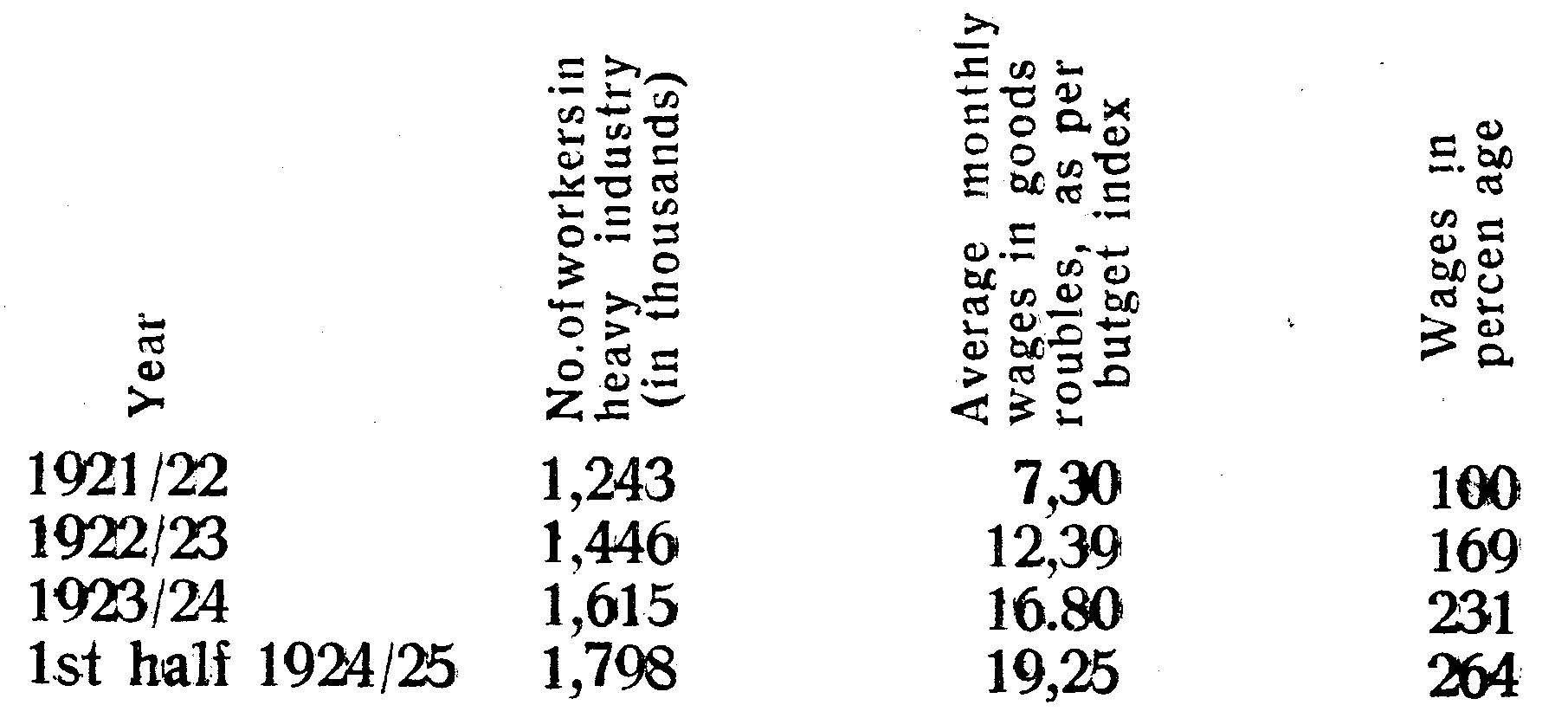
There is one question connected with labour which should attract serious attention. This is the problem of preparing skilled labour power. The absence of a trained proletariat threatens to become a serious obstacle to the subsequent development of a number of industrial enterprises. The State, the trade unions and the Party, must give the most profound attention to this problem.
The trade turnover has grown and the financial system of the U.S.S.R. has become strengthened, both in agriculture and in industry on the basis of increased production. During the past economic year the liquidation of primitive relations in the countryside was continued, and agriculture was reconstructed on the basis of marked relations. This circumstance must be taken into consideration when seeking an explanation for the tempo of increase in the trading turnover and the currency mass in circulation.
As far as the currency mass in circulation in the country is concerned, this has almost doubled as compared with the end of the economic year 1923/24. The new currency has stood the test with honour during a period of 11/2 years. It has coped with the extremely high prices of wheat during the autumn of 1924 and summer of 1925. This goes to show that the economic system of the country has become firmly and positively adapted to the stable currency. In the future our duty will be to follow attentively the condition of the purchasing power of our money and to destroy at the outset all dangers which might arise for the new currency.
The year 1924/25 has seen a considerable reduction in the dimensions of the single tax. The reduction in tax burdens, the rise in wages and the increased grants of funds for agriculture, also serve as a best proof that the successes attained by our economic system are immediately reflected in the material position of the toiling masses of the Union, which position is undoubtedly improving.
When we come to the question of the internal market it is first and foremost necessary to refer to the evolution of agricultural and industrial prices. Only two years ago we had the “famous” scissors. At the present time these “scissors” no longer exist. Agricultural prices have considerably risen while those of industrial goods have been considerably lowered. In connection with the expected increase in the development of industry, the fall of prices of industrial goods will continue. Of late, retail prices have jumped up excessively owing to lack of goods. The most effective method of struggle against this evil is to keep the market supplied with an adequate supply of goods. For this purpose both an increased development of industry and the importation of a considerable quantity of goods from abroad has been undertaken: At the present time one of the most effective measures of struggle against speculating with prices, is an increased support for the co-operative apparatus. The State is firmly conducting this policy. However, it will only be successful if the population itself participates extensively in the activities of the lower co-operative apparatus. The nature of this activity depends upon the degree of activity and interest of the population itself in the co-operatives.
Foreign trade acquires tremendous significance for the subsequent development of our economic system. In our country there is a surplus of agricultural goods and an acute shortage of industrial goods. Our task is to export surplus wheat and other agricultural produce and import into the Soviet Union the necessary raw materials and equipment for industry, and a number of goods for agricultural purposes (agricultural machinery, seeds, etc.). In order to collect all possible resources for export in a successful manner, the peasantry must be supplied with an adequate quantity of industrial goods. This is only possible with considerable imports of these goods from abroad. Thus exports and imports are indissolubly connected one with the other.
Raw materials and semi-manufactures occupy an important place in imports during the coming economic year. In accordance with the growth of our own agriculture, these groups of industrial imports will be reduced and will give place to the machinery and equipment group. However, for the coming economic year it is just this item of import which is the most appropriate and which guarantees the country the highest industrial efficiency. During the “restoration” period, it is most advantageous to the economic system to import raw materials and semi-manufactured goods, as big possibilities in the field of installations still exist within the country. In the future, it stands to reason that the situation will change greatly.
When we speak of the attainments in the field of schematic work, we cannot pass by the “control figures” recently published by the State Planning Commission. These “control figures” are an attempt to give reliable figures for the main branches of industry for one year in advance, on the basis of a study of our economic development. Although we will not devote ourselves to estimating this work, we must recognise that such an attempt to compile these figures is a considerable accomplishment in the field of schematic work. There is no doubt that actual life will usher in considerable corrections to the Gosplan figures. However, the discussion in the press which has arisen in connection with the publication of these control figures and the consideration of these figures in the higher governmental institutions, have not up to the present brought any substantial changes to the conceptions put forward by Gosplan.
The control figures are not the first attempt at schematic forecasts. In 1920 such an attempt was made for the first time in connection with the drawing up of a plan for the electrification of Russia. But even then we knew too little about Soviet economics. Later on, separate perspective plans were drawn up according to different branches of industry. Until quite recently, however, the attempts to sum up the separate sections of this work have been unsuccessful. Only after the economic system of the union, after transition to the New Economic Policy, entered the period of restoration, and only after the main lines of our economic development were traced out on this basis, did it become possible to make a first attempt at generalising the separate sides of our schematic work.
The work of compiling these control figures was preceded by 18 months work in studying the economic market situation of the country. In connection with the events of autumn 1923, the State Planning Commission formed a “conjuncture” council whose task was to follow the changes in the economic situation month by month. Only after definite experiences had accumulated as a result of this work, was it possible to commence a profound dynamic study of the economic processes of the country.
The main idea underlying these control figures is the assertion that the coming economic year 1925-26 will be the last year of the “restoration” process. This means that by the end of next year, the possibilities of further development at the expense of old fixed capital will have been fully utilised. In this manner the pre-war level of economy on the whole will have been reached. As we have already emphasised above, there can be no question of the economic system of the Union coinciding with the economics of pre-revolutionary Russia. During the last ten years far too deep changes have occurred in the basic elements of national economy for this. The significance of different economic regions of the Union has substantially changed. The economic relations of the Union with the external market are also quite different. Tremendous changes have taken place in the structure of national income and expenditure. One need only point out the changes that have taken place in the field of wages to become convinced of this. In this manner the attainment of the pre-war level must be understood as being absolutely conditionally and approximately. Whereas the control figures place the schematic questions within the bounds of a restorative process, the coming work of planning our national economy should bring forward in all their magnitude the problems connected with the programme for the future reconstruction of our economic system. The plan of electrification approved in 1920, which is now being reconsidered, is closely bound up with this programme. We are now approaching a programme of reconstruction.
We must now refer to the main methodological considerations connected with the drawing up of the reconstruction plan. We consider that separate economic or technical principles cannot serve as a basis for this work. The only method of approach for the compilation of this perspective plan is to be found in the necessity of organising the economic system on a Specialistic basis. This sole object should dominate all other methodological approaches.
First and foremost, the following must be taken into consideration:
The Role of U.S.S.R. Economics in World Economics. The connection of our economics with world economics increases from year to year. The further we proceed, the more our influence in the external world is seen and, on the other hand, our economic system feels the stimulus of the world market more and more.
The Problem of Internal Balance. Social construction in the Union can only be successful if it be conducted by the concerted efforts of the proletariat and peasantry. The path and tempo of development of industry depends in the closest manner upon the nature and tempo of development of our agriculture. In addition to this basic approach, the economic inter-relation of the various regions and districts of the Union has tremendous significance.
Electrification and Energy as a Whole. The problem of energy must also be considered as a basic approach in the sphere of reconstruction of our technical productive forces. The energy resources of the Union, their quality and distribution, must serve as the basis for our future plans of economic construction. Socialism demands technically perfected productive forces. For this reason the significance of electrification is tremendous, and the work done so far in this field is only initial work for the immeasurably huge work of the future.
In this manner, we must base our work of reconstruction on a combined economic and technical approach. This work is bound up with colossal difficulties. However, in view of the tremendous importance of this work, we must not pause before any difficulties whatsoever, in our accomplishment of this task. In this article we have only touched the most important problems of our economic situation and our economic policy. However, the sum total of the questions we have touched on will give, in our opinion, a general idea as to our position.
International Press Correspondence, widely known as”Inprecorr” was published by the Executive Committee of the Communist International (ECCI) regularly in German and English, occasionally in many other languages, beginning in 1921 and lasting in English until 1938. Inprecorr’s role was to supply translated articles to the English-speaking press of the International from the Comintern’s different sections, as well as news and statements from the ECCI. Many ‘Daily Worker’ and ‘Communist’ articles originated in Inprecorr, and it also published articles by American comrades for use in other countries. It was published at least weekly, and often thrice weekly. Inprecorr is an invaluable English-language source on the history of the Communist International and its sections.
PDF of issue: https://www.marxists.org/history/international/comintern/inprecor/1925/v05n78-nov-03-1925-inprecor.pdf
 Revolution's Newsstand