
Mary E. Marcy reports on the massive, but isolated, Upper Michigan W.F.M. copper strike and worries that workers there will be cornered into an armed conflict they cannot win, as recently in West Virginia, without solidarity from the larger labor movement.
‘The Copper Strike’ by Mary E. Marcy from International Socialist Review. Vol. 14 No. 5. November, 1913.
WAY up in the upper peninsula of Northern Michigan 15,000 copper miners are waging a grim battle against the absentee Copper Kings. The men have worked ten and twelve-hour shifts for many years at an average wage of only $2.00 a day. Recently the companies decided to force the men to work one-man drills. Three miles in the bowels of the earth they planned to send the human moles of Michigan to dig and bring forth wealth for the spending of the bosses.
But they reckoned without the splendid spirit of the miners, who have struggled along under growing pressure from the mine bosses, while the cost of living climbed merrily upward and the standard of living went down with every leap in the prices of commodities.
The mine boys came to a few conclusions themselves and decided to raise the price of their LABOR POWER. They also made up their minds that they would enact a new labor law (among themselves) and cut short their underground workday.
They looked over the financial reports of the Calumet & Hecla Company and discovered that the mine owners had only put $1,200,000 into the mines originally and had taken out over $120,000,000 for their OWN PROFITS. Most of the mine owners live in cultured Boston and have never seen the inside of a shaft. One man drawdown $120,000 salary as president and director of the company. The first vice-president (also a director) holds up the boys for $70,000, while other directors and officers make away with $45,000 and $40,000 each, and the directors are rewarded with a bagatelle of $20,000 a year. From one mine alone the officers of the company grant themselves $370,000 in loot (‘salaries’) every year.
Now the boys in the copper mines are fast becoming Socialists. They are all disgusted with the portion they are receiving. They run, manage and work the mines. They are beginning to doubt the wisdom of DIVIDING up so foolishly and partially for the benefit of the mine owners. They are organizing today to FIGHT the bosses in order to secure MORE time to plan for a better resistance later on. The day is coming when they are going to take possession of the mines in the name of the MINE WORKERS, just as the steel workers will take over the steel mills, just as a united working class intends to take over all the mills, factories, shops and mines to be run and operated only in the interests of those WHO WORK and RUN and MANAGE them. They are going to STOP MAKING PROFITS FOR BOSSES.
This is the way all militant labor wars are tending. Today the copper miners are fighting for $3.00 a day and an eight-hour day. Tomorrow they will demand the full value of the copper they dig.
Also, the men are determined to abolish the one-man mine drill.

When the boys heard that several carloads of armed “guards” were on their way to Calumet from New York City, they got busy. The train was rushed through Calumet, but a few miles beyond was halted by piles of tiles thrown over the tracks. The miners had gathered to see the fun and to show their contempt for the “guards”. This was too much for those “clothed with authority”. They immediately opened fire upon the boys. A little surprise was in store for them, however, as the miners stood their ground and instead of turning the other cheek, opened fire in return. So hot did it become for the “guards” that the train hastily backed out and the guards retreated, vanquished.
It is granted by everyone that the “mine guards” are on the ground to irritate the miners into an open and sanguinary revolt. Miners are attacked constantly. Many are seriously injured. Women are insulted and beaten. The miners are armed. Most of them realize that THE ARMED RESISTANCE OF A FEW WORKERS NEARLY ALWAYS FAILS, because the bosses can call all the forces of capitalist society to do their bidding. A group of workers cannot defeat the whole capitalist government—the entire capitalist class—the army. But the miners are not meek and lowly wage slaves. One of them writes to us: “For every miner who is deliberately picked off and murdered by a ‘guard’ they will have to settle with us.”
But the men want peace. Not the peace of the lamb that has been devoured by the lion, but the peace that follows a victorious engagement with the enemy, the peace after a strike is won.
Last reports claim that the militia and gunmen have declared that they have been ordered to crush the strike by the use of violence. Following attacks upon the miners, the troopers arrest all they cannot ride down.
Strikers frankly admit their participation in the disturbances. All the big trouble arose when the armed artillerymen deliberately rode down a nine-year-old girl who was the daughter of a striker. It is reported that the soldiers were commanded to go to any lengths to provoke an outbreak by the strikers in order to find further opportunity for brutality and terrorism.
During the absence of the commanding general and his staff the militia and thugs have promised the striking miners a “real reign of terror.” We are not prophets, but we have a suspicion that these boys of the Western Federation of Miners will give them all they are looking for.
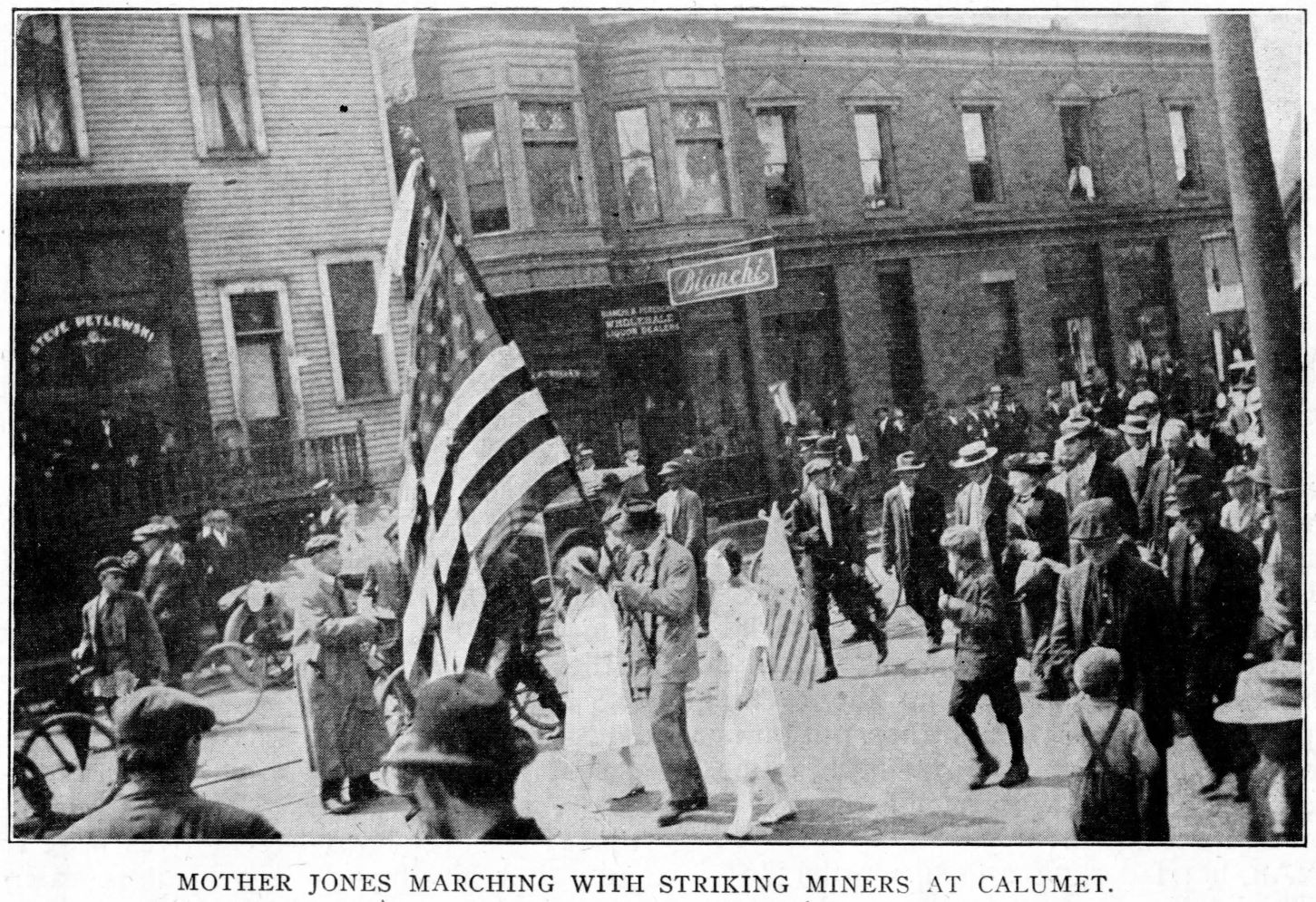
In the meantime the organizers are holding meetings and persisting in their picket duty. The spirit of solidarity is spreading rapidly and the mine men are confident of victory.
Much more could be gained, however, if the railroad men and all other miners would join the strike and enlarge the war zone. If many large groups of men in the same industry would STRIKE AT THE SAME TIME, they would be better able to fight the capitalist class.
WORKING CLASS SOLIDARITY and a general stoppage of all work in any industry are weapons that no GUN can destroy nor judge enjoin away.
The International Socialist Review (ISR) was published monthly in Chicago from 1900 until 1918 by Charles H. Kerr and critically loyal to the Socialist Party of America. It is one of the essential publications in U.S. left history. During the editorship of A.M. Simons it was largely theoretical and moderate. In 1908, Charles H. Kerr took over as editor with strong influence from Mary E Marcy. The magazine became the foremost proponent of the SP’s left wing growing to tens of thousands of subscribers. It remained revolutionary in outlook and anti-militarist during World War One. It liberally used photographs and images, with news, theory, arts and organizing in its pages. It articles, reports and essays are an invaluable record of the U.S. class struggle and the development of Marxism in the decades before the Soviet experience. It was closed down in government repression in 1918.
PDF of full issue: https://www.marxists.org/history/usa/pubs/isr/v14n05-nov-1913-ISR-riaz-ocr.pdf
 Revolution's Newsstand