
George Morris, labor editor of the Daily Worker, on what was behind the 1937 wave of sit-down strikes that transformed the U.S. workers’ movement.
‘The Sit-Down and How It Grew’ by George Morris from New Masses. Vol. 23 No. 6. May 4, 1937.
In both theory and practice, the new tactic is seen as a natural outgrowth of mass-production technique
THE sit-down, labor’s newest weapon, has caused a panic in the ranks of the open-shop employers. This accounts for the present outburst on the sacredness of “property rights.” The “constitution-savers,” whose tone has become quite familiar to the American people since the presidential election, are again on a crusade.
The very same people who for years refused to abide by the Wagner labor-relations act and similar legislation have hastened with arbitrary edicts banning the sit-down. Regarding the emergency as too serious to await formal passage of laws, governors of many states followed Governor Hoffman of New Jersey with announcements that sit-downs will not be tolerated. Now, with rock-ribbed Republican Vermont in the lead, state legislatures are preparing to rush through a ban on the sit-down.
In the whirl of arguments on the sit-down in Congress, state legislatures, and the press, many well-meaning people are undoubtedly carried away with the cry that the sit-down strike tactic is “illegal seizure,” “forcible entry,” and “trespass.”
It may therefore be appropriate to swing away from “the perfume of the corporation lawyer to the taste of the factory,” as Governor Benson of Minnesota said recently in a speech to his legislature, and see what is really behind the sit-down and how it operates. Are the sit-down strikers really out to change property relations to take possession of plants?
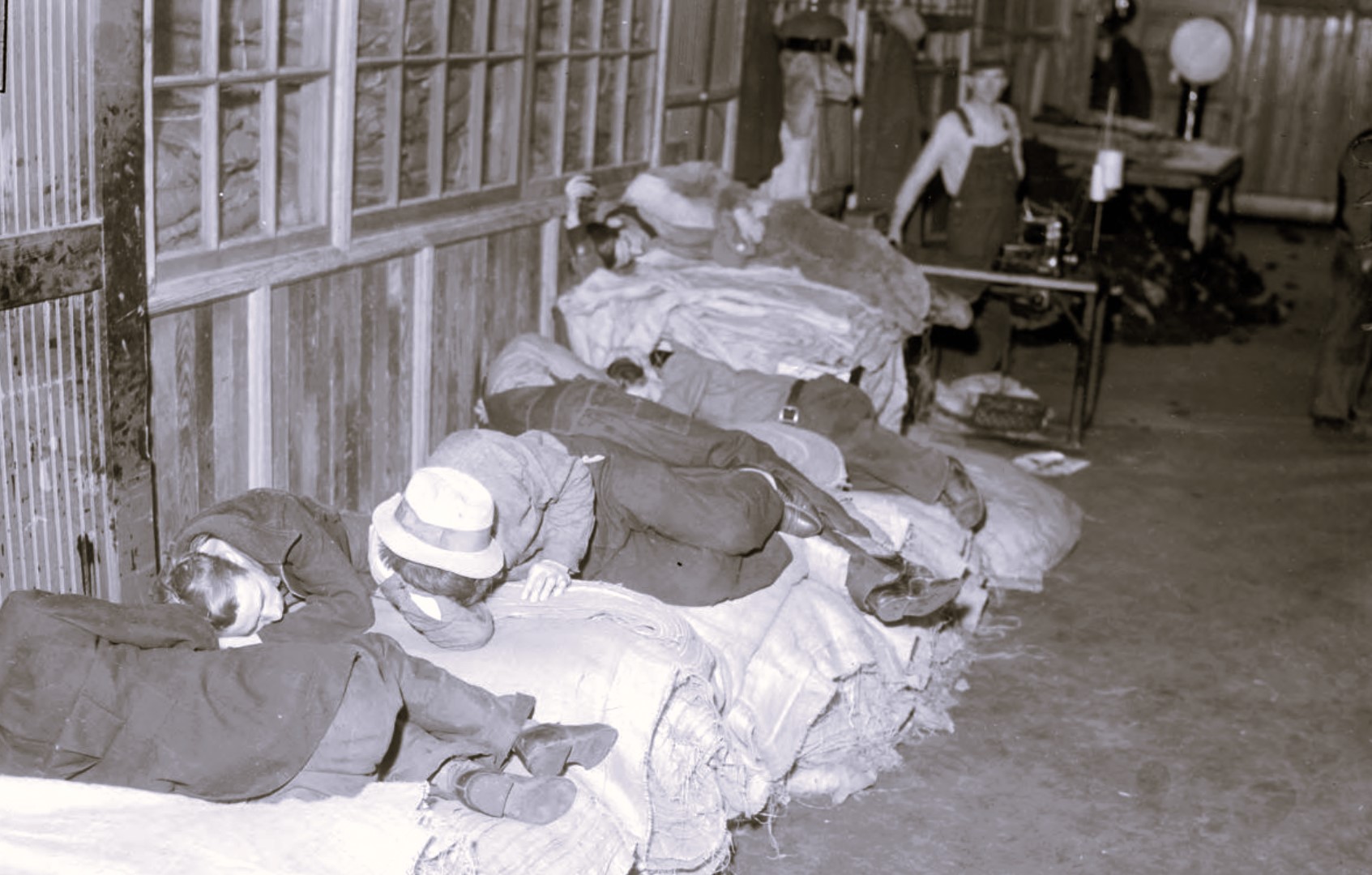
THE SIT-DOWN is not an invention of some individual. It was born on the belt-line and shaped by the workers themselves, out of conditions that obtain in mass-production industries and company-controlled communities.
For years before the present sit-down wave began, automobile and rubber workers protested speed-up of the line and wage cuts by means of short sit-down stoppages. This is not an accident. It is the factories of these industries that were famous for their spy organizations, for the blacklisting and discharge of workers on the slightest suspicion that they favored labor organization. Workers in these factories remained unorganized until recently. The trade unions that had claimed jurisdiction among them were divided into dozens of craft organizations which by their impotency only antagonized the unorganized.
Two years ago, when I arrived in Detroit, I was surprised at the indifferent way workers spoke of sit-downs that had occurred. It was regarded as quite common, especially early in the production season, when production and piece rates for new parts were set. The “kick-back” from the workers was, in fact, to some degree a gauge for the management on what prices and speed could be set.
An automobile production line stretches for a city block or more. Hundreds of workers along the line perform certain details as the car part passes. Every worker is taught to understand that he is just one link in a vast mechanism. He is instructed to remember that the interrelation between the workers has been so carefully figured out by engineers that lagging, delay, or interruption anywhere along the line will throw the whole system out of gear.
Guards in uniform and spies in overalls are stationed at every turn in the factory to see that this delicately arranged apparatus moves in good order. Any unnatural move by a worker attracts a suspicious eye. In the interest of forestalling interruption of that very sensitive production line, the employers of such cities as Detroit, Flint, Pontiac, and Akron found it necessary to send human rats to trail the workers everywhere in the community.
These conditions made impossible the ordinary procedure in organizing, and forced the automobile and rubber workers to discover a new way to organize and to learn where the gigantic enterprises are most vulnerable. The sit-down was the consequence. A sit-down stoppage can be initiated by several people along the line at a moment when the workers are aroused over a grievance. It must, of necessity, be a surprise move if it is to get by the spy machinery. From two or three points along the line, word is passed to the right and left that in a minute or two there will be a sit-down. The original source of that move is not known to anyone. But the whispers flash down the line and soon reach a sufficient number. Before you can say “Jack Robinson,” the line is down. Workers stay idle at their places, unfinished parts pass them, the line is clogged, it is stopped, and no one works. This all happens in about a minute. The factory management is suddenly confronted with hundreds of idle workers.
There is no way of telling who started the whole business. The foreman rushes to this one and that one to shake out some information. But no one can really tell him who the initiators are. No one knows. But the stoppage is an accomplished fact, and if it isn’t settled quickly, other divisions of the factory will be affected. Other workers may be involved, and if it lasts long it may mark the beginning of organization in the shop. Such stoppages are therefore quickly settled, as a rule, by announcement of a small concession. There were no negotiations. The live wires who initiated the stoppages remain hidden and unknown. There is no organization as a result of the stoppage. The line moves again and the banner of the open shop continues to fly over the factory.
Such was the type of stoppage employed for years when there was no union organization in the auto or rubber industries. But given a trade-union movement that sees a weapon in the sit-down, as the C.I.O. does, and given a more favorable political situation, as the defeat of Reaction last November has undoubtedly created, and you have the circumstances that brought about the present sit-down wave.
The type of sit-down we see today is merely an extension of the earlier sit-down stoppage. The workers are no longer satisfied with temporary concessions and to leave things as they were. They want more lasting gains and security. For that reason they stay in the factory as long as six and seven weeks, until they can walk out as free men and women with a collective-bargaining agreement and more substantial concessions. There is union leadership in the present sit-down. Most spontaneous sit-downs soon get the guidance of a union. So widespread has the sit-down become, so popular the technique because of its phenomenal success, that backward workers in out-of-the-way, unorganized mill towns have learned of the elementary rules for arranging it. From the sphere of the auto- mobile and rubber industries, the sit-down technique is now being adapted with success to every type of factory and store.
The sit-down is now regarded as the initial step for freeing a factory for organization for breaking the ice. The “seizure” fairy tale is made ridiculous by the very arrangements that workers make to administer affairs during the sit-down. Nothing happens that wouldn’t happen in an ordinary walkout. The difference is merely that the employer is restrained from bringing in scabs to take jobs, and the workers inside the factory walls are protected against attacks by thugs. When Governor Frank Murphy of Michigan presented a written promise that he would keep the Chrysler plants closed with state police at the gates, for the duration of negotiations, the workers took his word for it and vacated the factories. They swept out the plants and, as the company admitted, left them in the best of order.
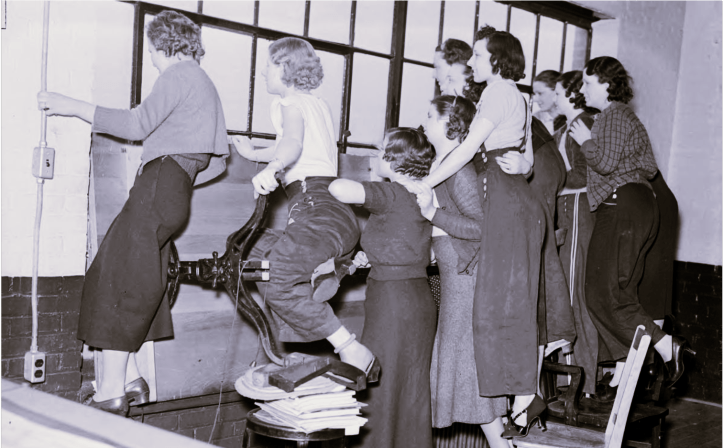
The basic idea behind the sit-down is that the workers are interested in the security of their jobs, but in the present social order their years of training are made part of the very gears and link-belts that move the production line.
William Allen White, a foremost observer for the top-hats, rightly admitted that the idea connected with the sit-down follows logically from the recognized right to picket. Given a right to sidewalks and highway in front of the factory, he says (New York Times, Sunday, March 28), the workers “suddenly crashed in the front door and sat down…They passed the industrial threshold and began to picket inside the factory.” The logic of this argument is that either the sit-down is as justified as picketing or picketing too should be banned.
As is quite apparent from the sit-downs we have seen, all principles that apply to a walkout still hold for the sit-down. A sit-down is seldom successful if only a minority of the workers support it. A minority may take initiative, but the still unorganized workers must at least favor the purpose. There have been cases when a poorly prepared sit-down gave the employer just the opportunity he was seeking to drive a wedge among the workers. Agents of the employer are sometimes set to precipitate unnecessary sit-downs so as to discredit the tactic among the unorganized or to antagonize many workers against the union. This was the case in several of the sit-downs in General Motors plants that followed the recent agreement.
The way the Hershey Chocolate Co. incited dairy farmers against sit-down strikers in its plants is only an example of how sit-down strikers cannot barricade themselves inside the plant and forget that the support of the middle-class people and farmers must be won.
It is remarkable how speedily sit-down strikers, though formerly unorganized, set up an administration in the factory. Department representatives form a leading council. Special committees are assigned for feeding arrangements, guard-duty, and policing of the plant, for entertainment and education, to serve as a trial board for violators of rules, etc.
The workers are divided to serve inside and outside, depending upon circumstances and how many may be needed to hold the factory. In the case of large plants, the workers determine which is the key department and concentrate their forces there.
In almost every sit-down, rules posted by the strike committee have restricted smoking to certain rooms, banned alcoholic liquors, and warned against damage to company property, gambling, quarreling, or any such disorder. Those in change of policing the factory saw that discipline was enforced. Where men and women are involved, separate sleeping quarters are arranged and a matron is often placed in charge of the women’s “dormitory.”
The chairman of the strike committee, the connecting link with the outside, reports at daily meetings. An outside strike committee arranges a kitchen where meals are prepared for the insiders, provides cots, organizes picket lines, and carries on in the orthodox “walkout fashion.”
Inside the plant, the workers are largely occupied with ways to kill the monotony. They play cards, checkers, chess, ping-pong, pitch quoits, box, play ball in the yard, practise on musical instruments, sing, compose songs, write jingles, do a hundred other things.
Much of the time is spent in educating the new recruits to unionism through daily lectures, study groups, and reading of labor literature. Short plays, and skits by workers’ theater groups or by talent from the ranks of the strikers, an improvised orchestra, vaudeville, etc., furnish much of the entertainment.
The sit-down is by no means as uncomfortable as many believe. Arrangements are often possible so that workers get passes to visit their homes. Relatives are frequently permitted to visit the plant. In cold weather, the advantages of staying inside are quite apparent.

Defense of the plant is a serious matter. Threats to eject them or to incite strike-breakers force the workers to lock all entrances and barricade themselves. During the General Motors sit-down, fire hose was used for defense and automobile bodies were piled to block passage-ways. On a number of occasions when sheriffs attacked, the workers were forced to defend themselves by every means at hand. But on the whole, considering the hundreds of thousands of workers that were involved in the recent sit-downs, there was very little violence, and few arrests as compared to major walkouts.
The sit-down is a more effective way to tie up a factory, and forces an earlier settlement; unorganized workers have more confidence in it because they do not leave their jobs; violence is reduced because the workers are protected; it makes easier the striking of gigantic plants which are difficult to picket; the usefulness of strikebreakers is reduced; the sit-down can be sprung suddenly and is therefore a means of holding the employers to an agreement; the employer is unable at the outset to distinguish between strikers and potential strikebreakers–at least not until the union has had an opportunity to organize.
It is quite clear: the reason some folks are worried about the constitution is because labor has discovered a battering ram with which it is successfully smashing one after another of the traditional open-shop fortresses.
The New Masses was the continuation of Workers Monthly which began publishing in 1924 as a merger of the ‘Liberator’, the Trade Union Educational League magazine ‘Labor Herald’, and Friends of Soviet Russia’s monthly ‘Soviet Russia Pictorial’ as an explicitly Communist Party publication, but drawing in a wide range of contributors and sympathizers. In 1927 Workers Monthly ceased and The New Masses began. A major left cultural magazine of the late 1920s and early 1940s, the early editors of The New Masses included Hugo Gellert, John F. Sloan, Max Eastman, Mike Gold, and Joseph Freeman. Writers included William Carlos Williams, Theodore Dreiser, John Dos Passos, Upton Sinclair, Richard Wright, Ralph Ellison, Dorothy Parker, Dorothy Day, John Breecher, Langston Hughes, Eugene O’Neill, Rex Stout and Ernest Hemingway. Artists included Hugo Gellert, Stuart Davis, Boardman Robinson, Wanda Gag, William Gropper and Otto Soglow. Over time, the New Masses became narrower politically and the articles more commentary than comment. However, particularly in it first years, New Masses was the epitome of the era’s finest revolutionary cultural and artistic traditions.
PDF of full issue: https://www.marxists.org/history/usa/pubs/new-masses/1937/v23n06-%5b07%5d-may-04-1937-NM.pdf
 Revolution's Newsstand