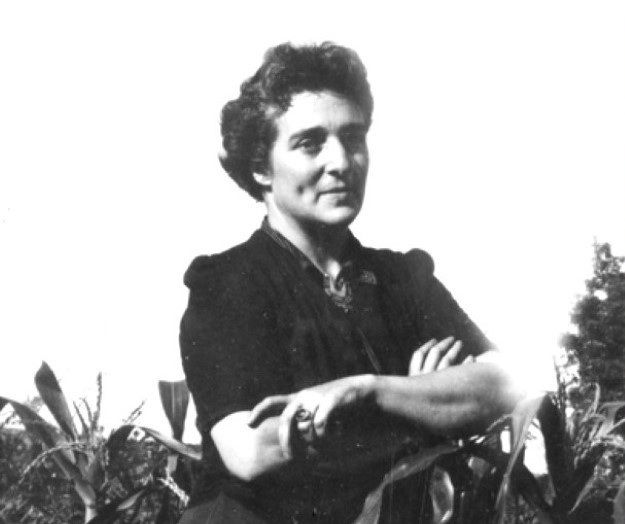
A short story from Meridel Le Sueur of Leah, a pregnant working class women who finds herself at a Communist meeting during the Great Depression.
‘Tonight is Part of the Struggle’ by Meridel Le Sueur from Partisan Review. Vol. 2 No. 9. October-November, 1935.
THAT AFTERNOON SHE THOUGHT of the bright half-spring sunshine and people coming from the relief walking slow in the half cold half heat of March. In the afternoon so many men without jobs and the dirty snow on the ground. She had walked slowly along with the men and women, carrying Dave wrapped in a pink blanket and sometimes a woman stopped and lifted down the blanket and looked at the tiny head and said what is his name? She lowered her lids over her thin cheeks, I better not act proud because this is the depression, I haven’t a right to have a baby that’s what they say, so she would try to look like an old stick, try to seem dry and brittle like old women, try to cover up her thin gold hair and make out like the baby bundle was a sack, some kind of old clothes maybe she had just gotten from the welfare and wrapped it up. But when she turned the corner and the sun blazed down as if lifting her, gee whiz, Jesus Christ it’s a baby and she felt the curve of new legs, the weak head falling against her, the pushing mouth…but we can’t give milk or cream or wheat you better nurse him as long as you can it’s the cheapest food anyway, its a law now anyway you have to nurse your baby but with worry the milk goes and you have to be thinking at two o’clock, I’ve got to have milk, at six o’clock I’ve got to have milk, at six in the morning, at ten at two at six again I’ve got to have milk. Drink a lot of water, drink hot tea, that is good, Mrs. Ellgerty says, that is excellent.
If they only had somewhere to go at night, to get out of that awful room with the baby sleeping in a cracker box on the table and no place to go to get away from Jock and nowhere for him to go but out to get drunk if he could.
She had to go through an alley, through an old carriage arch that wasn’t ever used now since the old mansion had become a boarding and rooming house and all the occupants on relief. She went up the dirty black alley and into the back door which led directly into their room. It must have been the kitchen of the mansion once. It was one room with a gas plate, a brass bed, one rocker and a table. Jock was sitting in his old socks reading the evening paper that he picked up from the next door before they got around to reading it. You couldn’t get used to seeing him it gave you a start to see him home at four o’clock and you got mad seeing him sitting there…for Christ’s sake, Jock, change the baby if you ain’t got nothing better to do.
He saw her getting thinner, he saw her breasts, the peak of her dress wet from the watery milk. It made his guts ache. He threw down the paper, he spit on the floor.
She screamed. “Don’t you dare spit on the floor when | broke my back cleaning it this morning.” The baby started in her arms almost as if still in her. She laid it down as if she had been burned. She laid it on the table with the relief order.
“A fine Mrs. I have,” Jock said, “can’t get back in time.”
“Go sit on your ass,” she said and took off her terrible hat so her hair shot around her face. I am pretty, I am pretty, Jesus, Jesus I am pretty. O Jock, look and see! I’m pretty as Joan Crawford…”
She had to get something to eat with him looking at her, hate screwing into her back.
He couldn’t go into any room. There wasn’t any other room.
Pretty soon he said, “It’s snowing, Leah, it’s snowing.”
She looked at him.
“I see by the papers,” he said, “there is going to be a mass meeting.”
“A what?” she said.
“A circus, you nut, a mass meeting.”
“You might talk as if I’m a lady,” she said.
“Oh yeah?” he said, “parading all afternoon like any moll.”
“Shut up,”’ she said.
“Are you cooking prunes again, Jesus God, prunes, what do they think we are?”
“Listen,” she said, sitting down to nurse the baby, holding out the big white globe of breast. Jesus, he thought, how can a little thing like that have such fine cow’s breasts, for a kid, who’d have thought it.
“Listen,” she said, “Can’t we go somewheres tonight? Every night is just like every other. A girl wants to have a little fun. I don’t never have a bit of fun since the baby came.”
“Sure, Madam,” he said, “Mrs. Rockefeller, I’ll take you to the opera to-night being as how on account of I’ll got a car-token that is just enough to get me down to the relief office tomorrow.”
“Tonight is just like every other night,” she said, “I got to get outen here. We might take a walk.”
“We might take a walk,” he said, “in the fine March wind, fine for the brat.”
She laid the baby in the cracker box, letting his white fine head down easy off her thin arm. He let his arms wave as if signaling to someone not in the room. It was silent, outside the snow was falling. Somebody began to holler upstairs. She looked at Jock. He sat helpless looking at his hands. You could hear the sour sounds of people scurrying upstairs like lonely rats. The baby kept signaling. You could just see his hands over the side of the box. Outside the snow was falling as if speaking against the window, saying something.
“Do you suppose,” Leah said, “that it is snowing everywhere?”
He looked at her, the things women said, how in hell should | know am I supposed to know where it is snowing.
She began to cry softly as if she were alone in the room. It made him nervous. “Listen,” he said, “why don’t we go to that mass meeting at the auditorium?”
“I don’t know what a mass meeting is,”’ she said.
“Well, the auditorium is only one block away and it will be good and warm there and we’ll see some people.”
“Oh, will there be people there?” she stood up. ‘Oh look look, Jock, I can wrap him right up, he won’t wake up he won’t even know and we can take turns carrying him.”
“Ok,” he said, putting on his three year old coat.
“Listen,” she said, “you wear the sweater under the coat, the wind is nippy.”
“For Christ’s sake shut up, put it on yourself.”
While they wrapped up the baby, he mumbled on: “Put on the sweater yourself, that’s what I say, that’s the trouble with women always telling men what they ought to do, make saps out of ’em.”
Outside in the dark alley the snow was falling softly and when they got out on the street being only one block from the auditorium, the hurrying people began to swell around them, caught them up in many powerful streamlets pouring into the main street towards the block-long building. The snow made a speed in the air, the people hurrying made another speed, men walking with women, bunches of men hunched over, blowing fiercely and darkly along in the wind together. Jock took her arm and she bent over the baby and they were caught up in a group entering the wide door with the wind blowing against them, all their bodies hunched the same way. They fell inside the building without the wind and as in a bas relief intent faces climbed swiftly up the ramp.
Jock said, “I was here once at a walkathon and it’s nuts sitting downstairs, you gotta sit upstairs and then you can see downstairs.”
Leah clutched the baby and climbed, it pulled her down in front to carry him. They came out on a giant shell a block long and they sat down on the side and already below was a vast ocean of dark people, and the sides of the shell were filling rapidly, people pouring in swift black rivulets.
They found a seat half way down and she laid Dave on her knees. It was warm, people were all around them. “Jeez,” Jock said, “this is going to be a lousy bum show.”
“Shut up,” Leah said, “it’s warm anyhow, so many people make it warm anyway.”
Men and women kept coming down the aisles, a heavy woman walked slowly. She was pregnant, her slow feet, searching only for food and shelter, worked hard, broken on the flesh loom of childbed, at stove, at work. Below the dark clothes the veins were burst, erupted like the earth’s skin, split by the terrible axe of birth. Leah shuddered. I will get like that. She shifted Dave so his feet dug into her empty stomach. “Sit still,” Jock said, you want to go?”
A man was talking. She was afraid he would wake Dave but he slept without stirring, his head falling back a little and his mouth open. She didn’t listen to the words very much, she looked at men’s bodies, they always told her something.
“LISTEN,” a man was saying, and she leaned back but his voice kept striking in every part of her. “TONIGHT IS PART OF THE STRUGGLE.” He began to tell about things she knew about, how they were hungry, how they could not get jobs, how they must fight together. Jock looked at her and he also knew it was spoken to them. She leaned forward shoulder with Jock to look at the man. He spoke in a very precise speech, was it Scandinavian, Finnish like her father who had been a carpenter, very gentle and precise speech. She couldn’t see him very well, he must have been half a block away, but his voice coming out of the delicate shell of his body, and the words made her think of the iron range on the Mesaba where she was born.
“Who is he?” she asked and the man next her said, “That’s Tiala.”
“Tiala?” she said.
The man next her said, “It’s snowing fierce outside now. Tiala is the district organizer for the Communist Party.”
“Two years ago,” he was saying, and the voice came large through the horns and now all the dark bodies were straining forward, “two years ago we had hunger marches, the seed we planted two years ago takes root now.” He talked in terms of growing, of yeast in bread, she could understand yeast and seed, it excited her.
“The rank and file,” he said, “the masses.” She looked down on the great black sea of bodies, heads like black wheat growing in the same soil, the same wind. Something seemed to enter her and congeal. I am part, she wanted to say.
The voice was coming into them. You are producers, wealth is only produced by hand and brain. I am a producer, she thought with her hand on the protruding belly of the baby, but not from hand and brain. She thought she was going to cry and Jock would kick her in the shins and yell at her when they got home. She heard only some of the words, the ones that her body’s experience repeated to her, the class struggle, militant workers, the broad masses. They were like words in the first primer, gigantic, meaningless, but she leaned over with the others, to see, to hear, to touch, make real, make the lips form on them.
They no longer thought of going. Something seemed to have broken behind Jock’s eyes, some hard thing and he looked frightened and open. It was like when you went home after a long hard trip. She wanted to cry down, “O Tiala, we are hungry, we are lonely, we are lonely and hungry. It’s dark, and the snow is falling in March and the night is wide for Jock and me and we might get old without…O Tiala…”
No one could say a word. They all sat like a great black rock. Then suddenly the man in the platform seemed to ask a question and without warning the great body moved, hands lifted, mouths opened together and rising suddenly, lifted by storm and cataclysm, wind and the earth’s eruption, the black body rose, lifted high, a black tide crest of hands, faces, shoulders, like erupted tree roots, black labor root erupted, rising block tide of labor bodies in a thick volcanic tide and there was a roar of flesh, roar of hands of a high key like a body of water on cliff sides, then, from man throat, from rocky Adam’s apple, from chests deep with lifting, building, riveting there rose a terrible, a great manroar…
AYE. AYE. AYE
The new flesh between her hands jerked as if lassoed, the breath caught in the thin ribs, the baby’s face got red as when he was born, the nostrils shot open as if the noisy air was too much to breathe. At the last AYE, it lifted its head, struggled and let out a bawl of rebellion, wonder, amazement and the young body cry topped the others, and faces turned seeing the pink blanket and there was a great laughter as they saw the tiny white head as Leah had lifted it from the checking and held it on her shoulder, the tiny white head like a dandelion top in spring sprouting there amongst the black froth of men from the tool and dye, carpenters’ unions, truck drivers, tobacco workers, stock yard workers, and there the dandelion-top new bright head as if just emerged and Leah hid her face behind Jock’s shoulder and he wriggled trying to show it wasn’t him and then he laughed and his ears were red and he put his big hand that was good on the Ford factory belt on the bright tiny head and his eyes said Leah, like when he wooed her.
The speaker was saying then, “…so Monday you must all be down to march to the capital to demand security for the workers. Bring your children…”
She and Jock looked at each other. They had something to do now for Monday. She felt close packed with the others as if they were all running forward together. Outside the snow was falling in the heavy March darkness and the thick mass would move and spread, explode like black projectiles from their strength…
And the speaker lifted his right hand straight up and he said in a loud precise and clear voice and she felt the strong taut thigh of Jock tensing next her and saw his knuckles white on his clenched fist…Jock without looking at her took her hand in a hard grip… “LISTEN,” Tiala was saying, “FELLOW WORKERS, REMEMBER, DON’T FORGET. EVERY HOUR, EVERY NIGHT AND TONIGHT IS PART OF THE STRUGGLE.”
Partisan Review began in New York City in 1934 as a ‘Bi-Monthly of Revolutionary Literature’ by the CP-sponsored John Reed Club of New York. Published and edited by Philip Rahv and William Phillips, in some ways PR was seen as an auxiliary and refutation of The New Masses. Focused on fiction and Marxist artistic and literary discussion, at the beginning Partisan Review attracted writers outside of the Communist Party, and its seeming independence brought into conflict with Party stalwarts like Mike Gold and Granville Hicks. In 1936 as part of its Popular Front, the Communist Party wound down the John Reed Clubs and launched the League of American Writers. The editors of PR editors Phillips and Rahv were unconvinced by the change, and the Party suspended publication from October 1936 until it was relaunched in December 1937. Soon, a new cast of editors and writers, including Dwight Macdonald and F. W. Dupee, James Burnham and Sidney Hook brought PR out of the Communist Party orbit entirely, while still maintaining a radical orientation, leading the CP to complain bitterly that their paper had been ‘stolen’ by ‘Trotskyites.’ By the end of the 1930s, with the Nazi-Soviet Pact of 1939, the magazine, including old editors Rahv and Phillips, increasingly moved to an anti-Communist position. Anti-Communism becoming its main preoccupation after the war as it continued to move to the right until it became an asset of the CIA’s in the 1950s.
Access to full issue: https://archive.org/download/sim_partisan-review_october-november-1935_2_9/sim_partisan-review_october-november-1935_2_9.pdf
 Revolution's Newsstand