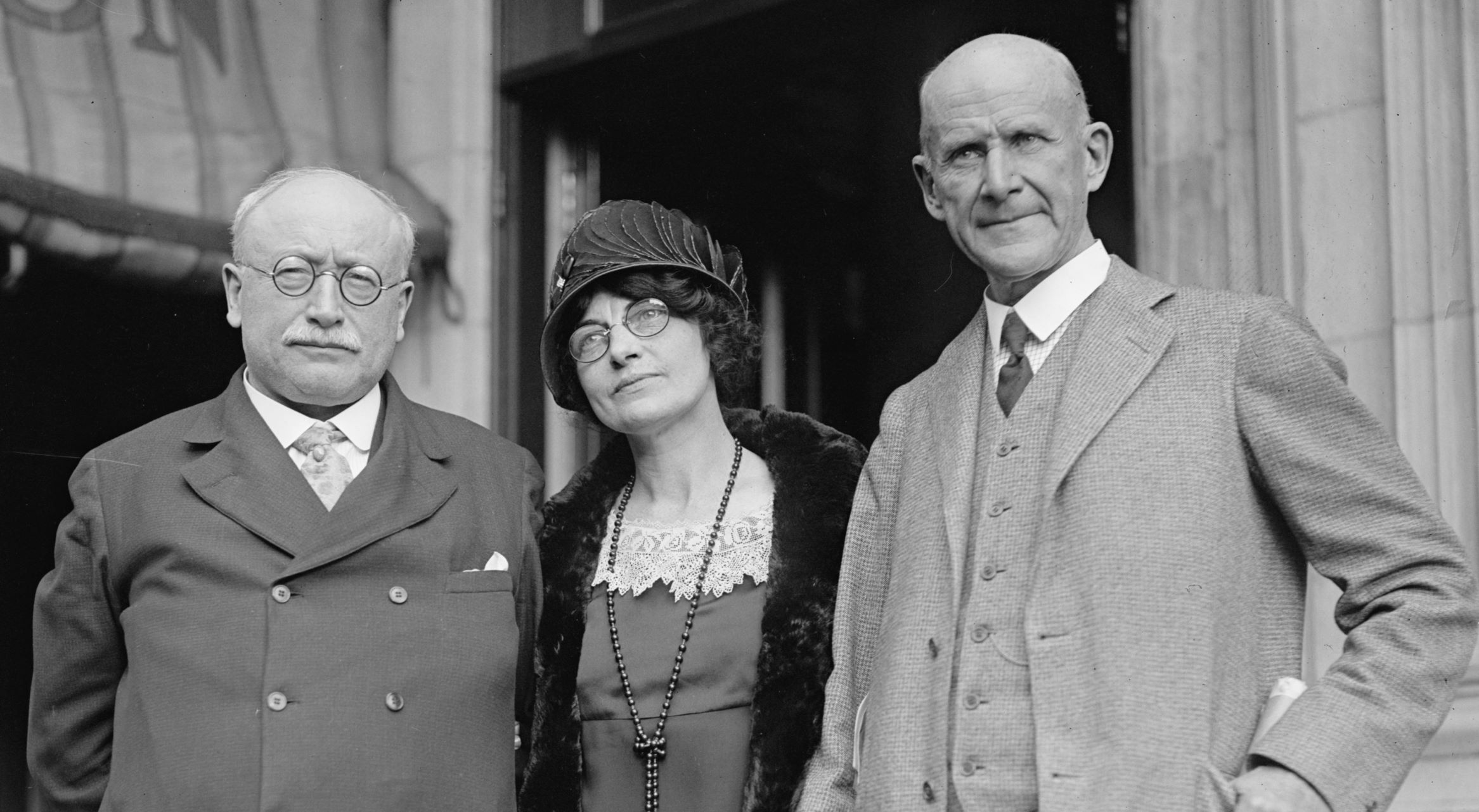
A major figure on the pre-1919 Socialist Party, Chicago Socialist editor J. Louis Engdahl stayed in the Party longer than most left-wingers as he helped formed the Workers Council group which fought for affiliation to the Third International until joining the Communist Party in late 1921. Here Engdahl analyzes his former Party’s 1926 convention and the role of its three leading figure, Victor Berger, Morris Hillquit, and Eugene V. Debs.
“It Still Moves—” by J. Louis Engdahl from Workers Monthly. Vol. 5 No. 6. June, 1926.
“Parties rise on the basis of social relations in society, representing the interests of various classes.”—Karl Marx.
THIS declaration by Karl Marx provides an excellent footrule with which to measure the decadence of the Socialist Party of the United States that has just held another national convention in Pittsburgh, Pa.
To be sure there were those present among the delegates who pointed out that the socialist organization had ceased to exist as a political party. They contended it had now become merely an instrument for the spread of socialist propaganda. But even the right of the socialists to claim they are educators of the masses in the theories of socialism may be successfully challenged, since within their dwindling ranks they have more conflicting groups than ever. Not one of these, however, raised its voice for socialism at Pittsburgh.
Three Outstanding Leaders.
There are three prominent leaders of the Socialist Party. They have conflicting viewpoints on most matters facing their organization. They are Eugene V. Debs, the chairman of the party, and the nominal editor of its official organ, the American Appeal; Victor L. Berger, the party’s congressman, and editor of the Milwaukee Leader; and Morris Hillquit, of New York City, the party’s international secretary.
Debs lived up to past traditions when he failed to appear at the convention. He had been to Bermuda with Mrs. Debs but returned to this country shortly before the gathering convened. He went immediately to Terre Haute, Indiana, his home, however, and did not come to Pittsburgh for the convention, the mass meeting or the banquet prepared for him. He was reported too ill to attend. At no time was his influence upon the delegates noticeable to any degree. He was re-elected to his two positions without opposition, a tribute to the five-time presidential candidate of the party.
The Debs leadership in the socialist party, therefore, does not actively function. It is pretty much of a myth. But there are those among the delegates who have a Debs ideology and they constitute what might be termed the socialist “left wing.” They are party workers of the “Jimmie Higgins” type who have taken party positions that have gone begging for occupants.
The Question of the League of Nations.
These “left wingers” are possessed of little aggressiveness. They went into battle on but one question, that of urging the United States government to enter the League of Nations. They opposed this attitude championed by Hillquit. They could have mustered enough votes to defeat it. Yet when Hillquit’s catspaw, James Oneal, editor of the New York Leader, hypocritically urged study and discussion of this question, with the postponement of any decision until the next convention two years hence, they surrendered without a struggle and accepted the overture. They carried their opposition, however, into the elections for the party’s national executive committee, resulting in both Hillquit and Oneal retaining their committee positions by the smallest margin. The Pittsburgh optician, William J. Van Essen, received the highest number of votes, outstripping even Berger, who had joined in the fight against the League of Nations.
Those delegates who opposed League affiliation claimed they still adhered to the party’s declaration in 1919, when it denounced the League of Nations as the “black capitalist international.” They had little conception of the meaning of this utterance. They could not visualize a workers’ international as opposing a capitalist international. If the European governments were only “labor governments,” meaning of the MacDonald British type, then there might be some object in joining the league. But not now. These delegates would have been shocked beyond recovery at the suggestion that they join in the Communist struggle against the League. They find satisfaction sufficient for themselves in their opposition and isolation.
Berger in Borah’s Footsteps.
Berger opposes the League for quite a different reason. Berger has been a constant attendant at the congresses of the Second (Socialist) International. Before the war he religiously said “Amen!” to all its majority policies. When the war came he sided with the central European socialists as against those of the Versailles peace. Berger was anti-war in the United States, and especially in German Wisconsin. To demand the revision of the Versailles Treaty called for its sequel-opposition to the League. In this Berger was consistent. Berger was antiwar to the extent of absolving Germany of all war guilt. When the German Social-Democrats themselves turned to the Dawes plan and supported the Hindenburg government in its efforts to have Germany join the League, Berger still insisted on his opposition. It was better campaign material in Wisconsin and Berger has his feelers out for the United States senatorial candidacy. Berger’s arguments against the League are the arguments of Senator William E. Borah, the Idaho republican, or of Frank L. Smith, who took the republican nomination recently from Senator William B. McKinley, in Illinois.
Hillquit on the other hand definitely takes his stand with the Second International in its attitude toward the League. He is for the League —the world government. Just as the socialists hope to win a majority of the votes and take power peacefully in the United States, just so does Hillquit expect a majority of nations to establish socialist governments and thus dominate the League. This is the Hillquit that says he is opposed to the Russian way, that ne believes in the British way. He capitalized this sentiment when the MacDonald “labor government” was in power, but said little at the Pittsburgh convention about British reactions challenge to the striking miners and their allies in the general strike. Hillquit follows the lead of the European socialists who definitely ally their parties with the left wing of capitalism.
It is plain that the opposition of Debs and Berger to the League’ offers no basis for socialist growth, since they do not call the workers and farmers to join the class war against world capitalism. The anti-League appeal of the Borahs and the Reeds is much louder, from the middle class viewpoint, and easily attracts these elements. The Hillquit pro-Leaguers do not need to come to the Socialist Party to function. In fact, here is the basis for further disintegration rather than growth for the Socialist Party. Yet this was the big political question before the convention.
Socialists in the Trade Unions.
Up to the time of the Bolshevik Revolution, in 1917, in Russia, the socialists in the United States had been in the opposition in the trade union movement. To be sure, this opposition manifested itself in a multitude of forms. But it was definitely arrayed against reaction and won considerable support from masses of the rank and file. With the Communist International offering new and militant leadership to the world’s workers, the American socialists, like their counterparts in other lands, turned their attack against the left wing inspired and led in great part by Communists. This led to their gradual but ultimately very definite alliance with the reaction they had previously opposed. The socialists who fawned on the Green administration in the American Federation of Labor at the Atlantic City convention last October, are the same socialists who made bitter war on the left wing in the Furriers’ Union, the International Ladies’ Garment Workers’ Union, the Amalgamated Clothing Workers’ Union, the International Association of Machinists, and other organizations, using thugs and gangsters to break up meetings, seeking to undermine the morale of workers on strike, and even conspiring with the bosses to bring about the defeat of the workers’ struggle. The direction of this campaign is acknowledged to be in the hands of the elements that cluster about Abraham Cahan’s New York Jewish Daily Forward. There are elements, to be sure, within the Socialist Party fighting Cahan policies in New York City. These were not represented at the Pittsburgh convention. Not the slightest disagreement with Cahanism was voiced. The convention satisfied itself with defeating a proposition that the requirement for trade union affiliation be stricken from the Socialist Party membership pledge.
Here, too, therefore, the socialists have no basis for existence. If workers will follow reactionaries, they do not need to pick them under the “socialist” label.
Out of the LaFollette Mess.
There was a general feeling of self-congratulation at Pittsburgh among the socialists, that they had finally gotten out of the LaFollette third party mess of 1924. It was urged that the party had now surely found salvation. Oneal, in the New Leader, reviews the casualties since the beginning of the world war. He recalls the jingo National Party and Social-Democratic League, started by renegade socialists, but fated to wither. The socialists steered shy of the farmer-labor party movement but how they did embrace the Conference for Progressive Political Action, joining savagely with the most conservative labor leadership to attack the Communists. But the C.P.P.A., and its greatest effort, the LaFollette campaign, have also gone with last fall’s leaves. The “liberal party,” representing “all the people,” the dream of the 48ers has vanished. The railroad brotherhoods, who espoused the Plumb Plan, that was too progressive for Gompers, and who supported LaFollette as an independent candidate for president have now repented of their ways. Their espousal of the Watson-Parker bill, passed by congress, that raises class-collaboration on the railroads to the nth degree, definitely allies them with the most anti-labor capitalists. The socialists, admittedly defiled in 1924, now claim that the two years of independence they have passed thru has restored them to their former pristine purity.
“Our Smallest Convention,” Berger.
But the workers who refused to be lured during the war into support of the National Party and the Social-Democratic League, who refused to accept the “progressive” party offered them by C.P.P.A. elements, when they demanded the labor party, are not now over-anxious to join the socialist party and give it strength for new betrayals. This was the big fact that confronted the socialists at Pittsburgh, admitted by Berger when he confessed, “This is the smallest convention we have ever had.”
No more than the other numerous wrecks that have strewn the highway of political conflict these past few years, does the socialist party now represent the interests of a section of any class. It does not even function as a worthwhile tip feather to a wing of capitalism.
With the 1926 national congressional elections rapdily approaching the socialists hold their main problem to be plans for increasing the party membership and expanding the party’s educational work. Yet the Pittsburgh convention did not seriously consider either of these measures.
In spite of the fact that the party constitution demands a convention report from Congressman Berger on his work for socialism in Washington, he made no such report. Berger does as he pleases in congress, without party guidance, and so little does the party know of his activities that the convention actually considered endorsing the reactionary Dyer-McKinley anti-lynching bill, when Berger had introduced a bill on the same subject.
The socialists have made strenuous efforts to win new members. Having lost 2,000 more members after the 1924 fiasco the party grovels at a new lower level. It has made no progress during the past year. One thousand new members were secured at a cost of $7 each, but an equal number was lost, so the membership figures remain stationary. It is difficult to ascertain what is meant by the party’s educational work. It conducts no schools, Its literature distribution has fallen to a minimum. During the whole year of 1925 a mere 188,445 leaflets were sold and distributed. The same period saw 95 cloth bound books and 17,832 books and pamphlets disposed of, the faintest shadow of an activity. It must be remembered that practically all local socialist publications have ceased to exist, which means that there is little or no distribution of literature outside of that actually accomplished by the national organization.
The “American Appeal.”
It was very evident at the Pittsburgh convention that many socialists placed their last hope in the American Appeal, the party’s official publication. This weekly was launched in January when, reports made to the convention declared, “the movement was at its lowest ebb in activity, vitality and enthusiasm. because of the substantial effacement of the party as a national political organization by the lack of a national socialist campaign in 1924 and the despair and hopelessness on the part of individual members as to whether anything could ever be accomplished.”
The American Appeal is patterned after the pre-war “Appeal to Reason,” founded by J. A. Wayland, but later edited and managed by Fred D. Warren. The policy of this weekly, that was privately owned, was to seize on popular issues, some of them having little relation to socialist propaganda, and use them as the bulwarks of circulation campaigns. Debs was at one time editor of it. An effort is being made to transfer this policy to the American Appeal. The first big subscription drive was to be based on a “May First Edition” dealing with the liquor problem. Debs had announced that this was the paramount question before the American people. This announcement was quickly withdrawn. Instead the issue dealt with the restoration of Deb’s citizenship, supposed to have been taken away at the time of his conviction under the espionage act during the war.
The Prohibition Issue.
It is still claimed, however, that the “wet and dry” issue is a live one from the standpoint of Socialist Party propaganda. When ‘the subject was introduced in the convention, half a dozen delegates from various sections of the country declared that any stand at all would split their local organizations wide open. It was finally decided to leave this matter for the different states to decide on the various policies they should pursue. Thus again the socialists acquiesce in the bourbon demand for “state’s rights.”
Reject the “United Front.”
It was into this sectarian and confused atmosphere that the Workers (Communist) Party sent its appeal for a united front at the fall congressional elections, the hope being to develop the independent political action of the workers and farmers under Labor Party standards.
The reply was the usual social-democratic attack on the Communist International with added vitriol for the American Communist movement. Hillquit made an effort to eliminate some of the language of gutter politics from the resolution that came before the convention. He wanted to scent it with the perfume of “dignity.” But in this he failed. The national Socialist Party insists on holding aloof from united fronts in which Communists play a part. It is interesting to note, however, that socialists locally do participate in such united front activities.
The socialist convention did pass a resolution demanding the recognition of and the opening of commercial relations with the Union of Soviet Republics. But it did not consider the defense of the Soviet Union.
No Fight for the Foreign-Born.
It did not consider the tidal wave of legislation in congress set in motion to intimidate, gag and shackle America’s large foreign-born population.
It did not take a stand on the important measures now before congress and, altho it had been announced that one of the chief objects of this convention would be to draft a congressional platform for the fall elections, no such draft was at any time submitted to the delegates for discussion and action.
Instead the convention conducted a serious debate on the question of keeping the party alive thru adopting sick and death benefit features as attractions to party membership. It was declared that hundreds of thousands of members had come into the party and gone out again. It is difficult to hold them. It was declared by some of the delegates that if the party became a semi-fraternal society, with attractive insurance features, then members would be loathe to leave its ranks.
“That is a good way for the party to die,” was the comment of Delegate William A. Toole, of Maryland, but the delegates voted, nevertheless, that a commission should investigate this matter and report to the next convention.
What remains of the socialist party membership is to be found in those centers where the party has enjoyed some election campaign successes and trade union contacts in the past. Thus New York, where the socialists still have a slipping hold on some of the needle trades unions, the membership is the highest. Milwaukee with its socialist mayor and congressman, and many city, county and state socialist officials, comes next, altho much of its trade union strength here has slipped away to the LaFollette movement. Massachusetts comes third, because of the hold that the socialists still have upon a dwindling number of Finnish workers grouped about the Finnish daily, Raivaaja, at Fitchburg.
No Strength in Basic Industries.
Thus the remaining socialist strength is largely artificial. It is nowhere a factor in the great basic industries of coal, steel or transportation. Its once extensive influence among the agrarian population is completely gone. In Texas, for instance, the socialist party, for the first three months of the year, showed an average of only five members, where formerly it had thousands.
There is vegetation in the tropical jungles that exists without roots in the soil. Political parties cannot lead such an existence in human society and live. They must be rooted in economic conditions, representing the interests of some class. The socialist party, once more in a national convention, has proved that it no longer has roots in any section of the working class. It cannot exist as tropical vegetation. Therefore, it must pass away, like the numerous offshoots it gave birth to, during and after the world war, as well as those semi-political organizations with which it sought alliances from time to time in an attempt to continue its own life a little longer. The American section of the Second (Socialist) International, the left wing of world imperialism, passes.
The Workers Monthly began publishing in 1924 as a merger of the ‘Liberator’, the Trade Union Educational League magazine ‘Labor Herald’, and Friends of Soviet Russia’s monthly ‘Soviet Russia Pictorial’ as an explicitly Party publication. In 1927 Workers Monthly ceased and the Communist Party began publishing The Communist as its theoretical magazine. Editors included Earl Browder and Max Bedacht as the magazine continued the Liberator’s use of graphics and art.
PDF of full issue: https://www.marxists.org/history/usa/culture/pubs/wm/1926/v5n08-jun-1926-1B-WM.pdf
 Revolution's Newsstand