After several false starts Ireland (re)launches a Communist Party in 1933. Brian O’Neill writing as Seumas MacKee reports on the background to the meeting.
‘The Constituent Congress of the Irish Communist Party’ by Seumas MacKee (Brian O’Neill) from Communist International. Vol. 10 Nos. 8 & 9. May 1 & 15, 1933.
THE decision of the Irish Communists, organised Tin the Revolutionary Workers’ Groups, to hold a congress on May 27th for the establishment of the Communist Party of Ireland is of great importance. The Communist Party of Ireland continues the revolutionary traditions of the Irish proletariat as represented by Jim Connolly and the heroic Irish. Citizens’ Army, but, benefiting from the teachings of Lenin, on the seventeenth anniversary of the Easter uprising, the Irish proletariat organises its own independent Party for the struggle for the overthrow of the Irish bourgeoisie and the establishment of the dictatorship of the proletariat, and leading the working farmers shall construct a socialist society, which will lead to freedom from all exploitation by capitalism and English imperialism.
The bloody suppression of the Easter uprising of 1916 by British imperialism deprived the Irish proletariat of its revolutionary leadership, and paved the way for the dominance in the leadership of the workers’ movement of the most shameless opportunists and imperialist agents. After the defeat of the uprising these opportunist bureaucrats of the Labour Party and the Trade Union Congress, showed their real anti-working-class policy by more openly sabotaging the workers’ struggles against the imperialist war, and during the national revolutionary war against British imperialism betrayed the dockers and railwaymen who refused to transport British troops and munitions. Shameless betrayal of the economic struggles of the workers was accompanied by treachery to the national struggle for independence by supporting the Anglo-Irish Treaty in 1921 which established the Irish Free State. They were rewarded by senatorial appointments for their support of the savage executions and terror against the revolutionary Irish Republican Army in the civil war against the Free State. These “Socialist” leaders during the past ten years have shown themselves to be the most reliable agents of the capitalists in their attack of the working-class, and the cringing flunkeys. of British imperialism in the Free State.
The Irish Communist Party which was represented at the Second World Congress of the Comintern, succumbed to the welter of confusion into which the masses were thrown, following the establishment of the Free State and the suppression of the civil war against it. The struggle against the opportunist trade union bureaucrats led by Jim Larkin, senior, on his return to Ireland in 1923, led to a split in the trade unions and the isolation of the revolutionary workers. The Irish Workers’ League which he formed, had all the appearance of developing into a Communist Party, but because the leadership was unable to pursue a consistent proletarian revolutionary policy, it fell into the wake of national- reformism and lost its following among the revolutionary workers.
The Irish Republican Army cannot mobilise the workers and poor farmers for the struggle for social and national emancipation because its aim is the establishment of a bourgeois republic. The growing radicalisation of the masses keeps the petty-bourgeois I.R.A. leadership continuously wavering between reformist demands on behalf of the toiling population and support of the national reformist Fianna Fail Party of De Valera. Such a position is typical of petty-bourgeois revolutionary republicanism, but it is incapable either of mobilising the masses for their defence against the capitalist offensive and the struggle against capitalism, or waging a consistent struggle for national independence. Such a struggle can only be waged by a Party absolutely independent of the bourgeoisie, basing itself on the revolutionary proletariat as the leader in the struggle of the masses against capitalist exploitation and national oppression. Among the proletarian and poor farmer elements of the I.R.A. this is more and more being recognised, and there is a growing tendency to seek a united front with the R.W.G., and many of them are joining the R.W.G. and taking a definite stand for the organisation of the Irish Communist Party.
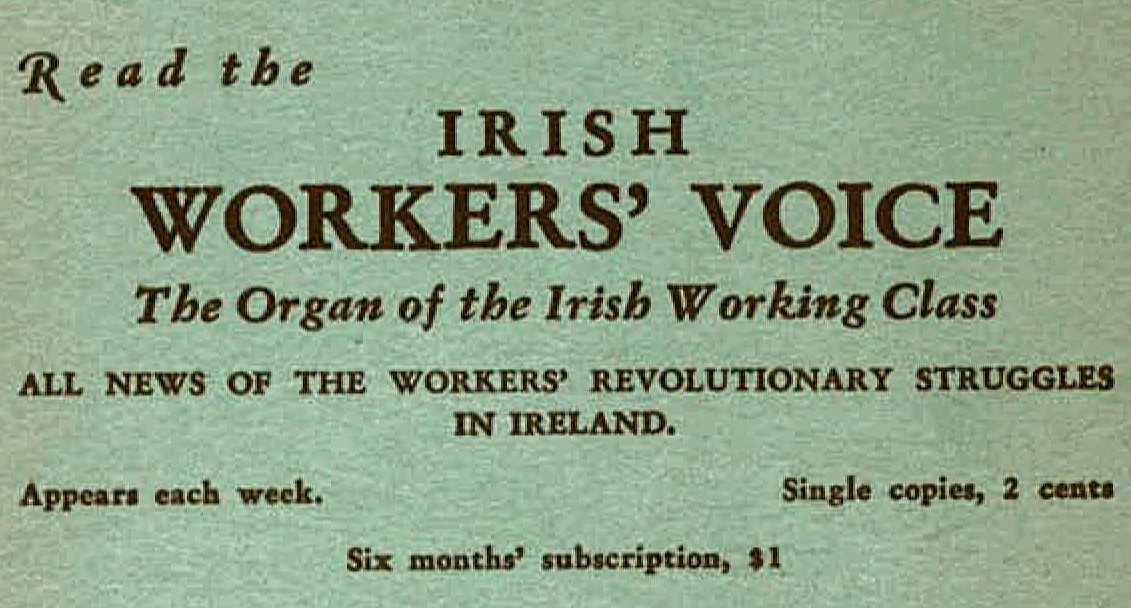
The consistent struggle for the formation of the Irish Communist Party has been carried on by the Revolutionary Workers’ Groups, and its weekly paper, “The Workers’ Voice” (which, unfortunately, is still weak), since 1930. During this time there has been a growth of membership and influence of the R.W.G. in the struggle against the social-reformism of the Labour Party and trade union bureaucracy, on the one hand, and against national reformism on the other. “The Communist menace” in Ireland has been attacked by all the forces of the bourgeoisie. Both the Catholic and Protestant churches “ex-communicated” Communism, and the Catholic Church in the Free State organised pogroms against the Communists, and against the Kilkenny miners a counter-revolutionary united front of the clergy and the trade union bureaucrats has been formed to wreck the militant miners’ union which secured better conditions for the miners by struggle under Communist leadership. In October, 1931, the R.W.G., the “Workers’ Voice” and the F.S.U., and I.L.D. were outlawed by the Cosgrave Government under its Coercion Act. De Valera especially attacked Communism in the recent election campaign and put forward his party as a substitute for a Communist Party under the slogan of “Against pagan capitalism for a new Christian social system.” The campaign to choke “The Workers’ Voice” is so widespread that the latter continues only because of the determined support of the revolutionary workers. This support on the part of the R.W.G. is evidence of the growing influence of the movement among the workers and small farmers for the formation of the I.C.P.
The attacks against the R.W.G. organised by the Irish bourgeoisie in order to prevent the mobilisation of the revolutionary vanguard of the Irish proletariat for the formation of the I.C.P. did not prevent the R.W.G. from participation in the struggle of the workers against the capitalist offensive. The combination of the struggle for the formation of the I.C.P. with the everyday struggles of the workers against the capitalist attack on their wages, hours, conditions, etc., and against unemployment and for social insurance, in defence of the small farmers being evicted for non-payment of land annuities, mortgages, etc., was a living necessity in order to rally around the revolutionary vanguard, the R.W.G., and to show the masses in deeds that the Communists were devoted to the struggle for the defence of the interests of the workers and the working farmers.
The R.W.G. have participated, and in some cases take over the leadership, of the economic struggles of the workers and the unemployed. In the first place we must put the great struggle of the Belfast unemployed last October, where the struggle was carried on by street battles between the workers and the police, and witnessed the greatest solidarity of the hitherto divided Protestant and Catholic workers fighting side by side against their common enemy. Similarly in Dublin and elsewhere, the R.W.G. organised the unemployed and forced concessions from the Government. In the strikes of the building workers, textile workers, miners, railwaymen, the R.W.G. played a big role. The strike of the Kilkenny miners was only successful because of the long preparations of the R.W.G. and its correct leadership of the struggle and the formation of the Kilkenny Miners’ Union.
The R.W.G. has popularised its programme for the small farmers, openly declaring that the fight of the farmers is bound up with the whole question of the struggle against capitalist exploitation and for national independence, and making demands which lead to the revolutionary solution of the abolition of land annuities squeezed from the farmers, the demand for no evictions, and the struggle for confiscation and distribution of the estates and large ranches to the small farmers and landless, abolition of debts of small farmers, state credits for small farmers, and moratorium for middle farmers facing bankruptcy owing to the capitalist crisis. The R.W.G. established contact in the country districts and has led farmers’ struggles against evictions for non-payment of land annuities ordered by the Cosgrave Government, and for the defence of Jim Gralton who has been ordered to be deported by the De Valera Government.
But in spite of these successes which the R.W.G. have to their credit, such as the leadership of the workers’ struggles against the capitalist offensive, and to some extent among the working farmers they have not been able to establish themselves organisationally among these workers and working farmers; to win them for the I.C.P. Even in the great Belfast struggle, where the R.W.G. had thousands following its leadership and many became members, the R.W.G. has not achieved the organisational results. it should have. This should alarm the whole R.W.G. to concentrate all energy on the task of founding the I.C.P. in the factory, there we can find the forces with which to conquer our exploiters, and only there can be found the basis for the building of the I.C.P. and to protect our Party. Only in the revolutionary forces of the proletariat, linked and organised through the Communist Party, can the proletariat lead the whole toiling mass (including the working farmers) in the struggle against capitalism which equally exploits the workers and farmers.
The organisation of the revolutionary vanguard of the Irish proletariat into the I.C.P. is the first essential step toward winning the proletariat for the overthrow of capitalism and the establishment of the dictatorship of the proletariat. The R.W.G. has put forward, as its main aim, the struggle for an Irish Workers’ and Farmers’ Republic, i.e., for the dictatorship of the proletariat. In this respect the Irish Communists must remember the words of Lenin:
“The class which has seized political power has done so knowing that it has seized power for itself alone. This is implicit in the idea of the dictatorship of the proletariat. When we speak of the ‘dictatorship’ of a class, we do not mean anything at all unless we mean that this class consciously takes all political power into its own hands, and does not fool either itself or others by any verbiage about a national authority, elected by universal suffrage, and consecrated by the will of the whole people.” (Works, Vol. XVIII, Part 1, p. 175).
In a country such as Ireland, where the proletariat itself has been imbued with nationalist ideas for so long, it is essential to emphasise this point, and keeping in mind the great mass of petty farmers in Ireland it is necessary to heed the statement of Comrade Stalin in his “Problems of Leninism”:
“This must not be taken to mean that the power of this one class, the class of the proletarians, (who do not and cannot share this power with any other class), can get along without an alliance with the labouring and exploited masses of other classes. On the contrary, the proletarians need such an alliance for the realisation of their aims.”
Further, in his pamphlet, “The October Revolution and the Tactics of the Russian Communists,” Comrade Stalin writes:
“The dictatorship of the proletariat is a class alliance of the proletariat with the labouring masses of the peasantry; an alliance entered into for the overthrow of capitalism, for bringing about the final victory of Socialism; an alliance formed upon the understanding that, within it, the leadership belongs to the proletariat.”
Without firmly grasping these fundamental principles of Marxism-Leninism it would be impossible for the constituent Congress of the I.C.P. to understand that revolutionary alliance of the Irish proletariat with the masses of petty producers, which alone shall make possible the freeing of Ireland from the grip of British imperialism and the establishment of the Workers’ and Farmers’ Republic.
Such a revolutionary aim requires the establishment of a Communist Party steeled in Bolshevik discipline which will enable the Party to win the confidence and support of the working-class which in turn shall lead the whole of the exploited. Regarding the establishment of such a Party, Lenin wrote : “How is discipline maintained within the revolutionary Party of the proletariat? What controls the discipline, and what strengthens it? First of all, there is the class consciousness of the proletarian vanguard, its devotion to the revolution, its self-control, its self-sacrifice, its heroism. Secondly, there is the capacity of the proletarian vanguard for linking itself with, for keeping in close touch with, for to some extent amalgamating with, the broad masses of those who labour, primarily with the proletarian masses, but also with the non-proletarian masses of those who labour. Thirdly, we have the soundness of the vanguard’s political leadership, the soundness of its political strategy and tactics–with the proviso, that the broad masses must become convinced by their own experience that the leadership, the strategy, and the tactics are sound.”
The I.C.P., organising into its ranks the vanguard of the Irish proletariat, can only become “the guide, the leader, the teacher of the proletariat, on the above basis” (Stalin).
Having clearly stated the aim of the I.C.P. as the organisation of the proletarian struggle against capitalism for socialism, having clearly defined the task of the proletariat for the seizure of political power and the establishment of the dictatorship of the proletariat (the Workers’ and Farmers’ Republic) and the tasks of the I.C.P. for the winning of the majority of the Irish proletariat, the Irish Communists must clearly define their attitude to the toiling masses, and convince them not only in words, but in deeds, that their path to social and national freedom lies in revolutionary alliance in the struggle for socialism with the proletariat, against the Irish bourgeoisie and British imperialism for the Workers’ and Farmers’ Republic. Therefore, the Irish Communists must have a programme of the national and social demands of the toiling masses of the population which will convince them that only in alliance with the proletariat, led by the Communist Party, can they find a way out of their poverty and degradation, in a joint struggle against capitalism, and for social- ism, for the dictatorship of the proletariat.
A correct revolutionary Marxist-Leninist position on the question of the struggle for the national independence and unity of Ireland from British imperialism is of vital importance to the I.C.P. because, first, on this question the I.C.P. must win the Irish proletariat for the internationalist position of Marxism-Leninism, and break down the divisions erected by the bourgeoisie between the workers of Northern and Southern Ireland on this question, and really unite the Irish proletariat in the struggle against the bourgeoisie and British imperialism, and prevent them from falling into, on the one hand, the imperialist camp of a section of the Irish bourgeoisie, and, on the other hand, into the hands of the nationalist bourgeoisie led by De Valera. Secondly, to link up the Irish proletarian struggle with the international proletarian struggle against imperialism, and especially unite the Irish proletarian struggle with the struggle of the English workers against British imperialism; thirdly, the whole question of the proletarian leadership of the exploited farmers in a joint struggle against the bourgeoisie, for the establishment of the Workers’ and Farmers’ Republic is bound up with the struggle of the poor farmers against capitalist exploitation, while this is most intimately connected with the struggle for national independence.
The I.C.P. can only be considered as a serious Party, leading the proletariat in the struggle for the destruction of capitalism and the establishment of socialism, when it recognises that the struggle for national independence from British imperialism is a central question involving the unity of the proletariat in the revolutionary struggle against the bourgeoisie, educating the proletariat in internationalism, arming them against the imperialist and nationalist bourgeoisie who seek to hold the proletariat in capitalist slavery, and aiding the proletariat in taking over the leadership of the non-proletarian masses in the struggle for social and national emancipation, for the dictatorship of the proletariat.
Therefore, it is necessary for the Irish Communist to especially pay attention to the words of Comrade Stalin when speaking about the tasks of Communists in an oppressed nation, “the twofold task of the Communists who must diffuse among the workers the spirit of internationalism”…”the need for a struggle against the narrowness, the particularism of those socialists in oppressed lands who cannot see beyond the boundaries of the parish in which they were born, and therefore fail to see the intimate connection between the movement for liberation of their own country and the proletarian movement in the country by which it is ruled” (Our emphasis.). These profound directives of Comrade Stalin are especially applicable to the situation in Ireland where the main danger is right opportunism, especially regarding the national question; to lose sight of the main task of the Party as the struggle for the dictatorship of the proletariat would inevitably result in our Party becoming the tail end of bourgeois nationalism, or sucked into the swamp of the I.R.A., and therefore losing sight of the main task of organising the proletariat as the single force which can lead the whole of the Irish masses in a consistent struggle for the unity and independence of Ireland, the revolutionary alliance of the workers and poor farmers in the struggle for socialism.
Basing itself on proletarian internationalism, and organising the proletarian struggle in this spirit, the I.Č.P. must wage a bitter struggle against bourgeois nationalism no matter under which guise it hides itself, then courageously declare that the I.C.P. leading the proletarian struggle to socialism, unites the proletariat with the working masses of the farming population, and wages the most determined struggle for the unity and independence of Ireland. This requires from the I.C.P. that it must base itself on the Leninist principle that:
“The centre of gravity of the internationalist education of the workers in oppressing countries must take the form of insisting upon the right of oppressed countries to secede and set up for themselves. Short of this, there is no internationalism. We can and should regard as an imperialist and a scoundrel every socialist in an oppressing country who fails to carry on propaganda of this kind. The right to secede is axiomatic, even though, before the coming of socialism, there may not be one case in a thousand where the right can be enforced.
“On the other hand, the socialists of a small and oppressed nation must mainly stress the second part of our general formula–the “voluntary union” of the nations. Without doing violence to his obligations as an internationalist, he may (according to circum- stances), either advocate the political independence of his nation, or favour its inclusion in some neighbou ing State. In all cases, however, he should fight particularism, a narrow conception of nationalism, should insist on the importance of wider issues, should favour the subordination of special interests to general interests.”
The constituent Congress of the I.C.P. must examine the political and organisational mistakes and weaknesses which have been observed during the R.W.G. struggle for the foundation of the Party. Such self-criticism is necessary in order that the Irish Communists shall realise that the main danger confronting them is right opportunism. Especially in Ireland this danger expresses itself in the tendency to capitulate to national-reformism, i.e., in refusing to struggle against Fianna Fail, to win the masses for a revolutionary alliance for the joint struggle against capitalist exploitation and for national independence. The Irish Communists must recognise that because of the demagogic programme of Fianna Fail of social and national freedom, it plays the role of a social buttress for Irish capitalism among the masses. On the other hand, the right danger is also expressed in the failure to struggle against the Labour Party and trade union bureaucracy, and independently lead the struggles against the capitalist offensive in spite of the class collaboration policy of the bureaucrats, to develop the struggle against their capitalist oppressors and clean the workers’ movement of these capitalist agents.
Capitulation to national-reformism.
Such an opportunist slogan as “nationalisation of the railways with compensation” cannot be passed over in silence because it disarms the Party in the struggle against the Social-Fascist Labour Party and trade union bureaucracy, which has precisely the same slogan. The R.W.G. must recognise that in precisely fighting such slogans they are fighting the chief danger menacing the very formation of the Irish Communist Party, because the right danger is the greatest danger for every Communist Party. From this must inevitably arise every opportunist capitulation to capitalism, which we must most strenuously fight against.
The campaign for the Constituent Congress of the Communist Party of Ireland must be more energetically waged than hitherto. There have been waverings, hesitations, even in many issues of the “Workers’ Voice,” nothing has been mentioned about the foundation of the I.C.P. And in the discussion regarding the establishment of the Communist Party of Ireland, the fundamental questions of the dictatorship of the proletariat and the proletarian-farmer alliance against capitalism and the relationship to them of the national struggle, etc., have been passed over. The campaign for the establishment of the Communist Party can only be successful if it is rooted in the masses of factory workers, among the unemployed, at the Labour Exchanges, in the workers’ quarters, by explaining to them that only the Communist Party, waging a stubborn struggle for the overthrow of capitalism, and defending the interests of the workers and working farmers, by a revolutionary alliance of the working-class and the working farmers, can finally free the whole of the toiling masses from capitalist oppression and poverty in the proletarian struggle for socialism.
The Irish proletariat, in alliance with the poor farmers, led by the Irish Communist Party, armed with Marxist-Leninist revolutionary ideology can organise the vanguard of the proletariat to lead the Irish working-class to the establishment of a free and independent Ireland–an Irish Workers’ and Farmers’ Republic.
The formation of the Irish Communist Party is of great importance internationally; the importance of this fact is the more marked because of the millions of Irish immigrants living in Britain, the British Dominions and Colonies and the United States of America, where there are more Irish than in Ireland itself. The formation of the Irish Communist Party will deeply affect the emigrant masses and aid the Sections of the Comintern in these countries to gain recruits among them, if these Sections recognise that these immigrant Irish and their descendants still maintain a great hatred of British imperialism, and consequently are deeply interested in the struggle for the independence of Ireland. This is especially necessary because both in Britain, America, Canada and Australia, not only the socialist but also clearly bourgeois politicians pay lip service to the national struggle for liberation in Ireland in order to maintain the vast masses in their country under bourgeois domination. Therefore it is absolutely essential to adopt a correct Marxist-Leninist attitude to the question of the struggle for liberation of Ireland from British imperialism. This will supply them with the bridge with which to encourage these Irish workers today, exploited by capitalism, to join the Communist Parties and fight alongside the Communist International not only against their former national oppression, but against their present capitalist exploitation.
Lenin paid great attention to the “Irish Question” (as did Marx and Engels before him) because of the great importance of the national-liberation movement in Ireland for the proletarian socialist struggle against British imperialism, and the advance of the proletarian revolution in Europe. In many articles on the Irish situation, Lenin draws many conclusions to which the Irish Communists should pay especial attention today because they answer many of the problems confronting the C.P. of Ireland.
Basing himself on the conclusion reached by Marx and Engels that Ireland must be separated from Britain in the interests of the proletarian revolution in Britain itself, in the advance of the European proletarian revolution, Lenin drew lessons from the class struggle in Ireland which are of the greatest importance to the Irish proletariat today.
Writing regarding the Dublin general strike in 1913, Lenin characterised the offensive of the capitalists against the Irish workers as follows: “The nationalist Irish bourgeoisie celebrate their ‘national’ victory (the Irish bourgeoisie expected to secure’ Home Rule at that time.–S.McK.) their ‘national coming-of-age by declaring war to the death on the Irish working-class movement.” (Vol. XII, Part 2, first Russian edition, page 192). It is of especial importance to heed this Leninist conclusion today, when the De Valera Government of national-reformists, relying on their former revolutionary nationalist reputations, lead the capitalist offensive against the proletariat under the guise of creating a new Ireland,” a “new social system” in the interests of the Irish capitalist offensive on the toiling masses.
In this article, “The Irish Rebellion in 1916,” Lenin stigmatises those who called it a “putsch” as “either a bitter reactionary or a doctrinaire, hopelessly incapable of imagining a social revolution as a living phenomena,” (Works, Vol. XII, Part 2, first Russian edition). In the same article (pages 432-33) he draws the conclusion that “We would really be a sorry band of revolutionists if we did not, during the great proletarian battle for Socialism, understand enough to utilise every movement of a nation against any isolated grievances which are brought about by imperialism, in the interests of a broader intensification and spread of the crisis. If we were, on the one hand, to proclaim and repeat in thousands of ways that we are against any kind of national oppression, and, on the other, to stigmatise as a “putsch” the heroic rising of the most mobile and intellectual section of some class of the oppressed nations against its oppression, then, indeed, we would have reduced ourselves to the same dull level of the Kautskians.”
In the present period in Ireland, which is witnessing a great advance in the anti-imperialist mood of the labouring masses of the population, the Irish Communists by a proper application of the above Leninist position can win them from the national-reformism of De Valera for the joint struggle with the proletariat, the struggle for Socialism.
NOTE. Since this article was written, the campaign of the British agents in Ireland, including the reactionary Catholic clergy and the Cosgrave Fascist organisation, the Army Comrades Association attacked and burned the headquarters of the Revolutionary Workers’ Groups in Dublin, Connolly House, on March 29th. This attack of the reactionary imperialist agents shows their fear of the growing influence of the R.W.G. in mobilising the workers for the formation of the Communist Party of Ireland.
The ECCI published the magazine ‘Communist International’ edited by Zinoviev and Karl Radek from 1919 until 1926 irregularly in German, French, Russian, and English. Restarting in 1927 until 1934. Unlike, Inprecorr, CI contained long-form articles by the leading figures of the International as well as proceedings, statements, and notices of the Comintern. No complete run of Communist International is available in English. Both were largely published outside of Soviet territory, with Communist International printed in London, to facilitate distribution and both were major contributors to the Communist press in the U.S. Communist International and Inprecorr are an invaluable English-language source on the history of the Communist International and its sections.
PDF of full issue: https://www.marxists.org/history/international/comintern/ci/vol-10/v10-n08-may-01-1933-CI-grn-riaz-OC.pdf
PDF of issue 2: https://www.marxists.org/history/international/comintern/ci/vol-10/v10-n09-may-15-1933-CI%20grn-riaz-OC.pdf
 Revolution's Newsstand