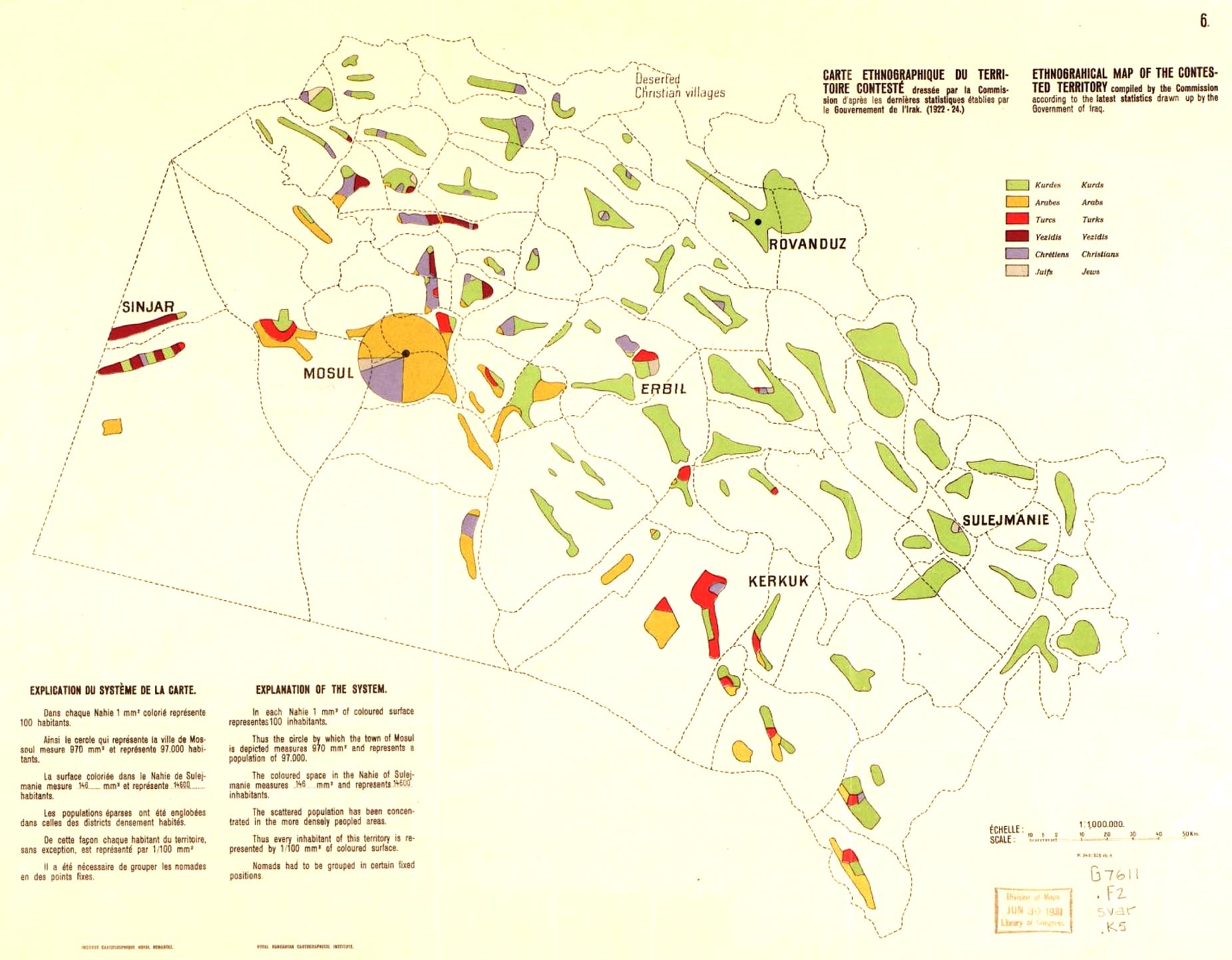
Where we are at is where we have been. Oil fields and geopolitics, an empire and competing imperialisms vying for predominance, ethnic divisions and a thieving, duplicitous ruling class. Mosul in 1925 as told by M.N. Roy.
‘The Question of Mosul’ by M.N. Roy from International Press Correspondence. Vol. 5 No. 72. October 1, 1925.
The Anglo-Turkish dispute over the possession of the Villayet of Mosul was the first point on the agenda of the Council of the League of Nations that met at Geneva in the first week of September. The Commission appointed by the League to investigate the question, had published its report two weeks before the Council met. The report was a curious document. The recommendations made did not correspond with the evidence and impressions recorded as a result of the investigations made on the spot. The contradiction between the data collected and the conclusions made is so flagrant that the reader of the report cannot help feeling that the findings of the Commission had been predetermined.
But, in spite of all patch-work, post-war imperialism does not work smoothly. The renewed controversy over the possession of Mosul reveals the ugly fact that Great Britain will find it very difficult to neatly appropriate the oil deposits of the Tigris valley. The Turks may be brow-beaten; but there are other factors to contend with. Behind a dispute, apparently Anglo-Turkish, lurk ominously France and the United States of America. This makes the question extremely more complicated than it appears on the surface. Other factors than the refusal of the Turkish delegation to renew the pledge to abide by the decision of the League, induced the Council to refer the question to a new commission. The new commission is charged to examine the report of its predecessor together with all other evidence available. This means that the findings of the previous commission is practically rejected and the solution of the thorny question postponed indefinitely.
The sum-total of the recommendation of the League Commission was that the British Mandatory right over Iraq should be prolonged for another 25 years after the expiry of the present term ending in 1928. It was through a very curious process of reasoning that the Commission arrived at this conclusion. The evidence recorded on the spot forced the Commission to admit that if it were between Turkey and Iraq, Mosul should go to the former. But this admission was qualified. The Commission argued that besides juridical and sentimental reasons, which were all in favour of the Turks, there was the economic interest of Mosul to be considered. It declared: “that although in general all the peoples of the region of Mosul are sentimentally attached to Turkey, their economic interests are closer to Iraq supported by the power of Britain”. Iraq, deprived of the protection of Britain, will have no legal or moral right over Mosul. Therefore, moved, by the Christian compassion to secure the economic welfare of the peoples of the villayet of Mosul (against their own desire), the Commission of the League of Nations imposed upon Iraq the duty of placing itself under British tutelage for another generation! Britain gracefully consented to accept this additional “white man’s burden” to which she is so well accustomed. The British delegate to the League Council, declared the readiness of the British Government to agree to the extension of mandatory responsibility which the commission regarded as a condition for the retention of Mosul in Iraq. What a sacrifice for the welfare of the humanity! As if the politically literate world had not known that Britain was determined to grab the oil deposits of Mesopotamia with or without the consent of the League. In order to invest this international swindle with a plausible motive, Amery declared that he could not commit the British government to 25 years’ responsibility, since, conceded the Tory Minister, Iraq might be fit to stand on its own legs before that period was over. What a magnificent gesture of disinterested liberalism! Since when has British Imperialism become so susceptible to the desire for self- government on the part of the peoples subjugated by it? This liberalism however, is not at all disinterested. Amery, as the Colonial Minister of the Tory Cabinet, has recently visited Mesopotamia. Just before his (Amery’s) departure for Geneva, King Feisal came to London. Consequently, the British Government is fully acquainted with the precarious situation of the puppet regime at Bagdad. It was with much difficulty that last year the Anglo-Iraq Agreement could be imposed upon the Bagdad Parliament, which reluctantly ratified the agreement only for four years. Naturally the British Government could not undertake the responsibility of “protecting” Irak for another 25 years. The Iraqis might at any time refuse to be protected; and for Britain to remain in Mesopotamia even in that case (for 25 years) would be financially disastrous. It is indeed difficult for Britain to maintain the grip on Mosul oil fields.
But this liberal gesture of British imperialism failed to placate the rival claimants. Other powers were alarmed by the concession that the Commission Report made to British claim in Mosul. Although Twefik Rushdi Bey played a lone hand in the Council Chamber, he was not without moral support. The correspondent of the London Times writing from Geneva on September 4, remarks: “I have said that the Turks do not appear to have here any open allies or friends. But in this place, where so many interests and temperaments mingle, they undoubtedly have sympathisers. It was obvious in watching the faces during the debate that the Turkish arguments appealed to some hearers more strongly than the British. Then again in some circles complaints were made against the firmness of Mr. Amery’s manners. The significance of this remark cannot be missed. The powers behind the League Council refused to hand over to Britain the rich oil deposits of Mesopotamia. That was the long and short of the show at Geneva. Now the robbers will hold secret conclaves.
But this is no solution of the problem. The ugly ulcer is covered up so that it might not prove fatal to the delicate constitution of the “organised Impotency”. Apart from Turkey, and for entirely different reasons, France and America were opposed to the settlement of the Mosul Question according to the recommendations of the League Commission. None of them failed to give expression to their opposition.
Immediately after the publication of the League Commission Report Admiral Chester, speaking in New York in a meeting of the Ottoman-American Development Company in New York, declared: “The final decisions of the League of Nations on the Mosul boundary could not effect the Chester Concession in the Mosul oil fields, because the concession was negotiated in 1911 and the League had no power to give decisions affecting the rights and properties of Americans abroad. Great Britain, France and other nations had admitted claims to be the oldest, whilst the ratification of the Chester Concession of 1,000 million dollars by the Turkish National Assembly in April 1923, made its validity unquestionable.”
This was a declaration of war upon the League. American capital had staked its claim on the spoils of the Tigris valley which could not be superseded by the claims of British imperialism supported by the League of Nations. Chester made the American position still clearer. He said that the only way in which American rights could be affected would be by disallowing Turkish right to Mosul whose population had been reported by the League Commission to prefer Turkish rule next after self-government. The spokesman of American imperialism added ominously that such a decision would create conditions approximating to a state of warfare in the villayet of Mosul. The British Delegation to Geneva could not have failed to take notice of this menacing voice raised across the Atlantic; nor were the Turks ignorant of what that gesture meant.
Then there was a menace nearer home. France did not at all take kindly to the prospect of the League’s ratifying British monopoly in Mesopotamia, particularly in this moment when her position in Syria is threatened by British intrigues. Unmindful of the debt negotiations conducted so laboriously by the radical Painleve-Briand-Cailleaux Government, French imperialism, through the Parisian press, made it quite clear that the rapprochement with Turkey begun with the Franklin-Bouillon Agreement of 1922 had not been abandoned by France. Although, in order to secure British sanction to the Ruhr Occupation France temporarily withdrew from the rivalry in Turkey, leaving Britain the master of the situation, she is again prepared to enter the lists. The report of the League Commission and the London visit of King Feisal provoked the Parisian press into a severe attack on British policy in the Near East. The Temps wrote: “Without Mosul and its petroleum England would no doubt wash her hands of Iraq and abandon King Feisal to his fate.” Another paper wrote: “Advised by Lord Curzon, Emir Feisal had sold the right of exploiting the Mosul oil deposits to more than one party. These parties were to enter in possession of their property in September 1925. The situation was indeed critical and complicated. It was urgently necessary to find a compromise. Therefore, England called in the aid of the League of Nations.”
The anti-British campaign in the French press called forth a dignified rejoinder from the organ of the British Foreign Office The Times. On August 19, the paper wrote: “It is, therefore, the more surprising that several responsible organs of the French press have seen fit to discuss the movements of the King Feisal in terms that are flattering neither to him nor to the policy of Great Britain in the Near East…This sudden criticism of our position in Irak, with a revival of all the pre-historic catchwords about oil and racial intrigue, is hard to understand…The lessons of experience have not been lost upon the governments, and for some time past the fundamental unity of British and French interests in the face of the new problems of the world of Islam has been at least informally recognised. The mandatory Powers in the East have big common problems. They have to decide whether they shall jointly secure the conditions for the fruitful development of the patient pioneer administrative effort of the last five years, or whether, by the obstinate pursuit of rival aims, they will expose their work to new and serious risks. The tone of French press criticism must, perhaps, be interpreted as a reminder that return to a better and healthier spirit can, after all, be gradual…”
This rather long quotation is necessary in order to show how irreconcilable are the interests of France and England in the East. Chamberlain’s efforts to bridge the gulf and form a united imperialist front have miserably failed. The righteous indignation of the British Government, however, was of no avail in persuading French imperialism to abandon its hostility to the project of having the League of Nations sanction British monopoly in Mosul. The subsequent events in Geneva proved that the report of the Iraq Commission was opposed by stronger powers than Turkey.
Apart from this rivalry between the imperialist powers, there is another factor which renders Britain’s position in Mesopotamia precarious. That is the internal situation. There is a touch of prophecy in the British reservation as to the duration of the new mandatory rights in Iraq. The government of King Feisal is anything but a stable affair. It was foisted upon an unwilling people by the force of British arms and has been maintained by the same means. But to maintain a sufficiently large army there, is becoming a rather expensive luxury. There is a deficit of 636, 714 pounds in this year’s budget of the Iraqi Government. This deficit is expected to continue for years. According to the Anglo-Iraqi Agreement, England undertakes to make up for this deficit. But the British bourgeoisie is reluctant to sink money in military adventure, while there is so little capital available for export. To head off a possible revolt against the Conservative Cabinet, the British Government, immediately after the statement of Amery at Geneva accepting the prolonged mandate over Iraq recommended by the League Commission, issued a communique to announce that the new policy would not entail any additional military expenditure in Mesopotamia.
But as soon as British imperialism is obliged to weaken its military forces in Mesopotamia, the fake kingdom of Feisal will disappear. As a matter of fact, Feisal’s government is trembling at such a possibility, and imploring the British not to abandon it to cruel fate. Immediately after he had made his speech at Geneva, Amery received the following telegram from the Prime Minister of Iraq: “Iraqi nation, represented by the Chamber of Deputies, declare its strong friendship for Great Britain and expresses its desire to continue in alliance with her after expiry of the present treaty!” This sounds like the frantic cry of a drowning man. In view of the fact that the Chamber of Deputies only a year ago would not ratify the Anglo-Iraqi Agreement for more than four years, this message of the Prime Minister is a simple political forgery. King Feisal will court ruin if he seeks his parliament to ratify a fresh 25 years’ British tutelage. The British know it better; therefore they did not commit themselves to the dangerous adventure of perpetual military occupation of a country inhabitated by a rebellious people. In the dazzle of easily earned purple, King Feisal might forget how his election to the throne of Iraq was secured; but the British have a long memory; and it is an irony of fate that the Commission of the League, in spite of its holding up British right to the oil fields of Mosul, should have incorporated in its report an account of the episode of King Feisal’s election. The commission found out that the plebiscite which was supposed to have raised Feisal at the head of the new Arab Kingdom was a farce. A number of docile and friendly Sheiks were called to Bagdad to declare Feisal the King elected by the people. The commission also admits having found evidence to the effect that the people, who was supposed to have delegated these Sheiks to invest the henchman of British imperialism with royal dignity, tried to break the heads of the Sheiks for their act. The bunch of hired reactionaries posing as the government of Iraq, are naturally anxious to have the British forces stay perpetually in Mesopotamia, because the withdrawal of British troops would be followed by the downfall of the fake kingdom. But this bunch is a very unreliable support for the British in the midst of a hostile people.
Thus, the question of Mosul is beset with insurmountable difficulties. Before them the League simply stood naked in its impotency. The rivalry over the oil deposits will make for a war unless a bona fide national government of Iraq, brought into existence by a popular revolution, repudiate the claims of all the robber bands. In such new conditions the dispute between Turkey and Iraq might be settled with comparative ease.
International Press Correspondence, widely known as”Inprecor” was published by the Executive Committee of the Communist International (ECCI) regularly in German and English, occasionally in many other languages, beginning in 1921 and lasting in English until 1938. Inprecor’s role was to supply translated articles to the English-speaking press of the International from the Comintern’s different sections, as well as news and statements from the ECCI. Many ‘Daily Worker’ and ‘Communist’ articles originated in Inprecorr, and it also published articles by American comrades for use in other countries. It was published at least weekly, and often thrice weekly.
PDF of full issue: https://www.marxists.org/history/international/comintern/inprecor/1925/v05n72-oct-01-1925-inprecor.pdf
 Revolution's Newsstand