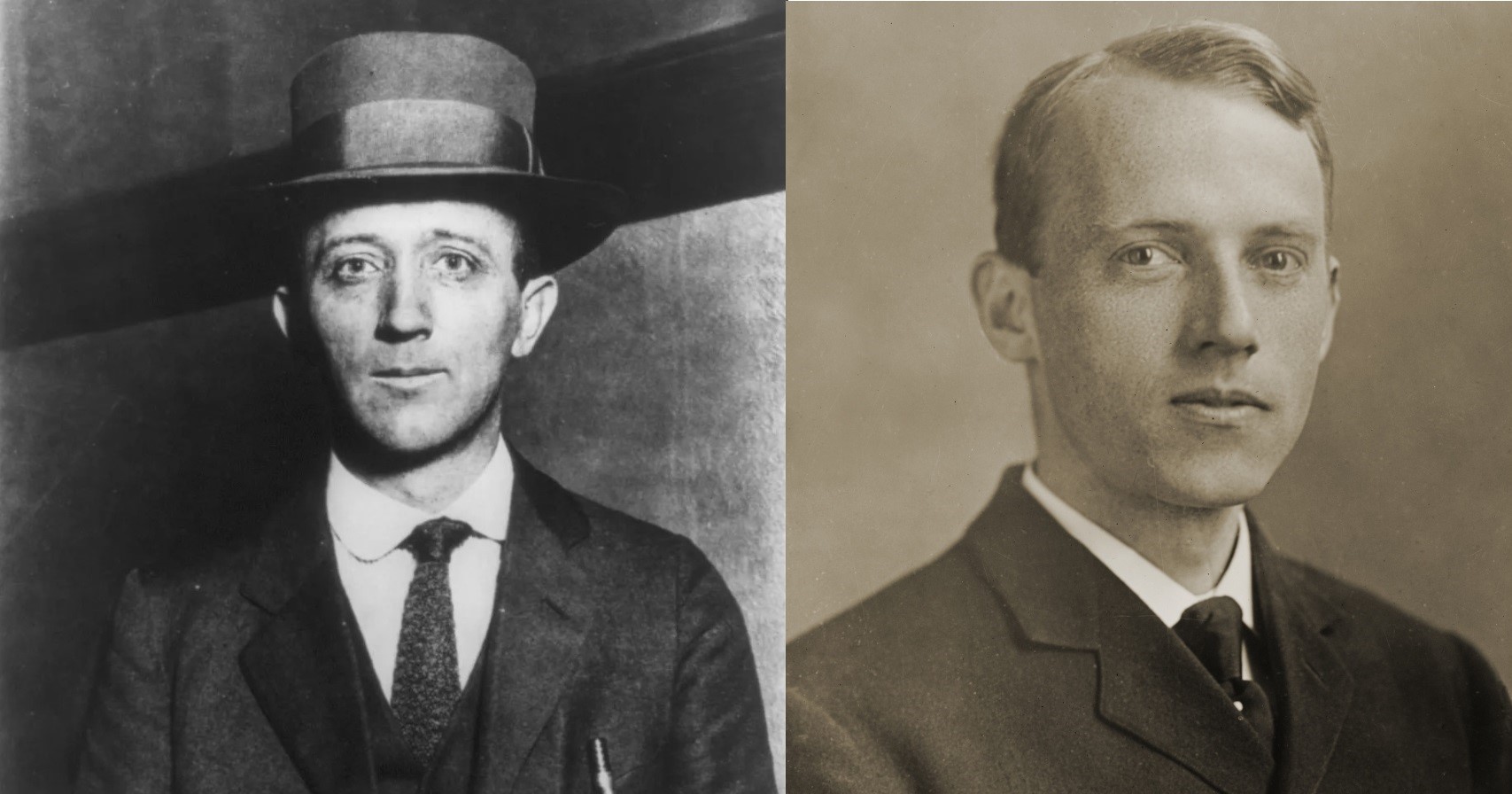
Foster replies to each of the four criticisms of of the Communist Party’s orientation made by Scott Nearing in this public debate of the 1920s. I am not aware of published response from Nearing, who would nevertheless apply to join the Communist Party in December, 1924–rejected because of his pacifism–but accepted in 1927 when he joined the staff of the Daily Worker until leaving the Party in 1930.
‘Foster’s Reply to Nearing’ from The Daily Worker. Vol. 2 No. 52. May 17, 1924.
DEAR COMRADE NEARING:
I must take issue flatly and fundamentally with practically all the points developed by you in your letter of Jan. 28th relative to the policies of the Workers Party and the Trade Union Educational League. As I understand the situation, your analysis of social conditions is faulty, your facts are inaccurate, and your conclusions are wrong. The four main points you would establish, and which I shall consider one by one, seem to be about as follows:
…1. There is no revolutionary sentiment among the working masses of this country, save in a few localities and among the foreign-born workers.
…2. The reactionary state of the labor movement, especially as it is expressed in trade union conventions, is a true reflection of the state of mind of the broad rank and file of labor.
…3. The militant program of the W.P. and T.U.E.L., carrying with it an active participation in all the struggles of the workers, is not only wrong in principle and futile in operation, but also actually harmful to the left-wing movement in general.
…4. The program of the left-wing should not be to plunge into the workers’ struggles but to carry on a careful and systematic campaign of educating and organizing the scanty revolutionary forces in preparation for the struggles of the future.
1. The weakness of your whole conception is that it is based upon the false assumption that there is no considerable mass revolutionary sentiment in this country. Thruout your letter, and as the very heart of your tactical considerations, you estimate the body of revolutionary sentiment as being expressed solely by the small number of conscious, clear-sighted, revolutionaries. You overlook completely the revolutionary significance of the prevailing discontent among the working masses. And by ignoring this tremendous factor you naturally draw conclusions which are valueless for our movement.
UNDENIABLY there is a great volume of discontent among the masses of American workers and farmers. This arises inevitably out of the clash of class interests within the frame of capitalism. This discontent, it is true, is mostly unconscious, blind, stupid, timid, and easily misled. But it is essentially revolutionary, nevertheless. It is the raw stuff of which revolutions are made. Revolutions are not brought about by the type of clear-sighted revolutionists that you have in mind, but by stupid masses who are goaded to desperate revolt by the pressure of social conditions, and who are led by straight-thinking revolutionaries who are able to direct the storm intelligently against capitalism. Never mind how stupid the mass discontent now is in America; never mind if the workers think, as you say they do, that “times will pick up again under the present system.” The unrest is basically revolutionary, notwithstanding. Capitalism cannot allay this discontent by granting the demands of the exploited. It must increase in volume, intensity, and intelligence until finally it culminates in the revolution. You make a fundamental error when you conclude that the only revolutionary discontent is that of the handful of class conscious militants, and when you ignore the far greater factor, the general discontent of the masses.
THE W.P. and the T.U.E.L. do not assume that there exists a large body of consciously revolutionary sentiment. On the contrary they merely “assume” the unquestionable, deep (even if vague) discontent of the masses. They know that the real function of the conscious left-wing is to educate, organize, intensify, discipline, and direct this discontent until it develops sufficient clarity, volume, and militancy to precipitate the final struggle with capitalism. You say that radical sentiment must be created by education, while we add to this that above all it must be developed out of the existing mass discontent. Your conception that the conscious elements are the only revolutionary force leads straight to the isolation of our movement and to its degeneration into a studious, sterile, cloistered Communist sect. The W.P. and T.U.E.L. conception, in direct contradiction to yours, makes inevitably for a broad mass movement of revolt and for an increasing participation in the ever-widening, ever-deepening class struggle; it makes for a real fighting Communist movement.
2. In your letter, as part of your general case that there is no real mass revolutionary discontent in this country, you make the rash assertion that the rank and file of the unions are as reactionary as their leaders. You even go so far as to say that Gompers is probably to the left of the general mass of unionists. Then, to support this broad contention, you cite the indifference of the organized masses at the expulsion of Wm. F. Dunne, the rejection of amalgamation and a labor party, and the repudiation of Soviet Russia at the A.F. of L. convention, as well as the continued imprisonment of Mooney, Sacco and Vanzetti, the discrediting of Alex Howat, the expulsion of left-wing militants in the needle trades, and various other outrages by trade union officials and capitalists. You claim that the views of the leaders on these matters are shared by the rank and file because both have gone to the capitalist schools, they read the capitalist papers, belong to the churches, vote the old party tickets–in short, the rank and file have been “taken into the camp by the enemy” just as much as their leaders have.
SUCH a contention, especially coming from one undertaking to use the Marxian method of analysis, is inexcusably erroneous. It runs counter to the truth on every side. The fact is the rank and file of the unions are far and away more radical than their leaders. And naturally so, for their economic position compels them to be. The trade union leaders are actually and ideologically part of the petty bourgeoisie. Iney draw large salaries; they live the life of the middle class; they are tied by a thousand and one filaments to the employers themselves; they have only a secondary interest in the struggle between the workers and exploiters; they feel no urgent and immediate interest in the building and militant utilization of the workers’ organizations; they are content to let well enough alone, so long as their own economic position, as expressed thru the regular receipt of their salaries, is assured. Like the rest of the petty bourgeoisie, they are active defenders of capitalism.
ON the other hand, the workers are struggle against the employers. For them the most vital consequences depend upon a successful prosecution. Despite their capitalistic training thru the newspapers, churches, political parties, etc. (which it would be idle to deny) they almost instinctively rally to the support of practical movements making for the strengthening–numerically, structurally, ideologically–of their political and industrial organizations. The tremendous spread of the amalgamation movement is proof of that. Between the petty bourgeoisie leaders and the working class rank and file, a struggle goes on constantly over the revolutionizing of the labor movement, with the leaders desperately resisting, by every means at their command, all attempts at fundamental improvement, which attempts almost always disturb the leaders friendly relations with the employers or their control over the unions.
THIS struggle between the rank and file and the leaders of the trade unions is now at a most critical stage. Innumerable instances of it might be cited, taken from every union in the country. Whoever does not perceive it knows nothing of the real forces at work in the labor movement.
STRANGELY enough, practically all the incidents cited by you to show the “consent” of the rank and file to the acts of their leaders are, when viewed properly, striking illustrations of the greater degree of radicalism among the actual workers in the shops. Consider the Portland convention of the A.F. of L.–what expression did the rank and file get there? Practically none. That was almost entirely a gathering of officials. Fully 150 of them violated their instructions when they voted against amalgamation, the labor party, and recognition of Soviet Russia–a flagrant but typical case of official suppression of rank and file radicalism. Or consider the case of Tom Mooney–have not the rank and file surged again and again, with their limited means of expression, in his behalf. And have not the leaders always broken up their movements of protest? The same is true of the Sacco-Vanzetti case. And in the case of the International Ladies’ Garment Workers; if the left-wing had demanded such support the rank and file would have split that organization in two.
BUT let us conclude with the Howat case. How you can get any comfort out of that for your theory is a mystery. It is one of the most flagrant cases on record of violent rank and file suppression by a reactionary officialdom controlling the organization machinery. At the recent Miners’ Convention, Lewis did not dare to give the rank and file a chance to express themselves on the matter, so, like trade union leaders generally, in handling radical movements, he used the full power of the organization to crush the Howat movement, arbitrarily adjourning the convention to prevent a fair vote being taken. Fully two-thirds of the delegates were in open protest but could do nothing. Then, because the rank and file have no effective mass means to counteract such outrages by their officials, you conclude that they acquiesce in them. Such conclusions, which are typical of many in your letter, completely invalidate your analysis of the situation.
3. Following logically upon your contentions that there is no revolutionary sentiment in America and that the rank and file of the labor movement are as deeply reactionary as their leaders, you condemn the W.P. and T.U.E.L. policy of maneuvering the masses on a large scale as is expressed in our various campaigns. Your objections would seem to fall under two general heads: (a) that we waste our strength because the non-revolutionary masses are unprepared to accept our program, and, (b) that we demoralize our own forces by carrying on maneuvers too complicated for them to follow. Now let us see what there is to these contentions.
THE mistake you make in this matter is to tacitly assume that the left-wing movement is going to the masses with a program so advanced that they cannot understand or accept it, and that therefore we cannot enlist them under our leadership. This would be true if we were to confine ourselves simply to the advocacy of the dictatorship of the proletariat and other revolutionary Communist concepts. But such is not the case. In addition to the ultimate revolutionary program, the W.P. and the T.U.E.L. have a program of every-day work, attuned to the prevailing discontent and the backward state of the working class. The latter can and do understand the need for amalgamation and the labor party, and they are following the left-wing lead in the campaign for these and other measures. With such a program of practical work, coupled to our general revolutionary teaching, we can say, yes, the sentiment is here, what we have to do is to organize and lead it.
The proof of the pudding is in the eating thereof. The fact that hundreds of thousands of workers are following the lead of the W.P. and the T.U.E.L. on the political and industrial fields is the best possible proof that they are ready for our program and leadership.
AS for your second objection, that our rank and file cannot keep pace with us, your fears are groundless. If a third party is formed with LaFollette or some similar at its head, and the Workers Party has to support it, the latter will not demoralize itself thereby. Quite the contrary would be the case. The best proof of this is our practice at present. Look at Minnesota. There the W.P. is deeply involved in the Farmer-Labor Party, which is a third party, as we understand the term. But, is it weakened or demoralized by this fact? Not at all. The W.P. has more real power and influence in Minnesota than in any state in the Union, and its members are intelligently following the struggle. Altho supporting the third party, they are pointing out its weaknesses and limitations. The same will be done in the coming national campaign if the W.P. co-operates with the third party thru an alliance. The tactic is not complicated. The time was when revolutionists held the notion that they could not participate in the mass unions and still maintain their revolutionary purity, but that has been thoroughly exploded. The same fate awaits the idea that they cannot safely take part in the mass movements of the workers on the political field. If the W.P. and the T.U.E.L. cannot function and prosper in the every-day political and industrial struggles of the masses, then they have no right to life.
4. As a natural consequence of your conception that the only available revolutionary force in the American labor movement is the small body of conscious revolutionists, you outline a plan for the careful education, organization and development of this precious little nucleus. You say, “our task involves first, education and second, organization.” You say almost nothing about utilizing the organization in the struggle. This is because you can conceive it fundamentally as an educational group, standing apart from the great masses and dealing largely with the theoretical aspects of the struggle. You would build it up slowly and cautiously. You would make of it, if your program were followed, simply a Communist sect.
NOW, with such a conception, the World Communist movement has nothing to do. Above all, the left wing is a fighting organization. We are soldiers in the class struggle, not merely students of it. The left wing is the vanguard of the proletariat, not simply in a theoretical, but also in an actual sense. It must not stand aside performing mental drill stunts and awaiting the great day, but it must participate increasingly in all the struggles of the workers. Education we must have; likewise organization; but both are futile without action. The struggle is the breath of life to every Communist organization.
IT is the function of the W.P. and T.U.E.L. to plunge into the struggles of the workers and by the example of practical leadership to secure control over the masses. The necessity for the left wing to do this, is greater in the United Stated than in almost any other country. Here the masses are utterly bankrupt of leadership.
The Socialists have nothing whatever to offer them. Likewise, the “progressives,” who with unexamples, cowardice and weakness, have trotted back to Gompers’ camp in the face of the bitter struggle now going on to revolutionize the labor movement. The left wing must take the lead. There is no one else to do so. To the extent of its power it must wrest the control of the masses from their misleaders and throw them into the struggle against the exploiters. This is exactly what it is doing in the great campaigns for the labor party, amalgamation, recognition of Soviet Russia, organization of the unorganized, etc. Such campaigns, instead of being a weakness to us, are our greatest strength. They give us control over great masses of workers who can thus be gradually prepared for more important revolutionary tasks. If properly exploited, they offer the best possible means for education and organization.
AS the struggle goes on, the revolutionary organizations must assemble all the proletarian elements made sympathetic. It must aim to build a mass party. And in doing this care must be taken not so much with the workers themselves but as with their erstwhile leaders. Of course, the left wing must avoid a decisive struggle with capitalism at this time. That goes without saying. Likewise, it must not extend its battle line over too long a line. But I fail to see the point of the steel strike illustration, as it has no bearing.
THE left wing must have a balanced program with education, organization and action going hand in hand complementing and vitalizing each other. The heart of the whole movement must be militant action. This is the program of the W.P. and T.U.E.L. You say it is based upon Russian experience, but this is an error. It is in line with Communist tactics and experience all over the world. Your program of peaceful education and organization will not do. It would make of the left wing a scholastic, sectarian, non-militant group. The program of the W.P. and the T.U.E.L. would make of it a genuine fighting organization, able to lead the workers in their struggles now and bearing with it the promise of eventually heading them in their final clash with the capitalist system.
Fraternally yours, WM. Z. FOSTER.
The Daily Worker began in 1924 and was published in New York City by the Communist Party US and its predecessor organizations. Among the most long-lasting and important left publications in US history, it had a circulation of 35,000 at its peak. The Daily Worker came from The Ohio Socialist, published by the Left Wing-dominated Socialist Party of Ohio in Cleveland from 1917 to November 1919, when it became became The Toiler, paper of the Communist Labor Party. In December 1921 the above-ground Workers Party of America merged the Toiler with the paper Workers Council to found The Worker, which became The Daily Worker beginning January 13, 1924.
PDF of full issue: https://www.marxists.org/history/usa/pubs/dailyworker/1924/v02a-n052-supplement-may-17-1924-DW-LOC.pdf
 Revolution's Newsstand