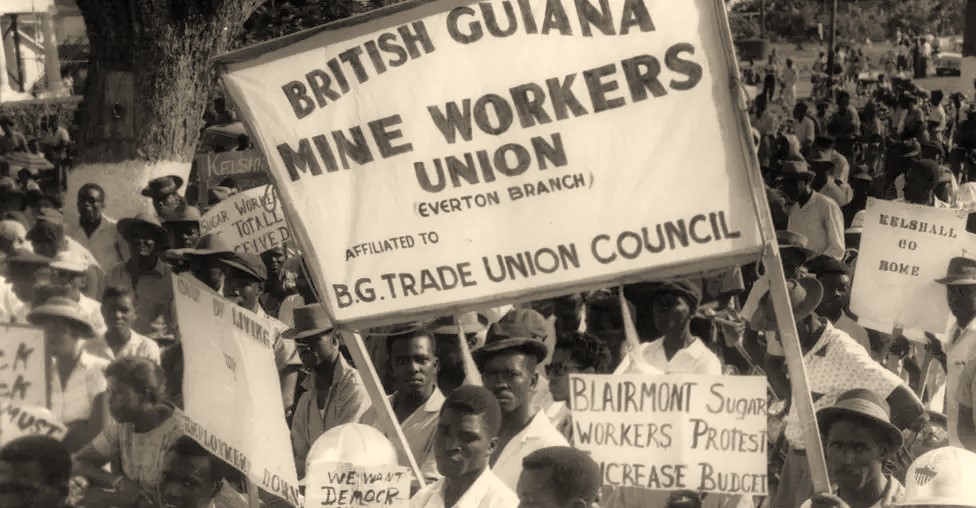
Founding Black Communist, Suriname-born Otto Huiswoud, writes as Chair of the Profintern’s Negro Trade Union Committee on British Guiana, introducing a statement from the Committee on tasks in the South American colony.
‘Imperialist Rule in British Guiana’ by Otto Huiswood from Negro Worker. Vol. 1 No. 8. August, 1931.
The world economic crisis has struck the colonial and semi-colonial countries very hard. The Caribbean colonies have felt especially the effects of the Sugar crisis. The production of sugar is the major industry of most of these colonies. The tremendous fall in sugar prices has caused an almost complete standstill of the sugar industry. This is the cause of tens of thousands of workers and farm labourers being thrown out of work, and they face actual starvation and destitution.
British Guiana is the only British colony situated on the mainland of South America. The total area of the colony is 89,464 square miles of which only about 275 square miles is under cultivation. The population is 307,784 with 57,000 in Georgetown, the capital city (1928 census) about one-fourth of the population live in the towns.
Blacks and mixed: 157,922
East Indians: 126,964
Whites: 11,302
Chinese: 2,810
Original natives: 8,786
The above figures show that the blacks and mixed are the majority of the population, it also shows that nearly half of the population are East Indians, who form the largest single racial group in the Colony.
The East Indians were brought into the colony over a period of years as pawned labourers to work on the sugar plantations. They are driven by the overseers to produce huge profits for the plantation owners for the miserable wage of from 24 to 40 cents per day.
Political Domination of the Colony
British Guiana is governed under the crown colony system. A governor appointed by the British Crown is assisted by a legislative council made up of 10 official (nominated) members and 19 unofficial members. 14 are elected and 5 nominated. In this scheme of things the Governor and the 15 nominated members, who are officials and representatives of the agricultural, commercial and shipping interests, usually Europeans. They have overriding powers over the elected members. The fiction of elective representation is kept up to fool the masses. This scheme insures the complete political domination of the colony by the British Imperialist.
The vast majority of the native population are disfranchised because he who votes is required to have an income of 300 dollars per year. A few years ago, an election was held. Out of the 86,000 adult male population, there were only 11,000 who voted. This shows that the majority of the workers do not even earn $,300 per year and are therefore not far removed from the starvation level. Besides the money requirement there is a requirement, about “reading and writing”. Since the people who cannot read and write, in the West Indies, runs as high as 50 per cent, the landowning class use this as one more device of reducing the working-class vote to its lowest.
The constitution also requires that elected members to the Legislature must possess a certain amount of real property. This is clearly a policy to prevent the election of workers to the Legislative Council. The elected members are therefore largely the native bourgeoisie and intellectuals who cooperate with the white ruling class in the exploitation and subjection of the masses. The native bourgeoisie are the allies of the imperialists who depend upon their support for the maintenance of Imperialist domination.
Agriculture.
61 per cent of the total export is sugar (1930) and over 40 per cent of the wage earners depend directly or indirectly upon the sugar industry for a livelihood. This shows the appalling misery and situation which the toiling masses face, now that sugar production, the main industry in British Guiana, is at a standstill.
In 1930 there were 32 sugar plantations with a cultivated area of 57,625 acres. The export of sugar in 1928 was 114,689 tons valued £1,692,639. Of the by-products of sugar 2,536,628 gallons of molasses and 1,109,485 gallons of rum were exported. The capital investment in the sugar industry is about £4,000,000.
About 44,359 acres are under rice cultivation. The export of rice in 1928 was 18,083 tons valued at £232,114. There are about 131 rice mills in operation. The production of rice is carried on mainly by small East Indian peasant proprietors. Of the other crops such as coffee, coconuts, etc. 52,863 acres are under cultivation.
Industry
The small industries of British Guiana comprise the following:
a) Diamond the export of diamonds in 1928 was 132,482 carats valued at £232,114.
b) Gold the export of gold in 1928 was valued at £15,864.
c) Bauxite (aluminium ore)–the export of this mineral in 1929 was 182,692 tons. This industry is operated by the Northern Aluminium Company of America which is under the control of the Andrew Mellon interests. The capital investment in the industry is about £1,000,000.
Besides these, there are many small industrial undertakings and factories for the manufactory of soap, matches, shoes, etc. In 1928 41% of the trade was with Great Britain, 30% with Canada and 9% with the United States.
Class Differentiation.
It is important to note that class groupings are sharply drawn among the native population. There exists a rigid colour caste system, deliberately fostered by the imperialists in order to divide the mulattoes and blacks and to maintain the exploitation and subjugation of the native masses.
The working class in the colony is composed of the blacks and East Indians while in the main the whites and mulattoes are the officials, the bourgeoisie, government employers, etc.
The sugar industry is in the main controlled by the British capital, while mining is in the hands of the white and native bourgeoisie and agriculture and small manufacturing is controlled by native and East Indians bourgeoisie.
The Situation of the Working Class.
The majority of the toiling population are Negroes and East Indians. The East Indians represent the bulk of the labour force on the sugar plantations and rice fields, while the city, mining and forest labourers are largely Negroes.
In 1928, there were 37,108 adult East Indians and 18,332 children on the plantations. Besides, there were also 71,524 East Indians, largely poor farmers and workers engaged in the production of rice and other crops.
On the plantations, these workers toil under the most miserable and degrading conditions receiving from 24 to 40 cents for a long day of hard toil under the broiling sun. They are housed in company owned shacks which are even unfit as dog kennels, living in squalor, degradation and disease. Chained to the land, driven by the overseers, these workers are most frightfully exploited and oppressed.
The conditions of the city workers is little better than that of the plantation labourers. The miners, dockers and other industrial workers, who are subjected to the most brutal exploitation, receive the miserable wage of about 60 cents. per day. They are forced to live in the most unsanitary disease-breeding hovels for which the landlords charge very high rentals. The living condition of these toilers is not far removed from actual pauperism. Poverty, starvation and destitution is the lot of theses masses out of whose blood is squeezed super-profits by the imperialists and land owning parasites.
The unemployment situation caused by the drop in sugar production is causing the greatest hardship and misery. In spite of the misery of the thousands of starving unemployed, the Government and employers are doing nothing to extend any relief to the masses. The Governor bluntly stating that: “he was not prepared to give relief or start a “dole system”.
Tasks of the Workers.
It was only the recent unemployed demonstrations led by the British Guiana Labour Union, that forced both the “Labour” Government and the local ruling class to come forward with certain fake “relief” schemes. But these “relief” schemes are clearly designed to fool the masses and prevent their revolt against the unbearable hardships.
In the present situation the tasks of the toiling masses in British Guiana is to intensify the struggle against unemployment, wage cuts and exploitation. In order to wage a successful struggle against the landowners and employers, it is necessary to build strong, militant unions of the city and plantation workers, which will carry on a determined fight against the Imperialists, for the betterment of the condition of the masses, and for national and social independence.
In this struggle of the masses in British Guiana, the International revolutionary movement particularly the British Minority Movement must give assistance possible.
What Must Be Done in British Guiana?
An open letter issued by the International Trade Union Committee of Negro Workers.
To all Workers of British Guiana.
Comrades!
Today the entire capitalist world is in the grips of a frightful economic crisis. Nearly 40 million workers in Europe, America and other countries are unemployed and are walking the streets from place to place searching in vain for work. The present economic crisis is painfully affecting the workers and peasants in the capitalist countries but is hitting all the more strongly the toilers of the colonies and semi-colonies where it is difficult to get exact figures of the great number of colonial people affected by unemployment. The employers attempt to place the whole burden of the crisis on the backs of the already poverty stricken workers and peasants through wholesale dismissals and reductions in wages.
The crisis in the sugar industry has hit British Guiana the slave colony of British imperialism especially hard and has thrown thousands of industrial and agricultural workers completely out of work. Sugar represents 61% of the total exports of the country and 30 to 50% of wage workers depend directly or indirectly upon the sugar industry. This shows the extent of the poverty of the masses in the present time when the sugar industry is in a state of complete standstill. Thousands of workers, men and women, who formerly merely eked out a miserable existence are at present entirely without any means of livelihood, and are quite destitute.
I. Unemployment and Starvation.
The major question facing the toiling masses of British Guiana is the unemployment situation. And what are the Government and the employers doing to relieve this terrible condition of the masses? Various fake relief schemes have been proposed. But these so-called “relief” schemes are only put forward. to fool the masses and to create the illusion that the ruling class is ready to aid them.
Under the mask of assisting the unemployed the “Labour” government has granted a loan of £162,000 to British Guiana. But the real object of this loan consists not in assisting the unemployed but in trying to assist the European sugar planters to overcome their crisis and prevent the total loss of their investments, amounting to millions of pounds. The governor knows that this so-called relief scheme is a fake and in order to prevent the workers from organizing for struggle he proposes that the British Guiana Labour Union organize a “trade depot” in which the workers can display certain products of their labour, and also that it “collect the unemployment statistics”. He also calls upon the masses to go “back to the land”. This is a direct mockery of the starving masses, who demand the right to work or immediate relief. But on the demands made by the Union for immediate financial assistance to the unemployed, the Governor replied that this question has to be discussed with other officials and that “he was not prepared to give relief or start a dole system”.
Fearing the growing wrath of the masses and their readiness to fight against unemployment and the starvation policy, carried through by the capitalists and the owners of the plantations and the government, the governor declared to a delegation of the Trade Union his indignation with the workers’ street demonstrations with banners insofar as this “may create excitement and lead to unpleasantness”. The governor knows full well, that it is only in the organization of the forces of the workers that a means for assisting thousands of starving men, women and children can be found. Consequently he and other supreme rulers are trying to keep the workers in fear, to terrorise the masses and to compel them to silently suffer privation.
While both the unemployed and the partially employed are compelled to roam about without work and without means, the greedy landlords are demanding from them payment of rent, and are depriving those workers who are penniless of their last cent. The last proposal of the landlords to allow the tenants only five days in which to pay their indebtedness for rent shows clearly the offensive they are preparing against the unemployed.
While on the one hand the workers and peasants are living in misery, squalor and degradation, receiving a mere pittance of their toil when they are employed while they are compelled to live in frightful hovels, we see on the other hand the officials and the employers, whites and natives living in luxury, receiving huge salaries and making colossal profits at the expense of the toiling masses.
II. What must be done?
Fellow Workers! the immediate task before the toiling masses of British Guiana is to organize and struggle against capitalist exploitation!
Every worker in British Guiana must know that only through organization can an effective struggle be carried and the unemployed and employed workers secure better conditions. The capitalist government and the employers will never voluntarily grant any of the demands of the workers or give relief to the unemployed unless forced by the organized might of the working class. The working class of British Guiana has had a number of strike experiences. You know too well that the small concessions you were able to wring from the employers in the past were due to the determined strike struggles you so bravely waged. Only on the basis of the programme of class struggle which was drawn up at the First International Trade Union Congress of Negro Workers, held in Hamburg, Germany, July 1930, which was attended by a delegate from the West Indies, can a real effective struggle be waged against capitalist exploitation and slavery.
III. The British Guiana Labour Union.
The British Guiana Labour Union has in the past led a number of demonstrations and strike struggles of the workers for the improvement of their degrading conditions. Despite the many shortcomings of the Union it is the only force rallying the workers in demonstrations and meetings against unemployment. But the political mistakes for the leadership consists in this, that it did not understand that a successful struggle for an improvement in the conditions of the masses cannot be carried on by way of appeals directed to the government and the employers but only by way of uniting the workers on the basis of an active fighting and decisive class struggle programme, and this mistake has prevented the Union from becoming a strong fighting organization. In view of the fact that the Union during the last period took no part in the daily struggles of the workers, that it did not fight for their daily demands, the condition of the Union is now exceedingly bad and the number of its members exceedingly small.
Fellow workers! You must sharply watch all the intrigues of the capitalists and the government who by means of the formation of trade depots supposedly to aid the unemployed, but, in reality, with the idea of obtaining cheaper labour and bigger profits, are really trying to deceive you.
Equally harmful are also the proposals of certain leaders of the Union to try and organize laundries and bakeries since such things simply result in the weakening of the fight of the workers against capitalism with its system of exploitation and oppression.
The workers must guard against also another danger and that is the penetration into the Union of politicians and such so-called leaders who will in the long run go over to the side of the employers and betray the workers. The workers must profit by the experience of the past, when similar elements used all their efforts to destroy the Union a few years ago. Only a class-conscious proletarian leadership is capable of leading the workers in an active fight against the imperialist parasites and their supporters who suck the life blood out of the workers.
To wage a successful campaign against unemployment and exploitation it is necessary to create a strong organization. Therefore, the primary task before the workers is the building of the union. With this object it is necessary to develop a mass recruiting campaign among the Railway workers, the dock workers and seamen, the mechanics, domestic workers, the miners and the day labourers. All these workers should be drawn into the union on the basis of their immediate demands, which should be linked up with the general class demands:1) The right to organize and strike; 2) freedom of assembly speech and labour press; 3) equal pay for equal work; regardless of nationality, colour of the skin, sex and age; 4) An 8-hour day; 5) a minimum wage for all workers; 6) two week’s annual holiday with pay; 7) the introduction of a workmen’s compensation law and social insurance; 8) maternity insurance; 9) repeal of the “masters and servants” ordinance; 10) federation with the West Indies and the right of self-determination.
IV. Organize the agricultural Workers.
The majority of workers in British Guiana are agricultural workers and they more than any other group of the proletariat feel the brunt of the agrarian crisis These plantation workers are subjected to still greater exploitation and live in still greater poverty than the town workers. A large majority of these workers are East Indians who are tied to the land and are working under the most frightful exploitation and oppression. In the past these Indian workers have on a number of occasions been in open rebellion against the ruling class, and have fought bravely against the slave conditions on the plantation. It is of utmost importance that the union pay special attention to drawing these workers into the common struggle against the landowners and begin active organizational work among them.
The union should call joint meetings of the natives and East Indian agricultural workers pointing out to them the necessity and importance of organizing an agricultural workers’ union. At these meetings special committees should be elected by the workers and charged with the task of drawing up a programme for organization and agitation, and to carry out the work necessary for organizing a union. The following demands should be included in the programme of action:1) The right to organize and strike; 2) A minimum wage and 8-hour day; 3) Women and youth must be given equal pay with the men; 4 Abolition of child labour on the plantations for children under 14 years of age; 5) Free rent for workers housed in company owned houses; 6) Exemption from taxes for agricultural workers; 7) Free grant of land to unemployed agricultural workers.
V. Organize the Unemployed.
Since the burning question before the toiling masses of British Guiana to day is the question of unemployment, one of the immediate tasks of the union must be the organization of the unemployed workers and the mobilization of the employed workers for a joint struggle for the demands of the unemployed. A special campaign should be waged among the Indian workers to draw them into the fight against unemployment.
The British Guiana labour Union should call a series of meetings of all the unemployed. The meetings should be advertised as widely as possible. The leading members of the union should explain the purpose of the meeting and call upon the rank and file to elect from their midst committees of action. One of the immediate tasks of the Committees must be the organizational of unemployed Councils composed of both native and Indian workers. The Committee must draw up a programme of action which should include the following points:1) Immediate financial relief for the unemployed and their families; 2) The funds for relief to be provided by especial tax levied on the business enterprises and capitalist and by cutting down the high salaries of the officials and by withdrawing the special bonus recently granted to the higher grades of the civil services; 3) No rent to be paid by the unemployed; 4) Food clothing and medical attention for the children of the unemployed free of charge.
These demands must be confirmed by a general meeting of unemployed. The Committee must call upon the unemployed to march to the Government house in order to present a petition containing these demands to the Governor and the Legislative Council. All the unemployed men, women and children should participate in the demonstration. The employed workers should participate in the demonstration and thereby show their class solidarity with the unemployed. The employed workers must recognize the fact that the employers always play off one group of workers against the other, holding the unemployed army as a threat over the heads of the employed workers. The employed must remember that today they are working, but tomorrow they too may be forced to walk the streets in search of work. Only the joint struggle of the employed and unemployed on the basis of their common class interests can prevent the bosses from further lowering the standard of living of the working class.
A call to the workers.
Fellow Workers! Only upon a programme of action as outlined above can the workers engage in a real struggle to better their conditions and build strong and effective fighting unions. In this fight many so-called “friends” of labour will come forward with the propaganda of the employers urging “Labour and Capital to work together much in the manner of the two blades of a scissors”. Politicians and lawyers of all shades will “join” the union in order to further their own selfish interests and later betray the workers. Fellow workers beware of these tools of the capitalists, and imperialists! Bitter experience has taught the proletariat of the whole world that the only way they can get anything from the capitalists is through struggle and the mass organization of the workers.
Working men and women British Guiana!
Organize and build your unions. Organize unemployed Councils. The Negro and White class-conscious workers of America, England, and other parts of the world are with you and will support your struggles. Fight against the imperialist exploiters! Demand federation with the West Indies and the right of self-determination! Refuse to let your wives and children starve while the capitalists and landlords and their families live in luxury. Demonstrate on the streets and before the Legislative Council and demand food, work and the right to human existence.
With Fraternally greetings!
International Trade Union Committee of Negro Workers.
First called The International Negro Workers’ Review and published in 1928, it was renamed The Negro Worker in 1931. Sponsored by the International Trade Union Committee of Negro Workers (ITUCNW), a part of the Red International of Labor Unions and of the Communist International, its first editor was American Communist James W. Ford and included writers from Africa, the Caribbean, North America, Europe, and South America. Later, Trinidadian George Padmore was editor until his expulsion from the Party in 1934. The Negro Worker ceased publication in 1938. The journal is an important record of Black and Pan-African thought and debate from the 1930s. American writers Claude McKay, Harry Haywood, Langston Hughes, and others contributed.
PDF of full issue: https://www.marxists.org/history/international/comintern/negro-worker/files/1931-v1n8-aug.pdf
 Revolution's Newsstand