
Much to think about for our own situation in this review by Sidney Hill, C.P. authority on housing in the 1930s, of the Museum of Modern Arts’ ‘City Housing Exhibit’ that sought to address the crisis during the Great Depression.
‘Slumming at the Museum’ by Sidney Hill from New Masses. Vol. 13 No. 7. November 13, 1934.
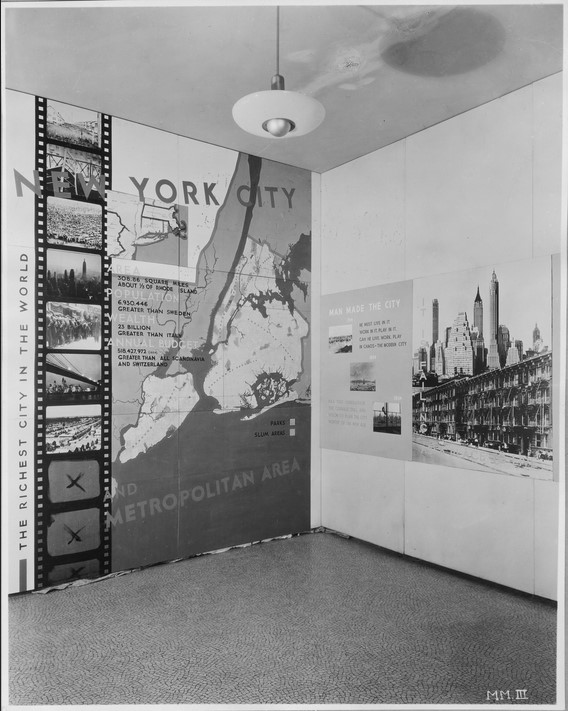
NEW YORK CITY, through the co-operation of the Municipal Housing Authority, Lavanburg Foundation, the Welfare Council, Columbia University, and a number of American and foreign experts, is staging a slum-clearance and low-cost housing exhibition at the very smart Museum of Modern Art. The visitor is treated to a lavish display of pictures, photo murals, charts and models showing the terrible housing conditions under which some two million inhabitants of the world’s richest city live. The crowded walls and panels are well calculated to impress the casual patron of the Museum with their frankness. Here at last is a public exhibition that dares to tell the truth about society’s obligation to the poor, about the great lack, for the majority of workers, of even the most elementary comforts and sanitary facilities; the misery, the devastating depression; the disease, malnutrition and other physical dangers to life involved in being poor and having to live in the slums. With an eye to the gallery, the exhibitors have gathered the most shocking photographic scenes of New York’s blighted rookeries and their inhabitants that one is ever likely to encounter. For the further titillation of the well-dressed, comfortable spectator there is offered an actual tenement flat, transplanted from the slums of Yorkville with its squalor, filth and odors intact. Here are all the thrills and shudders of a slumming expedition, vicariously enjoyed with none of the usual inconveniences.
The whole show is a veritable orgy of contrition. Sympathy for the slum dweller runs rampant on the walls of the museum. Pictures of mothers and children, hungry and in rags; miserably and inadequately sheltered in the “rotten slums.” Everything is loudly confessed; slums exist because interest rates and rents are too high and the wages of workers too low for decent housing. “Good housing is a vital need–not a charity.”
The City Housing Exhibit appears to be engaging in a radical and fearless exposé. Actually, however, attacking slum conditions is quite respectable and safe. Books, magazines, newspapers, radio, cinema–all have joined in the crusade. And they all treat the question in substantially the same manner. It seems that the slum is some sort of sore or cancer which is caused by poor planning, or by high interest rates or the wrong method of taxation. The more liberal exposers hint that low wages have something to do with it—but they won’t press the point. Some–notably social workers–even claim that the blighted areas are due to the “apathy” (sic) of the slum dweller who has become attached to his rookery. Always the special and more or less isolated factors are set up as straw figures for easy disposal. But what these slum clearers and housing experts rarely tell, perhaps because they dare not, is that the wretched hovels in which the poor are forced to live are deeply and inextricably wound up with the entire society in which we live; in other words, with capitalism.

The City Housing Exhibit, for example, rails against the greed and the calloused, anti-social attitude of the slum owner–in the abstract. It fails, however, to disclose, and it knows this perfectly well, that great sections of New York’s slums are owned by our most respected citizens and institutions–by the Astors, the Hamilton Fishes, the banks, the very oldest and most venerable churches, the great universities, even by the City itself.
The City Housing Exhibit proclaims a great shortage of decent workers’ housing, as established by the recent Real Property Inventories. But in terms of the real estate market–in terms of profit–there is no shortage whatsoever. Indeed, the real estate boards would have us understand that in view of the high percentage of vacant apartments disclosed by the same surveys, there is actually a surplus of housing. Is it unreasonable to expect the slum clearance workers and housing crusaders to clarify this seeming paradox to the bewildered layman. Why, for example, does our exhibition not explain to us how the Roosevelt Housing Program, which also gave lip-service to pro-social ideals, failed; how the housing campaign was inaugurated over a year ago with a newspaper blast about the immediate necessity of 800,000 new homes at a cost of 14 billion dollars to be spent in 2 years but how the P.W.A. allotted only 150 million for the purpose; and how even this pitifully small sum was never spent because the chambers of commerce and the real estate interests flocked down to Washington in droves crying that this was cut-throat government competition; and finally throat government competition; and finally how Roosevelt, to pacify them, turned the Housing Program into a Renovising Program which is nothing more than the guaranteeing by the government of loans and mortgages of private banks and companies and which is currently in process of failure because home owners cannot be ballyhooed into paying over 9 percent interest for a loan.
Such an explanation would, in addition, enable the public to evaluate properly the rosy statements issued regularly from Washington concerning the housing program just about to be started. The latest release, timed for the elections, appeared in the newspapers only last week and we are again promised “a program of slum-clearance and low-cost housing” involving, this time, the much reduced sum of 5 billion dollars spread over 5 years. But since the interests which spiked the original housing program are still extremely potent we have no reason to be optimistic concerning this one.
By directing its attack against such abstractions as greed and “rugged individualism,” or against other symptomatic issues such as the absence of rational city-planning and reactionary building ordinances, the Housing Exhibit avoids and obfuscates the real factors. By cleverly playing upon the ready sympathies of a gullible public, without, at the same time, exposing the powerful anti-social forces of the banks and big property interests, the housing reformers and experts serve to conceal the fact that it is the whole economic structure itself, of which these profiteering groups are a part, which is the basic reason for the existence of the slum.
The fate of the “New Deal” housing campaign has demonstrated a simple but significant truism. The real estate interests, despite their internecine throat slitting, are agreed on one issue, namely: that they are as unalterably opposed to decent shelter for the great mass of workers and the unemployed as the industrialists are admittedly opposed to decent wages and the complete elimination of unemployment. And for precisely the same reasons: because adequate housing for all workers means non-profit, completely public housing. And that means the elimination of the fat dividends which slums usually pay their owners and it also means the elimination of the private speculator who will build, according to capitalist rules, not for social use but only for profit.

We will soon see how, with such a false approach to the problem, the sponsors of the exhibition were led to an equally false and demagogic solution. And it will also be seen how, in addition to pulling the wool over our eyes, they actually attempt to help shake us down. The solution to the housing question is formulated by the exhibition as follows:
Investment in housing must be secured by:
1. long time planning.
2. government control.
3. reasonable returns.
4. low interest rates.
5. long term amortization.
The first two points are sound enough. The exhibition correctly states that an adequate housing program must be planned in advance to avoid the past chaos and social waste. It is also correct in asking for government control, if by that it means the public ownership and management of the housing and the land on which it is built. But what are “reasonable returns?” The building industry knows full well that the wages of most workers are too low to permit of even “reasonable” profit. That is why there has been so little construction in the past 5 years. We have the example of the so-called “limited-dividends” corporations which agree to limit themselves to only 6 percent but which nevertheless charge 2 and 3 times the rents which slum-dwelling workers can pay. (For example, the Hillside development now being constructed in the Bronx and the Woodside in Queens, both of which will charge $11 per room per month.) And what about the 15 million unemployed? It would seem then that “reasonable returns” would not benefit the very people for whom the exhibit pretends sympathy. And as for low interest and long term amortization, certainly the speculator will welcome such aid from the government. It will not enable him to re-house the slum dweller but it will give him the opportunity of competing in the medium rental market with those other speculators who unfortunately built without the benefit of easy public money. Incidentally, at the Housing Institute conference conducted in connection with the Exhibit, we found that our reformers were not so much concerned with providing housing within the workers’ means but with a “maximum” interest rate. Indeed one of our outstanding housing experts insisted that rather than become “un-businesslike” and cut interests too low(!) we ought to begin by reducing building costs through other methods; for example, the elimination of “luxuries” such as central heat and hot water.
Points 3, 4, and 5, mean simply that private initiative is willing to take a little less profit, especially when its investments are subsidized and guaranteed by the government. But it must be obvious, even to liberals by now, that any form of private building and ownership contradicts the only progressive features of the exhibition’s proposal. For, as has already been indicated, advance planning presupposes complete public ownership and control.
This must lead us to the conclusion that the City Housing Exhibit, consciously or otherwise, is using a liberal front to promote a cause which, to be kind, is decidedly non-liberal. It is not necessary to take merely the author’s word. The following is from a review of the exhibition in the New York World-Telegram of Oct. 21, 1934:
“The country has been blanketed with surveys and exhibits on low-cost housing for the masses in the last few years. Never has there been one which takes a Utopian dream and proves in terms of low interest, long amortization and dollars and cents, that its fulfillment would be an economic advantage. The organizers of the exhibit have been guided by the sound economics of values, by the principle that the real value of land depends on the continuity of its social usefulness.”
But Europe, the experts will explain, has done it this very way. Why can’t we? In the first place let us see what Europe has done. The exhibition displays a number of graphs and photographs showing the volume and kind of workers’ housing constructed in various European countries in recent years. The graphs and pictures, however, deliberately omit a great deal of more important information. For example, we are not told that what little housing was achieved in these countries was won through the organized strength and efforts of the workers. The intense reluctance with which the ruling class granted even this pittance is illuminated by the bloody violence with which it is withdrawn as soon as the opportunity arises. The City Housing Exhibit has the hypocrisy to show us the Karl Marx Apartment in Vienna without its now historically symbolic, shell-torn facades. We see bright pictures of the housing development in Frankfort-am-Main. But the exhibition is silent concerning the smashing of the housing co-operative societies and the abrogation of their rights in Nazi Germany and Fascist Italy. And this process is going on, although less violently, in Socialist Sweden and in Holland and other liberal countries through the bankruptcies of the co-operatives and the inability of workers to pay the rents demanded in the houses pictured on the walls of the museum.
England, the gentle reformers urge, can show us the way. “We ought,” says Helen Alfred, Secretary of the National Public Housing Conference, “to electrocute the experts who do not have the English type of mind. If the English have done nothing else they at least are thinking clearly.” (italics mine, S.H.) Let us see what this means.
“London:
“On almost every road leading out of London one passes long rows of houses.”…All the trappings of a building boom are there…If the new houses were sturdily built, there might be less harm in such a nation-wide wave of installment buying. But evidence accumulates that the bulk of the new houses are ugly and badly planned and that thousands of them are being built of shoddy material.
“Even more disturbing is the greed of speculators who have huddled new houses together on the least possible amount of land.
“In short, England is repeating many of the worst blunders made in the United States during the years of unrestrained individualism before 1929. She may some day regret her own building boom, even though it keeps 425,000 men busy in constructional trades today and has increased the profits of auxiliary industries by 87 percent in the past year.” (Housing Boom Aids Britain Recovery. N.Y. Times, Oct. 14, 1934.)
Here is “long time planning” and “government control.” What do we think now of What do we think now of our European example with its low interest rates and its “reasonable” returns? And what can we think of the honesty of the reformers and experts, and the housing standards their Exhibit seeks to promote?
A word about the Yorkville tenement flat referred to earlier. This was included in the exhibition at considerable expense by three wealthy young men who are promoting a slum “rehabilitation” scheme in Yorkville. According to this scheme the rents of the remodelled flats (governmentally subsidized) would be considerably higher than those paid by the present occupants and, among other advantages, their prospectus lists: “Speculative value of property left with owner.” To convince us of their social interest, they proclaim that the area in question “results in ill health, crime, lowered morale (slum mind)–social restlessness.”
It would seem unnecessary to explode again the theory that slums breed ill health, crime, etc. John Strachey discussed in THE NEW MASSES recently the now notorious experiment in England where 750 families were moved out of a slum into “garden homes” on the outskirts of Stockton. At the end of a year it was found that malnutrition, disease, and other ills had increased because the higher cost of living in the new houses left less of the family income for food and other necessities. And as for “social restlessness,” that also is not caused by the slums but by the whole rotten capitalist system which denies workers a decent living. The young men who set up the exhibition flat are apparently not aware of the fundamental causes. In promoting their idea they assure prospective patrons that it will dilute workers’ complaints. In this connection consider the statement of Dr. Gottfried Feder, Reich Commissioner for Land Settlement, who also wants to clean out slums.
“The modern metropolis…leads to the accumulation of anti-social elements, becomes the breeding place of Marxist agitation.” (Reich is preparing for Economic War. N.Y. Times, June 3, 1934.)
The City Housing Exhibit side-steps one more question: that of the interrelation of an adequate workers’ housing program with unemployment insurance. The people chiefly responsible for this exhibition are well aware, for example, that the Federation of Architects, Engineers, Chemists and Technicians has called their attention to this question by actively supporting the Workers’ Unemployment and Social Insurance Bill (HR 7598) in connection with its own Housing Program. But the City Housing Exhibit, as we have already seen, is afraid of such issues because it knows that to face them is to expose the forces at work behind the fake sympathy of the photo-murals, the hypocritical castigation of irrelevancies and the demagogic appeal to “courage.” Yes, it is courage that is needed. But it is the organized and enlightened courage of those workers whose misery currently decorates the fashionable museum–whose declining “New Deal” incomes force still further out-of-reach the tantalizing, sunny, garden apartments of the Exhibit. Despite the deep-seated conflict between those capitalist interests which stand to gain by the so-called “low-cost” housing and those which stand to lose, we may conceivably have some housing constructed in the United States in the near future. But it will not re-house the slum dwellers nor provide adequate, high standard housing for all workers unless they themselves see that it does. A really sufficient housing program requires a comprehensiveness of planning and public ownership which we know is unattainable under capitalism. Nevertheless, organized workers, intellectual and manual, can win concessions. But they must continuously fight even to retain them or the tragic story of Vienna will repeat itself here.
The New Masses was the continuation of Workers Monthly which began publishing in 1924 as a merger of the ‘Liberator’, the Trade Union Educational League magazine ‘Labor Herald’, and Friends of Soviet Russia’s monthly ‘Soviet Russia Pictorial’ as an explicitly Communist Party publication, but drawing in a wide range of contributors and sympathizers. In 1927 Workers Monthly ceased and The New Masses began. A major left cultural magazine of the late 1920s and early 1940s, the early editors of The New Masses included Hugo Gellert, John F. Sloan, Max Eastman, Mike Gold, and Joseph Freeman. Writers included William Carlos Williams, Theodore Dreiser, John Dos Passos, Upton Sinclair, Richard Wright, Ralph Ellison, Dorothy Parker, Dorothy Day, John Breecher, Langston Hughes, Eugene O’Neill, Rex Stout and Ernest Hemingway. Artists included Hugo Gellert, Stuart Davis, Boardman Robinson, Wanda Gag, William Gropper and Otto Soglow. Over time, the New Masses became narrower politically and the articles more commentary than comment. However, particularly in it first years, New Masses was the epitome of the era’s finest revolutionary cultural and artistic traditions.
PDF of full issue: https://www.marxists.org/history/usa/pubs/new-masses/1934/v13n07-nov-13-1934-NM.pdf
 Revolution's Newsstand