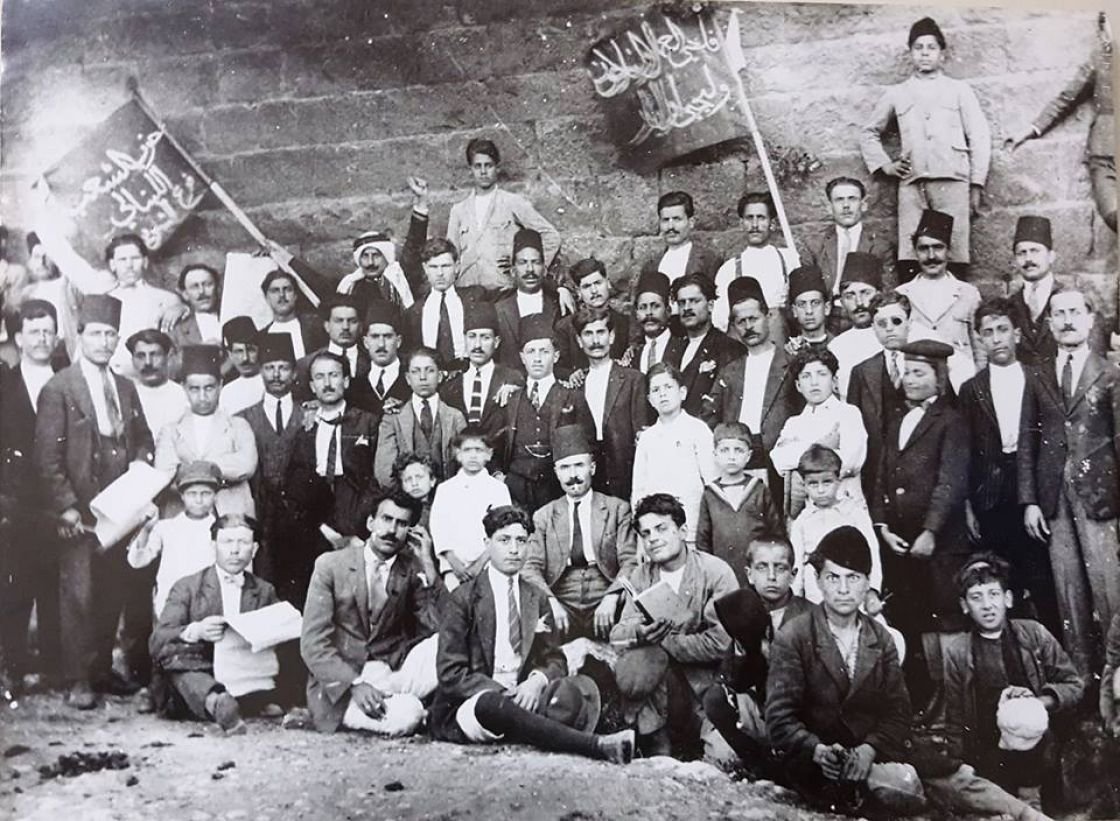
May Day, 1925 in Beirut, Tel Aviv (Jaffa), and Haifa.
‘The Rise of the Labour Movement in Palestine and in Syria’ by A. M. from International Press Correspondence. Vol. 5 No. 50. June 11, 1925.
It was the first time that the 1st of May was celebrated here as a real international proletarian holiday. It is true that in 1907 the 1st of May was celebrated in Lebanon, but this was only an attempt of a small group of Syrian intellectuals. Students who had studied abroad, brought with them the red proletarian flag when they returned to the steep mountains of Lebanon. But this holiday found no echo among the masses, it remained a historical curiosity, an episode. In Palestine also, where the Labour movement had existed for nearly two decades, it had not yet reached the level of celebrating an international genuinely proletarian holiday.
The Labour movement in Palestine had, up to now, been a purely Jewish national one. The Jewish workers, driven out of other capitalistic countries by the raging storm of antisemitism, arrived in this country on the black pinions of blue nationalism. The movement not only remained national but nationalistic.
The socialist slogans found no echo. Every proletarian sound died away in the narrow space of the new Ghetto which, to a certain extent, was voluntarily created.
The holiday of the 1st of May shared the fate of the general Labour movement. In Palestine there are various peoples and religions; and these have their own holidays and their peculiar ways of celebrating them. In the eyes of the Arabian masses of this country, the 1st of May remained a Jewish holiday. And when the communists attempted, in 1921, to make a demonstration in the streets, it ended in a bloody pogrom.
This is how it used to be. Now things have changed. In the near East, great and important events are occurring.
European imperialism with its tempestuous capitalistic culture has permeated the slow and smoothly flowing life under the hot rays of the Oriental sun.
The popularity of the Communist Party in Palestine and Syria is increasing at an unexpected pace. This can be explained not only by the consistent Leninist tactics of the C.P. of Palestine, but also (possibly still more), by the imperialist predatory policy of the foreign imperialists and the social patriotic traitors among the so-called socialists. During the years 1924 and 1925 a strong indigenous Labour movement has grown up; during this period the first Communist papers and trade union and socialist brochures in Arabian language have appeared.
The number of Arabian comrades in the P.C. of Palestine is strikingly increasing. The 2nd International has existed for nearly 40 years. Decades and centuries have passed during which the States in which the 2nd International has its chief centres, have enslaved and subjugated the colonies. Only last year the foundation stone of the proletarian Press in the Arabian language was laid, and that a communist one.
The beginnings of the Arabian Labour movement are thus communist. This is due not only to the merits of the communist International but also to its strength. Hundreds, thousands of copies of newspapers, brochures, tens of thousands of communist proclamations, hundreds of meetings, assemblies of groups – plus extreme exploitation and despicable plunder on the part of imperialism have done the trick – the Labour movement has taken a seven-leagued step forwards.
The 1st of May was the first “review” of the proletarian forces. It must be recognised – even our opponents admit it that the review was a brilliant one.
In Tel Aviv (Jaffa) more than 3000 workers celebrated the day. Meetings and demonstrations in the streets; here and there the red flag flew in the streets, meetings were formed, the streets were filled with lively revolutionary songs, led by the ‘International’. During the day English aeroplanes flew so low as almost to touch the heads of the demonstrating workers, the Irish mounted Constabulary (the most faithful servants of English imperialism) rode through the streets during the day the workers celebrated their revolutionary holiday.
In Haifa the centre of focal industry, the streets had a festive appearance. Hundreds of workers decorated with red flowers paraded the streets, motor cars with armed workers and police dashed to and fro.
The police was mobilised, secret agents spread over the working class districts like locusts. The police was informed that a public meeting was to take place near the railway station, they concentrated all their forces there – and at the same time the Communist Party was proudly marching through the centre of the town with the red flag. Jewish and Arabian workers in serried ranks marched together. The police heard of this too late, the demonstration was in full swing, the police lost control of themselves; the police officer ordered an attack, but the police “dared not” carry it out (read “would not”).
In Lebanon the Communist Party, which was only founded this year, appeared on the scenes with grandiose manifestations. More than 800 workers struck in Beyrout alone. Demonstrations with red flags, meetings etc. Under the leadership of our comrades, the 1st of May was turned into a day of battle for Labour protection legislation. Similar demonstrations took place in Rickafaia Sachle Schya and Dror-AI Schakir (Labour centres in Lebanon).
The 1st of May was thus the first proletarian appearance of the working class of Syria and Palestine.
The ECCI published the magazine ‘Communist International’ edited by Zinoviev and Karl Radek from 1919 until 1926 irregularly in German, French, Russian, and English. Restarting in 1927 until 1934. Unlike, Inprecorr, CI contained long-form articles by the leading figures of the International as well as proceedings, statements, and notices of the Comintern. No complete run of Communist International is available in English. Both were largely published outside of Soviet territory, with Communist International printed in London, to facilitate distribution and both were major contributors to the Communist press in the U.S. Communist International and Inprecorr are an invaluable English-language source on the history of the Communist International and its sections.
PDF of full issue: https://www.marxists.org/history/international/comintern/inprecor/1925/v05n50-jun-11-1925-inprecor.pdf
 Revolution's Newsstand