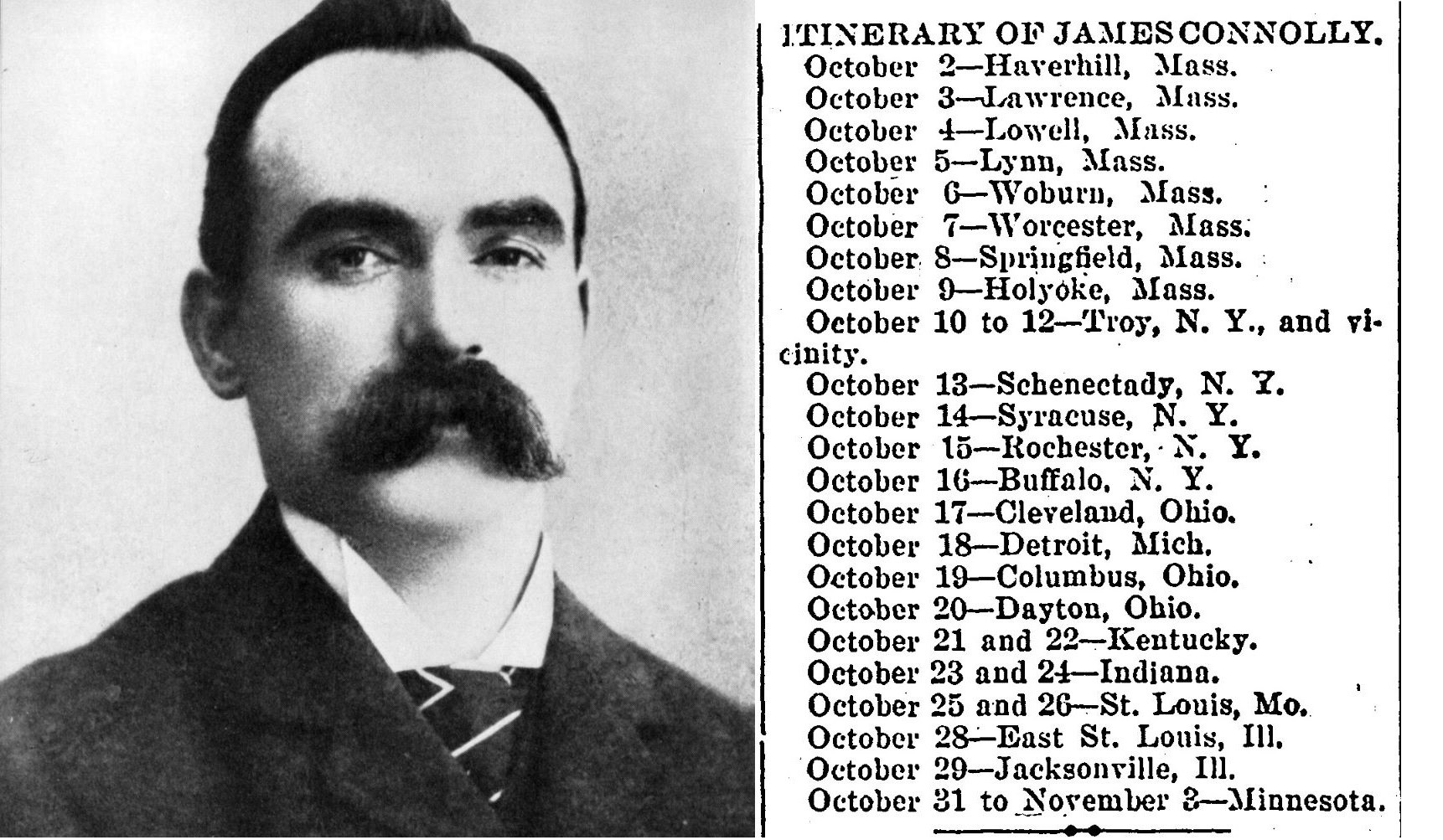
Several weeks into what must have been an exhausting speaking tour, Connolly lectures in Detroit, where twelve subs to ‘Workers Republic’ were sold.
‘James Connolly in Detroit’ from The Daily People. Vol. 3 No. 101. October 24, 1902.
FAKIR HIT.
Connolly’s Answer to His Question Touched Him.
Special to The Daily People. Detroit, Mich., Oct. 20. The occasion of Comrade James Connolly’s visit to this city gave evidence of the awakening of the working class to a realization of their class interests.
The Party was engaged in caucus work, balls and dances were in progress, and on top of them a Republican mass meeting was held with Secretary of the Treasury Shaw as the attraction. Notwithstanding that, however, a large audience greeted the speaker.
H. Richter opened the meeting, and with a few remarks, calling attention to the position which the Socialist Labor Party occupies in the political field and the mission it has to perform, he introduced the representative of the Irish Socialist Labor Party.
Comrade James Connolly, in his forcible and eloquent presentation of the condition of the wage. workers of Ireland and the analogous condition of America, kept the audience in rapt attention for nearly two hours. “Political freedom,” he said, “is essential to the Irish worker to obtain economic freedom, and both are necessary to secure to the worker the full product of his labor.” That religion is no preventative of exploitation he demonstrated by citing Italy, a Catholic country, France, a free thinking country, and Germany, a Protestant country, where the exploitation of the worker by their capitalist master is the same. “You have heard of the Holy Trinity,” he exclaimed, “here you have the unholy trinity.”
The freedom of capitalism, the freedom of contract, as far as the worker is concerned, he illustrated by a story. A man finds himself in deep water, in an exhausted condition, almost drowning. Another man, comfortably seated in a boat, comes up to him and says: “I will take you in this boat, providing you sign this contract, to work for me wherever I direct you. But, of course,” he adds, “I do not want to coerce you, you are perfectly free to do as you please.”
Submission or death is the only alternative, so the drowning man accepts the former. That is what capitalism has to offer to the working class.
Connolly concluded by stating that the only way out of this degrading condition s pointed out by the Socialist Labor Party, i.e., class-conscious organization of the working class, with the ballot as a weapon, to overthrow capitalist misrule and inaugurate the collective ownership of the tools of production, Socialism. Stormy applause rewarded the speaker when he finished, which indicated the waning influence of capitalist thought: A number of questions were asked, which were answered by Comrade Connolly in a manner that did not leave his enquirer in doubt.
One answer showed that Connolly was acquainted with the lay of the land, and never afraid of telling the truth even if in enemy is made.
The question was: “What effect will the coal miners’ strike have upon the progress of Socialism?”
Connolly answered: “I am no prophet, nor the son of one, but one thing is certain, as long as the generalship of Mitchell lasts it will only result in the further enslavement of the mine workers.” The fakir W.D. Mahon, president of the Amalgamated Association of Street Railway Employees, who was the questioner, sneaked out of the hall immediately.
Quite a number of pamphlets were sold. Twelve subscriptions for the “Workers’ Republic” were secured; literature was also distributed.
The collection which was taken showed an appreciation of the fact that money is very helpful in the fight against capitalism.
The meeting was voted a success all around.
New York Labor News Company was the publishing house of the Socialist Labor Party and their paper The People. The People was the official paper of the Socialist Labor Party of America (SLP), established in New York City in 1891 as a weekly. The New York SLP, and The People, were dominated Daniel De Leon and his supporters, the dominant ideological leader of the SLP from the 1890s until the time of his death. The People became a daily in 1900. It’s first editor was the French socialist Lucien Sanial who was quickly replaced by De Leon who held the position until his death in 1914. Morris Hillquit and Henry Slobodin, future leaders of the Socialist Party of America were writers before their split from the SLP in 1899. For a while there were two SLPs and two Peoples, requiring a legal case to determine ownership. Eventual the anti-De Leonist produced what would become the New York Call and became the Social Democratic, later Socialist, Party. The De Leonist The People continued publishing until 2008.
 Revolution's Newsstand