
Manuel Gomez looks at the centrality of Panama to global U.S. imperialism.
‘Panama and American Imperialism’ by Manuel Gomez from the Daily Worker. Vol. 2 No. 264. November 18, 1925.
FOLKS who imagined the occupation of the city of Panama by our “gallant boys in khaki” constituted an invasion were under an illusion. The entire “republic” of Panama is under American rule all the time. The recent episode was merely an application of “martial law” for the purpose of breaking a strike of decidedly un-American Panamans and restoring imperial law and order. The slaughter of five natives was just a “regrettable incident.”
Readers of The DAILY WORKER may be interested to know what the republic of Panama looks like now that it is back to normal.
IN the first place there is the strip of Panama territory known as the Canal Zone, ten miles wide, running straight across the middle of the country and completely dominating it. Contrary to popular belief, the Canal Zone is not legally a possession of the United States but is part of the “republic” of Panama. Certain it is, that in 1904, with the concurrence of Roosevelt’s “big stick” and the United States navy, the zone was “leased” to the U.S. in perpetuity. But Panama has never received a single penny of rental. The rent money is stored up in a Wall Stret bank to cover interest payments on the 30-year 5 1/2 per cent loan that American bankers forced upon the protesting “republic.” Similarly with the $10,000,000 that the U.S. was supposed to have paid over to Panama in return for the concession to build and operate the Panama canal. This money is invested in New York state bonds; the Panamans can neither change the investment, nor touch the principle or the interest. The entire net income of this “constitutional fund,” as it is called, is pledged to cover interest payments on another Wall Street loan-the 5 per cent serials of 1915.
However that may be, an American governor runs the canal zone as United States territory–with a 100 per cent American military administration, an American post office, American fortifications, and American soldiers and marines. A Panaman worker cannot even get a job in the Canal Zone, except at unskilled manual labor and at the very lowest rate of pay.
Of course, the soldiers and marines do not stay in the Canal Zone. They overrun the rest of the “republic” whenever the Canal Zone administration thinks it advisable. That is in accordance with the treaty of 1903 whereby Panama was forced to recognize our “special rights” as “the guarantors of Panaman independence.”

It was with reason that Roosevelt called the treaty of 1903 “a historic stage in the development of the Monroe Doctrine.”
Let us consider the territory of Panama (exclusive of the Canal Zone) under the present conditions of peace and normalcy. Customs, finances and police are under the direction of Americans. The Panama railway is owned by the United States government. Revenues from the liquor excise are pledged against interest payments on the 8 per cent “national defense loan” of 1921. (N.B. Any attempt to institute prohibition in Panama, in accordance with Yankee precedent, would no doubt mean another hurried military invasion from the canal zone.)
The total amount of private property in the “republic” of Panama was officially estimated about two years ago at $33,175,501. Of this, $5,000,000 or more belongs to the United Fruit company, which has its own railways, lands and equipments. By arrangement with the dummy Panama government, the Goodyear Rubber, company has exclusive warehouse facilities for rubber in Panaman ports. The American Foreign Banking corpora ion and the International Banking corporation (both controlled by the Wall Street money trust) have their branches in the “republic” and dominate the movement of financial capital there. Two-thirds of all the capital invested in Panama is American capital.
AMERICAN “big business” has thus an enormous stake in the little pseudo-republic where the Panama hats come from. Has not this at least a little to do with the determination of the U.S. government to guarantee Panaman independence so religiously, even from the Panamans themselves? Is not American imperialism simply a phase of the development of American capitalism toward the monopoly of whatever sections of the earth it can lay its hands on?
I have not touched at all the question of imports and exports between Panama and the United States, but when that is taken into consideration as well as the factors mentioned above, it will be plain that Panama has no more independence economically than she has politically. Like other states of the Central American and Caribbean region, she has been impressed into the American economic system, dominated by the lords of Wall Street, and is as truly a part of it as Illinois or California. With the difference, however, that she is one of the colonial divisions of the system–that she is a subject nation, exploited under imperialist slavery, and her sons and daughters are obliged to toil under the most abominable conditions to produce super-profits for the imperialists. It is the super-profits from subject nations like Panama that make it possible for American capitalism to continue its exploitation and pauperization of the American working class. For this reason, if for no other, every class conscious worker in America, must be a supporter of the growing Panaman movement for freedom from American rule.
BUT it would be extremely superficial to assume that American financial interests in Panama itself furnish the only, or even the main reason for the enslavement of this little dependency of American imperialism.
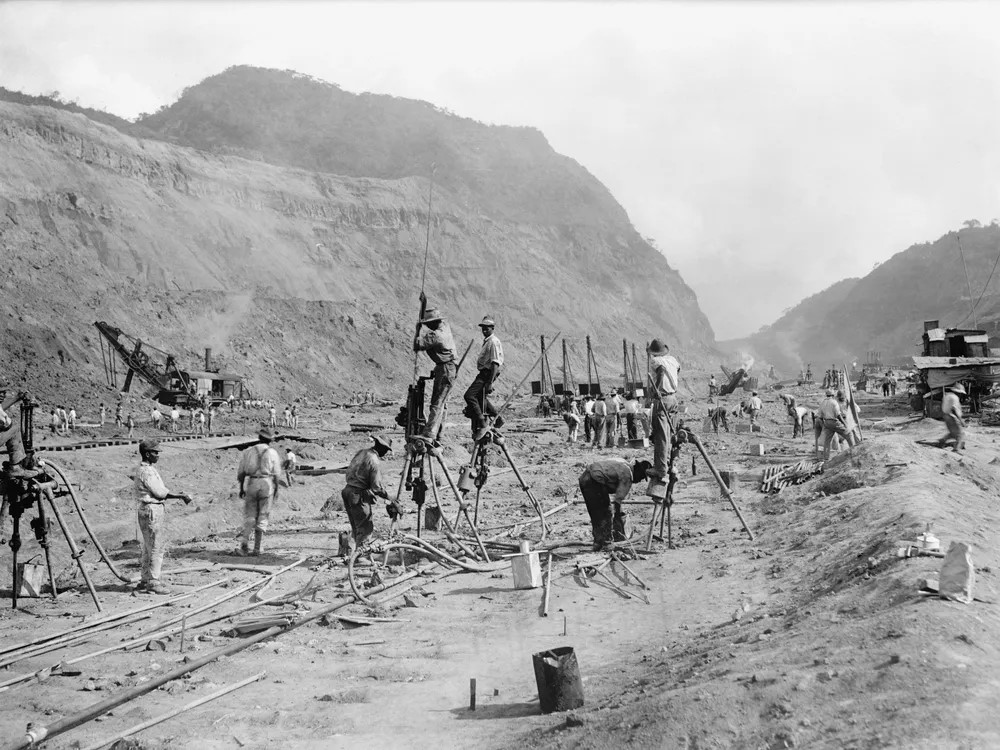
Panama must be looked at in connection, first and foremost, with the spread of American imperialism thruout Latin-America, and secondly, with the development of American imperialism over all the world. The Panama canal provides the key to the situation.
The project of the canal was what aspired the original robbery of Panama from Colombia in the imitation revolution staged in 1903. The project was an old one, but it did not acquire irresistible momentum until a certain period had been reached in the economic and political development of the United States.
To say that the canal was wanted for trading purposes is to repeat an obvious truth, without at the same time throwing any real light upon the question. The fact remains that it was only after America’s entrance on the world political stage that things began actually to happen in Panama. After the war with Spain, the American empire included Hawaii, Samoa and the Philippines, Porto Rico in the Caribbean and Cuba, a protectorate, close at hand. In the words of President McKinley, the building of the canal was intended to afford “that intimate and ready intercommunication between our eastern and western seaboards demanded by the annexation of the Hawaiian Islands and the prospective expansion of our influence and commerce in the Pacific.”
TODAY the United States is an empire stretching out everywhere–in The Atlantic as well as in the Pacific; in Europe, Latin-America and the Far East. Imperialism implies an industrial method of international seizure and monopoly; it is therefore, a form of business in which big guns are required no less than salesmen and credit men to protect and extend the monopolized areas. Imperialism and war are inseparable and there are millions of workers who can be used as cannon fodder. The various units of the American empire have been pieced together with that idea in mind.
Latin-America is the economic base of American imperialism, and the Panama canal is its central strategic base.
The entire Caribbean and Central American region has its strategic as well as economic importance for American imperialism. A series of naval bases beginning with Key West, Florida, and including Guantanamo Bay (at the southwest of Cuba), Porto Rico, and the Virgin Islands, give the United States absolute control of the Caribbean. The treaty of 1907 with Santo Domingo gives the U.S. he right to build a naval base at Samana Bay; the treaty of 1915 with Haiti gives her the same right to the Mole of St. Nicholas; and the Bryan-Chamorro treaty of 1916, permits her to build naval bases in the Bay of Fonseca and the Corn Islands off Nicaragua.
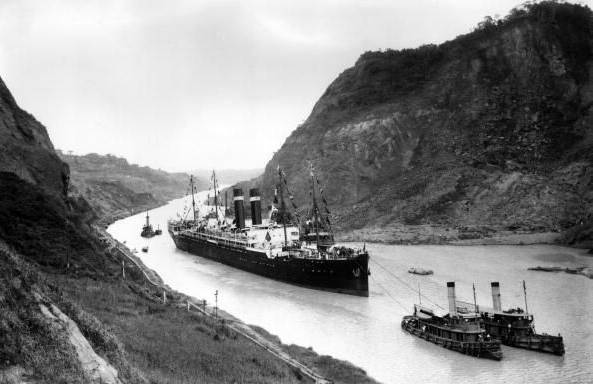
It is significant that in the not wholly fantastic volume recently published under the title of The Great Pacific War; A History of the American-Japanese Campaign of 1931-33,” the starting point of the war is connected with the blowing up of a Japanese steamer in the Panama canal and the consequent suspension of communication between the Atlantic and the Pacific. The author, H.C. Bywater, is a leading British naval authority, and he knows whereof he speaks.
NOT without reason are the American military forces in Panama concentrated in the Canal Zone.
American imperialism will cling to the “republic” of Panama in the face of everything. There is not another of her possessions that she would not give up before this. She guards jealously against the slightest unsettling influence on the peninsula. Anti-capitalist agitation that tends to destroy the present balance of forces, strikes of ragged and hungry laborers against extortionate rents, any working class or peasant disturbance at all will be put down as callously as Great Britain would put down a similar disturbance at Suez.
Panama is the pivotal point of the entire structure of American imperialism outside of the United States. In the face of this, what mean the protests of the little people of Panama who only want freedom?
The Daily Worker began in 1924 and was published in New York City by the Communist Party US and its predecessor organizations. Among the most long-lasting and important left publications in US history, it had a circulation of 35,000 at its peak. The Daily Worker came from The Ohio Socialist, published by the Left Wing-dominated Socialist Party of Ohio in Cleveland from 1917 to November 1919, when it became became The Toiler, paper of the Communist Labor Party. In December 1921 the above-ground Workers Party of America merged the Toiler with the paper Workers Council to found The Worker, which became The Daily Worker beginning January 13, 1924.
PDF of full issue: https://www.marxists.org/history/usa/pubs/dailyworker/1925/1925-ny/v02b-n264-NYE-nov-18-1925-DW-LOC.pdf
 Revolution's Newsstand