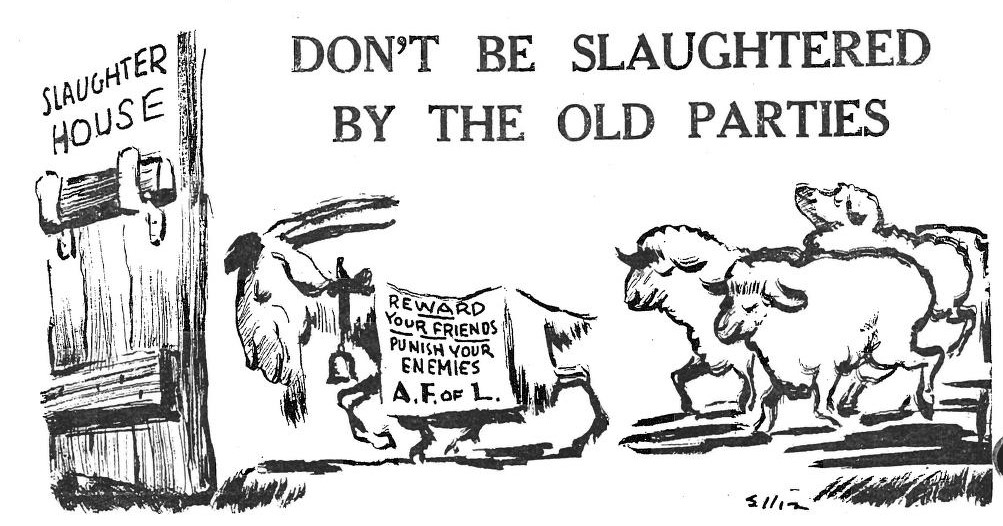
The 1920s were a decade of reaction for U.S. labor. At the beginning of the decade, the A.F.L. had over 5 million members, by 1930 it had under 3.5 million. This T.U.E.L. statement on the 1928 New Orleans convention of the A.F.L. on its crisis was also handed out as a leaflet there.
‘Statement of the Trade Union Educational League On the American Federation of Labor Convention’ from Labor Unity. Vol. 2 No. 10. November, 1928.
I. Crisis in the Labor Movement
THE 1928 Convention of the American Federation of Labor, scheduled to start Nov. 20, in New Orleans, finds the labor movement of the United States in the greatest crisis of its history. With the exception of certain new unions which are not affiliated with the A.F.L. the last few years have witnessed a rapid decline in prestige, militancy and numerical strength of the unions. There has been loss of membership, and degeneration of leadership. In the railway shop crafts, in the metal and coal mines, m the needle trades, in marine transport, in the packing houses, in every industry except building trades where the workers were formerly in the majority organized, now the unions represent a dwindling minority of those at work. In no single trustified industry do the unions have any power. They are not growing, they are decreasing in strength. And this collapse has taken place during a period of prosperity for the employers, of unprecedented industrial activity and of favorable opportunities for organisation.
II. Causes of the Crisis
The consolidation and rationalisation of industry, the merger and trustification of the employers, larger and larger scale production with more and more use of improved, labor saving machinery, has not been met by the unions of the American Federation of Labor with any consistent plan, any cooperation between unions, any militant struggle to avoid the evil effects of labor displacing machines by gaining a shorter work day and higher wages.
In the face of a constantly solidifying group of employers, and a constantly more mechanised technique of production, the A.F.L. unions have remained separated, resisting every attempt at amalgamation, which the rank and file in many industries, as for instance, building trades, printing trades, shop crafts, etc., would welcome.
Instead of consolidating union forces, the leaders of unions in these industries engage in ruinous and suicidal jurisdictional disputes, and invariably place the narrow craft interests, peace with the employers at the expense of other unions in the industry, above the interests of the workers in all of the unions. There is a complete failure to organise on a class basis, or to realise the common interests of Labor.
In a period of widespread wage cuts and intensification of labor in the shops, the leadership of the A.F.L. unions has on almost every occasion refused to lead resistance to the drive of the employers. This lack of militancy has been coupled with frequent exhibitions of open collaboration between the employers and the highly paid, un-proletarianised officials of the A.F.L. and the unions belonging to it. President Green of the A.F.L. has often in articles and speeches, declared to the employers that he is in favor of “increasing production by collaboration,” which means by reducing wages and speeding labor. Matthew Woll, vice president of the A.F.L., served with the committee of the American Bar Association to draft a federal bill against strikes, and has propagandised the workers in favor of it. Presiding at a banquet tendered by the American Bankers Association to Lord Melchett, originator of the infamous, class collaborationist “Mond Plan”‘ in England, Matthew Woll showered the plan and its founder with praise, and sneered at strike action. John L. Lewis, international president of the United Mine Workers has sold out the strike, with separate agreements, wage reductions, and loss of conditions. Batty and MacMahon of the United Textile Workers broke the strike of the 26,000 New Bedford workers by ordering their followers back to work. President Mahon of the Street and Electric Railways Employees not only stopped the proposed strike of the New York subway employees, but signed a contract with the Mitten interests of Philadelphia that he would not permit organisation on certain of their properties, Harrison, president of the Brotherhood of Railway and Steamship Clerks stopped the strike of 10,000 express drivers in New York by a threat to provide scabs. These are but recent exhibitions of such betrayals of the rank and file of the unions eager to strike for organisation against wage cuts or for better conditions. There has been during recent years a long history of such acts of treachery.
While the unions’ strength in organised fields has been thus frittered away by sheer sellout and betrayal no attempt has been made to organise the unorganised, which comprise some 25,000,000 workers, as compared with perhaps 2,500,000 bona fide dues paying members still in the A.F.L. unions. The organisation of the automobile industry, decided upon by A.F.L. convention, was turned into a negotiation between the A.F.L. committee and employers, to establish the unions as substitutes for company unions, on the openly expressed argument that the regular unions could do everything for the employers that the company unions could do.
The employers even refused to consider this.
These policies have only been carried out by widespread and consistent expulsions of militant workers, in nearly all unions, and most recently in the miners’, needle trades’ and carpenters’ unions.
These policies have been possible partly through the deliberate encouragement of race prejudice, the exclusion of the Negro workers from many unions, and discrimination against them in other unions, the discrimination against the young workers, women and foreign born workers within the unions, and failure to organise them into the union in the first place. The unions have been absolutely indifferent to the lynching and persecution of Negro workers.
These policies of surrendering the workers to the employers, of warfare on the specially persecuted groups of workers in America, make the official bureaucracy of the A.F.L. and its unions the natural agents of American imperialism. Under its control, the Pan American Federation of Labor has been merely a cloak for the corruption of the Latin American labor movements, in the interests of American capitalism. Because of the conflicts of American imperialism with its rivals the A.F.L. refuses to join even the reactionary International Federation of Trade Unions; however, American capitalism has so highly developed its system of corruption in the labor movement, class collaboration, etc., that the policies of the American misleaders of labor are eagerly copied by the European reactionary labor officials. Where separate unions of the A.F.L. belong to international bodies, there is mutual felicitation over the progress of the expulsion campaign by international representatives, as at the recent carpenters’ convention. The A.F.L. officials continually incite to war against the Union of Socialist Soviet Republics, the first Workers Government, as in Vice President Woll’s recent attack on “Amtorg.”
With all of this goes the most widespread and shameless corruption in official ranks. Not only are enormous salaries collected, during strike periods when the rank and file are starving, as in the case of Lewis’ $12,000 a year and huge expenses in the miners’ union, but there is plain graft, and bribery such as was carried on by Frank Farrington in the miners’ union, by Mike Boyle in the building trades, Con Shea in the teamsters’ union, by Brindell in New York and Feeney in Philadelphia building trades unions, Cronin of the moulders, Berry of the pressmen’s union, and many others. The whole movement is in a sea of corruption, and the facts that are disclosed must be only a superficial few of those as yet hidden.
Naturally, a group such as this dominating clique in the A.F.L. is not in favor of class political action for workers. It is more profitable to the leaders to deliver the labor vote to one or another of the old parties, even though both these parties have suppressed workers in strikes and on picket lines, issuing injunctions that practically prohibit strikes, and betraying them through the means of public mediators and arbitrators.
III. What the A.F.L. Convention Will Do
This convention, meeting in New Orleans, a nonindustrial city and winter playground for the rich, dominated by a corrupt clique whose only policy is surrender to the employers* will do nothing to remedy the situation. Their policy is based on complete surrender, through the help of “Capitalist Efficiency Socialism” theoreticians they are making a general social theory of B.O. plans and Mondism in its American form with added complications and refinements, all of them absolutely disastrous to the workers’ organizations and standards of living. With the Socialist party now openly disavowing the class struggle, the old party union heads are leading a mad stampede towards poverty, unemployment, and war. The convention will probably indulge in an orgy of friendship with open shop employers, representatives of Chambers of Commerce, etc., will support American imperialism against the workers, will clarify their line of class collaboration still more, and will approve of the war against the progressive forces in the unions, probably forming new committees to direct it on a national scale.
III. What Must Be Done
The workers of America must realize from the foregoing analysis that in almost every case their interests lie in policies the exact opposite of those pursued by the misleaders of the American Federation of Labor.
We propose to the workers that wherever there are still mass organizations, as in the building and printing trades, the workers who wish to struggle against open shop drives and reduction of wages, anti-strike laws and anti-strike agreements, shall organize themselves in the T.U.E.L. and struggle in an organized fashion to elect their own officials and manage their own unions.
Wherever there are no mass organizations of the workers, as in the automobile, metal-mining, rubber, and other such industries, the workers must follow the leadership of the coal miners, textile workers, and needle trades workers, and organise their own, new unions, with the proposition in mind of eventually uniting them with a vigorous and militant A.F.L., after the workers of the A.F.L. unions shall have come into control of it. We invite all workers, whether in unions or not, to join the T.U.E.L. and help carry out this program.
In all cases of crafts in a single industry, the way to strengthen the mass organisations is to unite them into strong industrial unions.
But with the masses of workers unorganised, the weight of the activities of progressive workers must be to organise the unorganised, even in spite of the opposition of old line trade union officials, who maintain skeleton organisation and claim jurisdiction without organisation over portions of the workers who must be organised industrially if they are to Insist wage cuts and unemployment.
In every case, the workers of America must break down the barriers of race and nationality which the union misleaders as well as the employers take pains to maintain. Jim Crowism must be ended. The Negroes must be organised, in the old unions if these are mass organisations, in the new unions otherwise, or in separate unions if reactionary leaders of mass organisations bar them. The young workers, women workers, and the foreign born must be freed from discrimination, admitted to the unions on equal terms, and receive equal pay for equal work, with special favorable conditions for women and young workers.
Workers must fight for their own class political party and wage a continuous political struggle against all the other parties and for a workers’ government.
An incessant struggle must be waged to secure adherence of the American labor unions to the only militant, working class international of unions, the Red International of Labor Unions, as part of the struggle against the war danger, to protect the first Workers Republic and in order to present an international united front to the employers and exploiters of labor.
The Trade Union Educational League invites all progressive workers in America who realise the facts of the situation as set forth above, and who wish to achieve the remedies we have outlined, to communicate with the Trade Union Educational League 2 West 15 St., New York City, to unite with us in a struggle for the organisation of the American Working Class.
Labor Unity was the monthly journal of the Trade Union Educational League (TUEL), which sought to radically transform existing unions, and from 1929, the Trade Union Unity League which sought to challenge them with new “red unions.” The Leagues were industrial union organizations of the Communist Party of the United States (CPUSA) and the American affiliate to the Red International of Labor Unions. The TUUL was wound up with the Third Period and the beginning of the Popular Front era in 1935.
PDF of full issue: https://www.marxists.org/history/usa/pubs/labor-unity/v2n10-w29-nov-1928-TUUL-labor-unity.pdf
 Revolution's Newsstand