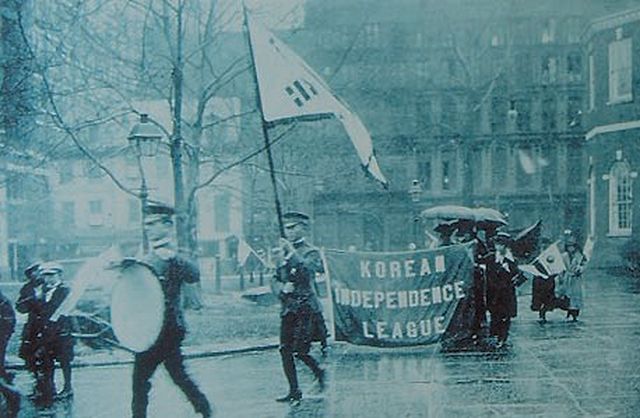
A report on fifty years of rapine by the Japanese ruling class of Korea’s land, resources, and labor.
‘Japan’s Colonial Policy in Korea’ by Asagiri from The Daily Worker. Vol. 6 No. 187. October 12, 1929.
By carefully studying the history of the penetration of Japanese imperialism in Korea, beginning with 1876, when Japan forced upon Korea the treaty, right up to the present day, we see one and the same line consistently carried out: the elimination of all factors, political or economic, which might hinder the growth of Japanese capital in Korea, as well as retaining at the same time in the old regime all which would hinder Korea’s development into an independent state.
Suppressing by armed force all movement the aim of which was a radical change from the old feudal regime and to clear the path for more progressive capitalistic relations, and supporting as a rule the more reactionary elements of the country, Japan on the other hand willingly carried out those reforms which helped to strengthen her position in the economics of the country–the reform of the currency, carried out by the Japanese banks; the organization of a banking apparatus completely subjugated to Japan; the introduction of private ownership of land, the construction of railways, ports, and so on. These measures, extolled by Japan as a greatest favor to Korea, which had so to say promoted her from a backward country to one of the most advanced, bringing the Koreans out off their state of barbarity to the state of “cultural people,” etc., were but a hindrance to the independent development of Korea and only helped the Japanese traders, the Japanese capitalists to get huge profits without much trouble, whilst the old feudal orders were in reality strengthened, such as feudal land-tenure, the old forms of exploiting the peasantry, the feudal gentry, etc. The thoughtful protection of the survivals of old forms of economy in Korea and the Japanese control over the banking and financial system of the country resulted in native commercial, and in particular industrial capital, developing at an extraordinary slow pace, leaving the field empty for the activities of their competitors from Japan.
Japan’s annexation of Korea (1910) only formally reinforced the existing state of affairs. After the annexation Japan took further measures to strengthen her position: besides putting up new barriers to the development of native capital (the law of 1911 which hindered the industrial activity of Korean capitalists), the unification of the small banks into one industrial bank was carried out, an Eastern Colonization Company was formed, which undertook the buying of land from the Korean peasantry with the assistance and the direct pressure from the state apparatus; attention was directed towards squeezing foreign capital out of the positions which it has already succeeded in gaining in Korea up to the annexation, and a law was issued limiting the industrial rights of foreigners in Korea.
At the present time all the commanding heights in the economics of Korea are in the hands of Japanese imperialism. In the mining industry, with the exception of a small share falling to foreign capital (13 per cent of the total output), and the small percentage of Korean capital (16 per cent), the basic capital belongs to Japan. Practically the entire output of the basic branches of national economy are exported to Japan. In 1926 of the total output of 118,000 tons of pig iron 104,000 tons were exported to Japan; out of the 422,500 tons of iron ore produced in 1927 about 169,000 tons were exported raw, the rest as pig iron; about half of the coal produced is exported. Practically the entire output of gold is exported. Thus Korea is deprived of the chief forms of natural riches and raw materials, which are practically completely swallowed up by Japan.
The manufacturing industry in Korea is very poorly developed and is primarily adapted to handling the first stages of semi-manufacture of agricultural raw materials. Big factories are literally counted in units. Practically half of the entire production of Korean industry is supplied by the food industry enterprises (rice cleaning, flour mills, distilleries, etc.). The textile industry is very weakly developed, and with the exception of three or four large mills (belonging to the Japanese) are concentrated in dwarf-like enterprises. The chief mass of the production (more than 70 per cent) belongs to the Japanese. Transport, the banks, and the entire currency system is likewise in Japanese hands. Japan does not limit herself to foreign trade, where she occupies all predominating posts in export (in 1910, 70 per cent of export belonged to Japan, in 1928, more than 90 per cent) she is squeezing native capital out of the home market, penetrating into the most far-distant corners of the colony with her products. These few data permit us to draw the conclusion that Korea has been transformed by Japan into a raw material basis and market for the products of her industry.
Even now Korea is a typical agricultural country. The basic mass of the production of her national economy comes from agriculture (70) per cent). The peasantry comprise 80 per cent of the total population of the country. As a result of the support to the feudal elements in the Korean villages and likewise as a consequence of the plundering activities of the Japanese financial organs (in particular the Eastern Colonization Company) a process of differentiation in the village and the peasantry’s loss of land is taking place in a very sharp form.
1914–1916
Landowners 46,754–103,654
Peasant-Holders 459,517–524,066
Half-Rentiers 1,065,705–892,624
Rentiers 911,261–1,185,674
Here we see clearly the tendency towards a constant contradiction of the middle groups at the expense of the extreme groups. On the other hand, the energetic activities in buying land carried out by individual Japanese and organizations such as the Eastern Colonization Co. have given large tracts of land into the hands of the Japanese. The activities of Japanese imperialism, however, in buying up land and supporting the landowning-feudal elements have far from resulted in the development of big landowning economy, which would have been a progressive form of carrying on agriculture as compared with the present form. All the lands which are in the hands of the big landowners and Japanese capitalist organizations are cultivated in parcel-plots, which are rented out. As a result, Korea at the present time is in a state when about 84 per cent of the landowners, peasants, own tiny plots of land; 64.5 per cent of all rice fields and 57.5 per cent of the dry-farming fields are cultivated by rentiers.
Even now the most binding forms of rent are in force in Korea (rent in kind, by working the rent off, and so on), which swallow up more than 50 per cent of the produce received from the cultivation of the land. The burden imposed on the peasantry is made still greater by the entire system of taxes and payments (irrigation, for agricultural improvements, etc.), which results in the extreme impoverization and the ruin of the peasants, bringing at the same time huge profits to the Japanese usurpers. Those extremely insignificant agricultural measures which Japan does carry out in Korea are directed mainly towards insuring the transfer of the great possible amount of agricultural produce to Japan. Thus, whilst the rice harvest from 1922 to 1927 increased from 15 million koku to 17.3 million koku (1 koku is about 5 bushels), the export of rice increased from 3 million koku to 6 million, that is, was doubled. The consumption of rice in the country decreased during these years from 11 million koku to 9.9 million koku. Despite the increased rice harvests, its consumption in Korea is thus gradually falling. Most of the peasants raising rice have not the possibility to consume it as food. In value the rice exports comprise more than 60 per cent of the total exports. The Korean peasants thus work for export, feeding on cheap Manchurian millet which is imported to a great amount in the colony (in 1912 millet was imported to the sum of 273,000 Yen, in 1918 to the sum of 15,500,000 Yen). The cotton raised in Korea is likewise practically wholly used for the needs of the Japanese textile mills.

In the economic sphere we thus see that Japan has ensured herself the monopolist exploitation of all the riches of the country, of the entire production of the economy of the country, by cultivating the most backward methods of carrying on this economy and by artificially suppressing all the signs of more progressive forms. This sufficiently clearly proves the incorrectness of the views held by those who consider that the activities of the Japanese imperialists in Korea had a progressive significance for the development of the country.
The picture is likewise none too cheering in the political and cultural sphere. The complete absence of the freedom of speech, press, meetings, the crying inequality of the Korean and Japanese in the courts, the inequality of the children of Koreans and Japanese in the schools, the lack of any elements of democracy in the administrative system (the so-called Council of Governor-Generalship which the Japanese make out to be the height of democratism, is nothing but empty fiction). All this is directed at suppressing and depersonalizing the Koreans, instilling in them feelings of reverent fear of all that is Japanese.
To support its policy the Japanese Government creates a firm support in the person of the dregs of the Japanese population emigrating from Japan. In 1926 in the police orders alone there were 19,000 such loyal servants of Japanese imperialism. Two divisions of gendarmerie were formed of these. Besides this the ranks of the so-called “reserve army” were augmented by them–a regiment of spies and firemen’s brigades, ready at the first word to strangle the smallest outbreak of national protest of the Korean population.
Besides putting into force suppressive measures, the Japanese government attempts to win the support of the Koreans by playing on race and chauvinist feelings. Widespread propaganda of the idea of the brotherhood of the yellow nations against the nations of other races is carried out for this purpose. This propaganda is gaining some success amongst the backward strata of the Korean population.
All this complicated system of measures of political and economic compulsion, however, is unable to break down the Korean nation’s hatred of the oppressors and their will for freedom. Parallelly with the intensification of Japanese oppression there grows also the spontaneous feeling of protest amongst the Koreans, which from time to time finds outlet in powerful national movements of protest against oppression (for instance, the March movement in 1919). Up till now the Japanese imperialists have found it comparatively easy to deal with these outbreaks, which were led by opportunistic elements, having no complete program of action, and therefore incapable of leadership. At the present time a new political force is rapidly forming and consolidating itself–the Korean proletariat. The recent Gensan strike proved that the proletariat of Korea is becoming a militant power. The proletariat will be the class which will unite and direct in the proper channel the general feeling of protest, and under its leadership, with the assistance of the proletariat of Japan and other countries, the Korean nation will achieve its liberation.
The Daily Worker began in 1924 and was published in New York City by the Communist Party US and its predecessor organizations. Among the most long-lasting and important left publications in US history, it had a circulation of 35,000 at its peak. The Daily Worker came from The Ohio Socialist, published by the Left Wing-dominated Socialist Party of Ohio in Cleveland from 1917 to November 1919, when it became became The Toiler, paper of the Communist Labor Party. In December 1921 the above-ground Workers Party of America merged the Toiler with the paper Workers Council to found The Worker, which became The Daily Worker beginning January 13, 1924.
PDF of full issue: https://www.marxists.org/history/usa/pubs/dailyworker/1929/1929-ny/v06-n187-NY-oct-12-1929-DW-LOC.pdf
 Revolution's Newsstand