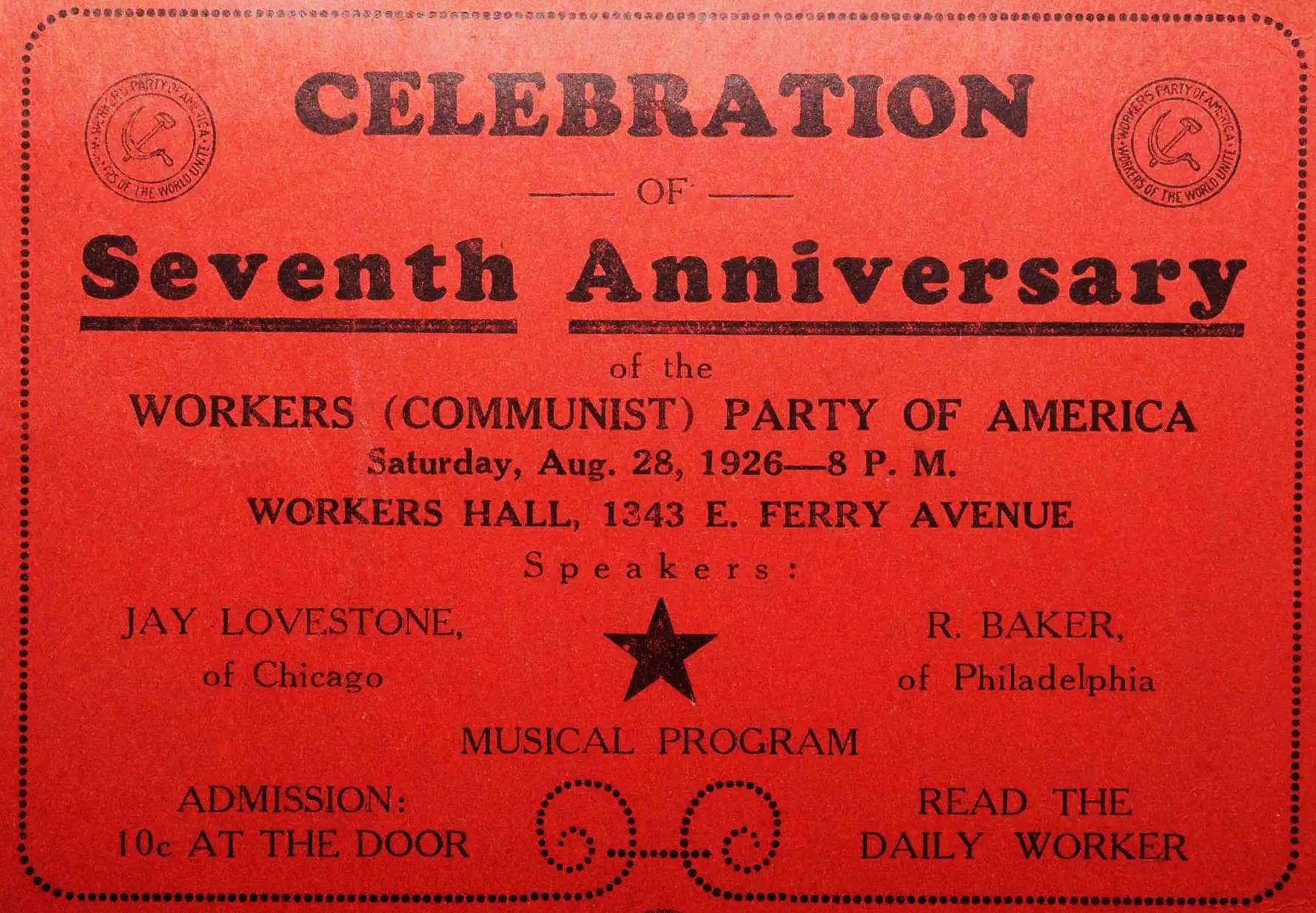
Continuing our look into the 1920s factional disputes within the U.S. Communist Party. In the previous year’s E.C.C.I. Plenum, the expanded leadership that met between Comintern Congresses, the Foster-Cannon wing were the majority and the Ruthenberg-Lovestone-Pepper wing in the minority. With the Comintern’s intervention, those positions were reversed at the C.P.’s 1925 Convention. And yet, the divisions remained unresolved, and a struggle again fought out at the following Plenum held in Moscow during April and May, 1926. The American Commission consisted of the Chair Robson, Secretary: Kuusinen with members from all Comintern sections present, also Zinoviev, Bukharin, Stalin, Manuilsky, Bela Kun, Clara Zetkin, Katayama. U.S. participants included John Pepper (as C.I. rep. to the U.S.), Earl Browder, William Z. Foster, James P. Cannon, C.E. Ruthenberg, Jay Lovestone, Robert Minor, and others. Below are the Commission’s report, U.S. Majority and Minority declarations, and finally the Resolution, unanimously passed, on the ‘American Question.’
‘The American Question at the Comintern’ from International Press Correspondence. Vol. 6 No. 31 & 40. May 13 & June 4, 1926.
Report of the American Commission by Comrade Ferguson (Great Britain):
Comrades, I think that the report of the American Commission will at least be distinguished for its brevity. I think that the discussion which will ensue will be a very marked contrast to the discussion which has just taken place on the German report and in presenting this resolution to the Plenum, I want only to make one or two points.
First, that it was agreed to unanimously, without exception, by the various factions in the American Party. We had no squabbles such as we have just witnessed in the German Commission refusing to give their assent and support to the Commission finds. I want simply to point out that the American Party has got a very significant role to play in the world politics even in some cases a decisive role so far as the struggle is concerned.
I also want to point out to the comrades that this trouble which has existed for some time in our Party in America is not simply due to any personal squabbles between individuals, but is mainly due to the very difficult conditions which our brother Party has got to work in. In America they have a very strong and powerful capitalist class which is taking active measures in order to strangle the labour movement in America and in addition you have a labour movement, a trade union movement in America dominated by the most reactionary trade union officials that the mind of anyone could conceive.
Taking these two facts into consideration, there is at least a very large explanation of the difficulties which have confronted our brother Party in America. This resolution which has been agreed to takes a very definite stand and assesses these facts at their true value. I simply want to indicate that there is one addition and one amendment which have also been agreed to unanimously and which ought to be incorporated in the resolution. The one amendment is to the existing paragraph 5 in the resolution and it reads:
“The Enlarged Plenum finds correct the basic line of the trade union resolution adopted unanimously by both tendencies at the last Convention of the Workers (Communist) Party. This resolution finds its further development in the present resolution of the Enlarged Executive Committee.”
This in place of the present paragraph 5 in the resolution. There is another addendum to be added which is: “The Party must extend its activities among the proletarian women for the purpose of drawing them into the trade unions and into the class struggle.”
I simply want to tell the Plenum that we believe that this resolution is going to lay the basis for the ending of the very deep-rooted fractional strife that has prevented our brother Party in America from pulling its full weight in the struggle. This resolution offers an opportunity to both the tendencies in the American Workers Party to work harmoniously, to co-operate with each other and by mutual cooperation and work to build a real mass Communist Party in America also want to say that the resolution takes a very definite and drastic stand against fractionalism and the recrudescence of fractionalism. It also offers or makes more explicit several of the tasks of our brother Party. Notably, the question of more intensive work among the farmers, a more insistent taking up of the problem of the Negroes, the greater stand for the independence of the South American countries, and in this connection, the American Workers Party has already to its credit several very notable achievements. No less a person than the president of the Mexican Republic has sent a telegram congratulating the Workers Party on the fight it has been making against American imperialist intervention in Mexico.
I want to point out that both the fractions in America are going back resolved that there shall be no more of this fractional struggle. Also, that the American comrades are going back to rally around the Executive Committee to carry out the tasks which have been laid down in the resolution and to build up in America a real mass Communist Party that shall bring the American working class under its banner and under the banner of the Communist International.
Declaration of Representative of the Minority of the C.C. (Foster-Group):
Comrades, before casting my vote for the adoption of the resolution, and in order to help to facilitate the liquidation of the mistakes in our Party I think it is necessary to make the following statement:
“The resolution submitted by the American Commission is of such a nature as to make it possible for us to accept it and to concentrate all our efforts on the carrying out of the decisions contained in it. We fully agree with the basic line and ideas of the Resolution.
The Resolution specifically endorses and develops the main line of policy and Trade Union work adopted by the IV. Convention of the Workers (Communist) Party. The Resolution of the IV. Convention of our Party provides for a correct policy for widening the basis of the T.U.E.L. (Trade Union Educational League) and for building it into a mass Left-Wing movement. It also provides a correct policy towards the centre, or so-called Progressive Group in the trade unions and outlines the united front tactics that the T.U.E.L. must apply towards the centre group. It stresses the vital importance of trade union work, and provides, the means for bringing every Party member into the trade unions and the Party as a whole more actively into trade union work. By endorsing the basic line of the trade union resolution of the IV. Convention of our Party, the resolution on the American question submitted by the Commission rejects the proposed revision of this correct line and strengthens the understanding and determination of the Party to proceed along the right road in the trade union work.
Secondly, the resolution on the American question expresses confidence in our loyalty. This expression of confidence, we hope, will put an end to the factional charge of “disloyalty” on the basis of which a broad campaign has been conducted in the Party against us. The resolution on the American question will go a long way towards repairing the serious damage inflicted upon our Party by this campaign against us.
Thirdly, the resolution before the Plenum corrects a number of serious mistakes in trade union work made by the Party since the last Party Convention, such as the mistake in the Anthracite strike, tendencies to underestimate the struggle for power in the unions, and dual unionist tendencies. The resolution will serve undoubtedly to guard our Party from a repetition of such mistakes..
Fourthly, the emphasis that the resolution places on the importance of revising the general programme of the T.U.E.L. and bringing it into accord with the demands of the united front policy, the insistance upon widening the base of the T.U.E.L., bringing into its organizations and committees the largest possible number of non-Party workers, and the general instruction to concentrate the energies of the Party upon building up a mass Left Wing in the American trade unions, all of these are in full conformity with our views. This is the position we are taking consistently in the Party. We are fully determined to do all in our power to carry these policies into effect.
Fifthly, we agree with the proposal contained in the resolution which provides for a certain division of work, giving to our group the leadership in the trade union work of our Party. We view this proposal in the light of the special situation which prevails at present in our Party. We understand this as in no sense establishing artificial divisions among the Party members excluding one group from participation in the trade union work, and the other group from the general Party activity.
Sixthly, we fully agree with all the other specific tasks laid down for our Party in the resolution, such as the organisation of the unorganised workers, more concentration upon the heavy industries without neglecting the light industries, the struggle against the company unions, intensive work among the negroes, full assistance to the building up of the Youth Movement, utilisation of the agrarian crisis for more effective work among the farmers, intensification of the work among the women, systematic attention to the struggle against imperialism and the establishment of organic connection with the labour and liberation movements of the colonies.
Finally, we fully agree with the categoric demands of the resolution that all factionalism, from which ever side it may come, shall cease immediately. We believe that the sincere and conscientious efforts by the Central Executive Committee to put this resolution into effect will enable the Party to concentrate its energies for the successful carrying out of the important tasks before it. Upon the basis provided by the resolutions of the Plenum we declare and support the Central Executive Committee.
Declaration of Representative of Majority of C.C. (Ruthenberg-Group):
Comrades, I think it is necessary to briefly outline the issues which were before the American Commission, how these issues arose, and the settlement which has been made in this resolution.
At our last Party Convention a new leadership came into control of the Party. Comrade Foster was in opposition to this leadership and was permitted to come before the Comintern to appeal against the leadership and the Central Committee. Comrade Foster came to Moscow proposing that the Central Committee of our Party be revised and that a new Central Committee giving him a majority of 13 against 8 be established. This demand of Comrade Foster has, of course, been rejected in the present resolution.
The comrades here have heard a great deal about the factionalism in the American Party, but I must establish now that this factionalism has not been a fight between individuals, but a struggle in regard to political questions in which the future of our Party is concerned. In the last Plenum here, we had the question of the Labour Party. In this Plenum we have had the question of the development of our Trade Union movement in the United States as the principal issue. Both these questions have been decided by the Enlarged Executive Committee, in a way that will make possible greater results from the work of our Party. We believe also that so far as the inner Party situation have strengthened our Party, clarified it, and made is possible in the future to pursue clear political lines for the upbuilding of the influence of the Party. In the present resolution we have established first that no change shall be made in the Central Committee, and secondly, the Communist International through the Enlarged Executive Committee, calls upon the entire Party to give its entire support to the present Central Committee.
Comrades, we from the very beginning, in taking over the leadership of the Party, considered as our chief task the unification of the Party. We knew that after 20 months of bitter fractional struggle our Party could not stand further fighting if it was to grow and strengthen itself. And the Central Committee pursued the policy of breaking down the factional struggle, of endeavouring to unify the whole membership behind the Central Committee and, as is established in the present resolution, it did make achievements in accomplishing this end.
Turning to the question of trade union work, I must take issue with the statement read by Comrade Foster in relation to the resolution of our Convention. The present resolution which you are asked to adopt endorses the basic line of the Convention resolution with the further development which had been made in the resolution of the American Commission. And, comrades, these further developments are of the most vital importance in our trade union work. What was the situation so far as our efforts of building a Left wing in the United States was concerned? We had an organisation for that purpose, the T.U.E.L., which in effect was a duplication of our Party organization is consisted of the Party members and the nearest sympathisers. Its programme was the programme of the “Dictatorship of the Proletariat” and support of the Communist Party in the United States. The Central Committee when it considered this problem, said that we could not build a Left Wing in the trade union movement on this programme. And if there have been differences in our Party, these have arisen on the trade union question because the Central Committee knew that it could not succeed with a programme, with the character of the T.U.E.L., with constitution of its committees and that it was necessary to make a change in these respects.
The resolution in the American Commission sets forth these changes. It establishes the fact that many errors were made in the programme of the T.U.E.L., it declares it necessary to fundamentally revise the programme, it declares it necessary to draw new elements into the leadership of the left wing movement, and it states in regard to the name of the T.U.E.L. that this question is one in which it is not necessary to make a change immediately. We believe comrades, that these declarations of this resolution fully endorse the struggle which the Central Committee made for a revision of our past activities in this respect, and that this resolution, as it now stands, will lay the basis for the development of a Left Wing in the American trade unions; and since this development has been made of our Convention resolution, we can accept and endorse the resolution.
On the question of factionalism within our Party, the resolution demands of Comrade Foster and his supporters that they desist from further factional struggle and that they must support the Central Committee of the Party in its work. On the basis of the acceptance and carrying out of this demand by Comrade Foster and his followers it will be possible to liquidate the remains of factionalism in our Party, and for the Central Committee. I pledge here that we will do our utmost to achieve
this end, that we will be ready even to make concessions to Comrade Foster, because, with the support of the Comintern as established in this resolution we can make such concessions in order to eliminate what remains of the factional struggle.
In this Plenum there has been more discussion of the role of the United States than in any past Congress or Plenum in the Comintern. We realise the importance of the role that the United States is playing today in the capitalist world. We realise, as emphasised in this resolution, the importance of the fight which our Party must make against the mighty American imperialism. We realise that for this purpose we must have a united Party, that can carry out the lines of the Comintern, that this Party cannot be a guild Party which centres its attention upon one phase of the struggle, but as set forth in this resolution, it must take up every phase, must mobilise the exploited workers, the agrarian and Negro workers, to back up the struggle against American imperialism in the South and Central American countries, and we pledge ourselves here that we will do our utmost to carry out this decision, that we will endeavour to begin to build a strong Party that can grow into the leader of the American proletariat and in the future challenge the mighty imperialism and all together with the Communist Parties of the capitalist countries and the Comintern, deal the final blow to this imperialism.
The resolution of the American Commission was passed unanimously.
Resolution on the American Question.
1. The Enlarged Plenum of the Executive Committee of the Comintern attaches specially great importance to the question of the creation of a real proletarian mass party in America. The hegemony of the imperialists of the United States of North America over the capitalist world renders the work of the American Communists an important and specially responsible one. The Communist Party of America is called upon to play a tremendous role, and in many respects even a decisive role. Even for that reason alone all the Sections of the Comintern, and the Comintern as a whole, will attentively follow the activity of the American Section and support it in every possible way.
2. At the same time, the Enlarged Plenum of the Executive Committee of the Comintern realises clearly the tremendous objective difficulties which the American Party must overcome during the next period of its development.
It is in America where reformism has developed its most hateful characteristics. The corruption of the upper strata of the working class by the bourgeoisie assumed particularly strong forms here because the American bourgeoisie has squeezed out heretofore unheard of extra profits: it had thus the opportunity of corrupting the labour aristocracy and availed itself of this opportunity on a broad scale.
In spite of this the American Communists, with correct tactics and with the support of the whole Comintern, will doubtlessly succeed in mastering all difficulties. It will succeed to rally broad masses of workers around its banner because the interests of these masses can never be identical with those of the demoralised and corruptible upper strata of the Labour aristocracy in the American Federation of Labour.
3. The first condition which puts the American Communist Party in a position to fulfil its historic mission, is the complete and absolute abandonment of the factional fight within the Party. The Enlarged Plenum of the Executive has reason to expect that the majority of the Central Committee will not misuse the apparatus and simply steam roller the Minority. Since there is no basis for doubting the loyalty of the latter toward the Comintern. The Communist International is firmly convinced that after the hard and tormenting fractional fight which the American Communist Party has gone through, a renewal of the fight might ruin the Communist movement in America for a long time to come.
4. The Enlarged Plenum of the Executive Committee of the Comintern approves the policy laid down in the resolution of the Executive Committee of the Comintern in the Spring of 1925. The Enlarged Plenum of the E.C.C.I. believes that any revision of this policy, in no case, has become necessary. The Enlarged Plenum of the E.C.C.I. is of the opinion that there can be no question of a new change in the composition of the present Central Committee of the American Communist Party; the Party itself determines the composition of the C.C. at its Party Congress. The task of the Party consists in carrying out the established line in friendly cooperation, and in putting an end once and for all to the factional fight.
The Enlarged Executive Committee calls upon all members of the Party to support the Central Committee which in the short time of its existence has already succeeded in achieving substantial success in the unification of the Party. The C.E.C. has centralised, through energetic reorganisation, the Party which up to recently was divided into 18 language sections. The Party press also shows decided ideological improvements. In bringing new life into the Labour Party campaign and building the movement for the protection of foreign born workers, the Central Committee has correctly applied the united front tactics. The Central Committee has continued the campaign for bringing the Party members into the trade unions.
The Enlarged Executive Committee expects that the Central Committee and the whole Party membership will unitedly and sincerely carry out the decisions of the Enlarged Executive on the American question.
5. The Enlarged Executive finds correct the basic line of the Trade Union Resolution adopted unanimously by both tendencies at the last convention of the Workers Party. This resolution finds its further development in the present resolution of the Enlarged Executive.
The Plenum is of the opinion that resumption in any manner, of the fractional struggle on the question of the Party’s tactic on the field of the trade union movement would be greatly harmful.
6. The Enlarged Executive has the opinion that more attention must be paid to the trade union work than hitherto and that the C.C. of the American Communist Party should divide the work within its ranks in the following way: Comrade Foster and those of his followers who have close contact with the trade union movement, are to be primarily entrusted with the trade union work. Of course, none of the remaining Party members will be excluded from this work. For this purpose Comrade Foster and his followers must have the majority in the Trade Union Commission of the C.C., which will have the task of organising and guiding directly the trade union work of the Party members. It is necessary that the Trade Union Commission of the C.C. is given full freedom to exercise this function. It is, of course, self-understood that this work must be carried on in full contact and under the control of the Central Committee and the Political Bureau of the Party. The Enlarged Executive expects that the Political Bureau will not exercise that petty control. The C.I. in the resolution of the Org Conference on the organisation of a trade union Commission has warned all the Sections against such petty control. The Enlarged Executive expects at the same time that no decision or no measure will be taken by the Trade Union Commission which will lead to a disorganisation, crossing, or confusing of the political and inner Party line of the Party.
The Executive Committee of the Comintern believes that the majority of the Central Committee must really give Comrade Foster and his closest comrades the opportunity of using their forces in this field. The attempt to fight Comrade Foster and those of his comrades, who on their part will desist from the fractional struggle, is in no case permissible.
Such a division of work within the leading circles of the American comrades is of specially great significance at this time; it must be put into effect in the near future, and must be conscientiously adhered to by all the comrades.
7. The Enlarged Plenum of the E.C.C.I. deems it necessary to extend the composition of the present Polit-Bureau of the American Party, so that one more comrade from the Minority will be added.
8. The Enlarged Plenum of the E.C.C.I. is of the opinion that the Party must devote more attention than heretofore to such decisive sections of the workers as the miners, the railroad workers, the metal workers, etc. Without neglecting the trade union work among the textile workers, garment workers, fur workers, etc. which has been carried on so far, the work among the great masses of workers in heavy industry must be taken up with the greatest energy, and gradually intensified. Not for one moment should one lose sight of the fact that in a country like America, the decisive section is the proletariat of heavy industry, and not the workers of light industry.
9. In the trade union tactic the Party must not content itself with work of ideological enlightenment, but has the task of applying the tactic of the united front everywhere. To gain mass influence, it is necessary, as a rule, to carry on patiently preparatory detailed work, and to conduct a tenacious fight for simple, concrete, every day demands of the workers in question, above all through local united front committees. Unprepared approach to the masses directly in the name of the Communist Party (which was done recently in the anthracite miners strike) does not lead to the desired results and must therefore be avoided. As soon as opportunities present themselves for gaining a leading position in a trade union by the application of the tactic of the united front, such opportunities must always be taken advantage of in a skilful manner. One of the most important tasks of the Communist Party is the struggle for power in the trade unions, which, of course, must be carried on in conformity with the principles and tactics of the Comintern and which must not be permitted to degenerate into an unprincipled chase after office.
In the formation and work of the Communist trade union fractions, the greatest care must be taken that the Communists never isolate themselves from the rest of the workers. Secessional movements and the formation of parallel trade unions should not be instigated or encouraged in any form.
10. As far as the Trade Union Educational League is concerned, the Enlarged Plenum of the E.C.C.I. is of the opinion that its general programme must be radically revised. An organisation which is called upon to embrace not only Communist workers, but also sympathising and non-Party workers, cannot and should not officially have a purely Communist programme. This organisation must conduct its work in such a way that it will really get the opportunity of carrying out the tactic of the United Front, that is, it must put forward a number of immediate demands which will unite the Communist vanguard with the broad non-Party masses instead of repelling them.
11. It would be wrong to place the blame for the fact that the Party and the Trade Union Educational League made a number of mistakes in their programme and in their work on this or that individual, the mistakes, however, must be rectified at whatever cost.
The Enlarged Plenum of the E.C.C.I. does not deem it necessary to change the name of the Trade Union Educational League immediately, but the character of the activity of the League and its programme must be brought into accord with the tasks of the tactic of the united front. The leading staff of the Trade Union Educational League must be changed in such a way that a much larger number of non-Party and sympathising leaders of the Trade Union movement are drawn into it. Comrade Foster must remain at the head of the Trade Union Educational League.
12. The Enlarged Plenum of the E.C.C.I. relies on all the members of the American Party to carry out the adopted resolution conscientiously. The Enlarged Plenum of the E.C.C.I. declares that the complete and unconditional abandonment of the factional struggle is a demand of the Comintern and that everyone who violates this demand, must reckon on the most serious consequences for himself.
Discussions are in the interests of the Party, when they serve to achieve ideological clarity, the deepening and strengthening of the Party and do not bring about the disorientation or disintegration of the Party.
13. One of the most important tasks of the Communist Party is to bring into the unions the hitherto unorganised millions of workers. This is a fundamental step towards the revolutionising of the American labour movement. The organising programme must be to build up the existing unions and to support the establishment of new unions in industries where no unions exist. An important phase of the campaign to organise the unorganised is the elimination of the company unions. This must be achieved under the slogan “Destroy the company unions and build trade unions”. Where the company unions have a mass character our comrades must penetrate these organisations, raise the demands of the workers, and utilise the resultant movement as a starting point for the formation of real trade unions.
14. Further the Party must devote more attention than heretofore to the work among the Negroes. This work will attain greater political significance from day to day.
15. The Enlarged Plenum of the E.C.C.I. holds the view that the agrarian crisis, becoming again more acute, must induce the Party to devote the greatest attention to the farmer problem.
16. The Party must carry on an energetic campaign among the proletarian women so as to attract them to the trade unions and the class struggle.
17. Greater attention must be paid to the building of a mass Young Communist League and Pioneer movement. In the future the Communist Youth will serve as a reservoir of trained Party members. The slogan “A League organisation wherever a Party organisation exists”, issued by the C.E.C. is correct and steps should now be taken to carry this into effect. Careful supervision and mutual agreement is necessary in transferring League members into Party work, especially at the present time when the League is still very weak.
18. The Enlarged Plenum of the E.C.C.I. points out to the American Communist Party the tremendous importance which the Labour movement (and the movement for independence) is assuming in the countries of South America, There is no doubt that in the ensuing struggle for the overthrow of the imperialist yoke of the bourgeoisie of the United States, the working class and the peasantry of Latin America will play a tremendous role. The American Communist Party must not be a Party of self-centered interests, but must become a Party which understands how to raise the question of the hegemony of the proletariat in the whole movement for freedom, which is directed against the imperialists of the United States. Moreover, it is necessary that the Workers Party maintain the closest contact with the labour movement in the Colonies of Cuba, the Philippines, etc., and support them in their fight against American imperialism.
In view of this the Executive Committee of the Comintern instruct the Central Committee of the American Communist Party to devote the most serious attention to the tasks indicated and above all to appoint an earnest group of Party workers to participate in the current work in Latin America in agreement with the Presidium of the Executive Committee of the Comintern.
International Press Correspondence, widely known as”Inprecorr” was published by the Executive Committee of the Communist International (ECCI) regularly in German and English, occasionally in many other languages, beginning in 1921 and lasting in English until 1938. Inprecorr’s role was to supply translated articles to the English-speaking press of the International from the Comintern’s different sections, as well as news and statements from the ECCI. Many ‘Daily Worker’ and ‘Communist’ articles originated in Inprecorr, and it also published articles by American comrades for use in other countries. It was published at least weekly, and often thrice weekly.
PDF of full issue: https://www.marxists.org/history/international/comintern/inprecor/1926/v06n31-apr-22-1926-inprecor.pdf
PDF of issue 2: https://www.marxists.org/history/international/comintern/inprecor/1926/v06n40-may-13-1926-inprecor.pdf
 Revolution's Newsstand