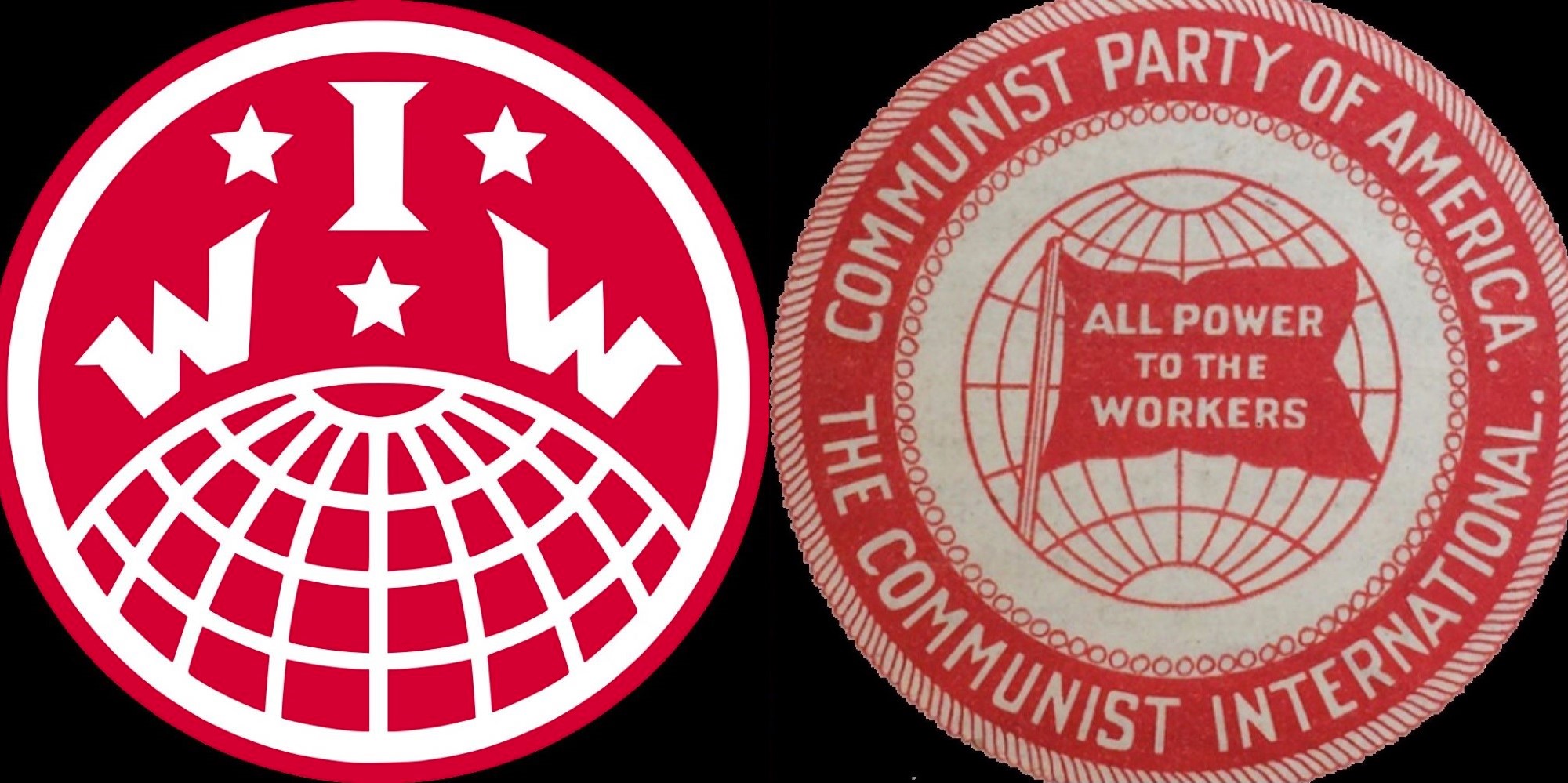
A great deal of the early Communist movement consisted of a negotiation between revolutionary syndicalists (for lack of a better term) and revolutionaries emerging from the old Socialist Parties. The large majority of the I.W.W. members who joined the Communist movement in 1919 were partisans of the Communist Labor Party. Here, their rival in the (old) Communist Party of America, with a primary orientation towards the A.F.L., answers questions about the the relationship between them and the I.W.W.
‘The Communist Party and I.W.W.’ from the Communist (old C.P.A.). Vol. 1 No. 12. December 20, 1919.
MANY inquiries have been received by the editor about the relation between the Communist Party and I.W.W. The questions submitted may be summarized as follows:
1) “What is the difference between the Communist Party and the I.W.W.?”
2) “Is the I.W.W. the ideal organization on the economic field, or should the Communist Party strive to create another economic industrial union?”
3) “Is the Communist Party in favor of sabotage?”
4) “Is the Communist Party in favor of direct action?”
5) “How do you define direct action?”
6) “What is the relation between the I.W.W. and anarchism?”
7) “Is mass action a direct action?”
Question No. 1.
The accurate scientific way to answer this question is to consider what historical circumstances account for the existence of each of these organizations and what life purposes they have to fulfil. Some phrases or sentences appearing in the literature of either organization cannot answer the question.
The I.W.W. is a labor union. It is a special kind of labor union. It came into existence in 1905 in opposition to the dominant trade unionism represented by the A.F. of L. It sought an industrial and class basis for unionism, as opposed to the narrow craft basis. It accepted the class struggle as its guiding principle of action, not the capitalist contract system which was fundamental in the action of the A.F. of L.–the trade unionists regarding their craftsmanship as a species of capitalistic property. Above all, the I.Ŵ.W. meant the bringing into the unions of the unskilled, of groups of workers heretofore ignored in the domain of union organization. It is this latter item which has made the I.W.W. so unique in character and of revolutionary spirit.
Industrial unionism, simply as a distinct form of unionism, using the United Mine Workers as an example, is not necessarily either revolutionary nor in opposition to the A.F. of L. It is a challenge to craft unionism as to greater effectiveness, and certainly there is no question about the effectiveness of an industrial strike such as we have just witnessed on the part of the United Mine Workers.
The I.W.W. is of revolutionary significance because it identifies industrial unionism with the class struggle. This is not settled by quoting the world-famous preamble of the I.W.W., but by recognizing that the unionism of the unskilled and semi-skilled necessarily brings to the front the class issue. We have seen how the unionism the class issue to the front, when they strike as of the steel workers and miners inevitably brings an industrial mass, instead of as craft groups. At the present stage of economic concentration, any stirring of the underlying mass of workers is bound to take on momentum toward the proletarian revolution. There is no possible basis for compromise between capitalism and the mass of unskilled labor. Capitalism depends upon having at its absolute mercy a large body of unskilled, unorganized laborers. It will accept the unionism of one-tenth of the workers, welding this group into an anti-revolutionary “labor aristocracy” and using this group against the general mass of the unorganized workers. But when A.F. of L. is itself invaded by the unskilled and semi-skilled, as in the basic steel industry, then Judge Gary takes a stand even against collective bargaining, i.e., against making contracts with his workers enforceable by a strike of the whole steel industry. From this viewpoint it is apparent why the coal strike was of such fundamental importance to the capitalist system that the government intervened to break the strike, and to take care that whatever gains came to the miners would appear to be voluntary grants, by aid of the government, rather than concessions directly won on the strike field, thereby impressing upon the miners their class power.
Unionism is bound to adapt itself to the conditions of struggle under highly concentrated capitalism. It was the I.W.W. which first gave conscious expression to this new form and temper of unionism in the United States. Not strictly first, because the I.W.W. itself was an amalgamation of several existing organizations which had already anticipated its principles; but the first to make a general propaganda of revolutionary industrial unionism and to lay down a basis for the entire re-organization of the labor union movement along new lines.
On the other hand, the Communist Party is the immediate organized expression in the United States of the propaganda of the proletarian revolution going back to the Communist Manifesto of 1848. The Communist Party represents no interests of labor except the totality of interests embraced in the proletarian revolution itself.
All of unionism is of interest to the Communist Party as it develops the forces which lead to the proletarian overthrow of capitalism and to the establishment of Communist industrialism.
It is from this viewpoint that we value industrial unionism as against craft unionism, though it is undoubtedly true that craft unionism has had its advantages for particular groups of workers, advantages now decidedly on the decline because of capitalist concentration. But the objective of Communism is the proletarian revolution, and its concern with all immediate actions of the working class, in the economic as in the political field, is their tendency and potency with regard to the ultimate revolutionary aspects of the class struggle.
The Communist Party is an organization for revolutionary propaganda. Its immediate business and its ultimate business are one and the same thing–always the propaganda of the proletarian revolution and of the Communist reconstruction. The special mission of the Communist Party is to analyze the class struggle as it develops from day to day, and to put this analysis at the service of the working class for whatever guidance it may give in the immediate struggles. The Communist Party, by its work of education and agitation, trains and inspires for revolutionary leadership and for critical understanding on the part of a considerable group of workers, so that the immediate actions are, perhaps imperceptibly, made to acquire a conscious revolutionary Communist character. What the Communist Party organizes, within itself, is proletarian revolutionary consciousness and understanding. Outside itself, the Communist Party aims to give emphasis to those tendencies in the labor movement which appear to lead most directly and surely to the proletarian conquest of the political power, this being the necessary first achievement for the Communist social reconstruction.
There could be no possible confusion between any kind of a labor union and an organization purely for revolutionary propaganda, except that the I.W.W., by reason of many circumstances which cannot here be reviewed, has been hitherto thwarted in becoming an actual union except in a very limited way in certain particular fields; especially among timbermen, longshoremen, metal miners, and other groups of semi-skilled heavy laborers. The I.W.W. has itself become primarily a propaganda organization, and has undoubtedly had a profound influence upon the labor movement in this country and elsewhere through its propaganda and through the character of its fighting in the important strikes in which it has played a part. Indeed, the I.W.W. propaganda has gone outside the union field, in a sense, into the political field, by its “free speech” fights in the West and by its class challenge as made through the courts.
The propaganda of the I.W.W., outside the advocacy of industrial unionism itself, has been of variegated pattern, and the only reason for any friction between the I.W.W. and the Communist Party is the fact that some of the I.W.W. propaganda has been anti-Communist.
There is nothing about the I.W.W. which should make its general propaganda anything other than the program of the Communist Party; but even with absolute agreement on propaganda principles the two organizations would go on side by side. The I.W.W. is still a union, in form of organization and in practical purposes. Its propaganda, after all, is meant to attract workers to the Ï.W.W. as a union. Indeed there are men in the I.W.W. who do not take the propaganda any more seriously than for its advertising value in getting members into the union. But most of the members of the I.W.W. are imbued with the struggle for working class domination of the social spirit of the class struggle as a revolutionary system. We might say that these members are Communists who are in a favorable position for carrying on revolutionary propaganda within the union field, and this is of the highest value.
But there is always the need for an organization which concentrates entirely on the revolutionary propaganda, untrammeled by any purposes of immediate gains, economic or legislative. Such an organization alone can maintain the perspective of the labor movement in its entirety. Such an organization alone is safe from being diverted to its own immediate organization advantages, which is not the case with unions, co-operatives, or political organizations built on participation in capitalist democracy for the winning of legislative reforms.
Question No. 2.
It is not the work of the Communist Party to build a new industrial union. Our work is to promote the revolutionary tendencies throughout the labor movement. Our fundamental understanding is that the forces of life, the pressure of imperialistic capitalism, compels the workers to accept new tactics. In a primitive stage of the class struggle one might talk about creating a new kind of union as an example; but in the present advanced stage this would be about the same as the proposition of trying out Communism on a South Sea Island. We must deal with the actual complications of the industrial world and of the labor movement as it lives and struggles today. We cannot declare by fiat that it shall all begin over again–on correct logical principles. It must go on and on, and it is our task to bring to the front the tendencies in the actual living struggle which appear to us most directly in line with the goal of the social revolution.
The minute the Communist Party begins to build a union of its own it ceases to be a Communist Party, but becomes a union; that is, its chief business becomes the demonstration of actual better union results with its own specially created union.
As to picking out the I.W W. as “the ideal organization on the economic field,” that is of the same logic. No matter how highly the Communist Party may value the I.W.W. and its work, no matter how closely we may come to co-operate in this work, it would still be a fatal error for the Communist Party to prefer the I.W.W., as an actual union, to other unions which exist or which may come into existence in the same field.
Certainly there is no objection to every member of the Communist Party joining the I.W.W. But that does not mean that Communists should not also belong to other unions. Indeed many members of the I.W.W., either from necessity or by choice, are also members of other unions. So of the Communists. The question of joining a union is to be answered individually according to locality and possibilities of choice. Nor is it a question of “ideal organizations,” but a question of the highest individual effectiveness in promoting the Communist propaganda. It might be argued that anything which promotes the I.W.W. as an organization is of itself effective aid toward the social revolution, but this argument would have to be limited by time and circumstance. The Communist Party cannot create within itself an “organization loyalty” as against the labor movement in its totality. It must be ready at every moment to adapt itself to changing circumstances and to work with all organizations, whether “ideally” started or not, which at a given crisis take up the revolutionary challenge of the class struggle. It must strive, above all, to attain a central unity of revolutionary proletarian action surmounting all the organization boundaries which exist in advance of the revolutionary crisis. The program of the Communist International points to the council, arising out of the revolutionary struggle itself, as the centralizing organization unit.
The loyalty of a Communist cannot be to any form of organization but always to the social revolution. Membership in a union, as a Communist, must constantly meet the test of the development of the class struggle. There is no question but that a strong case can be made for Communist membership in the I.W.W. at the present time, and the case would be far stronger if the I.W.W. made its general propaganda that of Communism.
Question No. 3.
Sabotage is a very loose term, but without entering into any extensive definitions and analysis it is enough to say that the Communist Party believes in the highest practical adaption of tactics to the conditions of struggle. Comrade Katayama favored us quite recently with a description of the use of sabotage by the Japanese workers under conditions where the strike itself illegal, and where there is no chance for union organization with strike funds. But we would not consider that sabotage, in the broadest understanding of the term as representing a general mass action, would ever present a question of what is “legitimate” and what is not “legitimate”. The question is entirely one of the most effective generalship under a given set of circumstances.
The working class cannot, in the final analysis, choose its methods of combating the capitalist oppression. The Communists refuse, therefore, to lay down any “principles” by which any forms of action shall be held taboo. under any and all circumstances. It is to the ruling class to get up off the worker’s back if they want universal amiability.
The Socialist Party clause against sabotage, adopted by referendum in 1912, was a disgrace to the labor movement in the United States, in that it accepted the capitalist moral valuation of a form of working class action. The Communists have no such moral valuations. The question is one of effectiveness under actual circumstances; of what is actually proposed to be done and of its apparent suitability to get results.
Question No. 4.
Yes.
Question No. 5.
By direct action we understand the opposite to representative, indirect legislative action. The term direct action arose as a demand for union action for political aims, contrary to dependence on parliamentarism.
Question No. 6.
The I.W.W. has suffered from a degree of infusion of anarchist doctrines in its general propaganda. This is the derivation of the anti-political or non-political theorizing of some of the I.W.W. writers. The demand for immediate, direct abolition of the State, in favor of independent, autonomous local associations of workers, industry by industry, is the modern theme of anarchism. Communism demands the Dictatorship of the Proletariat–the special State of the proletariat as the central and all-important means for the social reconstruction. The abolition of the State as an organ of class oppression is considered the inevitable result of the Communist suppression of bourgeois exploitation.
Question No. 7.
Mass action has the same derivation as direct action, only the term mass action is broader, being all-inclusive of working class action, whereas the term direct action is particularly a descriptive of union action.
Emulating the Bolsheviks who changed the name of their party in 1918 to the Communist Party, there were up to a dozen papers in the US named ‘The Communist’ in the splintered landscape of the US Left as it responded to World War One and the Russian Revolution. This ‘The Communist’ began in September 1919 combining Louis Fraina’s New York-based ‘Revolutionary Age’ with the Detroit-Chicago based ‘The Communist’ edited by future Proletarian Party leader Dennis Batt. The new ‘The Communist’ became the official organ of the first Communist Party of America with Louis Fraina placed as editor. The publication was forced underground in the post-War reaction and its editorial offices moved from Chicago to New York City. In May, 1920 CE Ruthenberg became editor before splitting briefly to edit his own ‘The Communist’. This ‘The Communist’ ended in the spring of 1921 at the time of the formation of a new unified CPA and a new ‘The Communist’, again with Ruthenberg as editor.
PDF of full issue: https://www.marxists.org/history/usa/pubs/thecommunist/thecommunist3/v1n12-dec-20-1919.pdf
 Revolution's Newsstand