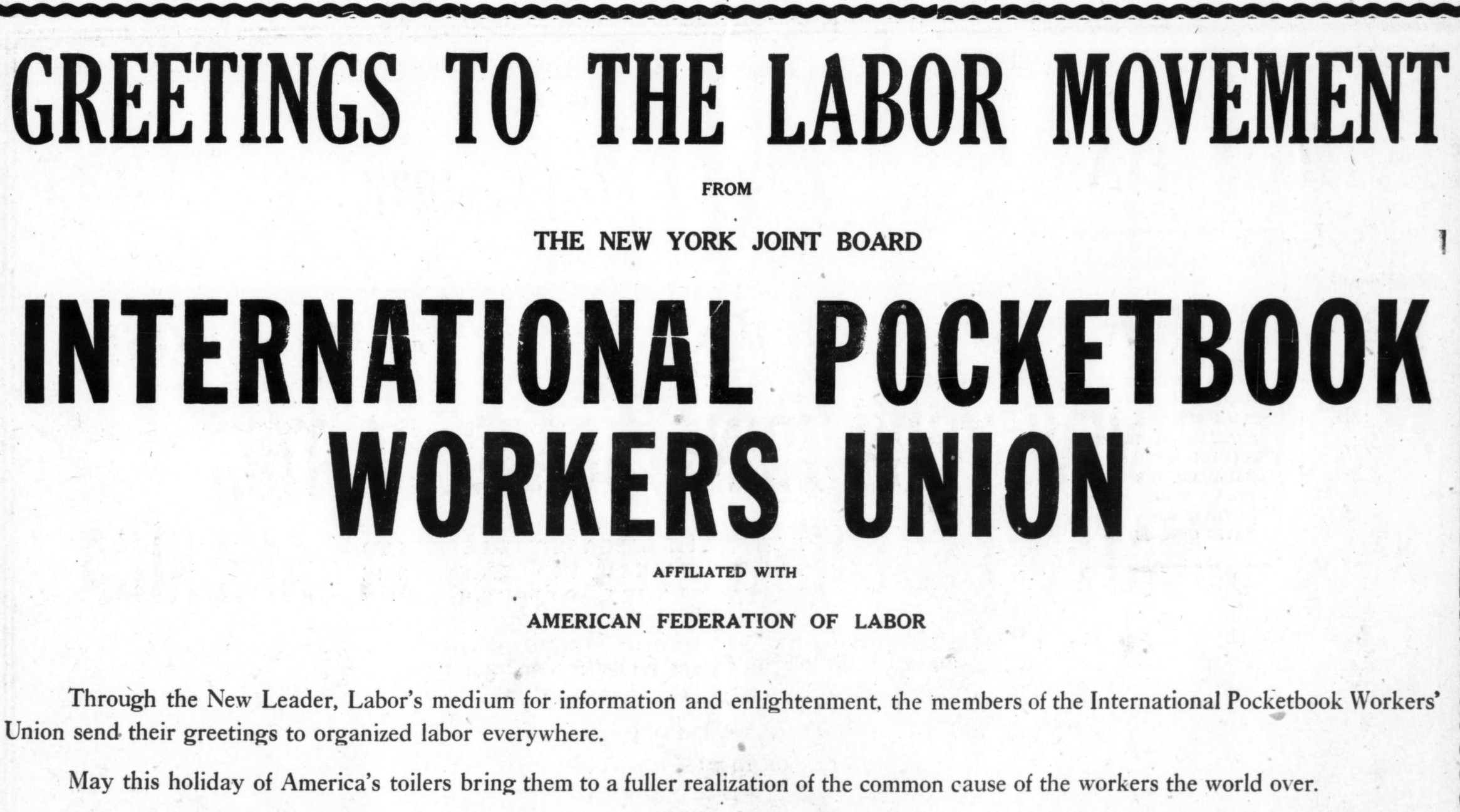
Recently elected President of the then 6000-member International Pocketbook Workers Union, Isador Laberman writes on how militant, relatively small unions can navigate their particular difficulties.
‘Practical Dilemmas Facing a Militant Union’ by Isador Laderman from Labor Age. Vol. 20 No. 1. January, 1931.
PRACTICAL problems facing militant unions are quite numerous, but here I want to outline a few of the more important ones concerning the International Pocketbook Workers Union.
1. Unified Control and Craft Interests.
The first problem that I want to touch upon is one having to do with the structure of our union. Our trade consists of five important crafts, namely, cutters, operators, pocketbook makers, helpers and framers. All of these crafts are employed in the same factories. The problem before the union therefore is how to have the organization function in a way that all the crafts should be under one unified control while at the same time each craft should have some way of considering its own special interests. Our union has answered it in the following way:
The workers of all the crafts belong to one local union under one management and have one treasury. The general officers of our union are elected by all the members of the various crafts without regard to the craft they come from. The highest body of our union is the Joint Council which consists of an equal number of representatives from each craft.
This Joint Council, together with the general officers, conduct all the business of the union including negotiations with employers. At the same time the five crafts are organized into separate sections, each having a section committee whose function is, however, very, very limited. The sections cannot make any final decisions but whatever question they may take up then goes as a recommendation to the Joint Council and to the general membership and grievance committees of that particular section. But even on these questions their decisions are not final but are referred to the general membership committee and the general grievance committee as recommendations. In other words, through the Joint Council and the general officers of the union, the union has unified control over the trade and the membership while at the same time each craft has an opportunity through its section committees and section meetings to discuss its own problems and bring them up at the Joint Council and the general membership.
2. Bureaucracy of Paid Officers.
This problem, the bureaucracy of paid officers, is not peculiar to our union but is of course a general problem. It is a known fact that paid union officers, after being for several years in office, are affected with the disease of bureaucratism. They gradually forget that they came into office from the shop to be servants of the workers. Instead they assume the role of bosses over the workers. Besides, when a union officer stays away from actual work in the shop for a number of years he, as a rule, gets a different psychological attitude and the workers find it hard to make him understand their grievances. This problem was very serious in our union for the last few years. Most of our paid officers were in office for eight or ten years.
The progressive members of our union, therefore, who are organized in a group, propagated the idea that our union should limit the time of paid officers being allowed to stay in office. As a result of this agitation our last convention decided that all paid officers of our union, with the exception of the Manager, should hold office consecutively for two years only. After which time they must go back to the factory for one year before being permitted to run again for office. Some people think that this decision is an unwise one because, in order to become efficient, officers of a union must have a great deal of experience and special ability. In our opinion this is one of the bugaboos which machine officers are wont to put up before the rank and file. In reality, to be a good business agent of a union, it is not necessary to have exceptional abilities. What is needed is that he should know the trade and its conditions; should be acquainted with union problems and be fairly intelligent. But above all it is necessary that he should be sincere, honest and devoted to the interests of the workers.
3. Piece-work or Week-work
As a rule, it is taken for granted that the workers want to work under a week-work system and the employers are striving wherever possible to introduce the piece-work system. In our trade there is a peculiar situation in this respect. At the present time we have both the week-work and the piece-work systems. Two sections, namely, the cutters and operators work exclusively week-work, while the other sections work partly week-work and partly piece-work. Most of the employers, however, would like to see also the piece-work sections changed to week-work. The workers who are working piece-work are strongly in favor of retaining that system. The reason for this is that there is a wide discrepancy between the earnings of | the week workers and the piece workers.
However, the progressive members of our union think that some way ought to be found whereby we could change the piece workers of our trade to week-work while at the same time safeguard their interests. We find that the present condition of having both week workers and piece workers in our trade is harmful to the union. It divides the ranks of the workers. It creates disharmony and opposing interests among them. Therefore the progressives are propagating the idea of a unified week-work system in our trade to be made possible by increasing the minimum scales of week workers.
4. Influx of Seasonal Help and Its Control.
Our trade is a seasonal trade. Whereas there is very little work during the beginning of the year and during the summer months, there are several months when the employers need more help than is available. In the rush period the employers are clamoring for as many additional workers as they can possibly get. Our union, from whom the employers must obtain their workers, is obliged to sup~ ply to the employers the necessary additional help during the busy season. The problem, therefore, with which we are confronted is how to supply the employers with the necessary additional help during the busy season while at the same time not overflood the market with too many workers who would make it impossible for our members to make a living in slower periods.
Our union has solved it in the following way: At the beginning of the busy season we take in workers from other trades who can easily adapt themselves to our trade. These workers are given temporary working cards for the season. When the season is over they are removed from our shops and go back to their other trades. This may seem unjust. But this cannot be helped and besides they have another trade to which to turn. It should be added that after a worker from another trade works in our trade for several seasons on a privileged working card he is, as a rule, taken in as a full fledged member of our union.
5. Runaway Shops.
An important problem confronting our union is how to deal with runaway shops. It should be stated that this problem faces only real militant unions. Unions which do not have a fighting policy and are easy-going with their employers do not face this difficulty because their employers do not have to run away in order to enjoy nonunion conditions. It is the living and fighting unions which must meet this situation.
We are one of those who face the question of how to deal with them. Varying methods have been tried but they are all difficult and costly. I understand that our union, whose membership is between 5,000 and 6,000, has spent in the last few years about a half million dollars on organizing the workers of the runaway shops and other out-of-town workers. Yet the success has not been very great.
It seems to me that in this respect our union as well as other unions are under a great handicap. They have to fight single handed the runaway employers in the new localities while the employer has the backing and support of the Government and Chamber of Commerce in his small locality. Our union has to fight alone without any support. I think, therefore, that the trade union movement, that of New York City, and of other large cities, is neglecting its duty when it does not bring about joint action in one form or another of these unions who are confronted with the problem of the runaway shops.
6. Organized Groups in Our Union.
It is a known fact that there are organized groups in many unions representing different opinions. Also in our union there are several such groups. Some people think that this should be prohibited, that organized groups are harmful to a union. I disagree with that. I find that in our union some groups have done a great deal of good. The fact is that before we had organized groups our union meetings were poorly attended. The members showed very little interest in the meetings because of their belief that they didn’t amount to anything anyway. They felt that whatever the machine wanted would be adopted whether the members like it or not. So what was the use of going to the meeting? But since groups were organized our general membership meetings are usually attended by between 1,000 and 1,500 workers. The membership as a whole is wide awake, actively participating in union questions.
Besides, when there are no organized groups of the rank and file there is always one well organized group, however, which is the machine, running the affairs of the union. When there is no organized: opposition group the machine is all powerful and can do anything it pleases without being afraid of the membership. The fact that there are opposition groups means that the administration must be careful not to overstep its bounds, knowing that if it does wrong there is an organized group of members which will demand explanations.
Naturally these groups have different purposes. There are groups organized around certain individuals who want to become paid officers. These individuals gather to them members with promises of jobs or other favors. There are other groups who organize because they have principles and policies which they want to see carried out in the union. The first group is, of course, harmful and should be fought. The second kind is useful and should be encouraged.
The problem, however, is this: While permitting organized groups to exist in a union the administration of the union should not be hindered by the organized oppositions and should have the authority to speak in the name of the whole membership instead of only one group. Our progressive group has solved this problem in this way. In our opinion no single group should: have the full control over the union but that all important groups should be represented in the administration by their best members so that they can fight out their differences in the administration and put up a solid front before the employers. We recently called conferences of the representatives of other groups in our unions and tried to bring about an administration which should represent all groups. Unfortunately we did not succeed with all the groups but did combine with one other group.
The principles for which the progressive group is fighting in our union are:
1. A clean union. That is, a union in which no suspicious characters should have anything to say.
2. An honest union. A union whose administration should honestly fight for the interests of all its members in the shops.
A democratic union. A union in which all members should be treated alike and which should be ruled and guided by the rank and file.
4. A progressive union. A union which should fight for the most progressive union conditions and at the same time combine with all other progressive forces in the Labor Movement for the larger struggles of the working class both politically and economically.
5. A strong united union. A union in which all members and groups should be united for the welfare of the entire organization.
Labor Age was a left-labor monthly magazine with origins in Socialist Review, journal of the Intercollegiate Socialist Society. Published by the Labor Publication Society from 1921-1933 aligned with the League for Industrial Democracy of left-wing trade unionists across industries. During 1929-33 the magazine was affiliated with the Conference for Progressive Labor Action (CPLA) led by A. J. Muste. James Maurer, Harry W. Laidler, and Louis Budenz were also writers. The orientation of the magazine was industrial unionism, planning, nationalization, and was illustrated with photos and cartoons. With its stress on worker education, social unionism and rank and file activism, it is one of the essential journals of the radical US labor socialist movement of its time.
PDF of full issue: https://www.marxists.org/history/usa/pubs/laborage/v20n01-Jan-1931-Labor%20Age.pdf
 Revolution's Newsstand