
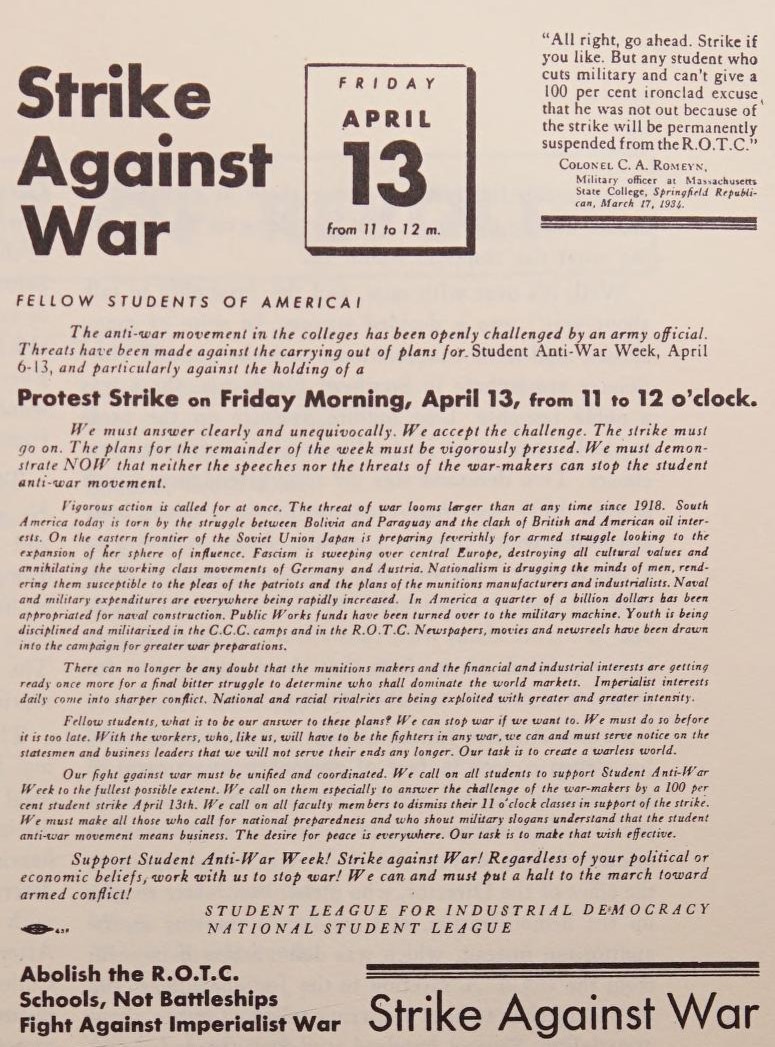
With the slogans ‘Abolish the R.O.T.C.’, ‘Schools, Not Battleships,’ and ‘Fight Against Imperialist War’ a national student strike against war was called for April 13, 1935 by all left-wing student organizations. Here a reports from the magazine of the Student League for Industrial Democracy of actions at Syracuse University, Harvard, University of Oklahoma, Vassar, University of Chicago, U.C.L.A., Pasadena and Los Angeles Junior Colleges, and City College of New York.
‘Students Strike Against War’ from Student Outlook (S.L.I.D.). Vol. 2 No. 5. May, 1935.
Harvard
There were about six of us at a rump session of a Liberal Club meeting. Most of the others were dubious about calling a strike. It was said that the response would be meager. To which it was urged that the strike was important not from the standpoint of Harvard locally, but in its status as part of a national move. If Harvard didn’t respond then so much the worse for it. We, at least, would have done our duty. Then the suggestion was made that the strike be implemented by a demonstration on Widener steps, and everyone was in enthusiastically.
Wednesday evening, strike notice distribution was on. We dropped the leaflets in all the mail-boxes, posted them; yard police tore them down. The Crimson tried to brand the whole thing as a communist affair. The Crimson, you will also remember, supported Governor Rolph’s stand on the lynching question, boosted Hanfstaengel for the commencement parade, and supported Harvard’s refusal to hire any of the exiled professors.
On Friday morning, there appeared an announcement that the Mullins Chowder Club would run a counter meeting. This group consisted of Crimson candidates, and was organized by the Crimson in an effort to discredit the whole strike. We had gotten permission to use Widener steps; they had not, but the authorities at no time interfered with them. The Freshman Dining Halls supplied the opposition with eggs and grapefruit, but their need for target practice was pretty evident.
By 10:30 groups were gathering in anticipation of the disturbance, cameramen in great quantities, and radicals who were a little scared by this monster which their strike notices were conjuring up. The yard police were there, fully mobilized, even though the university had announced that, because the N.S.L.–Student L.I.D. membership was only about twenty, no reinforcements would be made.
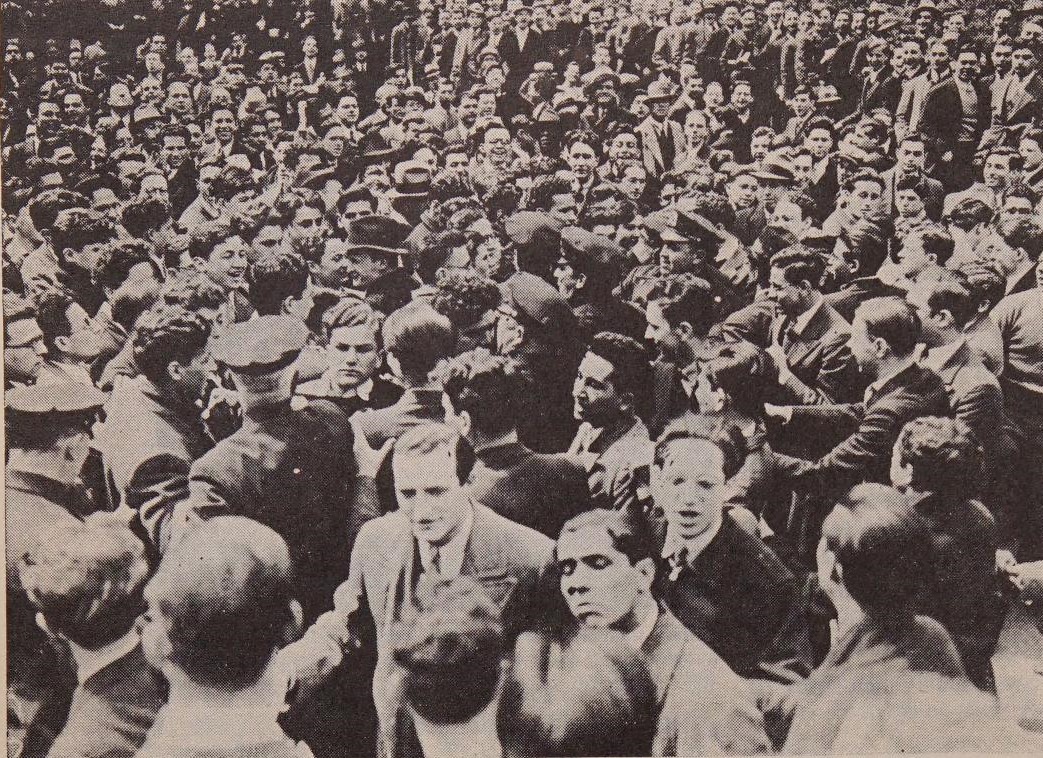
As the meeting opened, the Chowder boys appeared in their regalia, one clad in towels, holding his ‘‘Down with Peace” sign, another in black robes with a bomb, a Boy Scout tooting a bugle, and leading cheers for “We Want War,” and a Nazi-uniformed gentleman who assisted. They presented a medal to our first speaker, Marks, an N.S.L.’er. Marks pulled the boner of growing obviously sore, and the crowd hooted him and booed as they saw he couldn’t take it. We just waited; clowning couldn’t go on forever. Mallinger was second, but addressed them in Communist soap-box fashion, admonished them as the worst audience he had faced, and met with an ugly reception. I think there was a third pacifist who ran up then and spoke for a minute or so. George Clifton Edwards of the Student L.I.D. then went on. He was the success of the day; he fought the crowd with his pleadingly rational voice, spoke about the armament race, munitions makers, C.C.C., etc. He met the hecklers with banter and repartee; but despite his balance and poise, the majority of the audience was turning to the other rostrum where the Fascists had fled and were staging a mock meeting. There was the strange spectacle of a mob, continuous, but heads on one side sloping faithfully in our direction, and on the other side, hands going up in the Fascist salute. We heckled the other meeting, giving vent to continuous boos. The Fascist meeting was being licked. We would now have seized the meeting, but lo!—Edwards on the other side of the library was taking advantage of our strategy, and was speaking again. So back we rushed, and now for a while, the whole meeting was ours. Feuer of the Student L.I.D., went on as the last speaker,—pointed out that the other side was using the Fascist tactics that had triumphed in Germany, but that we were here to see that they didn’t win in America (applause)—that when the strike was called, a lot of people said they were for peace but didn’t like to be obstreperous; but that the object lesson today had shown that they had better learn to be so,—and that this strike was a dress rehearsal of what we would do if war should arise.
A bombardment started, and all sorts of objects whizzed pretty closely around Feuer’s ears. Our time was up, and Feuer closed the meeting asking all now to join and disrupt the other side, and concluded with three cheers for peace.
A large part of the audience was with us. Edwards got prolonged applause, and there were lots of. congratulations afterwards. The Crimson which engineered the whole affair, hypocritically followed it up with an editorial on the uselessness of demonstrations. Demonstrations are what they’re afraid of; they are a challenge to the student Fascist opinion which they represent. It is clear that the next time a strike goes on, it will be fraught with great danger. Further instructions and considerations of contingencies will be necessary. Their first weapon is ridicule, but that can’t be kept up. Another strike will probably witness violence and injury. The fun will turn into bitterness, and there were lots in the audience who would have joined a fighting rush. The tradition will now be a contest between both sides, so I guess we’ll have to outfit ourselves with…DEMOCRITUS
Vassar College
The Vassar anti-war demonstration, although the impetus came from the Student L.I.D. was managed under the auspices of the whole students association, so that it might have as wide an influence as possible on the people here and also on the Poughkeepsie spectators. The parade was headed by the President and about thirty faculty members (no trustees that I know about though it had been rumored that some would be there). There were at least five hundred students, some of whom marched in divisions determined by their various affiliations—the Student L.I.D., of course with “Against Imperialist War,” “Schools, Not Battleships,” and “Each man killed means $25,000 for the armament makers” banners—other groups were the French club with banners calling for peace (in French) the dramatic association with “More Plays like Peace on Earth,” etc. The seniors wore academic dress, a flag was carried in front and national and college anthems were sung from time to time. The most popular song however, was one made up by a senior, Caroline Hoysradt, the chorus of which is:
“Baa baa bomb shell, have you any will?
No sir, no sir, I’m just here to kill.
Little bomb, who made thee, who gave you your mission?
A money grasping crook and a dirty politician.”
In order to clarify our position and distinguish ourselves from the mass of sentimental pacifists the Student L.I.D. had a meeting just before the parade on causes of war—there was a discussion led by a member of the economics department in which the problems were, I think faced pretty realistically. The parade was received with a small amount of clapping and some hooting—but for the most part the townspeople were almost too surprised to react. The papers gave us a lot of half approving, half contemptuous publicity—one editorial remarked that “Although they were always glad to see the Vassar girls in town they would like to suggest that it would be even nicer if the daisy chain would rehearse in the war memorial square,” which appropriate place was the focal point of our parade. We marched down five blocks of the most crowded part of Main street at just five o’clock—when great numbers of people were getting out of work. Doris YANKAUER.
Syracuse
When “several hundred students,” as a local paper described it, can be called out to strike against war at Syracuse University the achievement is a signal one.
One week in advance, on the eve of Army Day, Student L.I.D. members of the Social Problems Club posted copies of the N.S.L.—S.L.I.D. call for a strike against war on April 13. The campus was startled. Caught unawares, administrative officials told the press that “it would be interesting to see how the students responded to such a call.”
Between 200 and 300 of Syracuse’s undergraduates came out, despite the fact that The Daily Orange, student paper, was not allowed to give an inch of news space to the strike. A variety of speeches greeted those who listened—all opposed to imperialist war, a few opposed to all wars, all opposed to militarization of youth, all demanding a diversion of war funds into educational channels.
For the most part, campus “liberals” and campus “pacifists” sneered at the strike before it occurred and half-heartedly admitted its success afterward. Here students learned the fundamental lesson that authority must be defied in time of war; here they received their first real test of their ability to defy those who exist in defending the status quo.
The local N.S.L. chapter, in formation, was asked to participate, and Rose Rosenthal spoke in its behalf. Others were Student L.I.D. and unaffiliated students—two from high schools. Roland Burdick, Syracuse.
University of Oklahoma
Oklahoma’s first attempt at participation in a nationwide protest against militarism, although far from successful, has laid a foundation for bigger and better movements to come.
University of Oklahoma sidewalks on Wednesday bore 25 posters, sent from New York and signed by both S.L.I.D. and N.S.L. Much comment and not a few arguments ensued, and several posters were torn or defaced in the course of the day.
Thursday morning found 175 large type posters screaming: STRIKE AGAINST WAR Friday, April 13, 11 to 12, Union Bldg. National Student League and Student League for Industrial Democracy was signed to the posters, although neither organization functions actively on the campus due to administration restriction.
The posters were printed and distributed by a secret group of over a dozen, most of them members of one or both organizations.
At 9:30 Friday morning—an hour and a half before the strike was to begin—President W.B. Bizzell learned the identity of several of the group, summoned them from classes and informed them that they would be responsible for any wholesale class cutting.
Under threat of expulsion, they prepared large signs and hurriedly posted them at the Union building: WAR STRIKE CALLED OFF at request of University Administration—N.S.L. and S.L.I.D.
Care had been taken in distribution of both sets of posters that no buildings should be mutilated, so as to avoid any charge of vandalism. Hypocritical officials, however, found in the time of strike a cause for action, and declared it subversive to incite to class-cutting.
Acting on the statement of President Bizzell
that a protest against war or militarism is not per se objectionable, plans are under way for an afternoon demonstration some time in May. Anon.
University of Chicago
Under the name of the United Anti-War Association, Pacifists, Internationalists, N.S.L. and Socialist Club members called a student strike against war on April 6th. A parade and outdoor mass meeting was held on the campus. At 11 o’clock the line for the parade started forming and by 11:20 placards were distributed to the students in line. There were about a hundred in the parade which was lead by an effigy of “our great American Patriot” William Randolph Hearst.
During the course of the parade, approved collegiate yell tactics were used to inform students and faculty that a group of sincere students were not attending classes and were protesting against the jingo journalism that is being practiced by the capitalist press today, fomenting a new war psychology, and protesting against funds being voted for new armaments while needy students and workers were in want.

At 12 o’clock the mass meeting in the circle was called. About six or seven hundred students had gathered around the speakers stand. Ted Noss of the Socialist Club, Joe Kepecs of the N.S.L. and Truman Kirkpatrick for the Pacifists addressed the meeting. The results have been more gratifying than had been hoped for. At least some of the students are started on the road to thinking about the causes and results of war. E.M. Duerbeck
Southern California
At U.C.L.A. plans were drawn up by a small committee of three students, Clothilde Parter, Student L.I.D., Paul Light, N.S.L., and Ann Le Sourd, a member of neither organization. They called themselves the student strike committee. The prospect of getting out a sizeable group of students was very discouraging. About a week and a half before Strike Day, these students were called in to “confer” with the Provost of the U.C.L.A. The latter, naturally, was opposed to the strike. The committee began by insisting on having it, and a compromise was concluded in the end. This called for an assembly sponsored by the Administration, and officially entitled “An Assembly to Talk About War.”
Several days before the assembly, the Administration put up form announcements such as advertise all official university events on the campus, including the statement “classes will not be dismissed for this assembly.” Whereupon the committee organized a campaign among the faculty, asking them to excuse their classes during that hour. But there was no way of telling what the response would be.
Well, it’s over with now, and the “assembly to talk about war” was a decided success. In spite of many classes, mid-term examinations, and the general reactionary atmosphere in Southern California, there was a noble response. Last minute pressure on the profs worked—they came in goodly numbers bringing their classes. Two thousand was the total attendance, which is only 1500 less than turn out to the student body assemblies which present a popular dance orchestra or a movie star. This was the first time that U.C.L.A. students had an opportunity in such large numbers to hear the truth about what causes war. At the same time it was pointed out to’ them that the assembly was for purposes of protest, and they knew it was strike day.
At Los Angeles Junior College a strike was planned for eleven o’clock in face of outspoken disapproval of the administration. Serril Gerber, who is national junior college debate champion was the leader. A few minutes before eleven o’clock he was called again to the office of the Director, who pleaded with him to give up the’ demonstration, and conduct a meeting in the auditorium instead, which was done. Some of us went from the U.C.L.A. meeting to the Junior College, and arrived in time to hear a stirring talk by Gerber about imperialism. Several hundred students attended. Later we saw copies of a little song sheet, on which were printed the college hymn of the institution, and the Star Spangled Banner. A purple swastika was printed over the latter. This bit of Hitlerism was released just before the assembly in front of the auditorium.
At Pasadena Junior College a successful strike could have undoubtedly been held. The War Resisters are strong there, and there is some good Congress of Youth leadership. The strike was also changed to an assembly, when the administration received word of a proposed “visit” from the National Guard at the same time that the strike was to be held. Unable to get a place on the school grounds, they had to meet in a church, three blocks from the campus. Some 250 students attended. Al Hamilton spoke. KATHERINE CLINE
City College
On April 13, 1,500 students at City College went on strike at 11 00 A.M. A mass meeting was held on the campus, in defiance of the Dean who had refused to grant a permit on the ground that he could not allow interference with classes, and despite attempts by Dean Gottschall and the police to disperse the gathering. On April 20th the strike committee, consisting of members. of the local Student L.I.D. and N.S.L. units, was called before the Faculty-Student Committee on Discipline to answer charges of having violated a faculty regulation in holding an unauthorized meeting on the campus. Everywhere the expectation was that the same thing would occur as last year, when 21 students were expelled from City College for anti-war activity.
The result, however, was an almost complete victory. No students were expelled; only one was suspended, and he had already dropped out of school. One was dropped for “low academic standing”, though there can be little doubt that his participation in the strike and mass meeting were the initiating causes of his dismissal. The committee, as a whole, received only a public reprimand.
Three points were regarded as important at the hearing. All three were won. The right to be represented by legal representatives was reluctantly accorded by the disciplinary committee. The right to a fair and open hearing was insisted upon in the face of the Dean’s determination at the start to conduct the whole matter with the usual secrecy and a minimum of publicity. After considerable argument, the student body of City College was allowed to be present. Finally, the students insisted upon the right to appear in a group, and to present their case through one spokesman, rather than as individuals.
Students at City College, both at the strike and mass meeting, and in the hearing before the Disciplinary Committee, demonstrated a unity of purpose in their support of the anti-war movement that enabled them to carry out the plans of April 13 without the disastrous consequences of the events of last year. Throughout the students on the strike committee insisted upon their identity with all those students who had gone on strike. They pointed out that they were elected representatives, chosen to conduct the strike in the most effective manner possible. They refused to answer questions individually. They impressed upon the Disciplinary Committee the fact that whatever any member of the strike committee had done he had done by virtue of his position as a member, rather, than on his own responsibility. Their acts were those of all the students who took part in the demonstration. This point they established clearly and unequivocally.
The mass support the committee received is ample testimony to the vitality of the anti-war movement at City College. K.M.
Going through a series of names in the 1930s starting with Revolt, then Student Outlook, then New Frontiers, and finally Industrial Democracy these were the publications of the Socialist Party-allied National Student League for Industrial Democracy. The journal’s changes in part reflected the shifting organizations of the larger student movement.
PDF of full issue: https://archive.org/download/industrial-democracy_1934-05_2_5/industrial-democracy_1934-05_2_5.pdf
 Revolution's Newsstand